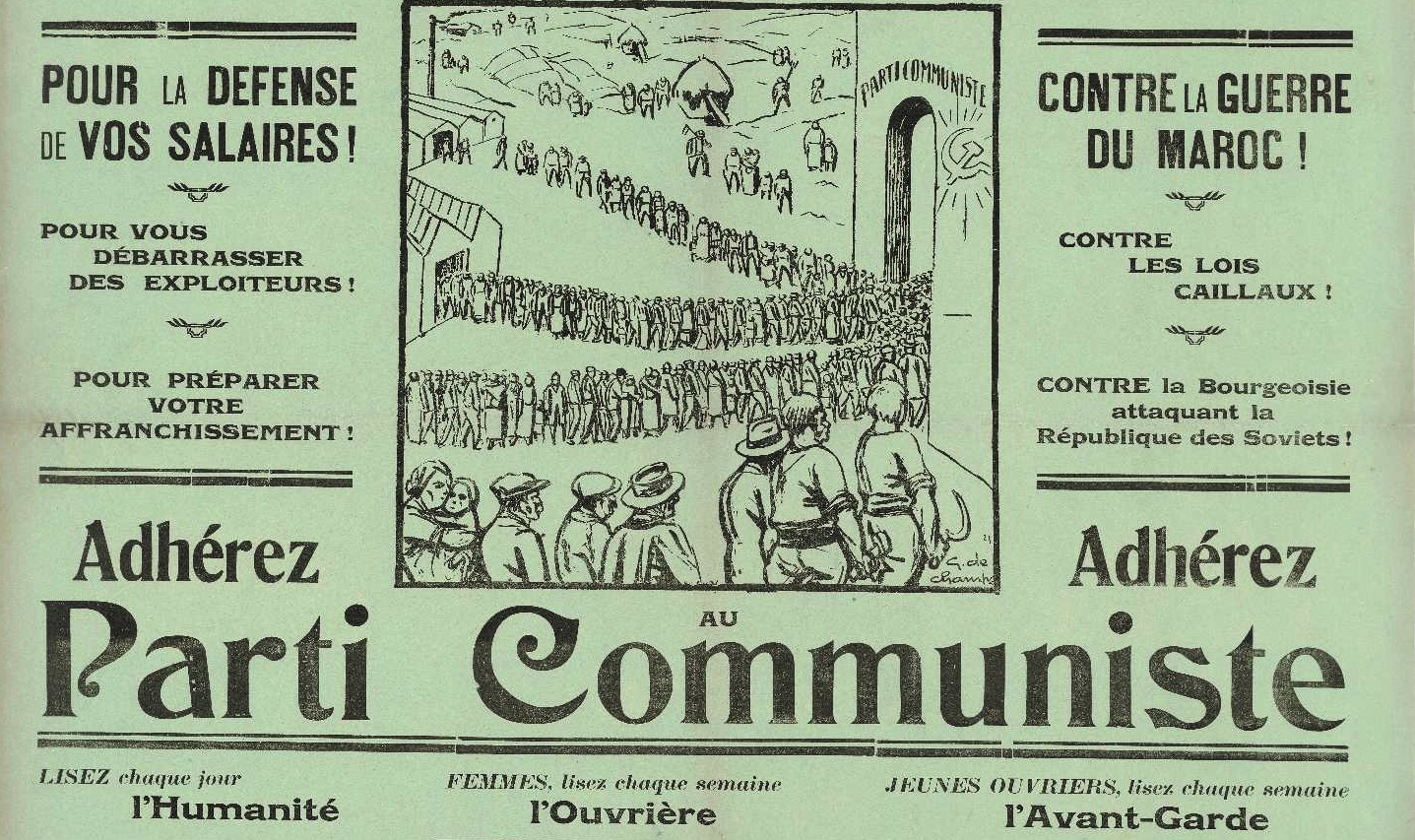
A partisan of the Left in the French Communist Party on the fractures before its 1922 Paris Congress.
‘The Crisis in the French Party’ by Albert Treint from International Press Correspondence. Vol. 2 No. 89. October 17, 1922.
The Agreement between the Center and the Left.
At the session of the Enlarged Executive Committee in May, the representatives of the Center of our party had agreed to solve the crisis in the French party in accordance with the views of the International.
Frossard and Cartier had undertaken to defend before the party the union of the Center and the Left against the anti-Communist tendencies and for the pursuance of an active Communist policy in harmony with the decisions of the International.
A beginning had already been made.
Frossard succeeded in reuniting the Communist fraction at the Congress of the C.G.T.U. at St. Etienne.
At the Congress of the Seine he flatly declared himself in favor of centrism.
Under most difficult conditions Frossard has made efforts that we appreciate all the more as we know how much they cost him. These efforts ended in a series of joint motions, called the Frossard-Souvarine motions which symbolize the agreement of the Center and the Left in the Communist movement.
In previous articles I have called attention to the fact that the Center, both in the Party and in the Federation, has sometimes led the battle feebly, while the Left, always more resolute and consistent, was thoroughly engaged in the struggle.
I have none the less greeted the first steps of the Center taken upon the path traced by the International, and I have always expressed the hope that these first steps, still hesitant, would be followed by others much firmer, and that the Center and the Left would finally unite to make the journey together.
The Ambiguous Declaration of the Center.
The motions Frossard-Souvarine had already sealed the agreement between the Center and the Left, when the Center issued a separate declaration on its own behalf.
The mere formulation of this declaration showed the preponderance in the Center of elements which, under cover of a formal agreement with the Left made before the Congress, wished in reality to follow separate activity in accordance with its own plan.
The contents of this declaration were even made significant. Beneath the false splendour of bombastic, but empty phrases, was discernable the faint gleam of poisonous allusions.
The motions Frossard-Souvarine were there represented as a basis for discussion at the Congress.
As shown in the press of the Center, it was a question of the personal ambition, of those who, instead of serving the Party, make use of it for their own advantage.
It is very evident that the signers of the declaration tried to place themselves above all suspicion, and said to the Party in a clever and insinuating manner: “Mark this. We are taking our stand with the Left. But it might well be that every movement of the Left serves merely as a pretext for some ambitious careerist to get a soft job.”
This vague manner of discrediting the fighting comrades of the Left, this presentation of the motions proposed jointly as not at all final and definite, gives the declaration of the Center an ambiguous character that can deceive none.
The Betrayal of the Agreement Between the Center and the Left.
Paul Louis, one of the signers of the Frossard-Souvarine motions has attacked the Left on the trade union question. He declares the first project drawn up by Rosmer to be something monstrous. The efforts of the Left to reach an understanding with the Center is, according to him, a retreat of the Left, terrified at its own work.
This is the Paul Louis who, at the Congress of the Somme, had voted for the Frossard-Souvarine motions with reservations.
Similar attitudes have been taken in other Federations. And furthermore, the equivocal declaration of the Center has been approved as a motion on the general policy, while the Frossard-Souvarine motion has been discarded.
Cachin wrote an article in the Bulletin de Presse Communiste attacking the motions which he himself has signed, giving his arguments in favor of the Renault motion. The Bulletin de Presse Communiste supplies our provincial press with unpublished articles. It is sent to the editors of our news- papers and to the secretaries of the federations. Cachin’s article was not reproduced in the provincial press. But it is incontestable that it has already pointed the way for the Centrist groups of the Party in the provinces.
All this increases the boldness of the Renauld faction, In a statement which appeared in Humanité on October 5th, this group tries to persuade the entire Center, and Frossard in particular, to follow the path of Cachin and Paul Louis.
In its “Reply to the Declaration”, the Left has denounced these acts. In vain will the attempt be made to say: The reply of the Left is a declaration of war against the Center.
Let me put this question.
A pact is signed. Some of the signers betray it. Who, then, declares war? Those who betray or those who denounce the betrayers?
And then, if you wish–yes, the reply of the Left is indeed a declaration of war. Not of the Left against the Center as such, but of the Left against those in the Center who, by their acts, broke the agreement between the Center and the Left.
Against those, the Left prefers to declare war openly rather than make war in an underhand manner.
The Future.
In the light of facts, the Center appears to us to be without cohesion. It is composed of dissimilar elements.
Some of them sincerely desire to work with the Left and the International. The Left is wholly with them.
Some reunite through political expediency, but respect agreements made. The Left watches their acts,
Some in the Center are under the influence of the Renault faction. The Left will fight these energetically no matter who they are.
An agreement on the basis of equality cannot be considered with the present Center as a whole.
Such an agreement can be made only with those elements in the Center who did not betray their pact with the Left and the International.
To act otherwise in view of the new facts disclosed since the most recent deliberations of the Executive Committee, would result in establishing a party in which the struggle between different policies, far from disappearing, would be renewed more sharply than ever.
This would mean the stagnation of Communism in France for many years.
We stand at a decisive point. We are about to witness the birth of our Communist Party. Let us take care that this new-born French child of the International should be strong enough to live.
This can be realized only by the collaboration of the Left wit: a Center cleansed of traitors.
This view of the Left in France which I am now expressing, at a time when the situation is grave, I shall maintain before our other parties, and before the Executive Committee of the Third International.
International Press Correspondence, widely known as”Inprecorr” was published by the Executive Committee of the Communist International (ECCI) regularly in German and English, occasionally in many other languages, beginning in 1921 and lasting in English until 1938. Inprecorr’s role was to supply translated articles to the English-speaking press of the International from the Comintern’s different sections, as well as news and statements from the ECCI. Many ‘Daily Worker’ and ‘Communist’ articles originated in Inprecorr, and it also published articles by American comrades for use in other countries. It was published at least weekly, and often thrice weekly.
PDF of full issue: https://www.marxists.org/history/international/comintern/inprecor/1922/v02n089-x-supp-oct-17-1922-Inprecor.pdf
 Revolution's Newsstand