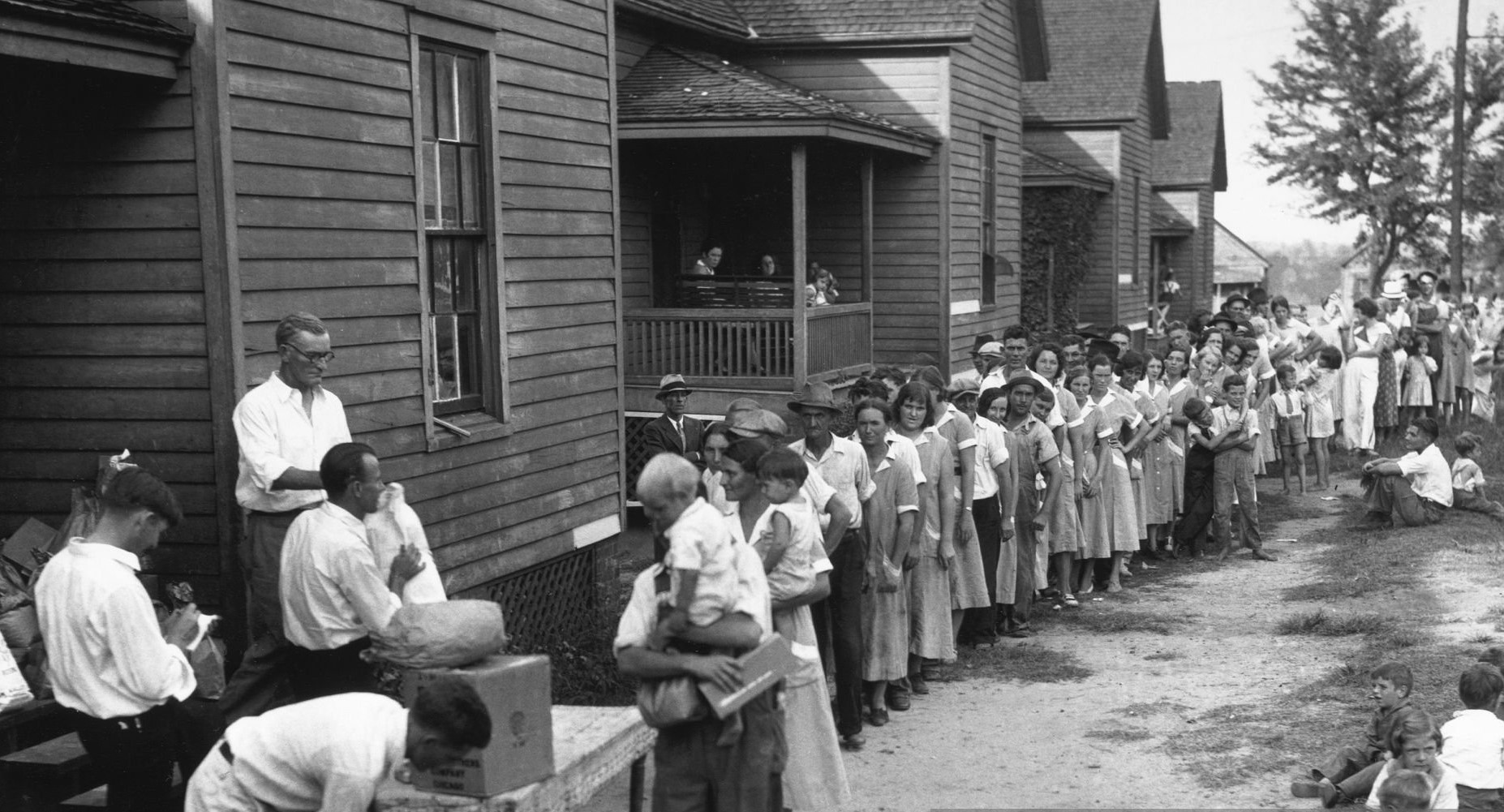
It is no exaggeration to say that the U.S. labor movement, and larger working class, still lives in the shadow of this defeat, never having recovered from the betrayal of the Uprising of ’34 which promised to bring unions to the worst exploiters, and most importantly, to the South. Those weeks saw nearly a million workers–many women, mostly unorganized, with Southern workers at the center–strike for a union, wages, and a dignified life. Two dozen were killed, hundreds wounded, thousands arrested, and whole regions placed under virtual martial law as the ruling class clearly perceived the major threat that it was to their regime. The abject failure of the A.F.L.’s leadership in the struggle was, however, a bellwether of the CIO’s coming challenge, which emerged the following year. All sell-outs are ugly, this one more than most. Waldman with the scene of the deal as labor’s misleaders toast their treachery.
‘The Textile Strike Sell-Out’ by Seymour Waldman from New Masses. Vol. 13 No. 1. October 2, 1934.
IN THE afternoon of September 22, in the offices of Matthew Woll’s assistant, Chester M. Wright, the American Federation of Labor top officials, their retinues and United Textile Workers associate officialdom staged a super-super-super strike sell-out ceremony attended with the publicity props usually seen at Hollywood movie openings and some of the trappings of a real movie set.
The newspapermen were called at their offices around noon of that day and told not to turn up before 2:15. Wright foresaw that a premature sight of the radio and telegraph publicity props—used so effectively when the irresistible strike demands from the New England mills and the Southern pellagra holes finally forced the U.T.W. leaders to flash the word “strike” to 300,000 expectant textile workers—that a preview of these props would have caused the reporters to send out a confirmation of what was fully expected sooner or later that day.
Everything was timed beautifully. And the milling around of about a hundred boilerbellied “labor” leaders, smiling N.R.A. Labor Advisory Board adornments, photographers, newspapermen, secretaries, clerks, and telegraph messenger boys gave it the seeming spontaneity of a suddenly arranged party.
Backslapping, laughter—the Rotary Club laughter of an A.F. of L. convention lobby. The class struggle was miles away and the moans of the wounded, the sound of silent, determined, murmuring figures burying the murdered dead, inhabited another world. For this was “VICTORY”–for the government, the employers and their jackals, the A.F. of L. factotums of the New Deal.
“Hello, there!” sang out Sidney Hillman, Amalgamated Clothing Workers of America chieftain and leading figure of the labor-gypping N.R.A. Labor Advisory Board. Hillman had come in to share the publicity—and to be in at the kill, with his brother jackals.
The telegraph operator was getting set. Camera bulbs were being adjusted.
“All right, photographers,” Chester Wright called out.
“Chester,–are we all getting drunk tonight?” a reporter asked the publicity chief of the strike forces. A promised newspaper-A. F. of L. party was in the offing.
A tall, husky middle-aged celebrant, with a long automatic protruding from his breast pocket, moved a bit so that I could: see the main speakers, the strike generals who were about to order surrender and retreat to a great, determined, victorious army—an army ready for further sacrifices, an army on the march, prepared for immediate advance. As in the British general strike in 1926, those who didn’t want the strike in the first place defeated a victorious army of labor by yelling retreat when the enemy was certain to surrender. The roots of the owners’ agents lie deep in the ranks of the workers.
William Green, president of the A. F. of L., Thomas F. McMahon, president of the U.T.W. strike committee chairman, and Belasco-collared Frank Morrison, A.F. of L. Secretary, stood shoulder to shoulder near the telegraph instrument and faced a dozen cameras and W.E.V.D. (E.V.D., initials of Gene Debs!) microphone. Wright had waved an okay to the press association men. “The strike is off!” shouted the A.P., the U.P., and Hearst’s I.N.S. The A.F. of L. leaders soon to entrain for their San Francisco Convention, rehearsed their posing.
“Now look down at the paper, Mr. Green…that’s right.” Flash! Mr. Green was preserved for the late afternoon and morning papers—and the revolutionary museum of Soviet America. Green’s pulpit face hovered like a halo over the preposterously brazen and empty claims of “complete victory…our triumph is one of the greatest in all labor history…overwhelming character of the victory…tremendous…we have taken every trench” that were to be recited as the fifteenth textile striker was dying, a victim of the bullets and bayonets of the strike-breaking National Guard, the mill thugs and the “folded arms” policy of the U.T.W., strike leadership. He rubbed his diamond-fingered hands together during Gorman’s “victory” speech.
What was all the to-do about? The Winant Textile Inquiry Board’s report of the three weeks’ old throbbing struggle had proposed calling off the strike immediately and rejected not only every demand of the New York strike convention, but even the eviscerated demands which were finally made, in Washington, by the Gorman strike committee clique. It was an “excellent” report, decreed President Roosevelt at his Hyde Park palatial home. “An indictment of management,” parroted Gorman, the same night.
To the U.T.W, demand for recognition of the union, Roosevelt’s wealthy social registerite investment broker Governor of New Hampshire (Winant), his Fusion Brooklyn president (Ingersoll), and his corporation director, lawyer, and N.R.A. southern regional head (Smith), answered: not “feasible…at this time.”
This, emphasized the U.T.W. executive council and strike committee, through the lips of Gorman, was “practical recognition of our union.”
To the U.T.W. demand for the thirty-hour week, of two shifts, with no exemptions, the Winant board replied that the President should “request the Federal Trade Commission…to undertake an immediate investigation of the economic status of the industry in relation to the problems of wages and hours, and report its findings at the earliest possible moment…and that a hearing then be called before such agency as the President may direct to determine whether a wage increase based upon reduction in hours can, under the prevailing economic conditions, be sustained.” In other words, after more than a year of “boards,” “investigations,” “statistics,” and what-not, the stale strike-breaking dodge was offered the workers under a new label.
This, pontificated the assembled U.T.W. and A. F. of L. moguls, is “a method of determining hours on a basis of fact.”
The Winant board rejected with unmistakable finality the four convention wage demands: $13 for unskilled, $18 for semiskilled, $22.50 for skilled, and $30 for highly skilled. Instead, more “investigations,” more “reports.” This, the U.T.W. officials interpreted as “a method of determining wages on a basis of fact.” Evidently, it was to preserve “fact” that Gorman assiduously ignored the four specific categories of wage demands acknowledged as “imperative” even by the openly reactionary who fought, against McMahon, the calling of the strike in the convention.
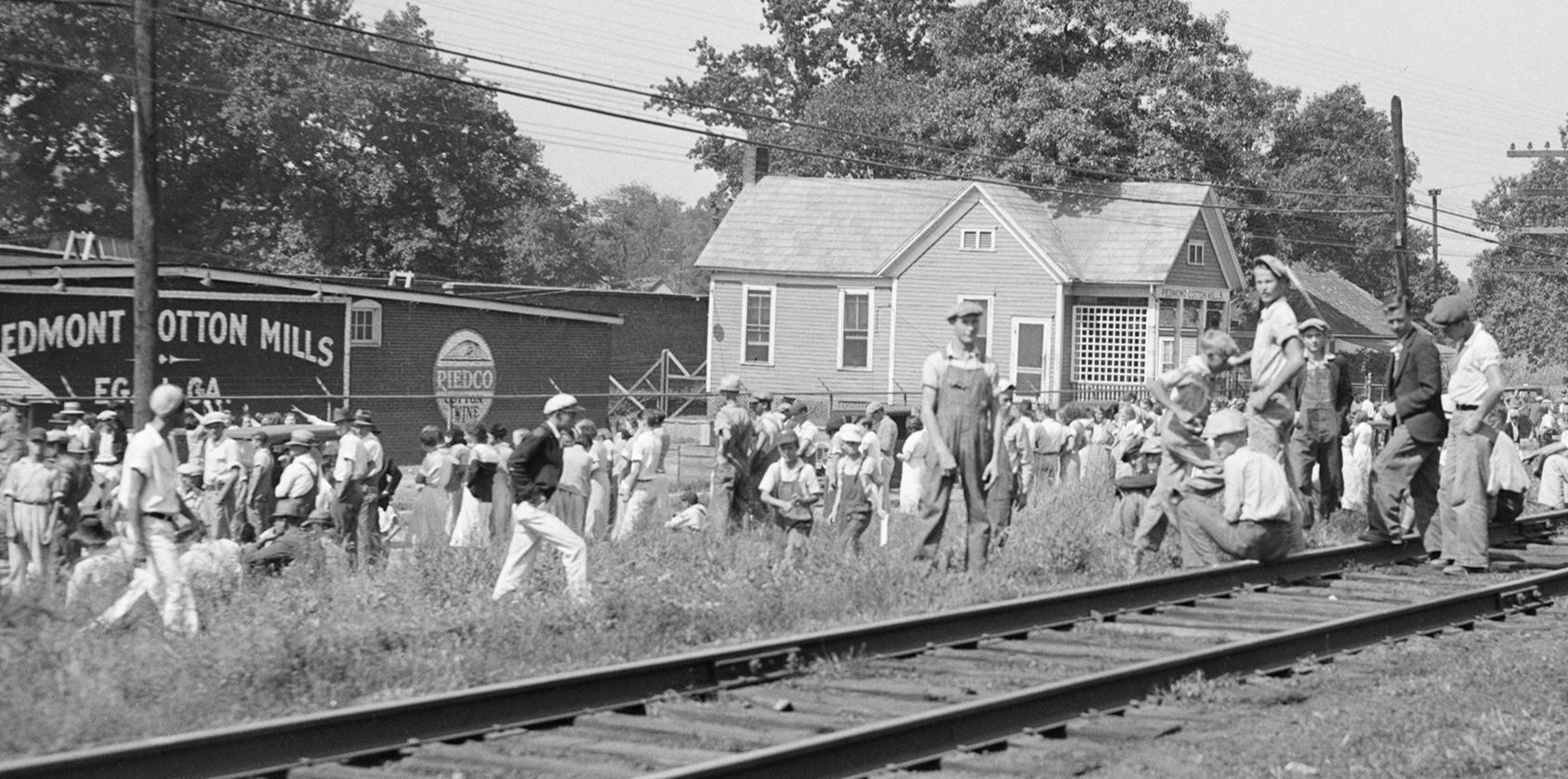
The U.T.W. convention had demanded its revisions of the stretch-out “on the basis of reason and ordinary common sense.” Not reason and ordinary common sense prevailed, but Roosevelt-A. F. of L. “fact” finding. Here the Winant Board not only turned down immediate relief but ordained that a new body, the Textile Labor Relations Board, shall appoint still another body, a Control Board which “shall study the actual operations of the stretch-out system in a number of representative plants, selected by the code authority [the employers] and the U.T.W., and shall by January 1, 1935, recommend to the President a permanent plan for regulation of the stretch-out.” In the meantime the workers are to go back to the same stretch-out against which they struck and faced machine guns, bayonets and concentration camps.
Even this was represented as a victory by the strike leadership. In fact, nothing else but “An end to the stretch-out…We have at last killed the stretch-out.”
“It would seem” that the Winant Board didn’t refer to the U.T.W. strike committee’s wage and hours demands, gloated George Sloan, chairman of the employers’ high pressure Cotton Textile Institute and head of the N.R.A. Cotton Textile Code Authority, shortly after hearing of the filing of the Winant report and its ecstatic reception by the President. Mr. Sloan refused to say whether he and his colleagues would accommodate Roosevelt’s demagogic request to take back the strikers without discrimination—with anything other than a demagogic acceptance, which means the ruthless discrimination regularly practised since the hatching of the N.R.A. The beautiful opportunity to weed out the militant strike leaders, spine of the rank and file, the prelude to the development of the “collective dealing between labor and management” which, said the Winant brethren, “can…for the present at least, best be achieved through development on a plant-to-plant basis.” That is, firing of unionists on “a plant-to-plant basis.”
Of course, Sloan and the Roosevelt. administration, to which the A. F. of L. moves closer every day, every hour (Secretary of Labor Frances Perkins, just a year ago, called it “the integration of labor in the modern State” in a speech before the Fifty-Third Annual Convention of the A. F. of L.), knew all along that Gorman, McMahon, Green and their kind didn’t want the walkout and that they were forced to call it to escape being brushed aside by a membership bent on a strike. Nevertheless Gorman couldn’t help reflecting the steadily mounting strength of the picket lines.
Thus, he tried desperately to drive the strike into the suffocating folds of arbitration, and having failed to do that, to castrate it by calling for “folded arms” rather than flying squadrons, mass picketing and mass marching. Sloan and the federal government realized that Gorman would do his best to screen the simple economic issues of the strike, and thereby retard its movement by yelling, in familiar San Francisco style, “Reds, Communist disruption, revolution,” etc.
This duplicity, however, could not prevent a great deal of the truth from overshadowing the strutting and bargaining of Gorman. Gorman talked to the “public,” through the press and the radio. For three weeks.
“The union front stands solid. More mills are closing and the strike becomes stronger every day. The workers are determined not to go back to the mills until their demands are met…Our people have had some pretty terrible experiences with boards in the past. On previous occasions, when a board has investigated conditions of the workers, conditions were worse afterwards than when the board began…we won’t go back until we win our demands, what do you think we’re striking for, anyway?…the half million who have left the mills will not go back until they go back on terms that meet the issues that caused the strike…we know management is weakening…with our continuous policy that we should propose arbitration…the proud thing today is to be a striker…the 30-hour week is absolutely necessary…let me state again our strike demands: first, recognition of the union, and the right to collective bargaining; second, we demand a reduction of the work-week to thirty hours; third, with no reduction in the weekly wage; fourth, we demand that the stretch-out be abolished…the strike is won…it was in harmony right now, make no mistake about that…the truth is that at this moment [a day before the sell-out], we have the strike won.”
McMahon, who stayed in the background, chimed in: “I have never in all my somewhat long experience witnessed such a demonstration of solidarity and support…” The thousands of telegrams from the field, demanding strike, however, didn’t preclude his quiet, confident remark (half prediction, half boast), to this writer, that “Our technical demands are broad enough so that reasonable men can sit down and give away here and there. Understand, I mean that we’re not going to insist on crossing all t’s and dotting every i…” In the final betrayal, they not only were not crossed or dotted, they weren’t even mentioned!
W.B. Watson, secretary of the U.T.W. special committee, reported early to Washington that the strike sentiment was strongest where the trigger-terror was worst. Three days before Sept. 1, the beginning of the strike, Watson wired: “…the South is ready to strike, solidly and on the hour the strike order takes effect …The spirit of the workers everywhere is that the action of our convention is the only action that can save the situation for them. They are back of the officers in carrying out those instructions. They will not tolerate any further delay and if anyone should attempt to bring about delay I do not believe the workers would remain in the mills.”
But while Gorman bellowed fire and brimstone with one side of his commodious mouth, for the newsreels and the reporters assigned to strike headquarters, with the other he offered, bargained and virtually begged Sloan and the Government to cooperate with him in either agreeing upon a strike-abortion formula which would camouflage his skulduggery or else, please, for God’s sake, give me some “concessions.” At that time, however, “concessions” must “include the recognition of the union and the 30-hour week.” Nothing doing. He even offered to accept “adjustments” (arbitration), a lethal weapon of the employers. You have until six o’clock, gentlemen! Go fly a kite, said Sloan. Well, until six o’clock tomorrow!! Fly another, said Sloan. He knew his Gorman. And he wanted Gorman to crawl to him. The strike lines grew anyway. Nothing could stop them. They moved, propelled by the dynamic strength of all labor, with the heart of San Francisco, Toledo, and Minneapolis.
The strikers were being starved. The old policy of no food to strikers was being enforced—by the local corporations that control the relief machinery nearly everywhere. No, he would not see Federal Relief Administrator Hopkins about the failure of the latter’s organization to feed strikers. “That’s government policy,” Gorman declared, though he himself volunteered, “Not only are they not feeding strikers’ families except in isolated instances, but they are taking them off the relief rolls unless they go back to work.” Still Sloan was unimpressed. For Sloan saw the ranks of the desperate, hungry, struggling strikers grow to at least 500,000, despite the fact that the 20,000 strategic dyers were still not called out (a deliberate maneuver to avoid a complete paralysis of the textile industry).
Gorman tried nearly every conceivable maneuver to slow up the dangerously (to U.T.W. official plans) growing strike. In the face of uniformed murder by State troops, he failed to protest against the use of any troops and called for federal troops (when have they helped strikers?) “to protect our strikers.” He fed the Red-baiters and the chauvinists, the former with sporadic cries of “Communist disruption,” the latter with thinly veiled attacks on the large number of non-citizen foreign born workers. Yes, the latter had the right to strike, of course. But “I’m for American methods,” he explained. “Is it American to shoot workers in the back?” “No, but that’s done by the reactionaries.” The echo of Roosevelt, Johnson, Richberg.

Green, the $12,000 a year smoke-screener, the speaker who declared a night before the formal sell-out, “The strike is to be declared,” Green, who so ably assisted General Johnson’s vigilantes and private thugs in San Francisco by knifing the West Coast strike with his announcement that “the strike was unauthorized”—Green soon decided to take a hand openly in things. A day after Gorman tried to frighten Sloan with the prospect of a general strike (“The situation as it stands at this hour is that other international unions may call their members out in support of our strike…”), Green saw to it that Gorman erased any unfounded fears. Gorman, the next day, told the press: “The general strike is out. I have no right to talk of a general strike. I’m a textile worker.” The bawling out Green gave him had worked wonders over night.
But that wasn’t enough. Green called off the scheduled meeting of the A.F. of L. international unions that presumably was to arrange for financial support of the textile strike:—according to Green’s own announcement. Of course, the A. F, of L. leaders would help out, Green explained, but they were so busy: and had so little time to get to San Francisco; the scene of the impending Fifty-Fourth Annual Convention of the A.F. of L. Why, it would be the first order of business of the convention—on October 1.
Gorman and Green played the Roosevelt Administration game (despite San Francisco, the special automobile board, the steel board: dodge, etc.) and shouted, “Back up the President, have-faith-in-the President,” louder than. ever, right after the flank attack on the textile strikers by General Johnson. Gorman, it will be remembered, remained eloquently silent when Johnson spewed his fascist venom on the San Francisco strikers. It was a despicable act on Johnson’s part to attack the textile strikers, roared Green and Gorman. But, no word which would even hint that Roosevelt has never repudiated Johnson’s open strike-breaking. That Johnson has always enunciated Roosevelt policy. Not Hitler, but Goebbels, and Goering, screamed Gorman and Green. They were thrashing the administration’s whipping boy, Johnson.
The building up of the Winant Board, from the moment of its birth, was clear notification that the shameless U.T.W. capitulators would soon unsheath their knives behind the backs of the strikers. A “competent” board, “sincere,” “conscientious” men, and so forth. The board would not be “cut and dried.” The step was short to: “We cannot refuse to co-operate with the President, as he has asked us to do…we have now gained every substantial thing that we can gain in this strike…we have secured things…on a scale so sweeping that we must confess ourselves surprised at the sweeping character of the victory we have won…It is a simple and cold statement of fact that our strike has changed the whole relation of the government and of N.R.A. to labor and we have utterly abolished the control of labor relations by code authorities. That is an achievement which cannot be too strongly emphasized. It is a tremendous thing to have gained.”
At this writing the employers have already begun to lock-out thousands of strikers from their jobs in the mills, while others try to show to the Roosevelt-illusioned the significance of the colossal sell-out, as others try to rehead the lines with new rank and file strike committees.
The workers, who will awaken to the sellout sooner or later, will be enlightened by reading reprints of the following Monday morning (Sept. 24) Washington Post (owned by Wall Street banker, Eugene Meyer) editorial. The editorial says:
“The United Textile Workers [the strike leadership], anxious to terminate this strike, do not emphasize that the Winant board found their wage claims exorbitant. That it did so should have no small weight with those employers whose fear of bankruptcy is a chief reason for suspicion of its findings.”
It won’t—for them, or the broad mass of workers when they realize that their militant worker leadership and the Communist Party fought for them, bled for them and is still there to lead them. The fight has just started.
The lines between capital and labor are more clearly drawn—drawn by a year of blood spilt in desperate battle. Millions of workers know it. And capital knows it. That’s why Secretary of Commerce Roper’s big business group called the Business and Advisory Council of the Department of Commerce (the sponsors of the first fascist Swope plan) is meeting now.
As stated by the official Commerce Department announcement, “future plans and a specific program to be carried out by the Council during the winter months will form the basis for a large part of the discussion.”
They won’t have to spend much time planning Hitler concentration camps. Georgia has blazed the way in the textile strike. And Georgia’s barbed wires are the tentacles of threatening American Fascism.
The New Masses was the continuation of Workers Monthly which began publishing in 1924 as a merger of the ‘Liberator’, the Trade Union Educational League magazine ‘Labor Herald’, and Friends of Soviet Russia’s monthly ‘Soviet Russia Pictorial’ as an explicitly Communist Party publication, but drawing in a wide range of contributors and sympathizers. In 1927 Workers Monthly ceased and The New Masses began. A major left cultural magazine of the late 1920s and early 1940s, the early editors of The New Masses included Hugo Gellert, John F. Sloan, Max Eastman, Mike Gold, and Joseph Freeman. Writers included William Carlos Williams, Theodore Dreiser, John Dos Passos, Upton Sinclair, Richard Wright, Ralph Ellison, Dorothy Parker, Dorothy Day, John Breecher, Langston Hughes, Eugene O’Neill, Rex Stout and Ernest Hemingway. Artists included Hugo Gellert, Stuart Davis, Boardman Robinson, Wanda Gag, William Gropper and Otto Soglow. Over time, the New Masses became narrower politically and the articles more commentary than comment. However, particularly in it first years, New Masses was the epitome of the era’s finest revolutionary cultural and artistic traditions.
PDF of full issue: https://www.marxists.org/history/usa/pubs/new-masses/1934/v13n01-oct-02-1934-NM.pdf
 Revolution's Newsstand