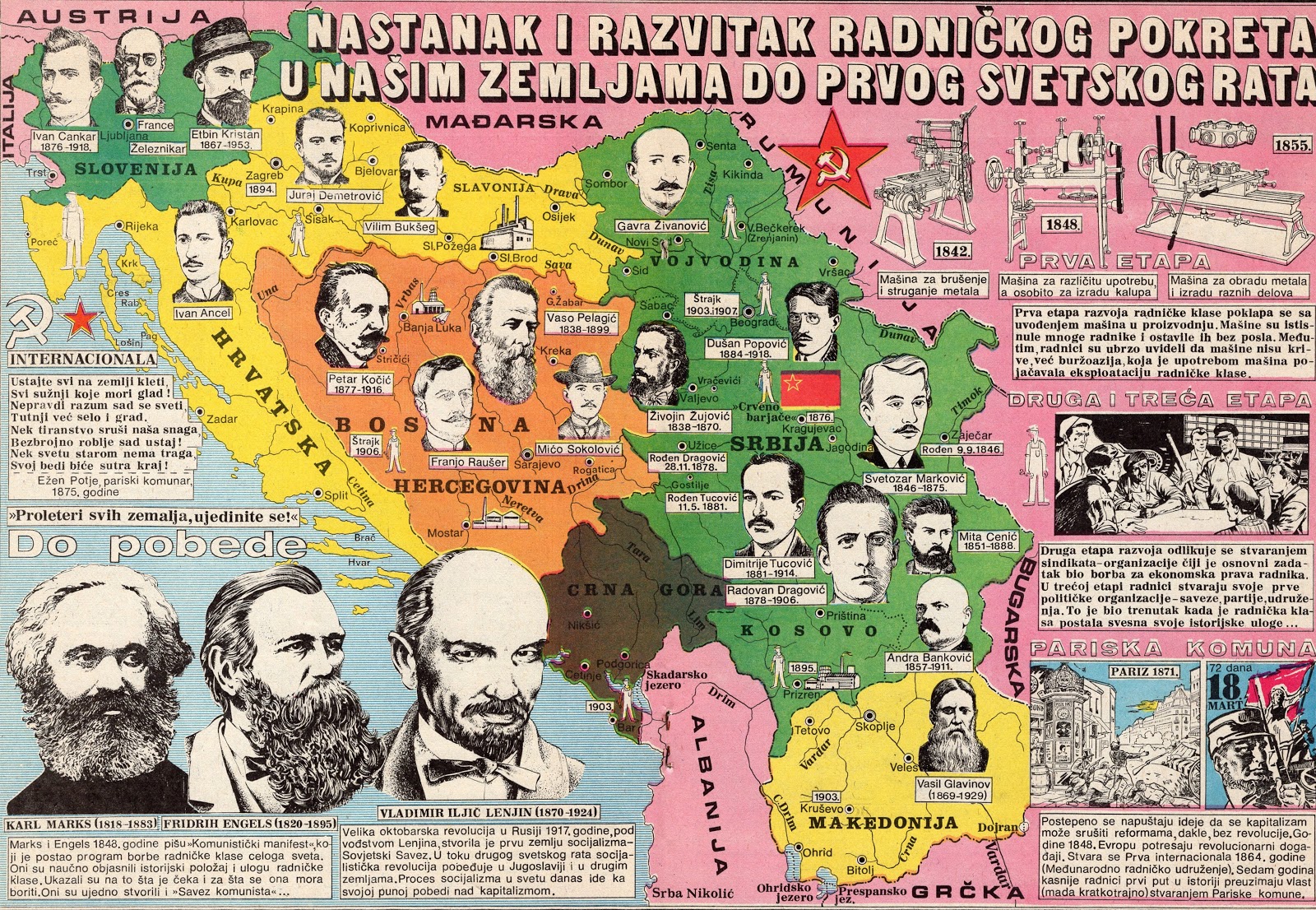
An overview of the political, military, and economic situation of perpetual crisis that was “Kingdom of the Serbs, Croats, and Slovenians” in the 1920s and the role of the Yugoslav Communist Party.
‘The Prospects of Yugoslavia’ by Charles Novak from Workers Monthly. Vol. 5 No. 12. October, 1926.
THE end of the war found a new state in the Balkans—a state that had been conceived by the treaty of Trianon, and that received the name of “Kingdom of the Serbs, Croats, and Slovenians” (Jugoslavia). Since its origin, October, 1918, the Jugoslavian state has been passing from one crisis to another so that the state of crisis can be considered as permanent. Of the 13,000,000 inhabitants of Jugoslavia, there are:
Serbians—4,900,000
Croatians—3,100,000
Slovenians—950,000
Montenegrians—400,000
Bosnian Mohammedans—700,000
Macedonians—600,000
Albanians—450,000
Hungarians—500,000
Germans—600,000
Roumanians—350,000
Turkish and Others—450,000
The creation of “one nation” out of this contradictory mixture of nationalities was, on the one hand, the culmination of a long struggle for national emancipation of these different groups and on the other hand, the final victory of the aspirations of the Serbian bourgeoisie for the creation of a greater Serbia under their hegemony. The long propagated “unification” of all the Serbs (the old Serbian kingdom, the Croats and Slovenians, former national minorities of Austro-Hungary) was performed after the war. The Serbian imperialist bourgeoisie utilized this opportunity and was careful to maintain the state power in its own hands. The unification announced on the first of December, 1918, was followed only four days later by the massacre of Zagreb (Croatia). This was the reply of the Serbian monarchists to the Republican strivings of the masses.
In order to understand the imperialist policy of the Great-Serbian bourgeoisie, it is necessary to consider several facts and particularly the absolute dependence of Yugoslavia upon foreign capital.
Yugoslavia is predominantly an agrarian country. The “emancipated” provinces of Croatia, Slovania, Bosnia, and Voivodina, are to a certain extent industrial (coal, iron, zinc, chemical industry). These territories were formerly under the control of the Austria-Hungarian bourgeoisie. The former kingdom of Serbia, on the contrary, possessed no important industry, and was dependent for its needs in industrial products upon foreign imports.
As an independent state, Serbia was even before the war under the domination of French capital. A French monopoly controlled the railroads. Another one dominated the distribution of salt. During the imperialist world war, Serbia was completely delivered over to French and English capital, which supplied the necessary raw material and means of life.
A clear picture of the economic dependency of former Serbia and of the present Yugoslavia can be obtained by examining the following figures:
THE PUBLIC DEBT OF YUGOSLAVIA.
The debts of pre-war Serbia 1,700,000,000 dinars
The war debts of Serbia 16,500,000,000 dinars
The transferred proportion of the debt of Austria Hungary 1,300,000,000 dinars
Foreign loans 1,500,000,000 dinars
Domestic loans 5,100,000,000 dinars
Owing to the National Bank 4,100,000,000 dinars
Total 30,200,000,000.
These figures are of course expressed in the old standard. According to the post-war exchange value of the dinar, the above sum must at least be doubled.
The chief creditors are France and England. The debt to France amounts to 19,800,000,000 dinars and the debt to England to 900,000,000 dinars. Herein lies the secret of the toading policy of the Yugoslavian government towards France.
These figures also show with what gigantic burdens the people are loaded. This public debt alone, aside from the regular budget, means a tremendous yearly tax burden for the inhabitants.
The Yugoslavian government is naturally compelled to fall in with the policy of the French imperialists so that the new state is really nothing more than a semi-colony of French imperialism. This makes it possible for us to understand the aggressive counter-revolutionary role of the government toward Soviet Russia and towards the exploited masses of Yugoslavia.
The state budget for the year 1926 amounted to over thirteen billion dinars. The money to cover this budget is obtained through direct and indirect taxes, which again adds to the already great load of the poorer strata of the populace. The reactionary government uses this money to cover the expenses of its militarism and its police apparatus. Only 150,000 dinars are devoted to the support of the unemployed. This is a ridiculous sum when we consider that there are 300,000 permanents unemployed industrial workers. The budget does not include the liquidation of the foreign debts.
The state budget for the year 1926 shows a deficit somewhat over one billion dinars—this will be the occasion for still greater burdens of taxation which the government will place on the backs of the people.
The balance of trade was for a time favorable. But according to the latest report of the Chamber of Commerce (1925-1926) it appears to have changed into an unfavorable one. Here are the figures:
Imports–4,602,941,563 dinars
Exports–4,506,486,074 dinars
This leaves a negative trade balance of 96,455,489 dinars.
These figures indicate that Yugoslavia is in the grip of a permanent economic crisis which is impossible for her to overcome. The Yugoslavian government of course attempts to unload the burden of this crisis upon the shoulders of the proletarian masses and the peasantry. But it cannot succeed completely in this endeavor because it is impossible to press more juice out of these exploited masses than there is in them. All endeavors of the government to raise the necessary sums to cover its budget place a burden upon the infantile industrial establishments and thus make their further development almost impossible. While the further economic existence of the Yugoslavian state depends entirely on its ability to make itself economically independent, yet its present day existence depends upon a policy of choking this development. Out of this vicious circle there is only one road and that is the road of the proletarian revolution.
The average rate of wages at the present time is about 30 dinar per day (about 50c).
The power of the Yugoslavian bourgeoisie rests upon a:
Standing army—250,00
Police and gendarmerie–110,000
Bureaucracy—270,00
Total—630,000
It is interesting to note that the formidable military forces of the new state are commanded by 106 active generals and 6 admirals. A further interesting fact is that out of the 106 generals, 104 are Serbians, only two being of other minority nationalities.
To understand the monstrosity of this military machine, we need only compare it with that of the former Austro-Hungarian empire. This old monarchy covered the territory of about 239,000 square miles with fifty million inhabitants. It had a standing army of 370,000 men including 80 generals. Yugoslavia today covers only about three-fifths of that territory (143,000 square miles) with less than one-third of the number of inhabitants (13,000,000). Yet its army comprises 250,000 men, which is two-thirds of the former Austro-Hungarian army, with 106 generals, which is 125 per cent. This makes one armed man for every thirty inhabitants, and counting in the bureaucracy it makes one state official, soldier or policeman for every twenty inhabitants.
This militarist policy of the Great Serbian bourgeoisie is both cause and result of its offensive against the workers and peasants. The 8-hour day, once guaranteed by law, has been completely abrogated. The rule now is the 12-hour day and even 14 hours are no exception. Parallel to the increase of the working day, real wages have decreased and extensive unemployment is still further diminishing the earning capacity of the workers.
The government is carrying on a policy of smashing the trade unions in the most brutal way. There exists quite a formidable trade union organization in Yugoslavia, but unfortunately the reformist trade union bureaucracy is supported everywhere by, and is supporting everywhere, the police and the bourgeoisie to put obstacles in the way of an aggressive policy of struggle by the organized workers. They are also doing everything to prevent an effective unity of the trade union movement.
But in spite of that, the struggle for trade union unity as carried on by the independent trade unions is getting much response from the working masses. Even the workers organized in the reformist unions are listening favorably to the plea for trade union unity.
“The congress of the independent trade unions called for January 24-26 of this year, and to which representatives of the International Federation of Trade Unions at Amsterdam, of the Moscow Red International of Labor Unions and of the Anglo-Russian Unity Committee, were invited, was to have prepared the basis on which the united trade union movement of Yugoslavia was to build its defenses against the offensive of capital.
“The bourgeoisie, however, did not let the congress take place. A week before the congress was supposed to meet, it forced a brutal attack against the labor movement. It ‘discovered,’ as it has done more than once in the last few years, another ‘Communist’ conspiracy, some more ‘Bolshevik agents and emissaries,’ who were supposed to be preparing a revolution in Yugoslavia and the Balkans which the Yugoslavian government was now frustrating and thus saving the country.”
Thru such attacks on the labor movement and thru the branding of the struggle of the working class against wage cuts and lengthening of hours, as “a Communist conspiracy” the Serbian bourgeoisie hopes to justify its reactionary attacks and to deprive the workers of all possibility of economic improvement.
According to latest reports, it is evident that the striving for unity of the working class is gaining more and more support in spite of the terror and of the sabotage of the social-democrats. A public discussion took place at Laibach upon the initiative of the Communists and was participated in by thousands of industrial workers. There it was shown that the mass of the workers (including those in the reformist unions), have taken a determined stand for unity. Because of the great pressure of the workers, the leaders of the Socialist party and of the reformist unions have been compelled to change their attitude. In a public declaration, very demagogically constructed, they have taken a stand for unity. This declaration of the reformists is all the more important in view of the fact that up to now they have bitterly fought every thought of unity.
At the same time, the class conscious workers of Laibach have a new paper, “Unity,” which takes the place of the workers’ and peasants’ paper, recently forbidden by the government.
The reactionary government has made every possible attempt to suppress the labor movement. A short time ago the mandates of the workers in the town council of Brod were annulled by the government.
Nevertheless, the workers stand by their Communist Party as is best shown by the latest municipal elections in Belgrade. For, while the Communists have made considerable gains, the Socialists have lost considerably and received mostly only the votes of petty bourgeois elements.
Il. The Inner Political Situation.
The general characteristic of political life is absolute disintegration and disorientation. This is especially true of the petty bourgeois elements that compose the bulk of the population. The party groupings reflect the special interests of the bourgeoisie of the individual provinces, who are very clever in turning their class interests into a nationalist platform and thus gaining considerable support among the urban and the rural petty bourgeoisie.
Nevertheless, there are two chief tendencies struggling with each other—one representing the interests of the “victorious” Serbian bourgeoisie, the other the interests of the “emancipated” bourgeoisie of the provinces outside of Serbia. The Serbian bourgeoisie formulates its interests in terms of “strict state centralization” while the bourgeoisie of the other provinces formulate their interests in terms of “a constitution of autonomy.” The chief basis for these struggles lies in the competition between the imperialist bourgeoisie in Serbia and the bourgeoisie of Croatia and Slovenia for the economic and the consequent political power.
The Serbian imperialist bourgeoisie, which completely dominates the state apparatus, carries on a policy of rendering impotent the entire Croation and Slovenian industry and of enriching itself upon that account.
Pursuing this purpose they conceded the valuable seaport Trieste to Italy, thus choking the industrial development of the immediate hinterland, Croatia and Slovenia. At the same time they are directing all exports thru the port of Saloniki, which they hope to annex some day. They are also endeavoring to get the comparatively well-developed chemical and iron industry of Croatia and Slovenia under closer and more direct control and influence. With the excuse that the nearness of the border endangers these industries they are preparing a transfer of these industries into Serbia proper. By this maneuver they hope to get financial control of these industries, strengthening their own hold over the economic life of the country and, at the same time, weakening the bourgeoisie of the “liberated territories.”
We must also take into consideration another equally important factor and this is the question of taxation which now is so apportioned that the “emancipated” provinces pay the bulk of it.
The following table will make this clear:
Serbia and Montenegro pay 379,000,000 dinar, 87 per capita.
Bosnia-Herzegovina pay 241,000,000 dinar, 128 per capita.
Croatia pays 372,000,000 dinar, 137 per capita.
Slovenia pays 287,000,000 dinar, 272 per capita.
Voivodina pays 518,000,000 dinar, 375 per capita.
Thus the people of Voivodina pay a per capita 400 per cent higher than of the Serbians.
The credit of the National Bank is open only to the Serbian capitalists. In the year of 1924, credit extended to the Belgrade capitalists amounted to 40 per cent of the total. In the year 1925 it rose to over 50 per cent. While the credit of the Serbian capitalists keeps on increasing, the “emancipated” provinces are deprived of all credit.
The more this economic, financial and general governmental crisis is aggravated—a crisis that weighs heavily not only upon the toiling masses but also upon the petty bourgeoisie—the greater is the dissipation of the jingoist illusions of the petty bourgeoisie, and the more does nationalism lose its basis. The petty bourgeois parties that at one time were for the centralized constitution and always supported the reactionary white terrorist regime of the Serbian big bourgeoisie are beginning to rise against these policies and to demand that an understanding be reached by the bourgeoisie of all nationalities on the basis of the revision of the centralized constitution and concessions of autonomy to other national groups. But if nationalism is to give way to economic needs it will hit hardest of all these petty bourgeois parties which are built on the basis of national and provincial interests. Hence it follows that today in Yugoslavia there is not a single bourgeois party that is not in the deepest crisis.
It is beyond doubt that the court and the Serbian financial oligarchy consider this as the most favorable moment for them, especially in view of the coalition with the leader of the Croation Peasant Party, Stefan Radic, who bought his liberty by his betrayal of the toiling masses. Nevertheless, every delay leads to a certain stabilization of the petty bourgeois parties, whose aims are emphatically supported by the autonomy-seeking bourgeoisie. The time has not yet come for the grouping of the entire Yugoslavian big bourgeoisie into a compact party in which all important questions will be solved in common. Serbian capital, supported by the court and defended by the army, has in spite of the extraordinarily severe financial and economic conditions in the country, not yet been brought to the point of making any sort of concessions to the bourgeoisie of the other provinces. Nevertheless, the idea of a united front of the entire big bourgeoisie is gaining greater and greater impetus. It is especially supported by the bourgeoisie of the minorities which see in it a realization of their aims, that is, not only the hegemony in their own provinces but also a leading role in the entire state.
It is logical that under such conditions, the government as well as the court, losing ever more its support in the people, should apply the most extreme terroristic means.
In spite of the fact that fascism has not developed to any large degree in Yugoslavia and has very little prospect of becoming an important political factor, yet it plays a certain role in the election campaigns. It stands completely at the service of the ruling big bourgeoisie and, favored by the state organs, it succeeds in spite of its numerical weakness, in disrupting the meetings of the extreme opposition, in destroying their printing houses and in threatening the chief leaders of the opposition. This it accomplishes through armed force, with bombs and revolvers.
Besides these fascist methods the government uses the law to the fullest extent. But the government does not hesitate to step outside the limits of all laws, conducting its campaigns of repression against the Communists and the Republicans, forbidding their meetings, confiscating their newspapers, persecuting and arresting their agitators. The putting out of a list of candidates for the elections, indeed, even the organization of a party in accordance with the law are interfered with.
But in spite of all these terrorist methods, the government cannot hope for very great success, The ruling Serbian bourgeoisie is even now making election compromises with all Right elements. These compromises will strengthen these most reactionary monarchist groups and will hasten their crystallization into a formidable party.
Should the Serbian bourgeoisie and the court fail to consummate this combination, then the only thing remaining will be to exclude, on the basis of the law for the defense of the state, any more powerful parliamentary group from parliament as has already been done with the Communists. Either of these two prospects is possible, but we must remember that at the present time in Yugoslavia there is no other more powerful organized power in the position to oppose with any degree of success the compact Serbian dig bourgeoisie. These relations open up the perspective of more bitter reaction and a more fierce White Terror.
The struggle of the working class against the exploiting policy of the Yugoslavian bourgeoisie is taking on ever sharper forms. The readiness for struggle of the laboring masses was made clear in the last Campaign of persecution against the workers and the Communists, The working class opposed these persecutions without any panic, with determination and with great resistance, Under the pressure of mass sentiment, the oppositional bourgeois press—for the first time in the last five years—was forced to come out against the persecutions. (The conservative pro-government “obzor” of Zagreb even demanded the legalisation of the Communist Party.)
But most sensitive of all is the government to the energetic action of the international proletariat. The detailed information and the press articles of the international Communist press as well as the protest demonstrations and the united action of the Red International] of Labor Unions and of the International Red Aid have forced the government into a retreat. The government itself has to deny the rumors of assassinations, insurrections, etc., on the basis of which it had made many arrests and carried on persecutions.
In recent times the government has begun to indulge in individual arrests. The former Communist deputy, Kosta Novakovich, was recently arrested at the time when he was supposed to be present at an illegal congress of the Communist Party. The government attempts to use its arrests in Order to organize a new anti-Communist campaign, and in this way to smash the unity movement of the working class. At the same time, however, the congress of the autonomous printers’ union took a determined stand for the unity of the trade union movement, which is naturally a protest against the policy of the terrorist government and of the reformists.
Under such circumstances, it is naturally very hard for the workers to carry on their struggle but in spite of this the working class has maintained the spirit of struggle and is opposing the government with the greatest determination.
Workers Monthly began publishing in 1924 as a merger of the ‘Liberator’, the Trade Union Educational League magazine ‘Labor Herald’, and Friends of Soviet Russia’s monthly ‘Soviet Russia Pictorial’ as an explicitly Party publication. In 1927 Workers Monthly ceased and the Communist Party began publishing The Communist as its theoretical magazine. Editors included Earl Browder and Max Bedacht as the magazine continued the Liberator’s use of graphics and art.
PDF of full issue: https://www.marxists.org/history/usa/culture/pubs/wm/1926/v5n12-oct-1926-1B-FT-80-WM.pdf
 Revolution's Newsstand