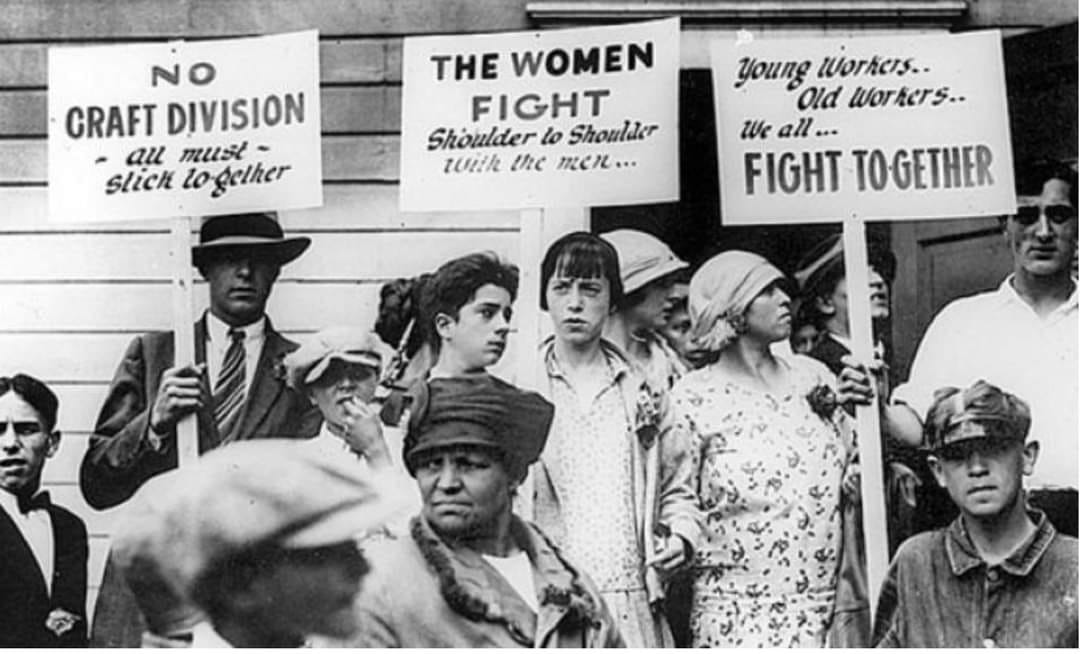
Deeply rooted in the movement and cognizant of its needs, the Trade Union Educational Leagues provides us with a gold standard in promoting the perspective of a radical, rank-and-file opposing labor’s misleaders with this 20-point program distributed at the A.F.L.’s 1926 National Conference.
‘Program For Building the Trade Unions’ from the Daily Worker. Vol. 2 No. 201. September 5, 1926.
American Trade Unionism Shown Road to Progress
The Trade Union Educational League, organ of the left wing trade unionists of America, around which rally the progressive workers in the struggle with the employers, has analyzed the conditions and needs of the American labor, movement and, in view of the approaching convention of the American Federation of Labor, drawn up a program for building the trade unions and for building the trade unions and for their victorious advance against the present attacks by the employing class. This program has been issued as a leaflet and will be distributed throughout the trade unions of the country. The Special Labor Day Edition of The DAILY WORKER includes it as one of the most significant declarations of the labor movement.
Proposals to the A. F. of L. Convention, Detroit, 1926
THE American labor movement is in a crisis, everywhere the employers are attacking the workers’ conditions of labor and standards of living and trying: to destroy the trade unions. In nearly every industry wages have been cut, either directly by a straight-out reduction, or by speeding up the workers to a vastly Increased production. Only in relatively few cases have wages been increased or hours been shortened. In most cases old gains have been swept, away and the long hour day of unorganized industry is threatening the standards of the organized, while every scheme possible is enforced on organized labor to multiply the output of the work day, regardless of health or safety.
The employers are combining their forces in constantly more powerful corporations, and super-trusts. By intensification of exploitation they are wringing enormous and ever-growing profits from labor. Knitting together the great industrial enterprises, the financial trust rules throughout industry, dictating the lives of millions, piling up such great wealth that billions are invested in imperialist ventures overseas to get super-profits.
THE employers’ combines are ruthless. They control the government, buying legislators and their will. Labor is outlawed in every effective action, injunctions, police and troops are used to beat down any resistance to capitalist attacks. The open shop is enforced by the government, the right to strike is savagely attacked and trade unionism seriously menaced by company unions, a fraudulent substitute for real unions. Against capital, labor is waging a losing battle when it does fight, though if united in struggle it would win.
While capital is thoroughly organized, there are only 3,500,000 organized out of 20,000,000 organizable workers. The unions have lost more than a million members in the open shop war. Company unionism is gaining, with over a million workers bound up in these fake organizations.
THE trade unions, weakened by craft divisions and top-heavy with an official bureaucracy which refuses to fight the employers, have retreated almost everywhere under the employers’ attacks. The bureaucrats have adopted a policy of surrender to and collaboration with the employers. For more “recognition” the bureaucracy undertakes through such schemes as the B. & O. plan, to help employers get more profits out of the workers than they can get through company unions.
In politics the bureaucracy trails behind the coat-tails of every capitalist politician of both capitalist parties, seeking “friends” by “non-partisan” politics, and thus reducing labor’s political power to zero, instead of building up a powerful party of labor alone. To remedy these conditions and to build the trade unions into powerful organizations the following measures are necessary:
1. Organize the Unorganized
Much of the weakness of the labor movement lies in the fact that only about 10 per cent of the workers are organized, and that these ten per cent are mostly skilled workers and in the light industries. It is therefore imperative that the A. F. of L. shall call upon the entire labor movement to embark on a general campaign to organize the many millions of unorganized, giving special attention to the basic and key industries, including steel, railroads, marine transport, mining, electrical manufacturing, chemicals, rubber, automobile, lumber, textile, etc. Emphasis must be laid on the organization of the unskilled workers.
The A. F. of L. convention shall create a general organizing committee to supervise the work of organization. Campaigns shall be initiated nationally in the various crafts and industries and locally on a general scale. A special organizing fund shall be created. The system of shop committees to mobilize the unorganized shall be established to induct them into the unions. The general organizing committee shall conduct a special campaign against the company unions, designed to convert them into real trade unions or to destroy them and to build up trade unions in their place.
To facilitate organization work the A. F. of L. should henceforth hold its conventions in big industrial centers, discontinuing the present practice of holding them in summer resorts, such as Atlantic City.
To facilitate the organization of the unorganized, a general reduction of initiation fees shall be recommended to affiliated internationals with high fees.
In those industries where no organizations exist, the unions to be established shall be based on the industrial form. In industries where a whole group of conflicting, weak unions claim jurisdiction over the mass of unorganized workers, the jurisdiction shall be awarded forthwith to the basic union of the industry, such as to the Amalgamated Association of Iron, Steel and Tin Workers in the steel industry, to the International Association of Machinists in the automobile and electrical manufacturing industries, to the Amalgamated Meat Cutters and Butcher Workmen in the packing industry, etc.
The campaign to organize the unorganized must be accompanied by a general demand for improved living standards of the workers.
2. Demands for Improved Living Standards
Thru advancing machine production and the speeding up of the workers by all manner of “efficiency” schemes to increase output, the employers are reaping profits almost beyond imagination. The unexampled profits in the General Motors corporation, the United States Steel corporation and the record profits of the railroads, loaded with over-capitalization though they are, show that the capitalist class is enjoying fabulous profits wrung from labor.
BUT Labor? Labor has been “deflated” since the war. The cost of living has gone up faster and farther than wages have been increased. And the costs stay up while wages have been out in many industries. The average wage is well below $30 a week, a glaringly insufficient wage. The workers’ health is undermined by the terrific speed-up.
To check this attack on the living standards of labor, the A.F. of L. must call upon the workers in the various industries to take advantage of the present active state in their industries to present demands for increased wages, decreased hours, and increased control over industry. All wage movements should be conducted jointly by related trades. Attempts to cut wages anywhere must be resisted by a militant strike policy.
3. A Policy of Militant Action
The most dangerous tendency in the labor movement is that hidden behind the pretty phrase of “co-operation with the employers,” now current with trade union leaders. The attack of the employers upon the trade unions and the standards of labor, cannot be stopped by having the unions adopt plans for increasing production. This only surrenders them to the employers. It demoralizes the very foundation of trade unionism and poisons the workers with the false teaching that labor has a common interest with those who exploit it.
Labor must call a halt to the trade union bureaucracy’s policy which leads the workers into such “co-operation” traps set by the bosses. The A. F. of L. must declare for an aggressive policy of action against the employers. It must condemn the so-called “co-operation” or class collaboration policy as expressed in the Baltimore and Ohio Plan and similar schemes. It must reject the Watson-Parker Law, which encourages company unionism, outlaws strikes on the railroads, practically establishes compulsory arbitration, permits civil courts to pass upon the merits of labor disputes and establishes a partnership between labor officials and railroad magnates, to be used by the latter to raise railroad rates.
THE A. F. of L. must reject the “New Wage Policy” adopted by the last convention of the A. F. of L., and repudiate also the so-called “Monroe Doctrine of Labor.” It must decisively condemn trade union capitalism, as expressed by labor banks, labor investment corporations, trade union life insurance companies, etc., and demand transformation of these institutions into genuine co-operatives. The investment of the workers’ savings should be in the socialized industries of the Soviet Union
4. A Labor Party
The present A. F. of L. policy of supporting candidates on the tickets of the republican and democratic parties is absolutely fatal to the interests of the working class. It checks the growth of class consciousness. It makes a unified, successful fighting front of labor against capital impossible and it destroys all real representation of labor in government. The evil effects of this policy are illustrated afresh by the exposures of political corruption in Pennsylvania and Illinois.
In place of this ruinous policy, the A. F. of L. shall declare for the formation of a labor party, which shall make a bloc with the organized farmers. To put this policy into effect, it shall immediately call conferences in the various cities and states for the purpose of establishing labor parties, and later hold a national labor party convention.
Labor should enter the November elections under its own banner. As the basis for organization the labor party there should be prepared a political program covering the pressing needs of the working class, which should contain the following main planks:
(a) Revision of the tax and tariff laws so as to take the burden of taxation and higher prices through the tariff off the workers and farmers. Higher sur-taxes on the incomes of the great corporations and multi-millionaires. (b) Legislation outlawing the use of the injunction, police and soldiers in labor disputes.
(c) The general eight-hour day in industry.
(d) Fight against all proposal to register, photograph and finger-print foreign-born workers.
(e) Industry to bear the cost of unemployment through legislation making compulsory the payment of trade union wages to all unemployed workers, funds to be raised through higher taxation of profits.
(f) The prohibition of the labor of children under 16 years of age, with provision to maintain the children of workers and provide for their education up to the age of 16.
(g) Relief for the farmers thru adoption of the principle of the McNary-Haugen bill and the addition appropriation of a half billion dollars to provide for the establishment of co-operative marketing associations controlled by the farm organizations and for the improvement of agricultural production.
(h) The nationalization of all large scale industry, including mines, railroads and the great manufacturing industries, food distributing organizations, etc. The establishment of workers’ control and the participation of the workers in the management of these nationalized industries.
(i) Reduction of the army and navy and a fight against militarism and imperialism. The withdrawal of American soldiers from all foreign territory. Immediate independence for the Philippines and Porto Rico and the right of self-determination for all other American colonies and possessions.
5. Save the Miners’ Union
The A. F. of L., in view of the deep-going crisis in the mining industry, and the reactionary leadership of the Lewis machine, which has already resulted in the collapse of the Miners’ Union in many of the most important districts under the open shop attacks of the coal operators and thus is threatening the very life of the whole organization, should call upon the whole labor movement to lend its active support by furnishing men and money to help carry on the widespread organization campaign necessary to rebuild the Miners’ Union in Pennsylvania, West Virginia, Kentucky, Alabama, Colorado and many other demoralized and disorganized districts. The fight must be to save the Miners’ Union, whose threatened destruction menaces the progress of the whole labor movement.
6. Nationalization of Industry
The A. F. of L. must declare against the private ownership of industries vital to the life of society. It must demand the nationalization of coal mines, railroads, super-power plants, grain elevators, packing houses, etc., with workers’ control in the management of these industries. The further development of organized labor depends upon taking this stand.
7. Against American Imperialism
One of the most outstanding features of world development is the rise of American imperialism, which is not only subjugating colonial peoples and the working classes of foreign nations to Wall Street bankers, but rebounding in its competitive effects against the American workers. It creates an ever-growing danger of war.
The A. F. of L. shall condemn the imperialist policy of the American capitalist class. It shall reject participation in the league of nations and demand withdrawal from the world court. It shall condemn the Dawes plan and the proposed war debt settlement plans. It must demand immediate and unconditional freedom for the Philippines and Porto Rico, and condemn the policy of American imperialism in China and other Far Eastern countries. Above all it must demand from the United States government a policy of hands off Mexico and other Latin-American countries.
The A. F. of L. shall act immediately to transform the Pan-American Federation of Labor into an instrument of struggle against American imperialism, now beginning in the Latin-American countries under the leadership of the All-America Anti-Imperialist League. It must condemn the plan of the Pan-American Union to develop into an American League of Nations, and specifically condemn in detail, the growing militarism of the United States.
8. Company Unions
Company unions constitute a real menace to organized labor. They have spread into many industries, especially those of a basic and trustified character. The employers have established these organizations in order to increase production and to block the formation of trade unions. The A. F. of L. shall devote more attention to this important problem and it shall wage an active warfare against the company unions, with the aim in view of breaking them up and establishing trade unions. To this end it will often be necessary to work within the company unions and capture them.
The weapons that must be used against company unions are an active defense of the workers’ interests in open struggle against the employers and a complete repudiation of the ideas and practices of collaboration with the employers in speeding up production and eliminating strikes, as expressed by the B. & O. plan and the Watson-Parker railroad law; a militant campaign to organize the unorganized; the amalgamation of the craft unions into industrial unions, and the systematic building-up generally of the trade unions into real fighting organizations to defend the class interests of the workers.
9. Fight Against Injunctions
The use of anti-labor injunctions in labor disputes is a stab at the heart of the labor movement, and the A. F. of L. shall call for a more militant fight against the issuance of injunctions. Such tyrannical action by the courts must be countered by a mass violation of the injunction by the strikers involved and by the labor movement generally.
10. Political Prisoners
The A. F. of L. shall initiate a vigorous campaign for the release of Sacco and Vanzetti, Mooney, Billings and the many other labor prisoners. A special day shall be designated whereupon the various state federations and local central bodies shall hold meetings of protest, adopt resolutions demanding the release of political prisoners and send delegations in co-operation with an A. F. of L. delegation, to the governors of California, Massachusetts and other states holding political prisoners, demanding the release of these prisoners.
11. Against Racial Discrimination
The trade unions must include wage workers regardless of race, creed, sex, age or color. The A. F. of L. must declare for the removal of all bars against Negroes, Japanese, Mexicans and other races and national groups which are being discriminated against in entering the trade unions. It must demand the abolition of all Jim-Crow laws, practices and discriminations, and the elimination of lynching.
The A. F. of L. shall initiate an active campaign to organize Negro workers, and demand that they be given equal pay for equal work, and extend them the utmost protection of the trade unions. Special campaigns should be launched to organize the Mexican and Japanese workers in this country.
12. Women and Youth
The A. F. of L. shall emphasize the special importance of organizing women and youth workers, calling upon its affiliated unions to remove all constitutional barriers existing against these workers and to intensify the work of organizing them. It must demand equal pay for equal work, prohibition of night work, child labor and excessive hours, and propose that their demands be brought forward in all wage movements by trade unions in industries in which they are employed.
13. Corrupt Labor Papers
The A. F. of L., in order to lay a basis for a campaign to eliminate the numerous fake labor papers which infest many cities with or without the endorsement of local labor, shall appoint a special committee to investigate this prolific form of corruption in the labor movement and to report back to the next A. F. of L. convention.
14. British Coal Miners’ Strike
The strike of the British coal miners is of profound importance to every trade unionist of the world. Their victory will be our victory and their defeat would encourage attacks on labor in America. The A. F. of L. shall pledge its complete and active support to the strike of the British miners. It shall call upon the marine transport and railroad unions to refuse to haul coal destined for Great Britain, and it shall call upon all affiliated members each to donate immediately to the strike relief fund a sum of not less than two hours’ pay. In addition it shall proceed to organize a loan of not less than $3,000,000 from the labor banks to the Miners’ Federation of Great Britain.
15. International Affiliation
The A. F. of L. shall endorse the Anglo-Russian Trade Union Unity Committee, and support its program of a world congress for trade union unity, to include the Amsterdam International, the Red International of Labor Unions, the American Federation of Labor, and the unions of South America, China, India, etc. It should recommend to its affiliated internationals that they affiliate to the respective industrial federations of the Amsterdam International on the basis of the admission of the Russian trade unions and the holding of a world trade union unity congress.
16. Recognition of the Soviet Union
The progress in the Soviet Union of the socialized industries can no longer be questioned and the Soviet government of workers and peasants now stands before all the world as a historic triumph of labor. Its strength has been shown in the recognition by scores of nations, among them the most important countries of the world. Only the United States withholds such recognition, and the A. F. of L. should demand of the United States government that it recognize the Soviet Union and establish full diplomatic and commercial relations with that country.
17. Trade Union Delegation to The Soviet Union
The trade unions of Europe have practically all sent delegations to investigate the conditions of labor under the Soviet government, no longer trusting the prejudiced news of the capitalist press, which time after time has proven wholly false. The American trade unionists have a right to know at first hand why it is that the whole world capitalist class is so bitterly opposed to the Soviet government and what are the conditions that 8,000,000 Russian trade unionists share under that government. Therefore, the A. F. of L. shall accept the invitation of the Russian unions and send an official delegation to visit the Soviet Union and submit a report to the American labor movement.
18. Centralization of the Trade older Union Movement
One of the main weaknesses of the A. F. of L. is its decentralized form of organization, which cripples the effectiveness of the workers’ struggles against the employers. The A. F. of L. shall, therefore, initiate an active campaign for the centralization of the forces of the trade union movement, including the affiliation of the Railroad Brotherhoods, the Amalgamated Clothing Workers, and other independent unions.
The executive council shall be enlarged to 45 members, representing principally mining, railroad, metal, textile and other key and basic industries. The executive council shall meet quarterly, with a smaller board to transact executive business in between meetings.
We must look forward to the time when, with a democratized A. F. of L. and an educated membership, all affiliated unions, before presenting demands to their employers, shall first have them passed upon the executive council, whereupon the executive council shall mobilize the support of the labor movement behind these demands to the extent and in the manner required by the situation.
The executive council shall have the right to levy strike assessments. There shall be a universal transfer system prevailing between the various unions, and efforts shall be initiated to establish a standardized dues system. Progressively, the Central Labor Councils shall be extended more jurisdiction over the organization and activities of their affiliated unions.
19. Amalgamation
As a part of the general movement to centralize the forces of the trade unions, the A. F. of L. shall endorse the principle of industrial unionism and call a series of conferences in the various industries for the purpose of amalgamating the many craft unions into industrial organizations. In carrying through this amalgamation, the principle of organization on the basis of the shop, instead of the miscellaneous local union, shall be introduced. Amalgamation is a powerful weapon against company unionism.
20. Democratization of the A. F. L.
The task of democratizing the A. F. of L. is basic, and a necessary complement to the centralization of the trade union movement. The present system of complete control of the A. F. of L. and its component unions, the A. F. of L. convention, etc., within the hands of a small, autocratic bureaucracy to the exclusion of rank and file participation and control is highly injurious to the growth, function and progress of the organization. For the democratization of the A. F. of L. the following measures are necessary:
At least 25 per cent of the members of the executive council shall be actual workers. The representation of the various international and local bodies in the A. F. of L. convention shall consist of at least 60 per cent of rank and file workers employed at their trades. All convention delegates must be selected by general referendum vote of their respective organization. No person should be a delegate to the convention who is himself an employer of labor or an owner of stock in any capitalist business institution.
THE convention representation of the State Federations and Central Labor Bodies shall be increased from the present system of one delegate each to from two to ten, and two to five, respectively, according to the size of these organizations. Upon the demand of 25 per cent of the members of the executive council, or of 25 per cent of the delegation at the A.F. of L. convention, or of 1,000 local unions, any question, including the election of officers, shall be submitted to a general referendum vote.
In order to make a start at correcting the glaring evil of an overpaid officialdom, the salaries and expense accounts of the general officers of the A. F. of L. shall be reduced 50 per cent, and the general organizers accordingly.
THE agenda system shall be introduced by a provision providing that two months before the holding of the annual convention, an agenda shall be made up touching upon the most vital issues confronting the labor movement, and such agenda shall be submitted to the various organizations for their consideration.
Full freedom of expression shall be guaranteed to minorities in the unions.
The foregoing general proposals for democratization shall also be introduced into all the affiliated unions of the American Federation of Labor.
Issued by, THE TRADE UNION EDUCATIONAL LEAGUE, 156 West Washington St., Chicago, Ill.
The Daily Worker began in 1924 and was published in New York City by the Communist Party US and its predecessor organizations. Among the most long-lasting and important left publications in US history, it had a circulation of 35,000 at its peak. The Daily Worker came from The Ohio Socialist, published by the Left Wing-dominated Socialist Party of Ohio in Cleveland from 1917 to November 1919, when it became became The Toiler, paper of the Communist Labor Party. In December 1921 the above-ground Workers Party of America merged the Toiler with the paper Workers Council to found The Worker, which became The Daily Worker beginning January 13, 1924.
PDF of full issue: https://www.marxists.org/history/usa/pubs/dailyworker/1926/1926-ny/v03-n201-Chi-sep-05-1926-DW-LOC.pdf
 Revolution's Newsstand