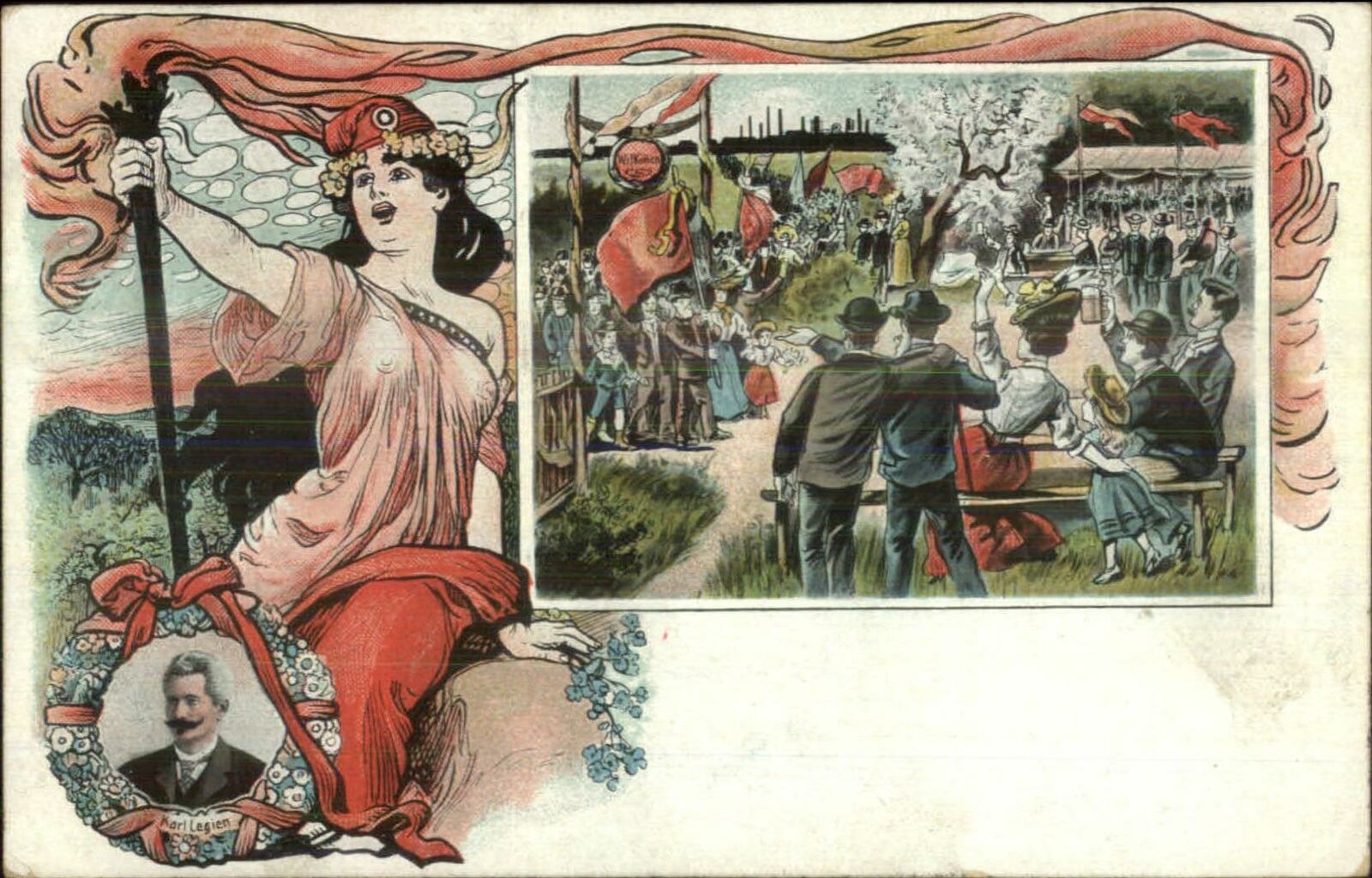
German Social Democracy did not suddenly collapse in 1914, it was rotting away for many years beforehand. Foster observes Carl Legien presiding over the national convention of Germany’s Socialist unions in an affair even Samuel Gompers would find lame.
‘German Unions in Congress’ by William Z Foster from Industrial Worker. Vol. 3 No. 24. September 7, 1911.
The German Socialist unions have held their congress in this historic old town during the past week. It was the tamest affair I ever attended and almost a perfect model of what a union congress should not be. Not alone was it destitute of even the suggestion of revolutionary spirit, but also ran on a machine plan that Sammy and Co. could learn much from.
Legien opened the congress by citing a lot of statistics showing the growth of the organization, which now has 2,276,000 members, their financial resources, etc. After this the congress speedily settled down to its “work” which consisted in doing whatever the general committee (G.E.B.) told it to do. During the whole congress not a single motion against which the general committee expressed its enmity was passed and not a single one of its recommendations was refused or even contested. The few motions on the order of business which were unwelcome to the general committee were cold bloodedly slaughtered by either a word from the dictator, Legien, parliamentary juggling or by being “settled” behind the curtains. The “business” that the congress was allowed to discuss, from a revolutionary standpoint, was trivial in the extreme. It consisted chiefly in windy kicks against the cruel government, and regulations of the insurance institutions of the unions. Only a couple are worth spilling ink over.
One proposition was for all the unions to form a central strike fund and another was that in great strikes or lockouts all the affiliated unions should be assessed per capita tax. These motions were aimed to checkmate the employers who at present keep close track of the funds of all the organizations by grace of the latter’s elaborate statistics and who thus know the fighting strength of the unions.
The general committee didn’t commit itself on these propositions but advised that they be referred to a conference between the general committee and the national committee of the various unions. Why this conference should be considered more capable than the congress is only to be explained on the grounds that one of the cardinal principles of the German Socialist unions is that the rank and file (or even the congress) is incapable of deciding important questions.
Our American Socialists who are demanding the referendum for the whole American people might do good work to propagate the idea in the German Socialist unions where it is practically unknown. Of course Legien’s recommendation was unquestionably acceded to. Then came a proposition from the general committee for the Soc. Co-operatives and unions to form a partnership and get into the insurance business on a business basis. It was pointed out that the private insurance companies are fleecing the workers out of hundreds of millions of marks yearly and that this could be stopped by the formation of a general working class insurance company. The proposition coming from the general committee was, of course, unanimously adopted.
This forming of a central insurance company is a logical development of union insurance in Germany. The present 53 unions, each with their separate insurance institutions are distinctly unbusinesslike and can’t seriously compete with the better organized private companies. Their merging their insurance features into one organization is inevitable and may react favorably on them by forcing them to develop into fighting organizations if they want to make any appeal to the workers–hitherto it has been their functions as “sick and death benefit societies” which have been their strongest drawing cards. However, it is not intended that the new company supplant the unions entirely as insurance societies, as it will limit its activities to death, old age and a few other benefits, The dear socialist guardians of the unions will never intentionally let them out of the insurance fog. However, such a central insurance company might easily have the effect I have suggested.
The balance of the business of the congress was a series of long, dry discussions and protests over the attitude of the government towards the employment offices, sweat shops, workers insurance, right of workers to organize, etc.
Needless to say the congress has left the prosecution of these kicks and threats to the “powerful” Social Democratic party. The idea that the unions should undertake by their own efforts to force the government to recognize their protests, as the C.G.T. is now doing with the French government in the old age pension matter, was not even hinted at in the congress.
On the other hand a vigorous propaganda) to support the Social Democratic party was openly prosecuted, and not a single objection to it was raised. Not a word was said in regard to the necessity for the development of better direct action tactics. The German Socialist unionists consider the old fashioned strike as the alpha and omega of such tactics. Sabotage and passive resistance were unmentioned, the general strike idea (the discussion of which unions have officially forbidden) remained undiscussed, anti-militarism–a burning question with all revolutionary organizations–was not even mentioned at the congress, this being also a matter for the powerful Social Democratic party to handle. Not a single speaker said anything which by any means could be interpreted as even a suggestion of the revolutionary conception of unionism. And this is perfectly natural as the unions entirely delegate the task of freeing the working class to the Social Democratic party via the ballot. They consider their own functions to simply be to mitigate the devasting effects of capitalism until the pasty has won the great battle.
The German capitalist class has but contempt for this immense organization of 2,276,000 members, which is so timid that it decorates its congress hall with bunting of RED AND WHITE (I asked what the red and white stood for and was assured it had no great significance, that the bunting was the colors of some local prince or other “and that it had been used “just so the decorations wouldn’t be all red you know.” I was also hastily informed that they were not the German national colors–this assurance because some of the German unrevolutionary unions decorated their congress halls with the national colors.) Of this contempt Legien in his opening address gave a striking proof. He said: “We must not forget that the employers have also changed their tactics. Whilst until within a few years ago they directed their attention chiefly to defending themselves against the demands of the unions; to the pursuing of defensive tactics, THEY HAVE NOW ADOPTED AGGRESSIVE TACTICS AND SEEK TO HAVE THE CONTRACTS IN THE GREATEST POSSIBLE NUMBER OF TRADES (gewerbe) EXPIRE AT THE SAME TIME. They do this in order to make “unconditional” terms to the workers in regard to the rearrangement of wage and working conditions, and if these are not unconditionally accepted they lock out great masses of workers in the hope that by these mass lockouts the financial strength of the unions must be crippled.”
In other words, the German employers have so much contempt for the tactics of the Socialist unions that they have adopted the same, attitude as American revolutionary unionists, though with a different end in view, and they want to fight labor wars on as large a scale as possible.
The industrial unionists with their modern tactics want the labor wars on a large scale, because then they can apply these tactics to good advantage. The German capitalists, opposed by organizations whose only fighting resources are their funds, and knowing their financial superiority, want to involve as many as possible of these organizations in battle at one time so they can’t financially aid each other as heretofore. They are encouraged to this aggressive stand by the timid holding of the Socialists who fear (and justly) all mass movements of workers as most dangerous to the Social Democratic party and who go to the extreme length to prevent them.
What the capitalist class thinks of the power of the Socialist Democratic party straw that this great labor organization is clutching at has been recently well illustrated. “Vorwarts” of June 29th, speaking of the recent vote in the Prussian Lantag when the Socialist motion for an equal franchise law was defeated by the combined Clericals, Liberals and Conservatives, says to the working class: “To the robbery of our rights, which has been committed upon you, the rulers of the three class parliament have added ridicule and contempt.” The two Socialist representatives at the close of the session wanted to quit the legislative hall before the customary cheers for the kaiser were called for, but were so heartily jeered and laughed at that they got sore and went back to their seats and remained seated during the cheering–the daring criminals. The only protest the Social Democratic party–which is by far the largest in Germany–can make to this “outrage” is to draw up a few hot air resolutions. It is absolutely without power to retaliate.
The president of the union congress in his closing address after congratulating the movement on its great development, unity and power, also raised a “protest” against the shameful treatment of the working class by the Landtag and the congress then adjourned, its “work” bring all accomplished.
P.S. No Clara we didn’t sing the “International” at the finish. It’s a little too raw don’t you know.
W.Z.F.
The Industrial Union Bulletin, and the Industrial Worker were newspapers published by the Industrial Workers of the World (IWW) from 1907 until 1913. First printed in Joliet, Illinois, IUB incorporated The Voice of Labor, the newspaper of the American Labor Union which had joined the IWW, and another IWW affiliate, International Metal Worker.The Trautmann-DeLeon faction issued its weekly from March 1907. Soon after, De Leon would be expelled and Trautmann would continue IUB until March 1909. It was edited by A. S. Edwards. 1909, production moved to Spokane, Washington and became The Industrial Worker, “the voice of revolutionary industrial unionism.”
PDF of full issue: https://www.marxists.org/history/usa/pubs/industrialworker/iw/v3n24-w128-sep-07-1911-IW.pdf
 Revolution's Newsstand