The revolutionary wave engulfing the world reaches Japan as riots sweep the country over scarcity, rents, and food prices.
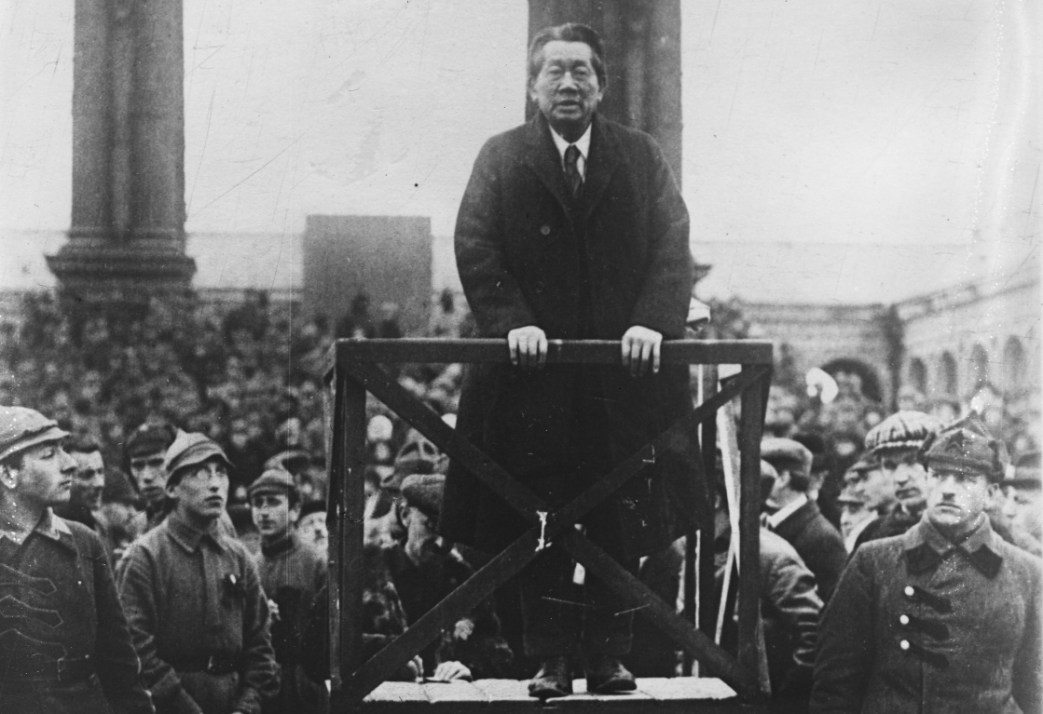
‘A Japanese Interpretation of the Recent Food Riots’ by Sen Katayama from Class Struggle. Vol. 2 No. 5. December, 1918.
Our brief sketch of the popular movement in Japan, its mobs and its riots, that appeared in the Sept.-Oct. issue of the Class Struggle under the title of “Armed Peace on the Pacific,” will be the best introduction to a description of the recent riots that shook Japan. Riots are not new in Japan. During the last three centuries of feudal regime there have been hundreds of riots among the farmers, tenants and even among the city people, uprisings against their oppressing rulers and their exploiting rich. In the cities these riots were usually directed against the wealthy rice merchants, the peasant uprisings against feudal chieftains, directly against land-tax collectors, and indirectly against the rich in the villages. But they rarely were of more than local significance. Under the ancient feudal system the peasant had no political rights; they were meek and passive in their relations with the feudal officers. But when conditions became unbearable, they had no means of redress, and their dissatisfaction found violent expression in riots, burning and destruction. The vengeance of the authorities, when once the disturbance was passed, was terrible. The leaders were brutally punished, and only too often their wives and children as well. They were crucified and exposed to the public gaze as a warning. But the demands made by the mobs were usually at least partially met. Rents were reduced and rice prices lowered; an oppressive ruler deposed, an unbearable tax collector removed. The recent riots, in their outward appearance, showed little variation from this general character. But for the first time in the history of revolutionary movements in Japan, they were not centered upon small territories. They extended over three prefectures, Tokyo, Osaka and Kyoto, over thirty provinces, and in Hokkaido, the northern part of Japan.
Altogether this uprising affected over two-thirds of the Japanese Empire. The Oriental Economist reports that there were destructive riots in 142 different localities; that in 38 places they could be put down only by armed troops. In Osaka the rioting continued for three full days and nights, and it is roughly estimated that at its height a force of over thirty thousand soldiers, including cavalry were necessary to control the infuriated masses. The press reports that have just reached us extend over the 13th of August and contain detailed reports of the revolts in Osaka and in a few of the principal cities of the Empire. After this date all reports suddenly cease. The Government had forbidden the publication of further news concerning these uprisings, fearing, not without cause, their extremely contagious character. Even later, when the press was again permitted to print reports of the riots that were spreading rapidly all over the country, these news items were strictly controlled and censored, and only news furnished by the government was allowed to appear in print. From all indications, however, rioting in Tokyo, Nagoya, Sendai and in other large cities must have been even more frightful than that in the cities previously reported. In Kure, where the chief Navy Yard of the Empire is located, the marines were called out in full strength to quell the desperate mobs, while all thoroughfares and important crossings were armed with machine guns. But in spite of the rigid military discipline that obtains in the Japanese army, it was found that a number of marines had made common cause with the rioting masses. The police authorities, realizing from the start their impotence in dealing with the rioters sent plain clothes men into the crowds who marked the backs of the ringleaders with chalk, to arrest them later when the fury of the mob had spent itself. Trickery of this sort, however, only served to inflame the popular fury. In Tokyo an uprising was led by women, girls and children, and spread within a week all over the country. The time was ripe for a revolt against the autocratic government. There were riots in the mines, and many millions of dollars worth of property were destroyed, before the wage increase demanded by the workers was granted. In Kobe the populace burnt down stores, offices, and even the residences of the wealthy rice speculators. The rioters were joined in a sympathetic movement of the 8,000 workers in the Mitsubiti shipbuilding yards, whose effective sabotage so desperately threatened the interests of the ship builders that they begged the men to enter upon negotiations with them, promising to raise their wages, asking them not to leave the factory, while promising to pay 70 per cent of the day’s wages for the day’s work of destruction. In its anger the mob in Kobe burnt down the offices of the rent collecting agency of the city, wreaking vengeance for the misery and suffering that this company had caused them in the past.
In spite of the wild and bitter struggles that marked this uprising in all parts of the Empire, the movement was for the most part conducted in an orderly fashion. The riot usually began in a peaceful demonstration that went to the homes of the rice dealers or to the granaries to demand cheaper food. Invariably it was the police who met the demonstrants with drawn sabres that turned these for the most part peaceful demonstrations into furious attacks. The people preferred prison and even death to starvation. This is the keynote of the revolutionary movement everywhere.
When the government saw the magnitude of the movement, it appropriated $5,000,000 with which rice was bought up to be given away to the poor, or to be sold at greatly reduced rates to stem the tide of popular dissatisfaction. Rice became cheaper all over the country, and it was understood by the poor that this reduction was the direct result of their mob action. But the cheaper rice by no means disposed of their grievances, and the uprisings went on, more vigorously and more hopefully than before. Dry-goods stores were sacked, fuel yards and fashionable restaurants were taken by storm. The riots were originally caused, it is true, by the unheard of increase in the price of the chief food staple of the Japanese people. But the people understood also that this rise in the cost of living was due not only to the rapaciousness of the dealers, but equally to the Government and to the political rulers who were encouraging the export of the necessary sustenance of the nation to other countries for profit, who had precipitated the country into a costly war, the interests of a rapidly developing capitalist class.
Significant for the importance of the revolutionary uprising is the impression that it created upon the minds of the intelligent classes of Japan. To them the power and influence that was wielded by the despised masses over the well-organized bureaucracy and powerful military forces and well-disciplined police, was a source of amazed astonishment. The role that the army played during these fateful days, the toll of killed and wounded that was exacted from the revolting proletariat at the point of the gun and the bayonet made the army the most hated institution in the empire. The rice riots have accomplished, in spite of their final suppression, the moral overthrow of Japanese militarism. For never again can the army regain the awe and the respect in which it was always held in the eyes of the Japanese people. Indeed the Terauchi ministry, the most imperialistic and militaristic ministry in the history of Japan, fell on account of the rice riots.
The following quotations from a number of Japanese magazines give a serious interpretation of the things that happened in Japan a few months ago, unlike the garbled and for the most part ignorantly untrue reports that appeared in the American press. The Oriental Economist, under the title of “Political Significance of the Recent Food Riots” says: The sole responsibility for the rice riots lies with the Terauchi ministry. The exceptionally high price of rice is directly due to the policy of the Government in aiding and encouraging export trade. The political machinery of the country functions exclusively in the interests of a few big capitalists while the interests of the vast majority of the people and the workers are completely disregarded. It can be truthfully said that in Japan there is no government for the non-propertied classes. Certainly the rice riots, if they have any meaning at all, have proven that the government has failed to give to the people adequate protection, that they have risen in arms therefore to secure for themselves the protection that the government has refused to accord them.
In this sense these riots have revealed a great political crisis in our country. They were more than an isolated attack upon a few millionaires who were in the possession of the food supply of the nation. They were the signal fires for a class war against all propertied classes, on the broad basis of national politics.
“Japan and the Japanese,” a monthly edited by Dr. Mijaki, one of the most prominent writers and thinkers of New Japan, says “The recent riots are the expression of the righteous indignation of the people against the government and a revolt against the lawless conduct of the millionaires.” “The price of rice,” according to this paper, “was only an incidental cause of the revolt against absolutism and autocracy. They were equally an expression of labor unrest and class feeling, a protest against an inadequate and unequal social system. The direct cause of the riots was the high cost of rice, but the principal cause lay in the Siberian invasion. Sending Japanese troops to Siberia was a thoughtless and wicked act on the part of the government. The riots were an open demonstration of lack of confidence on the part of the people in the government.”
Dr. Yokoi, the agricultural authority of Japan, says in “Industrial Japan”: “The past five years have produced super-abundant rice crops in Japan. Statistics show that there is no shortage in the rice crop in this year. The high price of rice is due solely to the inflation of currency, and the sudden rise in prices during July and August are directly attributable to the poor policy of the government in its management of the rice business of the country. The recent rice riots were caused, not by the lack of rice, but by the high prices that were demanded for its purchase. The dissatisfaction thus created gave to the people in the lower strata of society the opportunity they have been seeking, to open up a class war against the rich. The class war is said to be the most potent force in the modern world.”
In “The New Japan” Dr. Yamawaki says: “In a broad sense, the recent riots were a struggle between the working class and the commercial and industrial class on a huge scale. And if this class struggle should be carried to its ultimate political significance, we will find that in character and content it is a replica of the Russian Revolution. The recent mass action of propertyless classes and employees in Osaka, Kyoto and vicinity, expressing the popular indignation at the unreasonable cost of rice without waiting for the effect of the ineffectual policy of the government, attempted to lower the price of rice by force and violence, became, perforce, an attack upon rice merchants, a punitive war against rent collectors, a process of sabotage in the factories against the commercial and industrial classes. It is evident that these riots were a part of the class struggle, a popular movement for emancipation from the difficulties of living and of life.”
In “Japan and the Japanese” Dr. Tuchiya says: “The recent riots have rapidly developed into a disturbance of the most dangerous nature, because the Japanese have not learned to use organized demonstrations. They have not been allowed to organize themselves even into labor unions. It is a crime to restrain the liberty of the labor movement. In the recent riots ninety per cent. of those arrested came from the working classes.”
According to the latest reports (Sept. 12), over five thousand persons were arrested and are awaiting trial. It is estimated by the government that the number of arrests will reach more than 7,000 before the whole matter is settled. Among them are numerous socialists. Chief among these is Yei Osugi, arrested at Osaka. The government is particularly desirous of incriminating our comrades as mob leaders. Well-known socialists were kept in confinement in their own homes during the progress of the riots by their supporters, as it was well known that the government was prepared to arrest them on the slightest pretext.
In Osaka the Governor published an edict forbidding more than five persons from walking together on the streets. In Yokohama street assemblies were limited to nine persons.
The riots have not been without the profoundest impression upon all classes of the population. The poor found that in mass action they possessed a powerful weapon, while the bourgeoisie of Japan has learned a lesson it will not soon forget. Since the food riots have ceased there have been labor troubles in the mines and factories all over the country. The “Oriental Economist” gives a detailed report of 7 large strikes that occurred between the 1st and the 19th of August, while the daily newspapers enumerate at least 40 others. It is to be assumed that there were many others not mentioned in the daily press. Some of these strikes involved as many as 8,500 workers in a single factory, and they are demanding recognition and rights according to the most advanced standards, with a clearness of purpose that will develop in time into a conscious struggle for the social revolution. On the whole we may well be proud of what the Japanese proletariat has accomplished in the face of one of the most powerful military bureaucracies of the world. They have brought about the overthrow of the Terauchi ministry and have placed the pro-Bolshevik diplomat Uchida into the office of the foreign minister, while Premier Hara has reversed the policy of the old ministry in Russian affairs and openly declares that Japan desires only a responsible government in Russia, whether it be Bolshevik or not. The intelligent classes of Japan are unanimous in their condemnation of the sending of troops to Siberia. But most significant to the great world-wide proletarian movement is the awakening of the Japanese poor and working classes to the coming of the social revolution!
The Class Struggle is considered among the first pro-Bolshevik journals in the United States and began in the aftermath of Russia’s February Revolution. A bi-monthly published between May 1917 and November 1919 in New York City by the Socialist Publication Society, its original editors were Ludwig Lore, Louis B. Boudin, and Louis C. Fraina. The Class Struggle became the primary English-language paper of the Socialist Party’s left wing and emerging Communist movement. Its last issue was published by the Communist Labor Party of America.
PDF of full issue: https://www.marxists.org/history/usa/pubs/class-struggle/v2n5nov-dec1918.pdf
 Revolution's Newsstand