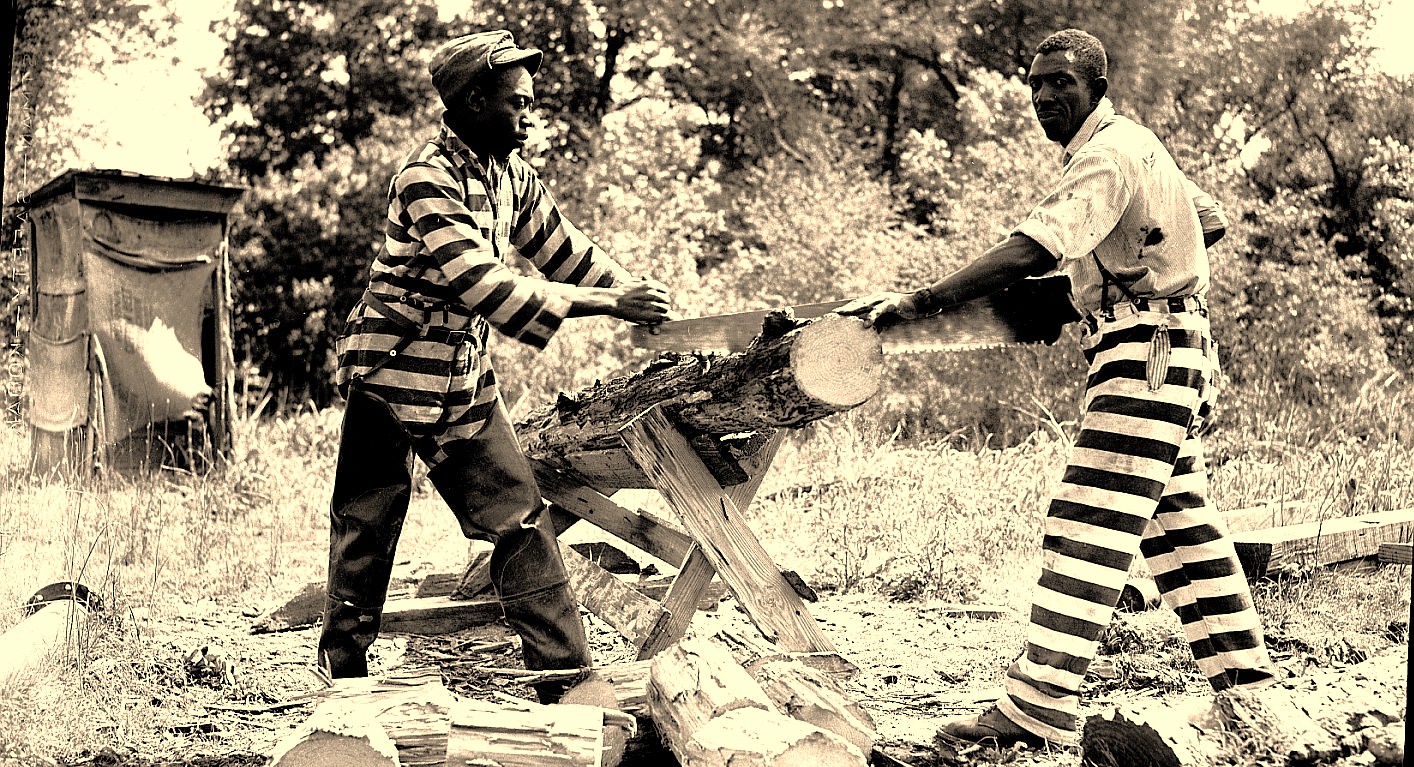
Shocking depravities, even for a country as depraved as the United States, as slavery continues in Georgia through the convict leasing system fifty years after the Civil War.
‘Georgia’s Disgrace–Reeking Horror of Convict-Leasing’ from The Weekly People. Vol. 18 No. 20. August 15, 1908.
GEORGIA’S DISGRACE–REEKING HORROR OF CONVICT-LEASING EXPOSURES.
Awful Tale Laid Bare Before Legislative Committee–Convicts Flogged to Death for Pettiest Offences–Left to Die Neglected, Regardless of Sufferings–“Drinking Too Much Water” Accepted by Coroner’s Jury As Cause of Death–Enormous Profits of Slave Drivers.
Atlanta, Ga., August 6. The disgrace which has come upon the State of Georgia as the result of disclosure of the terrible conditions which have evidently long existed in her penitentiary system is monumental. The story is one of cruelty, atrocity and graft. The investigation which has been in progress for two weeks and is still continuing before the legislative investigating committee, has shown up a system reeking with horror and cold-blooded crime.
Day after day the committee has heard first the story of a convict who lost his life under the lash, and almost from the very next witness how the same warden or guard who administered the fatal whipping was both in the employ of the State and on the payroll of the convict lessee. The wardens employed by the State to see that the convicts were properly housed, fed and otherwise cared for, and whose duty it is to make report to the State, supposedly their only master, have, throughout the entire system been for years in the pay of convict lessees, the presumed service to the latter being to get all the work possible out of the men whose labor they had bought.
The result was the State became a slave driver of the worst sort. Shocking cruelties were perpetrated and hushed up. Men who failed to perform their daily tasks were severely whipped; sometimes they died under the lash, and the death certificate ascribed it to consumption or maybe, as in one case, “drinking too much water.” All this, and more has come to light in the official investigation which the Legislature is now conducting, and which is probably the first thorough Investigation of the system made during the thirty-five years or more of its life.
This inquiry came about as the result of two causes. In the first place, legislative inspection of the convict camps had disclosed certain irregularities, and, second, the time had arrived when the Legislature must make further disposition of the convicts, as the present lease contracts expire March 31, 1909.
It had been discovered for the first time that the wardens employed by the State were regularly receiving pay from the lessees, and that the State warden, Jake Moore, in direct employ of the State Warden Commission, had acquired a fortune of some $40,000 within a few years, on a salary of $140 a month–which it has been discovered, came from trafficking in convicts and acting as go-between with the lessees.
These facts were reported to Gov. Smith at the beginning of the present year; he communicated them to the Prison Commission, composed of J.S. Turner of Putnam, chairman: Gen. Clement A. Evans of Atlanta, a prominent Confederate veteran, and Thomas Eason of Ben Hill County. The commission then permitted Moore to resign, and issued an order prohibiting wardens in future from accepting any money or gifts from the lessees. That the order has been disobeyed, in many instances, the testimony has abundantly shown.
The Legislature, which met on June 24 for a fifty days session, found it had to take hold of and settle the question of what disposition shall be made of the convicts when the present contracts expire, early next year. The money derived from convict leases, some $250,000 a year net, has been distributed among about 120 counties to assist the cause of common school education. They were loath to give it up. It looked as if the lease system would be continued. The counties wanted the money to educate the children; they didn’t seem to care where it came from.
Then there was made public all the details of State Warden Jake Moore’s trading in convict leases, the practical bribery of the camp wardens by the lessees, and finally there cropped out one or two stories of shocking cruelties which had been perpetrated at various camps.
R.A. Keith, formerly a convict, now pardoned, a white man who had been sentenced for slaying the despoiler of his home, told the committee–and his statement was corroborated by other witnesses–the story of how a sixteen-year-old white boy had been whipped to death by a warden named Goode at the camp of the Durham Coal and Coke Company, in northwest Georgia. Given a year in the penitentiary for stealing two cans of potted ham, the boy one day spilled some hot coffee on a pig belonging to the warden. Keith says he was held down by two men while Goode struck him sixty-eight lashes with a heavy strap. The boy had to be carried to the hospital and in a week he died. The death certificate gave consumption as the cause.
A sixteen-year-old Negro boy named Daniel Long had been brutally whipped in the Worth County Road camp, it is said, for refusal to work. The boy came before the committee accompanied by his mother and exhibited his back. Although healed, it gave evidence of terrible laceration from the lash in the neighborhood of the kidneys; the skin had been torn from his left hand and right foot; his right side is partially paralyzed.
Those are but two of the numerous instances of cruelty brought out before the committee, covering a period of ten years, and affecting three-fourths of the camps in the State. Not only are the lease camps attacked, but also those operated under exclusive county and State Jurisdiction.
At the camp of the Lookout Mountain Coal and Coke Company, in northwest Georgia, a Negro’s arm was broken by falling slate. No surgical attention was given, and the wound healed in jagged shape, making the arm useless. Warden W.O. Maxwell cursed the Negro when he was trying to tell members of the legislative committee of the accident.
At Stanley’s camp twelve convicts protested to the visiting committee against the daily beating of a small Negro boy. Reports made to the prison commission showed only two whippings in three months.
At the camps of the Muscogee Brick Company and the Royster Guano Company, members of the Legislature found convicts wearing anklets with spikes three inches long designed to trip them up if they attempted to run.
At the Floyd County road camp convicts were compelled to eat their meals chained to their bunks; Sundays they remained so chained during the entire day.
At the Coweta road camp a Negro dying with consumption was found lying on the floor in the room where stock food is kept. It was in November, and he was without sufficient cover and practically without medical attention.
Lovett Byers, another Negro, was overcome by the heat in the “clamps.” His subsequent death was attributed to consumption.
At the camp of Pinson and Allen, Nicolsonville, quantities of dirt were found in the provisions; the living quarters were exposed to the weather; the convicts were weak and emaciated.
J.A. Cochrane, white, sentenced for life for whitecapping, afterwards pardoned, told of the whipping of a Negro convict at the State farm. The Negro protested he was too sick to work; he was given twenty-five lashes and sent to the field to pick cotton; he fell exhausted in the cotton rows. The Negro had to be carried from the field. The next day he was dead.
Cochran and C.D. Wortham, the latter a former employee of the State at the camp of the Chattahoochee Brick Company, told of the whipping to death of a convict named Peter Harris. Harris couldn’t stand the heat in the brick “clamps,” where it was said to be so fierce that Warden J.T. Casey hesitated to enter for fear it would cause the discharge of his pistol. Harris was whipped in the morning and again in the afternoon for failure to perform his tasks. The next day Cochran saw his body in the cooling vat. The coroner’s jury accepted the testimony that he died from “drinking too much water.” Cochran said it was the daily duty of each convict to handle 100,000 brick. When he went there he weighed 218 pounds; in two months, he had fallen to 164.
Wortham testified there were five to eight whippings daily at the Chattahoochee Brick Company camp. “It was as common to hear a Negro holler there as to hear a pig squeal in the country,” he said.
J.B. Cochran, a brother of the foregoing, and sentenced for the same whitecapping offence, said he had often seen Warden Mitchell at the Rurham Coal and Coke Company’s camp, line up thirty to forty men for “shortage and slate,” that is, failure to get out the required quantity of coal, or having too much slate in it. It took four men one hour to administer the whippings with a strap weighing from three to five pounds.
R.A. Keith, who had spent part of his term at the same camp, did clerical work. Under instructions, he said he reported only one-tenth of the whippings to the prison commission. He knew the rules were regularly violated, but said nothing, and when he was pardoned sued the lessees at this camp for cruel treatment, and won a verdict of $2,000.
J.W. Roberts, a former warden at the State farm, told of the severe whipping of a white woman, Mamie De Cris. She was afterward compelled to work in the fields picking cotton or hoeing, the same as the men.
George Hurt, a lessee, saw a warden, at one of his Negro camps, order a notorious Negro who had killed several men to bring a mutinous convict into the stockade. In the night the latter was killed, the former burying his pick in the man’s lung. He mentioned two other cases of convicts having been killed by convicts at his camps, George Maynere, former warden, said a Negro had been whipped at the Chattahoochee brick camp because his shackles dropped off when the swelling over which they had been forged went down. At the same place, he declared, he saw Warden Casey beat a crazy Negro so severely that he died.
This string of horrible atrocities might be extended almost indefinitely. Warden after warden went on the stand, and admitted that he received from $10 to $100 a month from the lessee at whose camp he was stationed as an employ of the State, which pays them from $25 to $75 a month. Many of them received this pay after the prison commission’s order was issued prohibiting the practice. Physicians were likewise in the pay of the lessees as well as the State.
New York Labor News Company was the publishing house of the Socialist Labor Party and their paper The People. The People was the official paper of the Socialist Labor Party of America (SLP), established in New York City in 1891 as a weekly. The New York SLP, and The People, were dominated Daniel De Leon and his supporters, the dominant ideological leader of the SLP from the 1890s until the time of his death. The People became a daily in 1900. It’s first editor was the French socialist Lucien Sanial who was quickly replaced by De Leon who held the position until his death in 1914. Morris Hillquit and Henry Slobodin, future leaders of the Socialist Party of America were writers before their split from the SLP in 1899. For a while there were two SLPs and two Peoples, requiring a legal case to determine ownership. Eventual the anti-De Leonist produced what would become the New York Call and became the Social Democratic, later Socialist, Party. The De Leonist The People continued publishing until 2008.
PDF of full issue:https://www.marxists.org/history/usa/pubs/the-people-slp/080815-weeklypeople-v18n20.pdf
 Revolution's Newsstand