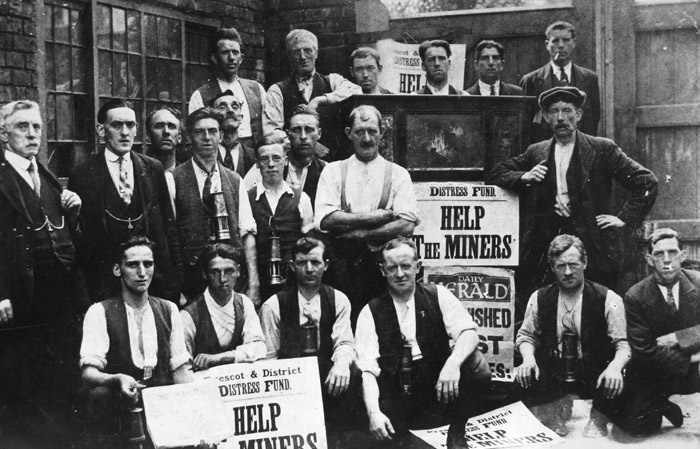
One of the great moments in Britain’s class war. Profintern statement on the continuing, tenacious, strike of the British miners after the end of May, 1926’s General Strike.
‘Declaration of the Red International of Labour Unions on the British Miners’ Strike’ from International Press Correspondence. Vol. 6 No. 58. August 26, 1926.
Declaration of the Executive Bureau of the Red International of Labour Unions on the British Miners’ Strike.
The Executive Bureau of the Red International of Labour Unions affirms that the British miners’ strike is at present passing through its most critical period after more than three months of heroic struggle.
At home, in British, the mine owners, bourgeoisie and State are lined up against the miners. Come what may, the capitalists are determined to bring the miners to their knees. To this end the Government is passing legislation for the introduction of the eight-hour working day for the workers below. ground; the Government is threatening the trade unions with new laws that will render null and void the right to strike, and is thereby preparing to break up the trade union movement. Municipal relief for the strikers is being reduced and in many localities completely stopped; Joynson-Hicks is carrying out mass arrests among the miners.
In order to carry disintegration into the united front of the miners, the coal owners for their part are submitting district agreements in the hope of smashing the courageous, rock-firm army of the miners. Having broken that army into separate sections, the mine owners will tighten up their pressure along the whole front thrown up by the miners, and this will be immediately made use of by the entire bourgeoisie to undertake an attack against the whole working class. The “compromise” memorandum of the Bishops is one of the methods adopted by Government and the employers to shake the miners’ ranks.
In face of this concentrated pressure of the bourgeoisie the behaviour of the working masses of the miners remains astonishingly militant. In spite of the fact that certain groups, including the miners’ leaders, have wavered, the majority of the strikers turned down the Bishops’ memorandum. Thereby the miners of Britain have given us all to understand that they will remain in their old positions: “Not a penny off the pay, not a second on the day! National agreements only!”
But despite the furious attack of the entire British bourgeoisie victory would be secured for the miners were the trade union movement of Britain and the whole world to actively support the strikers. Yet in this direction we are witnessing a treachery and open sabotage on the part of the General Council, the Amsterdam International and its affiliated body, i.e. on the part of organisations designed to defend the interests of the working class, that is incredible in the history of the trade union movement:
No one any longer doubts but that the General Council broke the general strike at the very peak of that movement. No matter what excuses the General Council may make to the working class throughout the world, it cannot hide the fact that from the very beginning, inside the General Council they were against the general strike and against the miners. It was only under tremendous pressure from the masses that the General Council adopted the miners’ programme of demands. But as soon as its became plain that the carrying out of that programme of demands would require a determined and daring struggle along the whole front of the labour movement, the General Council shamefully sold the working class by taking their stand with the bourgeoisie, and proposed to the miners that they agree to the notorious Samuel memorandum which at bottom stood for the salvation of capitalism at the expense of the working class, at the expense of wage reductions for the miners.
By turning down that memorandum the mass of the mine workers condemned the General Council leaders. In order to escape being justly condemned, the General Council, by means of hypocritical promises to help the miners, moved that the Miners’ Federation postpone the Conference of Executives appointed for June 25th. Having got their way in this matter, the General Council forthwith turned front against the miners. In name of the General Council Bromley published an article in which he tried to prove that for all the General Council’s treachery the people to blame were the miners. and the General Council had never made any promise to support the miners’ programme of demands.
A still more manifest instance of the General Council’s treachery we see in the last meeting of the Anglo-Russian Committee in Paris. As the resolution adopted by the Plenum of the Central Council of the Trade Unions of the Soviet Union states, the British Delegation “refused to go into the question of the miners”.
At a moment when an army of workers over a million strong were holding out against the incredible pressure of the united employers in spite of all threats; at a moment when distress among the three millions of the mine working masses had reached its highest point, the General Council refused to consider the question of helping the heroic fighters in Britain. Such a step is to be found nowhere in the history of the working class’ strike struggle.
No less treacherous is the behaviour of the Amsterdam International and its affiliated bodies. Like the General Council it too immediately put a stop to the assistance for the strikers that had been begun as soon as it knew the general strike had been called off. Like the General Council, the Amsterdam International isolated itself from the miners and tried to isolate the latter from the rest of the working class. But the miners’ strike continued and the need for help grew. And it is from this need that the Amsterdam International and its affiliated organisations want to extract the maximum material advantages. Amsterdam “nobly” proposed giving a loan, but demanded certain material securities for this loan from the miners. The Dutch Trade Union Federation headed by the “radical” Stenhuis is demanding 4% for the loan, whilst the General Federation of German Trade Unions headed by Leipart and Sassenbach whose business acumen is higher, is demanding 11%.
That is the way Amsterdam and its henchmen want to secure the prosperity of their funds by drawing on the blood of the miners out on strike, their funds being dearer to them than the interests of the British miners, than the interests of the spearhead of the working class.
The majority of the International Trade Secretariats have shown themselves no better in this strike. The Miners’ International has most outrageously sabotaged all support whatsoever of the miners. Husemann, the President of the German miners, the most powerful section of the Miners’ International, has concluded an agreement with the German mine owners, Britain’s chief coal competitors on the continent, with a view to making the most out of the British strike. From Germany more than 4,5 million tons of coal have been imported into Britain. The British transport workers and railwaymen, as well as those on the continent, are transporting scab coal into the European ports and bringing it over for British Industry.
The striking miners are thus surrounded by a close cordon consisting of the sabotage of the General Council and the Amsterdam International and its affiliated organisations on the one hand, while on the other they are faced with the solid front of the united capitalists and bourgeoisie of Britain and the whole world.
Only those sections affiliated to the R.I.L.U. have fully carried out to the end their duty of international class solidarity. With unexampled enthusiasm, the revolutionary unions of the US.S.R. responded to the British miners’ struggle by sending them a large measure of assistance to the amount of over 4,5 million roubles. The revolutionary unions of France and Czechoslovakia, and the revolutionary working masses of other countries have given what they can of their scanty resources to help the strikers. It is only from the R.I.L.U., its affiliated bodies, and all honest workers that the British miners have met with moral and material support. That support they will have right to the end.
The Executive Bureau of the Red International of Labour Unions appeals to all its organisations and to the whole international proletariat steadily to continue the collection of funds.
The British miners are fighting in the forward positions of the working class. The economic significance behind this tremendous struggle is that of struggle against the feudal organisation of industry. From the general class point of view the British miners’ struggle represents a reflection of the pressure of Capital which is threatening to go over to the general offensive not only in Britain but throughout the whole world. And any such offensive will mean not only a worsening of working conditions but also efforts to smash the entire trade union movement, will signify a strengthening of the reaction and a threat of fresh wars.
With their blood and with their need the British miners are advocating and defending the interests of the world proletariat.
One and all, help the striking miners!
The Executive Bureau of the Red International of Labour Unions.
International Press Correspondence, widely known as”Inprecorr” was published by the Executive Committee of the Communist International (ECCI) regularly in German and English, occasionally in many other languages, beginning in 1921 and lasting in English until 1938. Inprecorr’s role was to supply translated articles to the English-speaking press of the International from the Comintern’s different sections, as well as news and statements from the ECCI. Many ‘Daily Worker’ and ‘Communist’ articles originated in Inprecorr, and it also published articles by American comrades for use in other countries. It was published at least weekly, and often thrice weekly.
PDF of full issue: https://www.marxists.org/history/international/comintern/inprecor/1926/v06n58-aug-26-1926-Inprecor.pdf
 Revolution's Newsstand