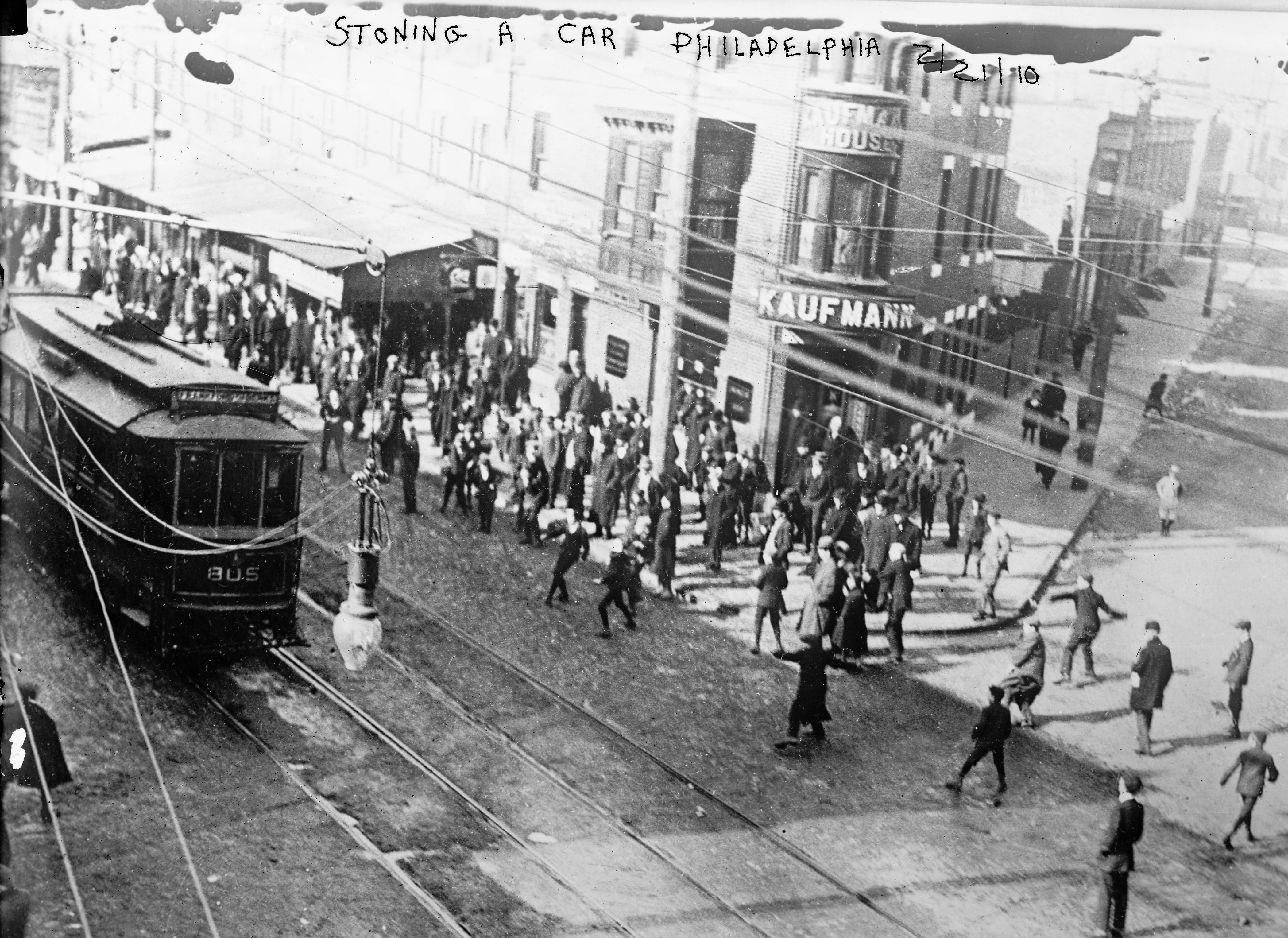
General strikes are a rarity in the U.S., but not nearly as rare as we are taught. In the decade before World War One, a number of cities and towns saw mass shutdowns, Philadelphia’s in 1910 being particularly dramatic. The news of just one day of class war in two straight months of intense conflict as solidarity with Philadelphia’s striking street car workers led to a general strike in the city, then the third largest in the country.
‘Philadelphia Workers Cheer Eugene Debs’ from The New York Call. Vol. 3 No. 55. February 24, 1910.
Socialist Leader Gels Enthusiastic Greeting From Philadelphia Strikers.
HE FEELS THE PUBLIC PULSE
Finds Public In Sympathy With State Constabulary on Way to City.
(Special to The Call.) PHILADELPHIA, Feb. 23. Never was the need of solidarity among workers more apparent than it is today in Philadelphia. With united action on the part of the organized workers of this city the strike of street railway men in this city is already more than won.
The local situation today large with possibilities. Socialists are backing the strikers to the limit of resources, but with solidarity the immediate outcome of this great struggle between the powers of predatory wealth which has robbed the citizens of Philadelphia of franchises right and left, has reached into their pockets and filched from them their earnings, which has debauched their city councils and made of their public officials mere tools to carry out the wishes of the traction trust, today be made a victory for the working which will bring about a great conscious and revolutionary movement.
This traction trust is strongly intrenched, you must understand. So complete has been its mastery of city for years that three years ago when it was stealing the present contract it holds with the city from the citizens of Philadelphia, there was not a newspaper in this city that are print a line of news concerning steal.
It was at this time that leading business men of Philadelphia, who saw what was being enacted in the city councils, went to the newspaper offices and begged the editors of the capitalist press to tell the people Philadelphia what was being done. The editors refused to print. They went to the business department of the papers and asked that it be inserted as advertising. The proposition was refused. Finally, business men, who were opposed to the steal of the transit trust, were compelled to go to New York and New York World and Collier’s Weekly to expose the steal which was being carried on and which the venal capitalist press of Philadelphia, held in check by John Wanamaker and his vast expenditures for advertising refused to print. But it was too late to stop the steal. New York was a long a range at which to carry fight. The contract want through and the citizens of Philadelphia were robbed of their property and of their rights by the assistance of the Director of Public Safety Henry Clay, Mayor Reyburn and the city councils aided by that apostle of purity, John Wanamaker.
Debs on the Scene.
Eugene V. Debs has been today looking over the situation. He has been busy, all day talking with Philadelphians who are not employed by the traction trust. He has been feeling the pulse of the people and this evening he was ready to say what he had discovered.
“I expect the men to win,” said the Socialist leader. “I find public sentiment is with them. They are standing solidly together and the great middle class of Philadelphia has entered into the revolt with them, disgusted at the piratical method of corrupt corporations, especially in Philadelphia. It looks good for the Socialist party. This strike is making people think.”
Debs spoke at the Labor Lyceum tonight and his appearance was one of the greatest events of its kind Philadelphia has ever known. The Lyceum was packed long before the hour for the meeting to begin had arrived. The streets leading to the building were jammed with people and the city authorities professed to feel great anxiety over the behavior of the assemblage. Immense forces of police were held in readiness, but they had nothing to do. Mayor Rayburn’s knees did not quit knocking together until after the meeting was safely over and the crowds had gone home, however.

Resolutions were passed at the meeting to the effect that inasmuch as the government is using all its forces to aid the traction trust in keeping its employes in subjection, holding their wages to a starvation limit and disrupt and destroy their union, and that Socialist party is the only political organization of the working class, sympathizing with all efforts to improve the condition of labor, it was decided that the organization give the strikers their earnest sympathy and support.
The company’s loss to date is half a million dollars as the result of the shut down. It acknowledges fewer cars were running today than yesterday. The company would like to quit the struggle but the city authorities insist on its being carried to a finish, as they realize their official heads are in danger.
Today a thousand police were sent to Kensington to awe that section of the city. Yet few cars went out of the Frankfort barn. They had no passengers onboard except strikebreakers and policemen.
Strikebreakers are being slipped in from 800 West 34th street, New York. Everyman is furnished with a meal ticket for twenty-one meals, consisting of two sandwiches and a tin of coffee. The monotony of the diet has palled on them already, and they are in ripe humor for mutiny.
Company Wants Federal Aid.
The desperation of the company is shown in their discharge of union men operating the mail and newspapers cars. When the strike began the strikers ordered the union men operating these cars to remain at work and they have not been molested at any time.
This morning when William McGuire, one of these union men, boarded his car on the 10th street line to it take to Germantown, Superintendent Gordo noticed that he wore a union button and ordered him to remove it. He refused and Gordon ordered him off the car. This fact was immediately reported to strike headquarters and the matter taken before Postmaster Ashurst at once: Ashurst had also received a notice from the company that it was unable to run its mall cars and assure the safe transmission of the mail.
This move is intended to serve as the basis for interference by the United States government. The Philadelphia Rapid Transit Company is so notorious throughout Pennsylvania, as is their political machine which composes and backs it, that there is some doubts to the loyalty of the state soldiers in case they should be called into the disturbance. At any rate, the company feels that it would be safer if Uncle Sam would lend it his assistants and help it break the strike. The nearest United States armory to Philadelphia is at Fort Mimin, within six miles of City Hall. There is a battalion of infantry there. But nearer still are several thousand marines, quartered at the League Island navy yard, within a few minutes’ ride of the center of the city by trolley,
The street railway service tonight is entirely suspended, as it has been every night during the strike. This morning the company attempted to resume the skeleton service it has been given, but found the trouble making element had been busy during the night. For miles along the streets the tracks were blocked with ash barrels, boxes, iron pipes, sewer pipe, anything that would help impede the progress of a car. It was simply impossible to move the cars on some streets until a force of men had removed all these barricades.
They kept the police busy doing the work of laborers, and the bluecoats sweated and swore at the company which has imposed such labor on them. It was the hardest work some of these police had been engaged at in many years.
During the night a crowd broke into the stables of Edwin Vare, one of the Republican gang leaders here, who holds a contract for removing ashes as part of his pickings from the city treasury, and hauled out a lot of heavy trucks, and left them on the street car tracks. In some cases the wheels were taken off and hidden, and it was a heavy job to raise the unwieldy trucks and open up the line.
Today bands or children paraded the streets, singing: “Who are we? Who are we? We are the strikers of the P.R.T.” Department stores have cut their advertising in the daily papers in half as there are few people getting into town to do any shopping. Everywhere there are crowds of people moving about the streets, but no serious disorders have occurred today. In fact, the crowds are all good natured and it seems the people of Philadelphia are rather enjoying the predicament in which the traction trust has placed itself as the result of its effort to break up the union.
Debs Gets Wonderful Ovation.
At the meeting in Labor Lyceum tonight Debs made a speech that stirred his hearers to the highest pitch of enthusiasm. Many women were present, and despite the fact that there are no cars running and the police did everything they could to discourage people from going near the hall, it was packed to the doors and there were 10,000 people standing about the streets. Although there was no possible chance for them to get in or to hear what was said, the great crowd remained massed about the building until the meeting was over, and when Debs came out there was the greatest shouting that Philadelphia has heard in years.
Men wept and laughed for joy at the sight of the man who is recognized as the leader of the working class movement. Cheer after cheer rent the air and it was many minutes before the speaker could make his way through the throng and get back the hotel.
“This strike.” said Debs in his speech, “is not a life and death struggle for labor. There is no death struggle for labor. Every labor strike which is lost to the men opens the eyes of the victims to the necessity for a closer struggle and forces them into working class solidarity. Ultimately this class struggle will result in unity on the political and economic fields.”
Cossacks to Arrive This Morning.
Tomorrow the armed mounted Cossacks of Pennsylvania, the Pennsylvania constabulary, a police force which exists by demand of the coal barons of the state and without warrant of law, will be in Philadelphia. The four companies, consisting of about sixty-four men each, will be brought from Punxsutawney, Greensburg, Pottsville and Wilkes-Barre, where they are stationed, to patrol the streets of the city. As is necessary, owing to their unlawful organization, they will be sworn in as special deputy sheriffs immediately upon their arrival in the city.
This constabulary is, without doubt, a great fighting force, but at McKees Rocks, where the Pressed Steel Car men were on strike, last summer, they were taught that workingmen can fight when they have to and they were led to respect their adversaries in that wage slave town before they got through with them.
The constabulary will arrive in the morning and will be sent to patrol the streets where the most troubles has occurred. What effect their coming may have on the enraged populace is yet unknown. But there are few in Philadelphia who look with pleasure on the prospect of having the city streets patrolled by these hirelings of the capitalists.
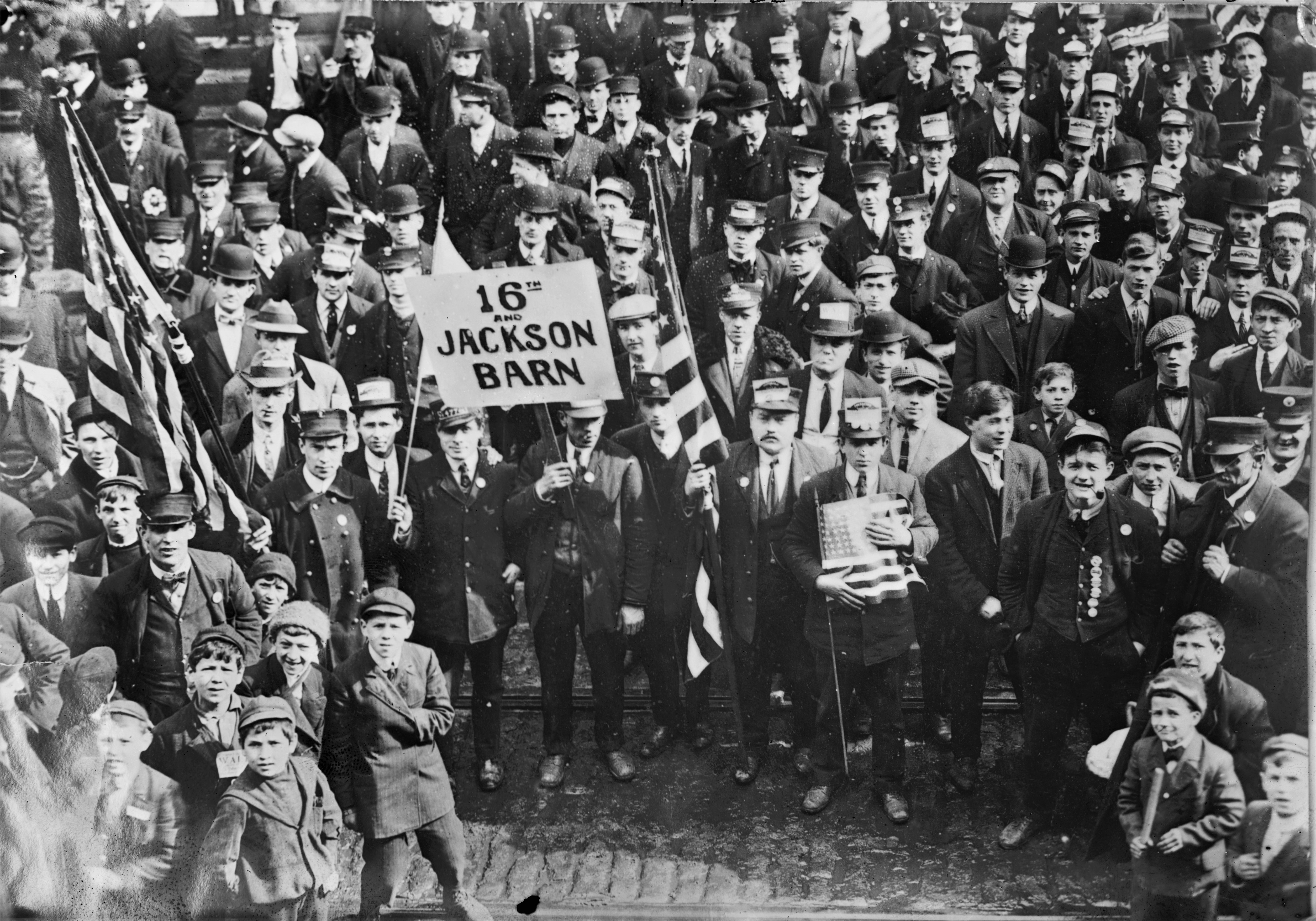
It is not believed that if trouble should start, the constabulary will be able to do much in the vast territory over which it has spread. The workmen in the big industries of the city are all a unit in sympathy with the strikers and have openly expressed themselves so. The most serious disturbance in the city today took place at Broad street and Spring Garden street when thousands of employes of the big Baldwin Locomotive Works were enjoying their lunch hour.
The men had gathered on the broad sidewalks surrounding the works and were laughing and chaffing among themselves when a squad of police from city hall attempted to herd them back into the shops. The street railway company had complained that several attacks had been made upon cars at this point.
Cops Start a Battle.
The police charged the crowd of workmen with drawn clubs and started to drive them in, but the men refused to be driven. A fight started immediately. The policemen were hemmed in so they could not use their clubs. One of them drew his revolver and fired, shooting William McIntee, a workman, in the leg. He was not seriously injured.
From that time on it was a battle with guns. The police fired into the air and the crowd fell back, laughing in their faces. The men retreated to the shelter of the locomotive works, and from the windows rained bolts, pieces of iron and bricks down on the police below. A dozen of the bluecoats were injured, but none of them seriously.
Superintendent of Police Taylor. frothing at the mouth, notified Manager Vauclain that hereafter policemen with shotguns would be on guard at that point and would shoot any workman making trouble.
The three girls’ high schools in the city have been closed for the week by the school authorities, but the boys’ schools and the grammar schools are still open. The argument has been presented that the boys are less able to get into trouble if in the school rooms than if running the streets. But if the strike and trouble continues next week it is possible all the schools in. the city, at least in the troubled districts, will be closed.
The street railway union has been warned by Pratt that it is in the most desperate position in its history. The Republican bosses, McNichol and Vare, fitted to Florida at the first grumblings of trouble. Senator Penrose stays in Washington uttering pleasant platitudes. There is no primary election which the strikers might use, as they did last June, as a bludgeon with which to hammer the P.R.T. into a compromise. In short, Pratt understands, as does about everybody else In Philadelphia. that it has been framed up for the company to win. In the Court of Quarter Sessions this afternoon. Ellwood Carr, a leader of the notorious “Calf Alley” gang, was sentenced to six years in prison for riot, assault and malicious mischief. Carr was arrested this morning for beating up an Italian passenger on a street car. He was immediately indicted and placed on trial. The jury found him guilty without leaving the box and sentence was immediately pronounced.
PDF of full issue: https://www.marxists.org/history/usa/pubs/the-new-york-call/1910/100224-newyorkcall-v03n055.pdf
 Revolution's Newsstand