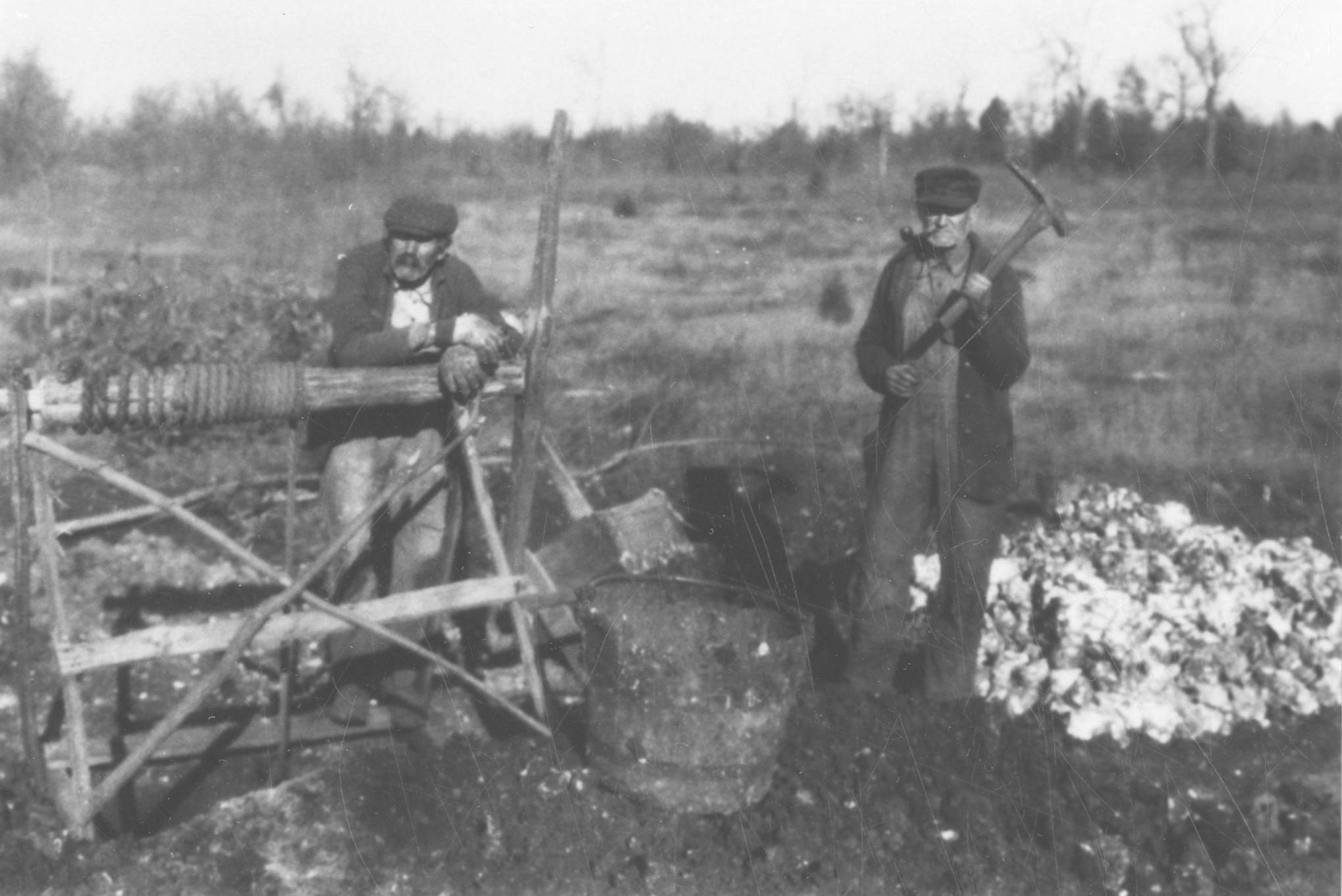
In the hills of Missouri, the earth is dug for tiff (baryte), a mineral used in many products and industrial processes, by the poorest of Ozark mountain folk who find dignity in banding together, organizing a union, and going on strike. The background to the fight from on the scene.
‘The Tiff Strikers Win’ by Karl Pretshold from New Masses. Vol. 16 No. 10. September 3, 1935.
Old Mines, Missouri.
SOME 3,500 to 4,000 tiff diggers who organized a union and conducted a strike marked by fearless militance and clear cool-headedness have just won a 60 percent pay increase for themselves. The first big walk-out of workers ever conducted in the Missouri Ozarks has ended in a smashing victory for the miners. Paid $2.50 a ton for digging tiff before the walk-out, the miners, by organizing, forced the companies to offer a dollar a ton increase before the strike was called. The dollar boost was rejected and the men went out demanding a $2 hoist in tonnage rates. After striking eighteen days they accepted the second offer of the operators—that of $1.50 a ton increase.
Since even with the increase the miners will only average $5 wages for a long, hard working week—instead of the $3 they had been averaging—the fact that the tiff miners have built a strong, militant union dominated by the rank and file is even more important than the pay boost victory. Just before the strike the miners organized locals of the American Workers Union. Under its banner they carried on their strike and during the strike decided to affiliate with the A.F. of L. organization for the metal-mining industry, the International Union of Mine, Mill and Smelter Workers.
Mass picketing and mass violation of an injunction issued to “protect” the National Pigment and Chemical Company, largest of the tiff concerns in this state, began even before the strike was called and continued twenty-four hours a day every day of the strike. Although the tiff miners are new to the business of striking and organization the strikers managed to dodge pitfalls and see through slick tricks which, in so many cases, have fooled and wrecked the strikes and organizations of workers’ groups with greater experience and age.
Well-disciplined, well-manned picket lines spotted the 200-odd square miles of Washington County. The woods around as well as the roads leading to strategic spots were patrolled, night and day, by men who “had orders” from the strike committee to let no one through unless he carried a pass from union headquarters. The pickets took their “orders” with deadly seriousness and if some tiff-mill official or straw boss tried to get by the lines without permission of headquarters the pickets “passed the buck” (“now we sure would catch hell from them fellows up at headquarters and you don’t want to get us into trouble.”) But behind the apparently harmless buck-passing was the very evident determination to take things into their own effective hands if anybody thought he would defy “our orders.”
When the sheriff of Washington County wanted to “go down the road” past a picket line the boys on the line were mighty pleased to let him through—if he had a properly signed pass. Reporters had to have and show their passes to get about the county. Even members of the strike committee of nine, known to every man on picket duty, couldn’t get by unless they exhibited written approval.
Picket lines, passes and that sort of workers’ “law and order” were in open defiance of an injunction issued by Judge E.M. Dearing at the request of the National Pigment Company before the strike started. It would, however, be stretching things to say the strikers “defied” the injunction—rather they “just sort of” ignored the whole matter. When the companies and the judge decided troops should be called in and appealed to Governor Park to order out the militia the strikers informed the governor they would raise their demands a dollar a ton as soon as the troops reached Washington County. The troops stayed at home, the mills didn’t operate and the dignity of the judge continued deflated.
For decades before the start of the strike the tiff miners have been the tenant farmers of the mining industry. Just as the “regular” farm organizations neglected the job of organizing the tenant farmers, so the “regular” unions have neglected—may never even have known about—the tiff miners. The economic set-up of tiff mining has many parallels to the “share cropping” system. Certainly the hunger-level existence of tiff miners is only comparable to that of one-crop tenant farmers.
“Tiff” (it is also called “bear teeth” by the miners because of its resemblance, in certain formations, to big, sharp teeth) is sulphate of barite. It is used chiefly in the manufacture of paint but has about two score other industrial applications. It is used both in the refining of and as an adulterant of sugar, in the making of fireworks and pottery, to give body to printers’ inks and in insecticides, for adding weight to rubber goods and linoleum, in tanning leather and the making of wall paper, as an ingredient in sealing wax and certain ropes, in poker chips and the making of glass.
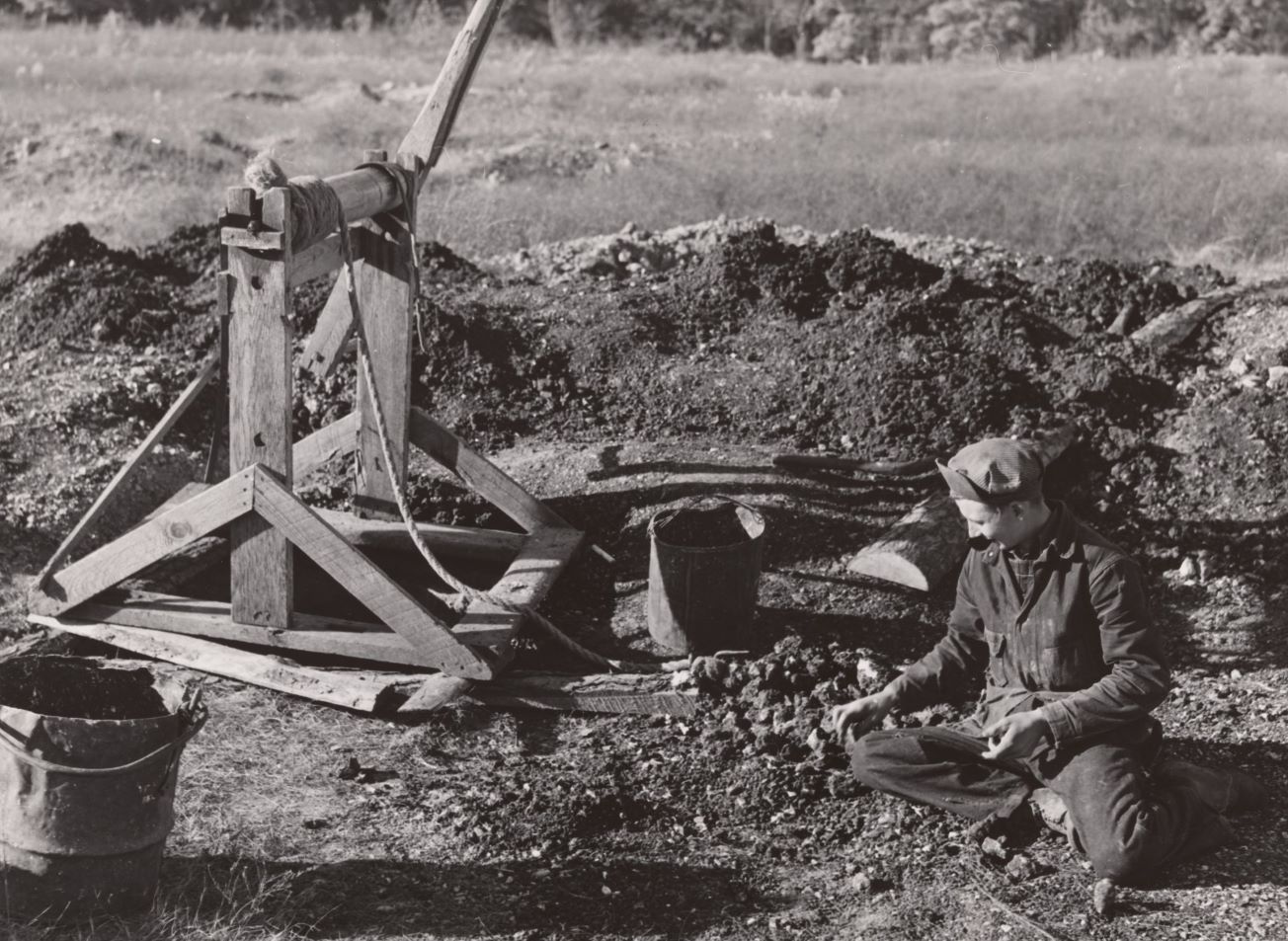
The men who dig the tiff are of French extraction. For just a bit over a hundred years Frenchmen and their descendants have mined lead and tiff in what are now Washington and St. Francois counties. The first explorers and prospectors of these foothills were a group of some 200 Frenchmen who came here in 1820 under the leadership of Philip Francis Renault and a M. LaMotte, “a man noted for his knowledge of minerals.” The party came equipped for silver mining. Instead of silver they found lead and tiff.
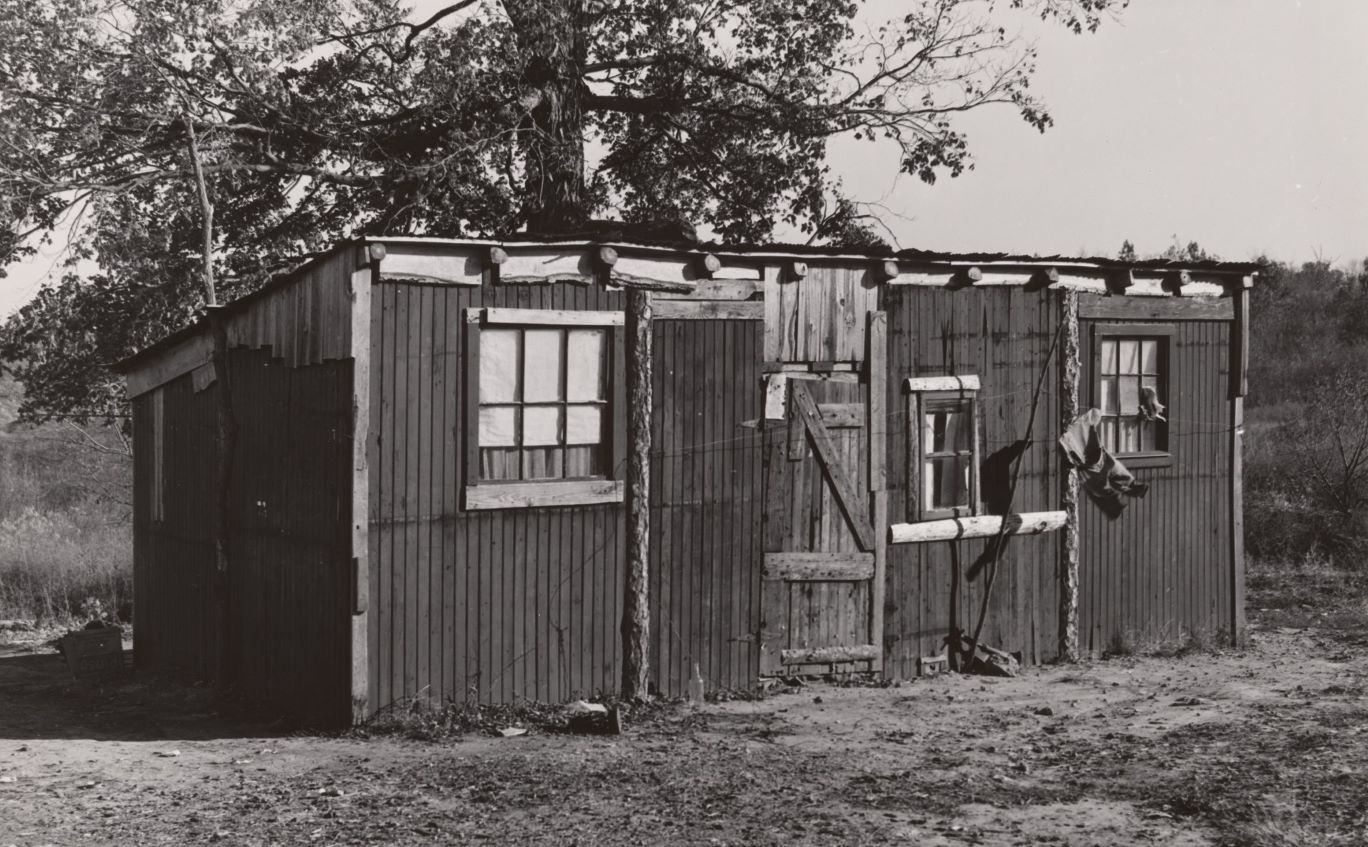
Most of the land now is owned by the tiff companies, the largest of which—and also the dominant —is the National Pigment and Chemical Company, a subsidiary of the great National Lead Company. The land, hilly, infertile, covered by second-growth scrub timber, is useless for farming. Little shacks—the miners called them “corn-crib homes”—are spotted over the company land. Scores of them are log cabins built decades ago. Others are clap-board affairs, more rickety and poorer shelters than the ancient cabins. In these company “houses” the miners live.
They are “permitted” to dig for tiff on such sections of company land as are “open.” Working either with a buddy, with a son or, in many cases, his wife, the miner will pick a spot where he can expect to “hit” tiff. Then he digs. Most of the land now open to mining has been worked and worked again in past decades. Sinking a shaft about five to six feet across, the miner will, if he is lucky, hit tiff somewhere between four and twelve feet down. But he may hit, instead, indications of an old shaft or an ancient drift. Then his labor of shaft sinking is lost; he just starts over again on a new spot. There are no regulation of hours or safety laws. No compensation for “dead work.” The miner has no boss—no boss but hunger.
If the miner hits tiff, it may be just chunks scattered through clay mineral formations or it may be a vein. The veins constitute the “pay dirt.” If a vein is hit a miner follows it back into the ground with a “drift.” Working on hands and knees, he digs out the tiff and hoists it to the top where it must be left to “dry”—that is for the clay which encrusts it to dry out. Then the clay must be cleared away and all foreign minerals knocked off with pick or hammer. In winter storms may come up and fill the shaft with snow; in fall and spring storms which wash shafts and drifts to ruin are frequent. All such misfortunes cost the miner dear in delay, cost the company nothing. After the tiff is cleaned of earth and unwanted minerals, it is loaded and hauled to the tiff mills, where it is weighed and payment made. There are, of course, no checkweighmen to watch that scales are not “doctored.”
The company pays for hauling on a basis of distance from mine to mill. Some miners own: their own teams and haul their own tiff while other workers devote all their time to hauling on a tonnage basis. Wives often help their husbands by working as haulers. Children are useful for going through the clay as it is tossed to the top to rescue small chunks of tiff. Hours of work by a child may add a cent or two to the returns of the family.
That’s the background. The tiff strikers, who talked about themselves and their lives with easy frankness and of their strike with pleased pride, furnished the action. Men in overalls and blue work shirts, young fellows in “regular” pants and white shirts open to the second button at the neck, boys dressed in the clothes they wear while digging (because they have no others) and frolicking kids sat “hunkered down” or lay in cool comfort under the trees around strike headquarters. The headquarters used to be a roadside filling station, lunch room and small dance hall. The strikers were waiting assignment to picket lines, or had “come in for news” or to make reports or ask help.
The atmosphere was as sociable as that of a school picnic or a family reunion. The idea of “The New Masses, a workers’ magazine, printed just to tell about the struggles of the workers, all kinds of workers, all over the world” seemed mighty attractive.
As the men told their stories about work and wages before the strike began, it was easy to see they had, each of them, been thinking hard about their lives, their work and what work and living meant. The luxury of “loafing,” the social contacts of the strike, the comradeship which came with “belonging to the union” were vividly precious things. These folks were enjoying themselves, savoring a new richness in life. Families that had known too much of nagging and quarrelsomeness which comes with overwork and worry were drawn together in understanding.
Young married couples who had struggled fiercely to earn enough to keep off relief were touched with tenderness toward each other. Lads were looking at the girls and in their eyes was the freshness of new dreams.
But tenderness and new dreams were not in the stories they told. They were stark stories of constant driving work which brought so little return that almost every family had been forced to turn to relief to maintain a two-meal-a-day living standard. And the meals were meager.
“Everybody’s been on relief ever since relief started and working too,” miners and their wives would explain. “You had to keep mining or the relief people wouldn’t give you any relief and they gave little enough even so.”
Eugene Boyer has been digging tiff for forty years. Ever since he was a kid of twelve. Born and reared right here in Washington County, he speaks with a trace of French accent. For months before the strike he earned $1.50 and $2 a week as a tiff miner. He asked relief. For the three weeks before the strike he got a total of $4 from the relief office.
Boyer tried to be thrifty. He “made garden.” In spite of poor soil. Worked all day at mining and then at night lighted a lantern and worked in his garden. He asked the mill boss for a bit more land for the garden.
“To hell with you,” the mill boss told him. “You are a miner. Stick to your digging and don’t try to be a farmer on company land. That ain’t why the company got the land. Dig tiff.”
The same story told as endlessly as one would listen; tales of struggle and hunger become statistics. The women talked about the children and school. They want the children to “get some schooling.” But hunger and the need of clothing constantly loomed to defeat them. Scarcely a tiff-mining family in Washington could have been found where father, mother, children each had one complete outfit of clothing. While one kid went to school others had to stay home, semi-naked. Stockings, even in winter, were luxuries. Last winter children by the score went to school with only small pieces of corn bread and a raw onion each as lunch.
Then demands were made by the miners and “the relief people” started serving lunches in the schools.
It was really as a movement for increased relief that the recent strike started. The American Workers’ Union is an organization of the unemployed of Missouri. Its main strength is in St. Louis, about 80 miles to the north and east of here. It is one of the organizations through which the United Front of St. Louis Communists and Socialists functions.
Organizers of the A.W.U. came into these parts and organized relief demonstrations. The demonstrations were effective. Relief allowances were boosted as much as two and three hundred percent. While the strike was on, Washington County was the only county in the state which didn’t have its allotment from the state relief administration slashed. It was boosted. The “relief people” didn’t want to try fooling around cutting budgets of workers who were already out on strike, picketing, feeling their strength and power.
All the time they were working on the relief problem A.W.U. organizers were learning about the situation in the tiff industry. The lads who had turned out for relief demonstrations were, it was apparent, fine organization material. Why not shift the power of the organization to the job of getting better pay?
While A.W.U. leaders were still considering that problem, one tiff mill boss refused to accept several loads of tiff from the men who had mined it. The loads were “dumped.” Too “dirty,” said the mill boss.
The mill boss was a new man to Washington county. He had come from over in the St. Francois County lead belt. He was going to show “these damn Frenchies” how to dig tiff. The “Frenchies,” by then well leavened with A.W.U. members, weren’t taking any of that stuff. They held meetings. They complained to the company. They threatened to do something.
Another company official came around, looked at the dumped tiff and said it was clean enough for any mill. But the miners were riled up. Thoroughly. They continued holding meetings. More and more joined up in the A.W.U. Talk of organization, union, higher pay, strike swept across the county.
Demands for a raise of $2 a ton for mining tiff were drawn up. They were served on the National Pigment and other companies. The companies stalled. The miners demanded action. The company would give its answer later.
But the companies have large reserve supplies of tiff stored on dumps at various spots around the county. The miners demanded that while the company was “considering,” it should not move any of this stored tiff. The National Pigment got its injunction. They tried to move some stored tiff to the mills. The miners, not yet officially on strike, stopped that in spite of the injunction.
National Pigment officials who had promised to meet with the men on a certain day failed to show up to answer the miners’ demands. They were busy trying to get reserve tiff to the mills. So the miners struck. The piles of reserve tiff were already being picketed. Lines were thrown around the mills and lads who looked as if they knew what to do if company officials tried any funny business halted all cars headed for the mills. They just wanted to see the passes. The sheriff tried it too. But he didn’t get farther than did the company men. The mill workers, they were paid thirty cents an hour, came out too. They joined the picket lines.
A.W.U. officers told the strikers to continue getting relief. They got it.
The companies howled for the militia. The strikers announced they would raise the ante of their demands if troops came; the labor movement of Missouri gasped, then grinned and workers by the thousands all over the state growled: “By Jesus, those guys got sense; that’s the thing to do—don’t take it laying down—smack back.” The tiff companies which had turned the heat on the governor turned it off again.
While they were trying to move tiff from the reserve supplies the companies had, in an evident attempt to divert attention from their shifty effort to trick the miners, offered to raise the pay rate $1 a ton. The miners turned the offer down, flat.
A commissary to feed the pickets was set up in what had been the kitchen of the filling-station restaurant. A.W.U. branch unions and other workers’ groups in St. Louis donated food. It was prepared in the commissary and the strikers knew they would get fed if they picketed. That many a lad knew he could fill his belly while he served his fellows didn’t interfere with its effectiveness on picket duty.
Square meals meant cool heads, solid morale.
Then William F. White, federal labor conciliator, came into the county trying to “conciliate” the strike. He went around to the bosses. Talked to them, listened to their tales. Finally, at long last, he turned up at strike headquarters. With a tale of having driven more than 500 miles around the county, trying to find somebody who could talk for the strikers.
Newspaper men managed ¢o find strike headquarters without any trouble. But not Mr. White, the conciliator.
The A.W.U. got out a circular telling in frank, open, simple language the role such “conciliators” play in strikes. Mr. White wasn’t very useful to the bosses.
Then at a big county-wide meeting called to consider affiliation of the A.W.U. locals with the A.F. of L., the National Pigment distributed circulars saying they had “decided to open their…places of business” next day and offering $1.50 tonnage increase if they “could resume normal operations without interference from anyone.” The strike committee had told Mr. White that they were willing to deal with the companies. The circular offer was an attempt by the companies to ignore the miners’ organization.
Without any fuss or fumbling, the miners voted to affiliate with the A.F. of L. and turn down the operators’ offer since it had not been made direct. The “places of business” didn’t operate next day. The pickets were on duty. The companies went trailing after Governor Park with new demands for troops. The miners didn’t even repeat their threat to raise their demands if troops came in. They knew the new plea for troops was the bunk; they treated it as the bunk.
Then, every dodge they had attempted met with quick, cool thinking or militant action; the companies backed down. They sent their officials to a mass meeting of the strikers to make their $1.50 offer direct to the men. The men voted to accept. There is in the settlement no recognition of the new union. But, the miners feel, there is, in the way the companies were forced to submit their offer, a recognition of the power of the workers. The mechanics of affiliation with the Mine, Mill and Smelter Workers’ Union has to be handled. When that is taken care of, demands for recognition of the union can be handled.
Meanwhile the miners are very conscious, and very proud, of the fact that it was their own action, with rank-and-file leadership and domination, which has brought them their better pay.
Unhampered by the A.F. of L. high officialdom which worried about “the industry” and “the problems of the companies” and that sort of thing the tiff strikers were forced to depend directly and solely on themselves. And self dependence meant dependence on mass action. With the rank and file dominating and leading, and furnishing the brains, the strikers were able to outsmart the bosses every time the bosses tried some slick trick. They can do it again if some new dodge is attempted. They also know why they were able to do it, what will be required if they are forced to act again. The miners have learned more from the strike than have the bosses. They are ready for any next move if any next move is attempted.
The New Masses was the continuation of Workers Monthly which began publishing in 1924 as a merger of the ‘Liberator’, the Trade Union Educational League magazine ‘Labor Herald’, and Friends of Soviet Russia’s monthly ‘Soviet Russia Pictorial’ as an explicitly Communist Party publication, but drawing in a wide range of contributors and sympathizers. In 1927 Workers Monthly ceased and The New Masses began. A major left cultural magazine of the late 1920s and early 1940s, the early editors of The New Masses included Hugo Gellert, John F. Sloan, Max Eastman, Mike Gold, and Joseph Freeman. Writers included William Carlos Williams, Theodore Dreiser, John Dos Passos, Upton Sinclair, Richard Wright, Ralph Ellison, Dorothy Parker, Dorothy Day, John Breecher, Langston Hughes, Eugene O’Neill, Rex Stout and Ernest Hemingway. Artists included Hugo Gellert, Stuart Davis, Boardman Robinson, Wanda Gag, William Gropper and Otto Soglow. Over time, the New Masses became narrower politically and the articles more commentary than comment. However, particularly in it first years, New Masses was the epitome of the era’s finest revolutionary cultural and artistic traditions.
PDF of full issue: https://www.marxists.org/history/usa/pubs/new-masses/1935/v16n10-sep-03-1935-NM.pdf
 Revolution's Newsstand