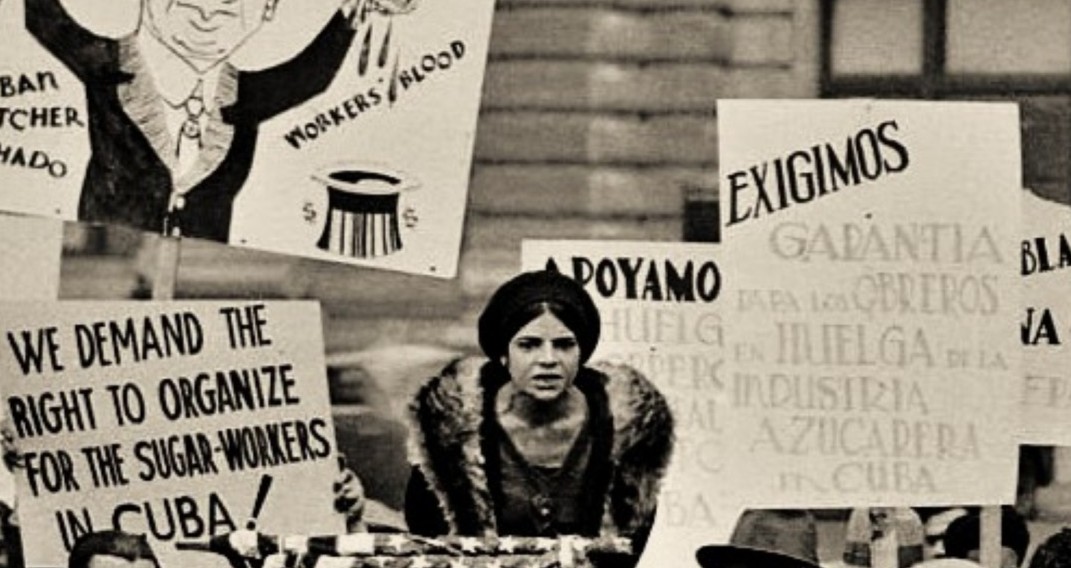
The terrible Old Days when the writ of the U.S. ruled Cuba.
‘Under the Wall Street-Machado Regime in Cuba’ by Albert Moreau from International Press Correspondence. Vol. 10 No. 12. March 6, 1930.
The growing economic crisis in Cuba which is bringing the proletariat and peasantry to the verge of starvation is rapidly shaking the very foundation of the “stable” Wall Street Machado Government.
Since the forcible American occupation in 1898, the history of the Island never recorded such a widespread misery and steady lowering of the living standards of the working masses. The lackey Government answers with ruthless suppression and assassination the discontent and rebellious mood of the workers.
The production of sugar, Cuba’s life-blood, is undergoing a severe crisis the solution of which the American financiers are unable to find. Sugar, Cuba’s economic barometer, was sold in June 1929 at 1.59 cents per pound, a price which compared to that of the panic year of 1901/1902 1.57 cents per pound clearly indicates the seriousness of the situation. Of the 1,250,000,000 Dollars invested by American financiers in the Island, 850,000,000 Dollars is thought to be invested in sugar. Two thirds of Cuban sugar is imported in the United States. But the imports from the duty-free American possessions of Philippines, Hawaii and Porto Rico have of late considerably restricted the home market. The restriction of the United States market compelled the Sugar Barons to intensify their drive against the colons and the cane plantation workers. The law enacted by President Machado early in 1928 prohibits the “independent colons” to cut their canes. The colons, unable to pay their mortages to the big landowners, were forced to abandon the rented properties to the rapacious trusts. The ruined colons swelled the army of the exploited workers. Simultaneously, the workers were forced to accept a wage-cut. Unemployment is steadily increasing. More than 300,000 jobless are today in a desperate situation. Consequently the consuming power of the workers has been steadily lowered, especially since 1927 when Cuba was the leading Latin-American market for United States products, now being listed as the eleventh.
The United States financial magnates, through the State Department have strongly dug their claws deep into the flesh of the bleeding oppressed workers and peasants in treaty-bound subjugation of the economic and political life of the Island. The Platt Amendment enforced upon it in March 1901 binds the country to the economic chariot of Wall Street. It prohibits the contraction of public debts with any country other than the United States. It prohibits the entering into any treaty with foreign powers other than the United States for military or naval purposes. The Platt Amendment gives the right to the American Government to intervene for the preservation of Cuban independence, the maintenance of a Government adequate for the protection of life, property and individual liberty. So openly aggressive has been the attitude of the Washington Government towards the oppressed masses of Cuba that no better illustration could be offered than the shameless imperialistic declaration of Ella Root. Secretary of War in the Roosevelt Cabinet:
“Cuba has acquiesced in our right to say that she shall not put herself in the hands of any other power, whatever her necessities, and in our right to insist upon the Maintenance of free and orderly Government Throughout her limits. However impoverished and desperate may be her People.” (Emphasis ours.)
Acting for the big capitalists, the State Department is empowered to crush any revolutionary movement which aims at the overthrow of the Government which so faithfully serves their interests. The policy of American marine invasion of Cuba in case of a revolution, solely aims at the complete subjugation of the workers and peasants as the latter are the only forces capable to secure the independence of Cuba from American Imperialism and its tyrant tools.
Machado’s rival group, the Union Nacionalista, again and again evoked the Platt Amendment and appealed to the State Department for intervention. The bourgeois elements of the Union Nacionalista sought to substitute Machado’s regime by their own, promising faithfully to carry out the will of the American trusts. They are backed by individual American capitalists whose interests in Cuba collide with those of the big enterprises and the National City Bank. In reply to Mr. Barlow’s appeal, an American capitalist, the Foreign Relations Committee headed by its chairman Mr. Borah, conducted a fake investigation. President Machado, with the endorsement of the American Chamber of Commerce of Cuba, the National City Bank and the Bethlehem Steel Corporation, was persecuting the leaders of the labour and the communist movements in October 1929, just at the time of the hearings in the Foreign Relations Committee. In order to stifle the reports from Cuba on the fascist regime of deportations and assassinations, Secretary of State Stimson appeared secretly before the Committee and officially discounted “the alleged rumors against Machado’s regime of terror”. Thereupon, Mr. Borah promised the adjustment of Mr. Barlow’s claims against the Cuban Government, thus sanctioning the continuation of suppression of the working class movements by Machado.
So horrid has been the systematic suppression of the militant workers and peasants organisations that Mr. William Green, President of the American Federation of Labour could not remain indifferent to the repeated protests of the Latin-American workers. He ordered an investigation which led to the endorsement of Machado’s Government of “progress and order”.
Wall Street installed Machado as president of Cuba in 1924 with a Carte blanche to liquidate all opposition to American Imperialism. No other lackey could so successfully satisfy the masters as he did in a period of four years. At the expiration of his period of residency, in 1928, Machado put himself as President for another six years after crushing all opposition to his candidacy. His crimes, since his advent to power are notorious. He drove the Communist Party to operate illegally. One by one, the communist leaders and militant workers who had an unquestionable influence in the trade union organisations. mysteriously disappeared or were killed in cold-blood. His black hand extended, out of Cuba reaching Mexico where Julio A. Mella, leader of the Communist Party, was murdered by his mercenary agents.
In spite of this regime of terror, the workers and peasants of Cuba have not lost their militant spirit. All attempts to substitute the militant revolutionary unions by reformist or Government fascist unions have completely failed. The recent strikes of tobacco workers, the strike of the millinery workers and the mass political demonstrations showed an open defiance of the workers to the dictatorship. The working youth is now particularly active in its open attack on the fascist reign of terror.
The Communist Party of Cuba has not lost its contact with the toiling masses. On the contrary, more than ever, the militant unions find in the Communist Party an active supporter of their struggles against fascism and American Imperialism. The economic crisis becoming deeper and deeper every day has increased the militancy of the workers and peasants. The future class battles resulting from this crisis will undoubtedly bring the proletarian revolution on the order of the day.
International Press Correspondence, widely known as”Inprecorr” was published by the Executive Committee of the Communist International (ECCI) regularly in German and English, occasionally in many other languages, beginning in 1921 and lasting in English until 1938. Inprecorr’s role was to supply translated articles to the English-speaking press of the International from the Comintern’s different sections, as well as news and statements from the ECCI. Many ‘Daily Worker’ and ‘Communist’ articles originated in Inprecorr, and it also published articles by American comrades for use in other countries. It was published at least weekly, and often thrice weekly.
PDF of full issue: https://www.marxists.org/history/international/comintern/inprecor/1930/v10n12-mar-06-1930-inprecor-Virginia.pdf
 Revolution's Newsstand