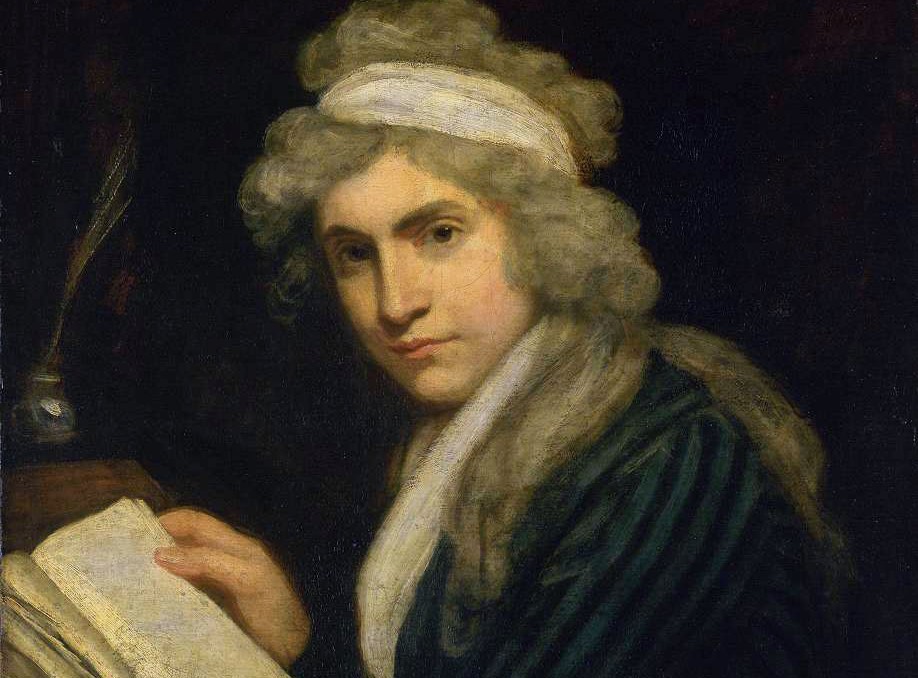
A central figure for the first generation of Socialist Feminists was from the eighteenth century, the Age of Revolution’s Mary Wollstonecraft, mother of Mary Shelley.
‘Mary Wollstonecraft–Pioneer Suffragist’ from Progressive Woman. Vol. 2 No. 22. March, 1909.
The pioneer has always been the salt of the earth. He who first turned aside from the calf path of conventionality and established order has made possible the climb from savagery to modern civilization.
When women had been held for many, many centuries in a state of almost inhuman restrictions because of their sex, held by all the laws sacred to custom and precedence, a young English woman stepped out of the beaten path, and said it was all wrong. She had been reading the philosophy of Rousseau, and the doctrine of abstract rights, which was in every thinker’s mouth, but which did not include women, awoke in her a spirit of protest, and brought forth a book–the first of its kind.
When Mary Wollstonecraft wrote “Vindication of the Rights of Woman” in 1792, it was considered not a very nice thing for a woman to write even a “nice” book. Any form of literary, or other work, which necessitated the comradeship of the brain, was bad form for really nice. women, in Mary’s day. But to write the Vindication was to bring down the scorn and condemnation of a horror-stricken public. A public that had not known such indelicacy in all its civilized existence.
It denounced her as a social outcast. None less than Horace Walpole called her “a hyena in petticoats, a philosophising serpent.” And yet her teaching was conservative, compared to much we hear now-a-days regarding woman and her rights.
Mary Wollstonecraft’s early home life was a hard, bitter experience. Her father drank, spent his money for selfish pleasures, and beat his wife. That lady, worn out with hardships, died early and left six young children to the tender mercies of a drunken brute. At sixteen Mary met Fanny Blood, a young girl her own age, and one whose family life was about the same as Mary’s. Fanny was already achieving some success in literary work, and Mary, taking a passionate fancy to her, determined to make a literary career for herself.
At nineteen she became a lady’s maid. Later she developed into a governess, and for nine years taught either in a private school, or in a family. All the time she had dependent upon her most of her brothers and sisters. This and earlier experiences convinced her that there was little reason to believe with Rousseau that woman’s sole duty was to please. Bound to support, not only herself, but others, among them those of the male persuasion, from her very girlhood, and hindered upon every hand by the unwise and unkind restrictions which were thrown about women of the time, it is little wonder that she finally evolved her vindication.
After having issued a pamphlet on “Thoughts on the Education of Daughters,” for which she received ten guineas–about $50–Mary went to London, became a contributor to the Analytical Review, and acted as translator for the editor. She lived poorly for some time in a mean street, and with few comforts. This because she had to send much of her earnings to dependents. But great folks found her, Tallyrand and others, and the artist, Opie, painted her portrait for the national gallery. And a beautiful portrait it is. Southy said of her that her face was the best, infinitely the best, of all the lions or literati he had seen in London.
Soon after her production of the Vindication she went to France, and here met the tragedy of her life, in the person of Captain Gilbert Imley. This young American she loved with all the passion of her nature, a love which for a time was reciprocated. In France, at that time, it was a difficult matter to arrange a legal ceremony, making them man and wife, and Mary had evolved an idea, through observation and study, that a ceremony of any kind was unessential to true marriage. She discarded the ceremony, and went to live with Imley as his wife. Wonderously happy was she for some time. this happiness one may read in her published letters. Also of the misery that followed, when she discovered coolness and even infidelity in the man she had trusted. A daughter, Fanny, was born to the pair. Separation followed, and later a marriage with Godwin, a clever writer, and a defender of “pure reason.” To them was born Mary Godwin, who became the wife of Shelley. From this bed of travail she never rose, for death claimed her some ten days later. At the height of her power she was cut off, but she left the one book which has carried her fame through the century that followed. There were many others, and they were not condemned, but they died, while that which was condemned lived.
In the introduction to “Vindication of the Rights of Woman,” Mary Wollstonecraft says: “My own sex, I hope, will excuse me if I treat them like rational creatures instead of flattering their fascinating graces, and viewing them as if they were in a state of perpetual childhood, unable to stand alone.” Later on she says: “’Educate women like men,’ says Rousseau, ‘and the more they resemble our sex the less power they will have over us.’ This is the very point I am at. I do not wish them to have power over men, but over themselves.”
Education was the strong point in Mary’s philosophy. Everything depended upon that. Women were slaves, sickly, puny, incompetent, contradictory, because of what they were taught. She believed also in woman’s economic independence. But we who live one hundred years later know that these things–proper teaching, and economic independence, could come only with the invention and development of machinery. Mary was one whose vision outran her time. She saw what could be accomplished only after a long century of material struggle. But she was a great soul, for all that, and her Vindication should be in the library of every liberty-loving man and woman.
The Socialist Woman was a monthly magazine edited by Josephine Conger-Kaneko from 1907 with this aim: “The Socialist Woman exists for the sole purpose of bringing women into touch with the Socialist idea. We intend to make this paper a forum for the discussion of problems that lie closest to women’s lives, from the Socialist standpoint”. In 1908, Conger-Kaneko and her husband Japanese socialist Kiichi Kaneko moved to Girard, Kansas home of Appeal to Reason, which would print Socialist Woman. In 1909 it was renamed The Progressive Woman, and The Coming Nation in 1913. Its contributors included Socialist Party activist Kate Richards O’Hare, Alice Stone Blackwell, Eugene V. Debs, Ella Wheeler Wilcox, and others. A treat of the journal was the For Kiddies in Socialist Homes column by Elizabeth Vincent.The Progressive Woman lasted until 1916.
PDF of original issue: https://www.marxists.org/history/usa/pubs/socialist-woman/090300-progressivewoman-v2w22.pdf
 Revolution's Newsstand