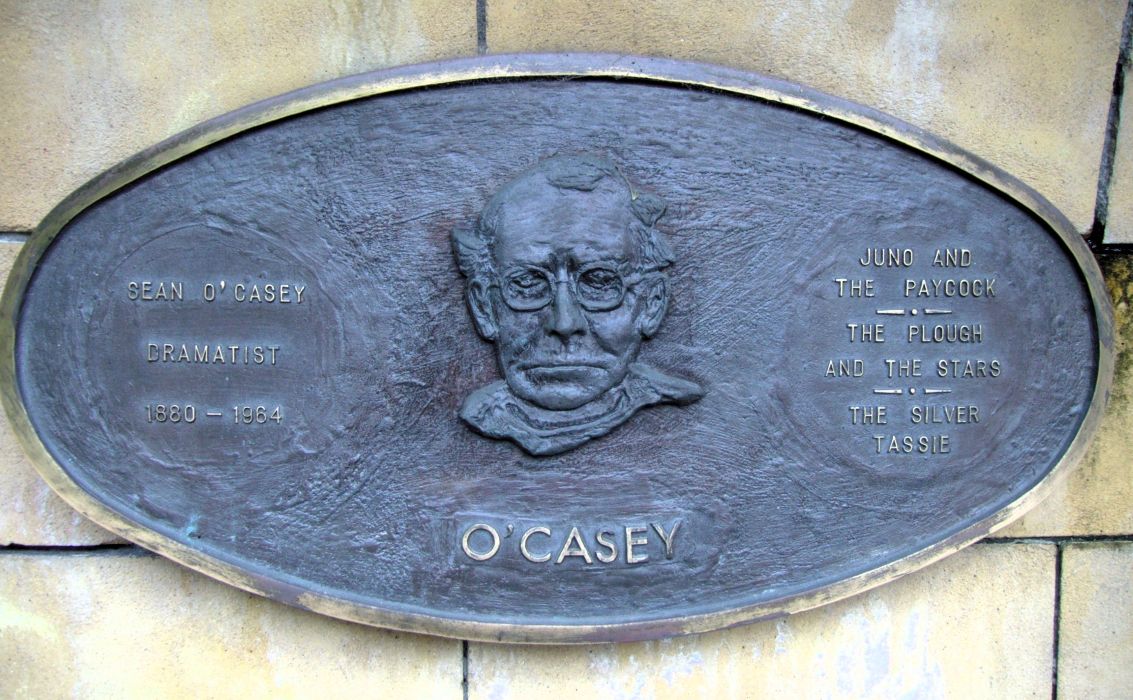
An essay full of observations on the past and present of Irish language and literature from one of 20th century Ireland’s most important leftist of letters, the dramatist Sean O’Casey.
‘Literature in Ireland’ by Sean O’Casey from International Literature. No. 11. 1939.
In this essay, written last summer at the request of the editors of International Literature, Sean O’Casey treats only certain phenomena in Irish literature and literary history; much has been left out by the author; and a great deal has remained scarcely touched. We do not agree with everything the author has to say. His interpretation of Yeats, for instance, is interestingly written but seems much too idealizing; his evaluation of James Joyce suffers because of the complete absence of a critical approach. Despite all this, Sean O’Casey’s observations on the literature of his people are doubtless of great significance and interest to our readers.—Ed.
***
To write about literature in Ireland is a complex job. At present, and for some time past, Irish literature has been the core of several controversies. What is and what is not Irish literature is dividing the country into two clever camps. There are those, few in number, but loud-voiced and a little bitter, who claim that only that is of value in Irish prose and poetry which is written in the Gaelic language, the national tongue of the Irish people; that all the works, written in English, be they ever so great or so beautiful, fail, by any true test, to form part of Ireland’s literary heritage. There is a good deal to be said for those who hold this view, that Irish literature can only be Irish when it is written out of the heart and mind of the Irish, that is, the Gaelic language. The weak point is that the English language is still the tongue of the vast majority of the people. The Irish language was, of course, the language of the people for many centuries, and, even today, the idiom of that language is heard and felt in the English at present spoken by the people. For many centuries the Irish language was the tongue in which the people said their say, sighed their sorrows, bought and sold in the market place, sang their songs, prayed to their gods, blessed their friends, and cursed their enemies. In this language were expressed all the sorrows and most of the glories of the older ages in Ireland; and the language in the works of the poets and scribes was thrusting itself forward to a fuller strength and higher beauty, when the first English invasion interfered, and started the long drawn-out bloody conquest of the people. As soon as the English had the power, they began to put an untidy end to Gaelic scholarship and to hunt the poets from their high places, hanging them, if they couldn’t tame them; to dragoon the people, having first, of course, robbed them of their patrimony. From the day this alien power settled itself to rule Ireland from Dublin Castle, every effort was made to destroy the language, customs, and characteristics of the people, but it was only about one hundred and fifty years ago that the language ceased to be the language of the majority of the people, and it was never entirely lost.
In the days of long ago, pre-christian times, when Ireland was probably the center of a Celtic civilization stretching from her own shores to the shores of the Black Sea (Dr. Dwyer Joyce, in his Irish Names of Places, mentions the close connection between the Irish and the Georgians), many things were written, but because of the destructive invasions of the English and the Danes, all or mostly all were lost though it is thought, many lie scattered about in the world unhonored and unknown.
The present Irish Government are doing something, in compilation and translation, to bring before us, through the mass of manuscripts left, the light of other days, for Ireland never gave way before the denationalizing influences of the Roman Empire; and, even when Christianity came, Ireland for many years was too far from Rome to be dominated by her, the national language remained practically untouched, and it flourished in the literature that then arose. It is, indeed, thought that it was the Irish influence in Northumberland, England, that taught and encouraged the Anglian scribes to preserve and cultivate the national literature.
The Danes, in their various forays, set fire to anything that would burn, and thousands of manuscripts perished in the flames. So terrible was the fear of the Irish before these invaders, due, I think, to the softening of the martial fiber of the Irish by their new Christian practice of prayer and fasting, that a poet, thinking of the terror, wrote:
Bitter is the wind tonight,
It tosses the ocean’s white hair;
Tonight I fear not the fierce warriors of Norway
Coursing on the Irish Sea.
Far better the spirit of
Ye people of great Murrough,
Against which neither forest nor wild moor prevails,
Ye that before your Norse battlestandards of sun-bright satin
Have routed the heathen hordes as far as the Boyne!
Blood breaks like snowflakes from their noses
As they flee across Aughty in the late evening.
When the invasions broke all patience down, the whole country united and finally defeated the Danes in a great battle on the outskirts of Dublin.
It is often thought that we Irish are a dreamy people (we, of course, have our dreams), and that the fairy atmosphere, as set down in so many stories and sayings about us, and the forawhile cult what was called The Celtic Twilight, is redolent of the whimsical, mystical nature of the Irish. But many of the things written by the Celt show that he was a practical thinker as well as one who had a vivid imagination. For instance, the Triads, typical of one form of Irish thought, show how wise and practical the Gael or Celt could be. Here are a few:
Three slender things that best support the world: The slender stream of milk from the cow’s dug into the pail;
The slender blade of green corn upon the ground;
The slender thread over the hand of a skilled woman.
Three glories of a gathering: A beautiful wife; a good horse; a swift hound.
Three laughing-stocks of the world: An angry man; a jealous man; a niggard.
Three things that constitute a physician: a complete cure; leaving no blemish behind; a painless examination.
Three candles that illumine every darkness: Truth, nature, knowledge.
Three coffers whose depth is not known: The coffers of a chieftain; of the church; of a privileged poet. (Today we have the capitalist, the church—as ever—and the venal best-seller. S.O.)
But, on the whole, apart from some fierce songs by some fierce poet, and many lovely love songs, Irish literature, after the conquest of Christianity, became a thing of patience, penance, and prayer, and weakened the Irish terribly in the fight to regain their own again. As, for instance, in this song called Eve’s Lament, showing Christianity’s strange unnatural dread of woman:
I am Eve, great Adam’s wife,
’Tis I that outraged Jesus, of old;
‘Tis I that robbed my children of heaven,
By rights, ’tis I should have gone upon the cross.
There would be no ice in any place,
There would be no glistening windy winter,
There would be no hell, there would be no sorrow,
There would be no fear, if it were not for me.
And many more of this kind of ringing of church bells, so mocked by Oisin the great Fenian poet in his argument with St. Patrick.
After the defeat of the Confederation of Killkenny, the flight of the Earls, owing to party ambitions, personal greed, and religious nonsense, Ireland’s fetters were set firmer on her feet. Then Cromwell came blasting away through the country; and, after him, the flying Stuarts whose cause the Irish stood by, the common foolishly following a royal name and a royal coward, Sheamus a chaca—Sheamus the shit as he was afterwards called by the people who suffered in his cause. The fate of the people grew worse, and anyone who had anything had to conform to the law and established religion, or lose all or the little they had. The literature is now: full of hopes for the restoration of the Jacobite line; visions of a beautiful girl, symbolical of Ireland, telling her woes, often ending in the wish fulfillment form of the overthrow of Ireland’s foes, and her own rise to wealth, comfort, security, and jubilation. We have the lovely lyrical strains of Eoghain O’Ruaidh O’Suilleabhain, the vigorous chants of Aodhagain O’Rathaille, and the not so vigorous, but more gentle (though he could be fierce enough at times) verse of Sean Clarac O’Domhnaill. In Ata an Speur’sa Cuallacht, the vasty sky’s in sore affliction and a windswept downpour’s falling ceaselessly, O’Domhnaill paints a vision in which he sees despair, misery, and want change to glory, with wine and corn and dancing in plenty for all in Ireland. So it went on in most of what was written down by the impoverished and hunted poets, a never-ending hope for the future, and an endless curse on the foreigner holding down their country. But the English tongue kept getting a firmer grip on the people pushed hard out of the fair places in the land to the parts where the land gave little, and the life was stern. There had ceased to be any law for them; they were outcasts and beggars, living on less than husks in their own land; but the clergy still preached patience and the love of god.
We come to later times when the English find the language they forced on the people vetting used against themselves in the writings and ballads of the men of “‘48” a stream of song that dried up only when the present President of Ireland, Eamonn De Valera, gave the signal that ended the civil war. Although many of the old Gaelic poets had written fierce satires about individual clerics, they were narrow and isolated. Now began a stiff challenge to the commonplace and tearappealing cry for patience sent up by the crowd following fast on the heels of the clergy, all of them looking sturdy and each of them feeling faint.
On this scene of processional patience, burst the patriotic ballads of Thomas Davis and the fiery denunciations of John Mitchel in a paper called The Nation read by all who could read, and listened to by all who could not. In the midst of famine and disease, took place the scene described by Mitchel: “a ‘model’ communal kitchen was turned into a gala, one of the ghastliest galas ever exhibited under the sun. There in the Esplanade, before the Royal barracks, was erected the national model soup kitchen, gaily bedizened, laurelled, and bannered, and fair to see; and in and out all around, sauntered parties of our supercilious second hand ‘better classes’ of the Castle offices—fed on superior rations at the people’s expense—and bevies of fair dames and military officers, braided with public braid and padded with public padding; and there, too, were the pale and piteous ranks of model paupers, broken tradesmen, ruined farmers, destitute seamstresses, ranged at a respectful distance, till the genteel persons had duly inspected the arrangements, and then marched by the police to the places alloted them, where they were to feed on the meager diet with chained spoons—to show the gentry how the pauper spirit could be broken, and the pauper appetite could gulp down its bitter bread, and bitterer shame and wrath together.”
Mitchel’s voice rang out from one end of the land to the other in The Nation, but the people were too soaked with the advice to submit and be patient to hear the cry that “the railways were better dispensed with for a while than allowed to become a means of transport for invading troops. Troops transported by rail might be conveniently met with in many? places. Not even Hpfer and his Tyrolese could have desired a deadlier ambush than a good deep railway cutting. A few hundred men could lie in wait with masses of rocks and trunks of trees ready to roll down; and a train or two advancing with a regiment of infantry, and the engine panting nearer and nearer till its polished name may nearly be read: Now, in the name of the Father, and of the Son, and of the Holy Ghost!…Now!”
This sort of literature didn’t go down with the clergy or the authorities, and Mitchel was hurried away in chains to serve a long sentence, writing his fine Jail Journal in the convict hulks.
Here, at this time, too, wrote Fintan Lalor, the most advanced thinker of his period declaring in The Rights of Ireland, “The principle I state and mean to stand upon is this, that the entire ownership of Ireland, moral and material, up to the sun and down to the center, is vested in right of the people of Ireland; that they, and none but they, are the landowners and lawmakers of this island; that all laws are null and void, not made by them, and all titles of land invalid, not conferred or confirmed by them. In other, if not plainer words, I hold and maintain that the entire soil of a country belongs of right to the entire people of that country, and is the rightful property, not of any one class, but of the nation at large.”
But these declarations, unfortunately, were not seized on by the other leaders, and never reached the host of people who would have acclaimed them, and as surely fought for them; and it was not till another generation that these things were made plainer by Michael Davitt, and plainer still, later on, by Jim Larkin and Jim Connolly.
Then came the wide, energetic, and tremendous struggle for security of tenure under Parnell and Davitt; Parnell’s betrayal by the debauched members of his party; and literature sank down into the wearisome platitudes preached by the leaders of the party after Parnell’s death. Then, suddenly, a great Renaissance of literary and dramatic activity sprang into being in the midst of the pseudopolitical life of the people. The Gaelic League, a society for the revival of Ireland’s language, songs, dances, and customs, became strong and prominent; and the Abbey Theater was founded in Dublin by W.B. Yeats, George Moore, and Lady Augusta Gregory. From these two fine and pulsing movements, have sprung all the literary and dramatic activities that stir up Ireland today. The greatest of these big figures was undoubtedly Yeats, the strange, dreamy, faraway poet who could, all in a moment, be so practical in the affairs of the theater. He was the great poet of the period, and so far, possibly (to me, certainly) in his day the greatest poet writing in the English language. At the first go-off, and, indeed, for some time, Yeats built all, or almost all, his poetry on the legends and romances that sparkle in the literature of the Gaelic past, though, to no little extent, he fled too far away from the common people, turning the poet into a cold aristocrat who turned his head up to the heavens, looking at no one below the altitude of a star; failing to see that many, especially among the workers, were themselves, in their own way, seeking a vision, more roughly, perhaps, but no less deep than his own.
In London, Yeats mixed with Lionel Johnston, Dowson, John Davidson, T.W. Rolleston, John Todhunter, and others. “There,” says Horace Reynolds, in a preface to Letters to the New Island, “Yeats could talk poetry to his peers.” But these weren’t his peers, not by a long chalk, and they surely did him some harm by interesting Yeats too much in the tiny importance of the talk of cliques {much less majestic than the scorned roar of the mob) who loved, before all else, their own imagined importance, and thought that what they wrote down would be printed in the book of books. This literary giant spent far too much of his time blathering to poetical pygmies. Again, he sought too much the weblike fellowship of theosophy and the Hermetic Students (whatever they may be) as they sat pensively on the Cabala (whatever that is), trying to make a cat jump, by imagining a mouse under her nose. All these things were a waste of time to Yeats, and gave a slant to a good deal of his work, which, but for the great poetry in the man, would have turned him completely away from the life that lived so abundantly around him. When he stood upon the Lia Fail, Ireland’s Stone of Destiny, he was great; when he perched on the Cabala, he was foolish: when he sang of love, he was beautiful, for Yeats has written the loveliest love lyrics in the English language, such as,
Had I the heaven’s embroidered cloths,
Enwrought with gold and silver light,
The blue and the dim and the dark cloths
Of night and light and the half light,
I would spread the cloths under your feet;
For I, being poor, have only my dreams;
I have spread my dreams under your feet;
Tread softly because you tread on my dreams.
In spite of his dreaming, his holidaying after the symbolic, Yeats knew in his deep heart that there were many things wrong with the world, and longed that it should be brighter for all men:
All things uncomely and broken, all things worn out and old,
The cry of the child by the roadside, the creak of a lumbering cart,
The heavy steps of the ploughman, splashing the wintry mould,
Are wronging the image that blossoms a rose in the deeps of my heart.
Yeats, in the beginning, challenged what he called “the Davisization of poetry,” saying, trenchantly, that poetry and literature must be freed from politics; and the then Irish Literary Movement swung towards what was called a pure art expression; but deep in his fine heart was a deep doubt, for he wrote a political play called Kathleen Ni Houlihan (symbolic name for Ireland) that became a trumpet-call to the Irish Republicans in the struggle for national independence. This terror of immersion in the things that belonged to the people was, I think, due to the pure and precious literary groups with whom Yeats mixed and talked; little themselves, they wanted to make Yeats a little less than he was, and while they plucked away at their onestringed instrument, Yeats couldn’t help sometimes pouring out strains on the literary and national warharp of the nation.
There was a lot to be said for opposition to the Davisization of Irish poetry, for Davis, though a fine singer, was not a poet, and he was followed by a stream of poor and infantile imitators. But Davis wrote many fine rousing national songs, one of which I partly give here:
Oh, for a steed, a rushing steed! on the Curragh of Kildare,
And Irish squadrons trained to do: what they are willing to dare;
A hundred yards, and the English guards, drawn up to engage me there!
Oh, for a steed, a rushing steed, in any good cause at all!
Or else, if you will, a field on foot, or guarding, a leagured wall,
For freedom’s right, in flushing fight, to conquer, if then to fall!
Yeats, too, was a fine and fearless fighter, raising himself against the intimidation, the stupid intolerance, the ignorant opposition of the religious societies, anxious to make sure that nothing outside of their own seedy, senseless, and lackalight lumber should be said or sung in the land.
In the last years of his life, Yeats became much more human, drew nearer to the world’s needs, and, as he told me himself, became intensely interested in the new voice of the resurgent working class speaking in its own way, and demanding the earth and the fullness thereof. He is gone now, and Ireland will miss him sorely, for he was Ireland’s greatest poet, and a great warrior to boot.
Following him, and often trying to move a little in front of him, came George Russell, writing under the title of “AE,” who, for many a long year, was looked upon as a great poet, a great painter, and a greater seer. Possessing many good qualities, he was far from being a great poet; looking at painting from a serious point of view, he was a wretched painter; and his quality as a seer was, | think, largely built on the qualities of others. But we remember one thing: in the great strike of 1913, when the workers of Ireland were battling for their rights under the leadership of Larkin and Connolly, George Russell and Yeats wrote splendid letters defending the workers, and this was done when there were very few who dared to stand out openly and say a fair word for the workers.
Over all this cloud of poetry and mysticism, shone out the piercing sun of G.B. Shaw’s wisdom in preface and play, dissolving a thousand and one shams that went with the gold-guarded respectability of religion and life; and through him, eyes became keener to see, ears became keener to hear the shaded lies that pretended to harmonize the smell of the workers’ sweat with the perfumes of the well-to-do.
In an article, it is not possible to go into the things written by these men.
So now we reach the day we stand in, and look round to see what we can see: Around the Abbey Theater, a group of playwrights, old and young, going round the building continually, and sometimes finding the door open; the best of them, Paul Carroll, with his The White Steed and Shadow and Substance; with Synge and Lady Gregory still holding their own; and all the new ones, I think, commenting on the life of Ireland that was and that is today.
Next door to these are some young poets, Austin Clarke, F.R. Higgins and Seumas O’Sullivan who have written well; a newcomer, Patrick Kavanagh who, in his Songs of a Ploughman, and The Green Fool, bids fair to become a name in Ireland. There was, some time ago, a brilliant young promising poet, Lyle O’Donaghy, but I haven’t heard of him for ages. Then there is a group of novelists, mostly young, Sean O’Faolain, Frank O’Connor, Francis Stuart, Francis MacManus and P. O’Donnell and that, I think, about ends the list of novelists worth considering.
Most of these are to be found in the land of realism, mainly critical or commenting or simply describing the moods, manners, and methods of their own people; and this is not, on the whole, liked by a large section who like to think that the life of the Irish people is altogether fair and fruitful, especially those whose poor minds reflect the trend and altitude of thought mirrored in the common and cheaper sections of the press that is called Catholic and, of course, by those who know that their way of livelihood depends altogether or to any great extent on the approving smile of the clergy.
This element is, in Ireland, growing in main strength and ignorance, and has formed an official censorship in the country, and, at the moment, hundreds of books have been banned. If it continues much longer, nothing will be tolerated above the understanding of the cheap and tawdry piety of the average member of the confraternities and Young Men’s Catholic Associations busy daubing the face of Ireland with their own ignorance. Those writers who have already gained an extra-national public, don’t, and needn’t care about it; but the writers, as yet unknown outside of Ireland, will wilt before it, will have to cry a halt to their thoughts, will have to say everything in the name of the Archbishop of Armagh, and in the name of the Archbishop of Dublin, and in the name of the Archbishop of Tuam, amen.
Many things have been written round the war between the English forces and the Irish Republican Army, the best of them being, I think, On Another Man’s Wound, by Ernie O’Malley, and the Left wing of the Labor Movement in Ireland has undoubtedly produced a fine writer in Peadar O’Donnell, a member of the Communist Party in Ireland.
For her size, Ireland has done more than well in the world of literature, and the daddy of all those who write, a genius standing alone on a high and lonely peak is undoubtedly he who is called James Joyce with his Dubliners, Ulysses, and now Finnegans Wake lying at his feet; the last, a judgment on the world’s life as it was and is; a Sinai spouting flames of scorn, with the thunder changed to peals of laughter.
Ireland’s life has been a life of rich literature; and she moves on; but, if she is to go farther, she will have to strike down the thick and clumsy hands that are trying to quench the three candles of truth, nature, and knowledge.
Literature of the World Revolution/International Literature was the journal of the International Union of Revolutionary Writers, founded in 1927, that began publishing in the aftermath of 1931’s international conference of revolutionary writers held in Kharkov, Ukraine. Produced in Moscow in Russian, German, English, and French, the name changed to International Literature in 1932. In 1935 and the Popular Front, the Writers for the Defense of Culture became the sponsoring organization. It published until 1945 and hosted the most important Communist writers and critics of the time.
PDF of full issue: https://www.marxists.org/subject/art/literature/international-literature/1939-n11-IL.pdf
 Revolution's Newsstand