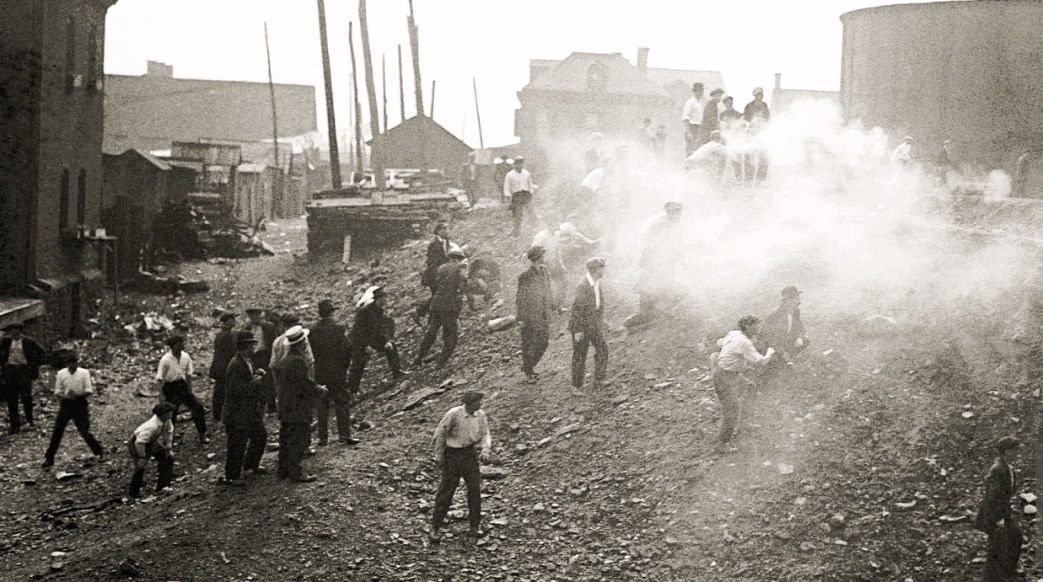
When Polish immigrants were not considered, or treated, as ‘white’ by those that were. Doing 6-day, 84-hour weeks for $2.50 a day, and without a union, workers fought two desperate strikes against John D. Rockefeller’s Standard Oil and Tidewater Petroleum in Bayonne, New Jersey in 1915-16. Intense violence between local police, security guards, ‘deputies’ and strikers with their supporters lasted 8 days in July, 1915, with several refineries burnt to the ground. Eight-six workers wounded, and five killed. The strike ended with the Governor ordering mass arrests of strikers and security guards, while refusing to call out the National Guard. The workers won an 8-hour day and a small increase in pay. The following October, the strike was on again and for two weeks riots raged, with four workers dead and hundreds injured. This time, with no concessions.
‘The Explosion at Bayonne’ by John A. Fitch from Solidarity. Vol. 7 No. 356. November 4, 1916.
Three people dead, a dozen or so in the city hospital badly wounded, property destroyed, innocent people brutally assaulted–that is the situation in Bayonne, N.J., after two weeks of the strike of the employes of the Standard Oil Company refineries.
The strike had been in effect less than twenty-four hours before there were battles between strikers and the police. Bricks were thrown and shots were fired. The second day of the strike a young woman was killed as she leaned out of an upper window to watch an encounter in the street. The next day a young lawyer, on business in the strike district, was struck by a bullet and killed. Then a workman, whose identity seems rather uncertain, was, killed as he walked out of a saloon.
What is it all about? What desperate situation lies back of it all? There are varying opinions, but here seems to be about the only documentary evidence; it is the list of “demands” served on Supt. George B. Hennessey of the Standard Oil Company just before the strike began:
“We your employes of the various departments hereafter named, present the following amicable request, feeling reasonably certain that if you consider the condition under which we are compelled to work, the prices which we now are compelled to pay for the commodities of life, or rather the means of sustenance, you are bound to realize that our demand is fair and reasonable.
“1st. We request an increase in all departments except in the still cleaning department–in which wages have been raised and are adequate in the following manner: 30 per cent increase to the men now making less than $3, a day, and 20 per cent increase to the men making $3 a day or more.
“2d. We request that an 8-hour day be adopted as a basis throughout.
“3d. That fairness be exercised in discharging men and that men shall not be discharged without just cause.
“4th. We request humane and decent treatment at the hands of foremen and superiors in place of the brutal kicking and punching we now receive without provocation.
“5th. We request twenty minutes’ time for lunch in the press department.
“We make the above requests in a peaceful and amiable manned, without threats or violence, preferring to obtain what we deem is justly due us in a friendly and peaceful manner. We must, however, state that unless our request is granted within 48 hours, we will be compelled to strike.” There is nothing in all of this suggestive of violence. On the contrary the emphasis is laid upon the peaceful and amicable spirit of the petitioners. It does not have the peremptory tone commonly found in the demands of men who are ready to strike. I learned that it was written in Polish–most of the strikers are Polish–and translated by M.F. Trakimas, a Lithuanian photographer. I strongly suspected that the friendly and diplomatic language had been inserted by the gentlemanly translator. He insisted to me, however, that he had done nothing of the sort. It is, he asserts, a faithful translation of the original petition.
How then shall we account for the violence? It has been just fifteen months since these same men were on strike, In July, 1915, Bayonne, N.J. attracted to itself the attention of the country by reason of the violence and bloodshed that took place during a strike which was finally ended by the spectacular activity of Eugene F. Kinkead, sheriff of Hudson county. Six men instead of three were killed at that time.
These two strikes within fifteen months seem to suggest that the workers of Bayonne are a particularly turbulent and bloodthirsty lot. And then we find this respectful, courteous petition, the basis for the present outbreak. If we examine it more carefully, however, some explanation of the existing feeling begins to emerge.
The first paragraph calls attention to “the prices which we now are compelled to pay for the commodities of life or rather means of sustenance,” and then the first demand is for an increase in wages 30 per cent for those getting less than $5 a day. Here we begin to get some light upon the situation. There is always dynamite in a low wage with an increased cost of living. When the men went on strike in 1915, and asked for a 15 per cent advance, unskilled labor, which constitutes a large proportion of the 5,000 odd employes of the Standard Oil Company in Bayonne, was receiving $1.75 a day. A 15 per cent advance would have meant for them $2.02 a day. They have received, it is said, two increases during the last year, and were getting when the present strike began $2.20. That is $688.60 for a year of 313 days, which is a full working year omitting nothing but the 52 Sundays. That is less than the lowest estimate that has been made in recent years as absolutely necessary” to support a workingman’s family. In the last month, furthermore, the prices of some of the most important necessities of life, such as meat, eggs, butter milk and bread have been materially advanced.
“How do you think we can live on $26 in two weeks?” a wife of a strier wrote to a Bayonne newspaper. Superintendent Hennessey gave out a statement declaring that the wages paid by the Standard Oil Company were higher than those of any other company in the vicinity of Bayonne, excepting one company which is handling war orders. I have not investigated the truth of this statement, but even if true, it is small comfort to know that there are others worse off than you are, if you have not enough to live on. It may be, also, that the strikers had not failed to note the story prominently featured in all the papers just a few weeks ago, that on account of the advance in the market value of Standard Oil stock, John D. Rockefeller is now a billionaire.
The second request is for an 8-hour day. Some of the men now have an 8-hour day, others work 9 and 10 hours, and some work 12, and there is a certain amount of seven-day labor in the big oil plant.
No comment is necessary on the moderation and restraint of the fourth demand: “We request humane and decent treatment at the hands of foremen and superiors in place of the brutal kicking and punching that we now receive without provocation.” Nor can much be added to the fifth: “We request twenty minutes’ time for lunch in the press department.” What is the time for lunch now do you ask–15 minutes, 10 minutes? The men on the street in Bayonne tell you that no time is allowed.”
These factors must be taken into consideration in trying to find an answer to the question of why there is violence in Bayonne. But such a suggestion seems to assume that the strikers are the ones who are guilty of violence. With regard to the specific cases mentioned, I have no information. I do not know who killed the young woman about to be a bride, or the lawyer, or the workingman. But I do know that violence has not been confined to the strikers.
As I looked the situation over in Bayonne, it seemed to me that the issue here is primarily one of Americanism. It is tremendously significant that in the common language of the street there are two classes of people in Bayonne “white” men and foreigners.
“It’s just these low-class foreigners,” a newspaper man told me. isn’t peculiar to Bayonne–it’s the way they act everywhere. You know what a terrible time they had in Paterson during the silk strike a few years ago. It is the same class of people and they act the same every where.” Now, as a matter of fact although there are Poles in Paterson, and more than 20,000 workers were on strike for three or four months, there was less violence than there would be at a county fair, except as it was engaged in by policemen and detectives.
I asked a group of policemen standing on a Bayonne corner what they thought about the strike.
“You see it’s this way,” replied big fellow with a protruding jaw, St is just a case of these fellows, making too much money. When they’ve got little money in their pockets, they just have to get out and raise hell.”
That was a little too strong for another one in the group, who remarked somewhat apologetically, “No we are not saying that. These people are not getting enough money. It’s on account of a lot of agitators coming in here and stirring up trouble among the foreigners.”
I asked a business man what he thought about it “It’s a case of the ignorant, low-class foreigner, making trouble,” he said. “This is an orderly, prosperous and comfortable town. Those fellows live over by themselves and refuse to become Americans. They live in dirt and filth and hoard their money.”
“It has been suggested,” I said to him, “that that is rather a neglected part of Bayonne where the foreigners live, that unsanitary conditions prevail there, and that the authorities do not trouble themselves about the matter.”
“Nothing to it at all,” replied the business man, “they live there because they like it they prefer that sort of thing Rents are high over there, but they prefer to stay nevertheless. This is the first time that I have said a good word for the Standard Oil Company, but I am with them on this deal.”
The morning that I went to Bayonne, “order” was said to have been restored. The town was alive with men in police uniform. Not nearly all of them were regular policemen. They had been hurriedly sworn in and given uniforms and badges. They had made raid after raid into the strike district. A leader of the foreign people, protesting against what he called the lawlessness of the police, took me into the district where they live to show how they had wrecked saloons. All of the saloons had been ordered closed, and when some of them in the foreign section had continued to run, despite the order, the police raided them
I had supposed from the accounts in the papers that they had emptied the stock into the streets. My guide took me into two wrecked saloons. Broken bottles were piled up a foot high in the corners; the walls were scarred with the impact of the bottles that had been thrown against them; floors were soggy with the liquor that had been poured out; there were even pools of it standing here and there; furniture was damaged and electric globes and fixtures had been smashed. It was a scene of wanton destruction of property far exceeding the drastic measures that doubtless were necessary.
Going away from the district, I encountered a moving picture operator. He had gone in at another point with a squad of police on one of the regular raids into strike territory for the purpose of putting respect for authority into the hearts of the strikers.
“That man Cady is a bird,” he said. “He led that bunch of cops in there and put everybody off the street. No body dared to say a word, or he got smashed over the head. A fellow was standing in a doorway and just made a kind of a face and said, ‘This is a fine bunch,’ or something like that, and Cady laid him out with the butt of his revolver. The man’s wife came out to the door and threw her arms around Cady to protect her husband. He just grabbed her and threw her back bodily through the door. I have a peach of a film of the whole thing.” By all means let us have law and order! But I wondered as I looked at the funeral passing up the street of the girl who was shot almost on the eve of her wedding day, as I observed the destruction wrought by the police, and as I noted the sullen faces on the street, I wondered how much had been contributed toward law and order and a peaceful settlement of Bayonne’s next strike.
The most widely read of I.W.W. newspapers, Solidarity was published by the Industrial Workers of the World from 1909 until 1917. First produced in New Castle, Pennsylvania, and born during the McKees Rocks strike, Solidarity later moved to Cleveland, Ohio until 1917 then spent its last months in Chicago. With a circulation of around 12,000 and a readership many times that, Solidarity was instrumental in defining the Wobbly world-view at the height of their influence in the working class. It was edited over its life by A.M. Stirton, H.A. Goff, Ben H. Williams, Ralph Chaplin who also provided much of the paper’s color, and others. Like nearly all the left press it fell victim to federal repression in 1917.
PDF of full issue: https://www.marxists.org/history/usa/pubs/solidarity-iww/1916/v7-w356-nov-04-1916-solidarity.pdf
 Revolution's Newsstand