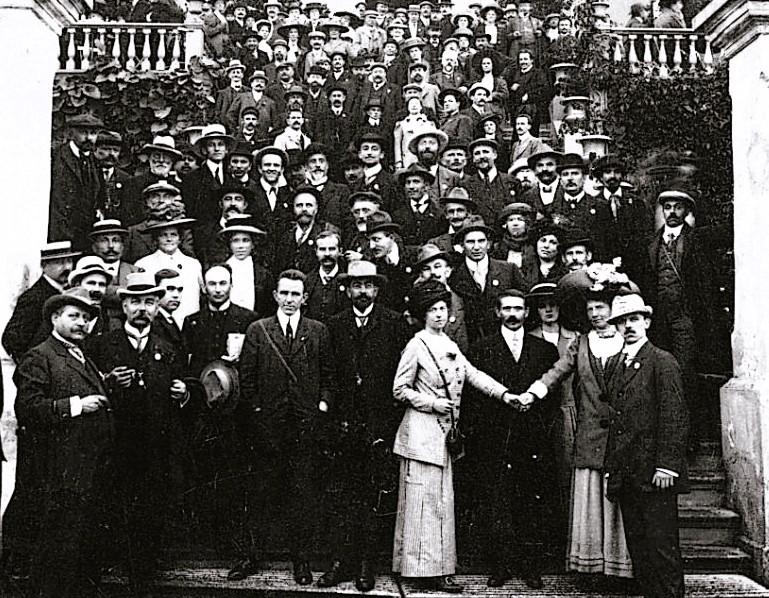
Bohn reports from 1910’s Congress of the International at Copenhagen. ISR’s longtime international editor was William E. Bohn (1877-1967), on the center-left of the Debsian Socialist Party, later director of the Rand School and an Old Guard editor of New Leader, partner and comrade to Marxist classicist Maude Thompson.
‘The International Congress’ by William E. Bohn from International Socialist Review. Vol. 11 No. 4. October, 1910.
ONE expected the eighth international Socialist congress to be numbered among the gatherings which have marked epochs in the history of the labor movement. The fundamental problems about which surged the struggles in the conventions of the old International and even in the early congresses of the International Socialist movement have been laid to rest so far as the working-class of the world is concerned. Proletarian thinkers no longer marshal themselves for the battle under the opposing banners of Socialism and Anarchism. Neither is it necessary in these days to fight the political reformer in the councils of the international labor movement. There is no call now for dramatic struggles like those in which Marx led the fight against Mazzini or Bakounin. In the incessant class war of the past forty years the working-class of the world—has learned certain fundamental principles from the logic of events. The men and women who labor know now what they want and they know in general how to go about getting it. At least they know the general direction which all their efforts must take. The problems of the immediate present are minor ones which, it is taken for granted, are to be solved on the basis of certain accepted principles. Using the term in its broadest sense they may all be said to be problems of tactics.
The efforts of the working-class looking toward its emancipation fall under three divisions, marked by three great organizations which spread over the entire civilized world: the Socialist party, the labor unions, and the cooperative societies. At the gatherings of the working-class, then, there are always two questions to be answered: How shall the work of each one of these organizations be conducted within the limits of its own activity? and, What are to be the relations among the three of them? These questions involve, of course, the whole problem of the relation of the revolutionary movement of the proletariat to the present capitalist state. In order to answer them we must first decide just what can be forced from the present industrial and political order and what must be left to the time when this order gives way to a higher one. In addition to solving what have here been designated as problems of tactics practically all that is left for a working-class congress to do is to take some actual part in the particular working-class struggles going on at the moment of meeting. The great gathering just held at Copenhagen, for example, represented ten millions of the world’s voters and many millions of the unfranchised. It was in duty bound to bring pressure to bear in favor of all groups of the working-class which happen now to be in special danger or are for any other reason in need of support.
The agenda as finally amended by the International Socialist Bureau included only one problem of tactics which may be regarded as fundamental, that involved in the relation between the Socialist movement and the cooperatives. Next to this the most important matters set for discussion were the methods to be used in securing certain things which the working-class demands of the present industrial and political order; the abolition of unemployment, the abolition of war, insurance against old age, industrial accidents, and occupational diseases, and the abolition of the death penalty. Another list of problems to be attacked had to do with the inner organization of the Socialist movement: means to be adopted for the carrying out of resolutions adopted by international congresses, the organization of international solidarity, the unity of the Socialist and labor movements within the separate nations. So far as the actual struggles of the working-class are concerned the situations in Finland and Persia were the only ones formally put upon the program for discussion, but Argentine and the Balkan region both came in for attention before the sessions of the congress were over.
The difficulty of discussing all these subjects and taking intelligent action upon them can be appreciated when it is remembered that there were 887 delegates in attendance upon the congress. General debate was, of course, quite out of the question. The various headings of the agenda were assigned to five commissions. These commissions began work upon the first day and reported resolutions as early as possible. Their resolutions were made the basis of what little discussion the size of the gathering and the shortness of the time permitted. This method worked as well as could be expected, but the general impression carried away by the delegates was that the congress was unwieldly in its operations. It has been proposed to cut down the number of delegates to future congresses.
The Socialist Party and the Cooperatives.
The action of the congress on the cooperative movement was a victory for the cooperatives. I will set down here in full the text of the resolution adopted:
(*The only text of the resolution which I have at hand is fn German. The wording of my English versions will, of course, not correspond exactly to that of the English versions submitted to the congress.)
“In view of the fact that the cooperative societies not only offer their members immediate material benefits, that they are organized to strengthen the working-class by eliminating the middleman and also carrying on production for their own distribution, thus educating the working-class for the independent direction of its own affairs and preparing the way for the democratization and socialization of industry, this congress declares that the cooperative movement, even though by itself it never can bring about the liberation of the working-class, nevertheless be an effective weapon in the class struggle which the workers are carrying on with the never varying purpose of conquering political and economic power with a view to socializing all the means of production and distribution, and that the working class has every reason for utilizing this weapon. The congress therefore urges all party members and all members of labor unions to enter actively into the cooperative movement and to use their best efforts to develop the cooperative societies in the direction of socialism, in order that the cooperative societies, instead of being a valuable means for the organization and education of the working-class, may not be turned into an influence which will destroy the socialist spirit of solidarity and discipline. The congress therefore most earnestly urges all party members and members of labor unions to use their influence in their cooperative societies against having the profits all returned to the members but rather in favor of their being used for the establishment of funds which will enable the societies, singly or combined in their wholesale organizations, to undertake cooperative production, to provide for the education and assistance of their members, to see to it that the wages and conditions of labor of their employes come up to the union standard, that their own concerns are so organized as to serve as industrial models and that in the ordering of goods sufficient attention is paid to the conditions under which they are produced. To what extent the cooperative societies should directly support the labor unions and socialist party from the funds at their disposal is left to the cooperative organizations of the various countries. In view of the fact that the service of the cooperative movement will be the greater the stronger and more unified the movement itself comes to be the congress declares that the separate cooperative societies of each country should join themselves into one organization. The congress declares, finally, that it is to the interest of the working class in its struggle against capitalism to have the political, the labor union, and the cooperative movements enter upon constantly closer relations without decrease in the independence of any one of them.”
This resolution was accepted almost unanimously. It was opposed in the discussion by the English, who maintained that in England the cooperative movement is anti-socialist, and by the Czechs, who favored national cooperative organizations instead of organization by countries. One group of delegates favored a clause in favor of regular contributions from the cooperative societies to the socialist party. Another group urged the establishment of organic relations between the two organizations.
War and Militarism.
The attitude of the working-class toward war was the only subject which roused violent feeling and led to dramatic scenes. The resolution introduced and finally carried is practically a repetition of the one carried at Stuttgart three years ago. The preamble explains that wars are instituted by capitalists for their own benefit and that the working-class of one country cannot possibly have any reason for shooting down that of another. When it comes to suggesting definite action the resolution requires of all socialist parliamentary groups to work for international courts of arbitration, disarmament, the abolition of secret diplomacy, the discontinuance of the imperialistic policy. The paragraph about which the debate finally centered is the following, taken directly from the Stuttgart resolution: “When there is danger of an outbreak of war the working-classes of the countries involved, supported by the International Bureau, are to do their utmost, through the utilization of the means which seem to them the most effective, to prevent it. The means naturally, will vary with the acuteness of the class-struggle and the general political situation. Keir Hardie, of England, and Vaillant, of France, representing the minority of the commissions which had had the matter under consideration, introduced the following amendment: “The congress regards the general strike as a means of preventing war, particularly the refusal to work in industries concerned with the production and transportation of munitions of war.”
Comrade Ledebour, upon whom, as reporter, devolved the duty of defending the majority report of the commission, maintained that the Stuttgart resolution was adequate. It advised the use of any means “which seem effective.” That is, the general strike or any other means. He held that to mention the general strike would be to prevent free choice of action by the working-classes of the various nations. Under some circumstances the general strike might be, not only ill advised, but impossible. He twitted the English Socialists with the fact that they had supported the Liberal budget and thus given their votes in favor of increased armaments. Moreover, he affirmed, the English comrades had among them some who made violent propaganda in favor of larger army and navy. Therefore a resolution in favor of the general strike as a weapon against international war came with an ill grace from England.
Keir Hardie made a very effective reply. In the first place he explained that the amendment did: not make the general strike obligatory. If was intended merely to impress upon the working-class the fact that it has in the general strike a weapon which can be effectively used if the conditions are favorable. And as to its coming from England the English working-class was ready to act upon it. Incidentally he explained that the English budget is voted for item by item and that the Labor members of Parliament did not support the appropriations for army and navy. Further, he went on to say, the jingoes in the English Socialist movement are only two in number. They are leaders without a following. The English labor movement is clearly, consciously, opposed to all international war and is ready to make war on war with any means at its disposal. Comrade Hardie s amendment was vigorously supported by Vaillant.
Finally Comrade Emil Vandervelde (Belgium) moved a substitute for the Hardie-Vaillant amendment: “The congress refers the Hardie- Vaillant amendment to the International Socialist Bureau for further study. The Bureau is to report upon the propositions contained in it to the next international congress. This substitute was unanimously carried. With the amendment out of the way the main resolution was soon carried amidst great enthusiasm.
The debate on Keir Hardie’s amendment as well as the vote goes to show that idea of the general strike has gained ground since the Stuttgart congress. The Germans are not quite ready to accept the general strike as a means of preventing war. But they maintained their position with difficulty. Unless all signs fail the general strike will be definitely mentioned in the anti-war resolution adopted at the congress of 1913.
Unemployment.
The resolution adopted on this subject, after setting forth he fact that unemployment is a necessary result of capitalism, directed Socialist members of parliaments to make seven rather modest demands: Statistics as to the extent of unemployment, payment of union wages, special assistance for the unemployed in times of industrial crises, security of political rights during unemployment, government employment agencies, use of legal means to decrease unemployment, obligatory support of the unemployed. The English delegates insisted on a declaration of the right to work. They were told that under the capitalist system there can be no such thing as the right to work.
Abolition of the Death Penalty.
The lack of interest in this subject showed that there was little excuse for placing it on the agenda. A resolution against the infliction of death as a punishment for crime was introduced and, of course, carried.
International Solidarity.
A resolution first suggested by the Swedish Labor party was introduced and carried. This resolution puts the international movement on record in favor of the international support of great strikes. In the debate on this subject the delegates from England and France were forced to listen to denunciations of their respective labor movements on account of the feeble support given by these movements to the great Swedish strike. The English answered that they are poor and have no labor press by means of which to appeal for funds. The French had no answer to make.
National Unity of Socialist and Labor Movements.
A strong resolution was adopted in favor of unity within the various national movements. The French comrades received high praise for the spirit of mutual forbearance with which they supported their unified party. Much of the success which they have attained was attributed to their unity of organization. It was when this resolution was up for discussion that the Czechish comrades made their principal fight for autonomy. They maintained that they are hindered in their work by German domination. They were answered that if the principle of national autonomy were introduced into Austria many localities would witness the formation of as many as eight independent labor organizations. When the resolution was voted upon there were only two or three delegates who sided with the Czechs. The sentiment of the congress was overwhelmingly in favor of the minimizing of national and racial differences in favor of effective organization.
There was one dramatic moment during the discussion of this question. The representative of the American Socialist Labor Party, in an impassioned address, accused the American Socialist Party of making unity of the American Socialist movement, impossible. He supported his accusation by telling of the attempt made by the S.L.P. to open negotiations looking toward the unity of the two parties. As is well known in this country, these attempts did not meet with success. On behalf of the American Socialist Party answer was made by comrades Morris Hilquit and Victor Berger. They answered, in the first place, by stating that it is the tactics of the S.L.P. which have made unity impossible. The Socialist Party cannot join itself to an organization which opposes the labor movement of the country. And, further, they explained to congress that unity is surely being brought about in America. Some ten years ago there were two parties containing about 5000 members each; now there is one party with 50,000 members and another with something under 1000. This looks like an approach to unity. One of the Socialist party delegates promised the assembled delegates unity would become a fact in America before the next international congress.
Finland, Argentine, Etc.
Strong resolutions in favor of the oppressed working-classes in Finland, Argentine, Persia and the Balkan region were introduced and, it goes without saying, unanimously adopted. The same may be said of a resolution in favor of the right of the asylum in foreign lands, of those whose only crime is political or union activity.
The next international Socialist Congress is to be held at Vienna.
What Does it All Mean?
The international Socialist movement is larger than ever before. Is it as strong in its revolutionary spirit? The quiet tenor of the debates, the careful attention to details, the lack of oratory, of fine phrases, might give the impression that there has been a falling off on this side. Moreover it is noticeable that the “immediate demands” are of the most modest sort. What does all this mean?
It does not in any sense indicate lack of revolutionary purpose. The immediate demands are modest because the international Socialist movement has given up expecting much of the capitalistic regime either “immediately” or in the distant future. Therefore it asks little. And even in the consideration of matters touching only the inner organization of the socialist movement the tendency was always to “resolve” only things which could actually be accomplished. This means that the working class is making use of its experience in the world of affairs. It is working for a complete economic revolution, but it knows that such a revolution can not be achieved by “passing “revolutionary” resolutions. Therefore it sets itself thoughtfully, carefully to achieve its great purpose. The eighth international Socialist congress indicates and advances in the consciousness of power possessed by the working-class.
The International Socialist Review (ISR) was published monthly in Chicago from 1900 until 1918 by Charles H. Kerr and critically loyal to the Socialist Party of America. It is one of the essential publications in U.S. left history. During the editorship of A.M. Simons it was largely theoretical and moderate. In 1908, Charles H. Kerr took over as editor with strong influence from Mary E Marcy. The magazine became the foremost proponent of the SP’s left wing growing to tens of thousands of subscribers. It remained revolutionary in outlook and anti-militarist during World War One. It liberally used photographs and images, with news, theory, arts and organizing in its pages. It articles, reports and essays are an invaluable record of the U.S. class struggle and the development of Marxism in the decades before the Soviet experience. It was closed down in government repression in 1918.
PDF of issue: https://www.marxists.org/history/usa/pubs/isr/v11n04-oct-1910-ISR-gog-Corn-OCR.pdf
 Revolution's Newsstand