A fine scholarly work on the context for Haymarket–the massive, bloody rail strikes that shook the country in 1886, less than a decade after the Uprising of 1877. Initially led by Martin Irons, one of the great agitators of the early labor movement, it involved hundreds of thousands of workers in battle against Jay Gould’s ‘octopus.’ From Louis Corey’s sort-lived magazine.
‘The Railroad Strikes of 1885-86’ by Harry Frumerman from Marxist Quarterly. Vol. 1 No. 3. October-December, 1937.
THE RAILROAD strikes of 1885-86 occupy a place of great importance in the annals of American labor. In magnitude they were second only to the railroad strikes of 1877; in the ferocity with which the struggle was waged to none. In them capitalism at its worst in the figure of the notorious Jay Gould was pitted against the forces of organized labor as represented by the Knights of Labor. Both sides realized the significance of the issues at stake and left no stone unturned to achieve victory. The strikes were of unique prominence in a period of general labor unrest.
During the 1880’s the Knights of Labor began organizing the poorly paid and dissatisfied workers of Gould’s enterprises. In the summer of 1883 they had been associated with the strike of the Western Union telegraph operators which was savagely crushed. They continued their efforts in the greater sphere of the Gould railroads in the southwest, concentrating on shopmen, trackmen and others not included in the Railroad Brotherhoods. A collision was certain for Gould, who was violently anti-labor and often boasted that he could “hire one-half of the working class to kill the other half,” did not intend to allow the Knights of Labor to dominate the Southwestern system without a struggle.
The initial outbreak came in 1885. Although the Missouri Pacific Railroad, the backbone of the Southwestern system, was enjoying a period of comparative prosperity, the management decided that it could take advantage of the generally unsettled condition of business and slash the wages of the shopmen, who unlike the engineers, firemen and conductors, were poorly organized and could not offer strong resistance to such measures. A wage cut of 5 percent was added in February, 1885 to a 10 percent reduction which had been imposed on them the previous October.1 A similar wage reduction was given to the shopmen of the Missouri, Kansas and Texas Railroad and the Wabash Railroad. The day after they received their wage cuts the Wabash shopmen went out on strike,2 and were followed a few days latter by their fellow workers in the Missouri Pacific and the Missouri, Kansas and Texas. By the first week in March the strike had spread to all the important shops of the Southwestern system in Missouri and Texas.
The injustice of the Southwestern system’s action was clearly brought out in a special report which the Commissioner of Labor Statistics made to Governor Marmaduke of Missouri in the middle of March:
“The grievances of the employes,” he wrote, “were based upon repeated reductions of wages and shortening of time in the shops of the…Missouri Pacific Railroad and leased lines operated by it, bringing the wages of the employes below the wages paid by the other lines in this state, and in Kansas and Texas. The feeling of dissatisfaction was intensified by the publication of the financial statement of the Missouri Pacific Railway Company, at the last annual meeting of its director, showing large earnings for the road by neglecting to show the deficit in the earnings of its leased and other lines operated by it; and when on February 9th a notice was posted in the shops that another reduction would take place, dating from March 1st, the employes determined to quit.”3
The strikers sent a statement of their grievances to H.M. Hoxie, then 3rd Vice-President of the Missouri Pacific, demanding the restoration of their old wage scale and complaining that they were allowed to work only five days a week and sometimes did not work more than three or four. Hoxie ignored the petition and on March 9, 1885 the strike became general on all points of the Southwestern railroad system, involving 10,000 miles of railroad and 4,500 workers.
Public sympathy was on the side of the strikers for the Gould management was cordially detested. The Knights of Labor saw this strike as a golden opportunity to strengthen their position in the Southwestern system and decided to intervene and lend active support to the strikers. The Knights of Labor of the Union Pacific appropriated $30,000 and sent an organizer, Joseph Buchanan, to assist them. Buchanan organized railroad men’s assemblies wherever he went during his extensive travels over the striking lines.4
The powerful Railroad Brotherhoods rallied to the support of the striking shopmen and as a result all freight traffic was suspended on the Southwestern system. The strike was orderly in character and law abiding. “No specific acts of violence were resorted to, and there was no particular destruction of property…” reported the Congressional committee sent out to investigate the strikes.5 Railroad officials tried to move the accumulated traffic of about 1,500 freight cars, “but without success.” When an engine was fired up, and attached to a train, the engineer was approached by strikers with the plea: “For the sake of your family and ours, don’t take out that engine.” The appeal was generally effective. A delegation of strikers was sent to confer with the governor at Jefferson City. On March 12th, at a meeting of strikers and citizens, it was proposed that the strike be settled by restoring all strikers at the wages paid them before the strike broke out; that after April 1, 1885, the wage scale be restored to its former level; that no reduction be made for a year; and that no employee be dismissed for participating in the strike.6 Three days later the Missouri Pacific settled on these terms and on March 16th the strike was officially ended.
During the strike shopmen in large numbers had joined the Knights of Labor. The prestige of the Knights of Labor was greatly enhanced by the victory, in which they had played a conspicuous part, and thousands more from the Southwestern system flocked to their ranks.7 In September, 1855, District Assembly 101 was formed, comprising all the Local Assemblies of the Southwestern system. At first there were five locals; by the time the strikes of 1886 broke out there were thirty locals and thousands of members. Existing lodges and unions of railroad workers were absorbed by the Knights, and this contributed greatly to the growth of their numbers.8 A clash between the Knights of Labor and the Southwestern system was inevitable. Realizing that the Knights would soon whip into a compact fighting body the large number of unskilled workers who had joined the local assemblies on the Southwestern system, the management decided to strike at them by discharging as many leaders as they dared to. The Wabash Railroad was first to strike out against the Knights. In the spring of 1885 the shopmen at Moberly, Missouri were reduced to the lowest possible number, and on June 16th the shops were closed altogether.9 The lockout was a direct violation of the agreement by which the strike of the previous March had been settled and on August 18th, the Knights called a strike on the Wabash.10 After a futile attempt to confer with the receivers of the Wabash, the General Executive Board of the Knights of Labor issued a general order to all assemblies on the Union Pacific and the Southwestern system directing their members to “…refuse to repair or handle in any manner Wabash rolling stock until further orders…”11 Had this order gone into effect, a strike equal in proportions to the great railroad strike of 1877 would have broken out. The Wabash was bankrupt and in receivership and could ill afford a strike. The Southwestern railroad system, with which the Wabash was allied, feared that it would be involved. Gould took a suggestion the Knights made and called a conference of the managers of the Missouri Pacific and Wabash Railroads and the General Executive Board of the Knights of Labor and threw his influence in favor of making concessions to the strikers. He assured the Knights that he wanted the workers to come directly to him in all labor disputes, that he believed in labor organization and the arbitration of all labor difficulties, and that he “would always endeavor to do what was right.”12 The Knights demanded the dismissal of those who had been hired by the Wabash repair shops since the beginning of the lockout; the reinstatement of all discharged men, the leaders of the strike being given priority; and the assurance that in the future no discrimination would be shown against members of the Knights of Labor by the railroads. Under pressure from Gould the Wabash receivers settled on substantially these terms.13
To the public the settlement meant that Jay Gould had been beaten. One of the most powerful of the railroad magnates had been forced to capitulate to the Knights of Labor against his will.
“Here a labor organization for the first time dealt on an equal footing with the most powerful capitalist in the country. It forced Jay Gould to recognize it as a power equal to himself, a fact which he amply conceded when he declared his readiness to arbitrate all labor difficulties that might arise. The oppressed laboring masses finally discovered a champion which could curb the power of a man stronger even than the government itself. All the pent-up feeling of bitterness and resentment which had accumulated during the two years of depression, in consequence of the repeated cuts in wages and the intensified domination by employers, now found vent in a rush to organize under the banner of the powerful Knights of Labor.”14
The tremendous growth experienced by the Knights of Labor at this time was almost wholly due to their success in bringing Gould and the Wabash Railroad to terms. Their number swelled mightily. New locals sprang up with lightning rapidity. Between July, 1885 and October, 1886 membership in the Knights of Labor jumped from 110,000 to 730,000!15 So rapidly did the organization grow during this period that responsible leaders, fearing that it would get out of hand, took measures to curb this too-rapid growth. Charters to new locals had to be refused, and Terence V. Powderly, Grand Master Workman of the Knights of Labor, who always favored a conciliatory policy, took pains to deny the exaggerated accounts of the phenomenal growth of the Knights published by newspapers which were seeking to magnify the “menace” of organized labor.
II.
In spite of the solemn promises made by the officials of the Southwestern system when the second strike in 1885 was settled, the Knights found that the terms of the settlement were constantly being violated. Railroads workers who had joined the Knights of Labor were being dismissed, and the companies were limiting the benefits of the strike settlement to shopmen whereas the Knights held it applied to yardmen, sectionmen and others. Other factors which led the leaders of the Knights of Labor to consider another strike were “the violations of the contract in not restoring the pay; the overtime work that was not paid for; the bridgemen who had been hauled about or traveling without being paid for it; the section men not receiving pay back—that is wages restored; and then, we considered that the wages were too small for them; that they could not live on them, as they frequently have only half time.”16
The organizer and leading spirit of the strike of 1886 was Martin Irons, chairman of the executive board of District Assembly 101 of the Knights of Labor.17 Irons was much reviled by contemporary middle class opinion after the strike of 1886 had assumed serious proportions and violence broke out. The Congressional committee which investigated the strikes called him a “dangerous if not pernicious person,” while James Ford Rhodes, voicing the feelings of the bourgeois, dismissed him with the epitaph “a vulgar labor agitator.” Irons was headstrong, domineering, and perhaps more zealous than able, but he was wholeheartedly and sincerely devoted to the interests of his fellow workmen, without thought of personal aggrandizement. He had spent years wandering about the cities of the middle west and the south working as a machinist. In 1884 Irons joined the Knights of Labor and was instrumental in organizing District Assembly 101 the next year. Irons rose rapidly in the councils of District Assembly 101; by 1885 he was Master Workman of one of the local assemblies, Recording Secretary of the district assembly, and Chairman of the executive board, a position of great power. Convinced that the Southwestern system could be forced to obey the terms of the strike settlement only by having the Knights of Labor recognized, Irons embarked on a course of action by which this would be accomplished, fully recognizing that another strike might be necessary.18
In January, 1886 District Council 101 was holding a convention in St. Louis. The Executive Committee presented a resolution embodying demands for recognition of the Knights of Labor by the Southwestern system and a minimum wage of $1.50 a day for unskilled labor. It was upheld almost unanimously, and the Executive Committee felt itself empowered to call a strike at its discretion to force the acceptance of the demands for recognition and a minimum wage.19 Only an opportune moment was necessary.
Trouble broke out first on the Texas and Pacific Railroad. This road had gone bankrupt and was taken over by receivers in January, 1886. Claiming that the receivership absolved it of all responsibility to observe the terms of the strike settlement, it repeatedly violated it. The Knights believed that the road had been put in receivership to get rid of the strike settlement and to obtain the support of the federal courts. They still regarded the Texas and Pacific as part of the Southwestern system and were ready to fight the whole system because of these violations. On February 18, 1886 Charles A. Hall, Master Workman of District Assembly 101 and a foreman in the Texas and Pacific shops at Marshall, Texas, was dismissed for being absent from work without permission. Martin Irons intervened and attempted to have Hall reinstated by appealing to the receivers, but with no success. He concluded that the time for a showdown had come. “Without any further warning on Monday, March 1, 1886 at 3 o’clock the whistles at Marshall and Big Spring Rock sounded, and the employes in and surrounding the shops at these points walked out to a man, and the…strike…was inaugurated.”20 By prearranged agreement the shopmen at Fort Worth and Dallas walked out at the same time, and the strike became general along the whole Texas and Pacific line.
In contrast to the strike of the previous year, violence broke out almost immediately. Coal heavers, miners, and telegraph operators joined the striking shopmen. Messages were delayed in transmission from 24 to 36 hours, and in some cases destroyed. On March 5th all freight shipments came to a standstill and all traffic was discontinued west of Colorado. After unsuccessful attempts to end the strike, it spread by March 8th to the entire Southwestern system. Nine thousand shopmen, switchmen, trackmen and other employes were on strike; many were “laid off” because there was no work for them to do. All freight traffic was ended. A strike of the employes of the St. Louis Bridge Company, an independent railroad running from East St. Louis, Ill. over the bridge and through a tunnel to St. Louis, paralyzed transportation between St. Louis and the East. Almost all the terminal facilities in St. Louis were in the hands of the St. Louis Bridge Company; the twelve railroads which converged in East St. Louis had to use it in forwarding their traffic to St. Louis.21
On March 10th the Missouri Pacific Railroad began advertising for strikebreakers. Meanwhile the strikers were attempting to force the engineers, firemen, brakemen and conductors to join them. Threats, intimidation and violence were used and were effective in forcing them to abstain from working and in some cases to give aid against their will.
As in 1885, public sympathy was on the side of the strikers in the beginning. Jay Gould was extremely unpopular in the Southwest and many were glad to see his Southwestern system in difficulty. Newspapers of St. Louis, Kansas City and other points in the southwest supported the strikers, while the great journals in New York were also sympathetic. However, as the strike spread, became more intense and took a violent turn, there was an immediate and decided change in public opinion. Hatred of Gould was overwhelmed by hatred of the revolting workers and fear of the consequences of their victory. As the business interests of the Southwest began to feel the effect of the traffic blockade, all the forces of wealth and power were aligned against the strikers. Great pressure was exerted on the state governments to intervene against them. Newspapers and periodicals unleashed savage attacks against the Knights, painting their acts in lurid colors and predicting dire consequences should the strikers win. The pages of the liberal Nation were full of bitter denunciations of the “anarchical” strikers, and E.L. Godkin revealed the narrow range of his sympathies and his lack of understanding of the problems of labor in his blasts against the Knights. By the time the strike had gotten under way, the Knights and the strikers were completely isolated by public opinion and faced by a solid opposition of all classes.
Violence and lawlessness increased as the strike progressed. Those who refused to go on strike were intimidated and threatened. Locomotives were “killed” by the removal of some vital part, trains were sidetracked, cars were uncoupled, water tanks were opened, machine shops and roundhouses were broken into and wrecked, bridges and trestles were burned, and tracks were torn up. An army of deputy marshals, police, detectives, sheriffs and constables was recruited by the railroads to preserve order and protect property, but their efforts were in vain. The national leaders of the Knights of Labor deprecated violence and lawlessness, but the rank and file took to it in increasing numbers. Passenger trains were generally unmolested, but suburban trains were stopped. The Wabash, being in the hands of receivers and having the protection of the federal courts, was unmolested, though the Texas and Pacific, also in receiver’s hands was made to bear the full brunt of the strike.
The strike in its initial stages was directed by Martin Irons. Seeing that no progress had been made by the middle of March, Terence V. Powderly, Grand Master Workman of the Knights of Labor, decided to intervene. Powderly differed from Irons in almost every respect. With the advent of Powderly, the strategy and tactics of the strike underwent a great change. He disapproved of Irons’ methods, was opposed to strikes and favored arbitration. Powderly immediately took steps to settle the strike by arbitration. On March 18th he asked H.M. Hoxie, managing Vice-President of the Missouri Pacific, who had assumed charge of the management of the Southwestern system during the strike, for a conference. Hoxie, according to a contemporary observer, was “an able, straightforward and humane man, imbued with a strict sense of duty and discipline but disposed to just treatment of his subordinates.”22 But his sympathies were entirely with the capitalist class and he had a deep hatred of the Knights of Labor and all strikers. As stubborn and determined as Martin Irons, he was steadfast in his resolve to stamp out the strike and root the Knights of Labor out of the Southwestern system. Consequently he turned down Powderly’s request, though he did agree to meet him as a private citizen. Powderly refused to confer with Hoxie in any other capacity than Grand Master Workman of the Knights of Labor and negotiations to end the strike by arbitration were broken off.23
Meanwhile St. Louis was beginning to feel the full effects of the strike and the traffic blockade. Factories were closing because of their inability to obtain supplies, especially fuel, and ship goods. Unemployment became widespread and the price of coal and provisions soared. Business was coming to a standstill and discontent was rife. On March 24th at a joint meeting of the directors of the Merchants’ Exchange and the Merchants’ Transportation Committee of St. Louis the strike was unanimously condemned, as harming all classes. The same day a monster mass meeting of manufacturers and merchants was held at the Mercantile Club in St. Louis. Resolutions were passed declaring the strike not merely a question between employer and employes, but a national issue in which four states were vitally interested. If the strike continued, they stated, it would ruin the commercial, industrial and laboring interests of St. Louis and the Southwest. The Knights of Labor were denounced for interfering with the rights of property and of individuals and demands were made that freight traffic be restored with the protection of state and municipal authorities. “The blockade on the commerce of the city shall and must be raised—peaceably if possible, forcibly if necessary. The trains must run.”24 This was their ultimatum to the strikers.
The governors of the states affected by the strike acted quickly. Proclamations were issued in Missouri, Kansas, Texas and Arkansas calling for the end of the strike. On March 24th Governor John S. Marmaduke of Missouri condemned the strike for holding up traffic and called on the Missouri Pacific to resume operations, pledging the entire power of the state to their aid, and warning the strikers to refrain from interfering.25
The tide of public opinion had turned against the strikers. Hitherto Hoxie had not dared to run trains out of St. Louis because of the inability to obtain police protection from the municipal authorities of St. Louis or the state authorities of Missouri. His policy “was one of masterful inactivity.” Unwilling to take the risk of having trains wrecked and men injured or killed, Hoxie had suspended all train movements out of St. Louis. Now that police protection became available, railroad traffic was gradually resumed in Missouri, Kansas and Texas.26
Again Powderly projected himself into the strike, this time appealing to Gould himself in an effort to secure a favorable settlement before it was too late, for the resumption of train movements portended the end of the strike. On March 27th Frederick Turner, Secretary of the Knights of Labor, wrote to Gould asking for a conference between representatives of the Knights and the railroads to settle the strike.27 Gould called on the Knights to order the strikers back to work and to end violence and the interference with train movements. He did meet with Powderly on the 28th, however, and apparently a basis for arbitration was reached. In a letter to Powderly he quoted a telegram he had sent to Hoxie ordering him not to discriminate against Knights in hiring men then stating: “We see no objection to arbitrating the differences between the employes and the company, past or future.”28
Jubilant at having ended the strike at a stroke, Powderly wired Irons the day that Gould had consented to arbitration and ordered the strikers back to work. Powderly announced to the press that Gould would arbitrate with the strikers and that the strike was over. In all quarters satisfaction was expressed with the manner in which the strike, which had been growing more serious every day, had been ended.
Suddenly Gould announced that next day that he had never consented to arbitration!29 He declared that Hoxie had entire control of the strike and that he had merely said that he saw no objection himself to arbitration. Gould must have known that Hoxie was not in favor of arbitration when he gave his assurances to Powderly. The whole incident appears to have been a trick to break down the morale of the strikers. Astounded as he was by Gould’s perfidy, Powderly was willing to continue negotiations with Gould for a peaceful settlement of the strike. At a conference between Gould and Powderly it was established that Hoxie, pursuant to Gould’s instruciions, had taken charge of arbitration, but refused to meet a committe of strikers. Hoxie declared that he would only deal with a committee of employes who were actually at work! In other words, the strike would have to be called off before the grievances of the strikers were heard. Anxious to have the strike settled as quickly as possible, for he saw that the strikers were losing ground daily, Powderly ordered Irons to yield to Hoxie’s terms.30
Had Irons obeyed, the strike would have ended at this point, and the Knights of Labor would have suffered a crushing and humiliating defeat, for these were the terms of abject surrender. Irons, however, was determined to see the strike through to its conclusion whatever it might be. He disregarded Powderly’s telegram, therefore, and prepared for a last-ditch battle.31 His stubborn refusal to make any concessions forced Powderly to consent to a continuation of the strike. “This will be a fight to the death,” remarked an official of the Knights.
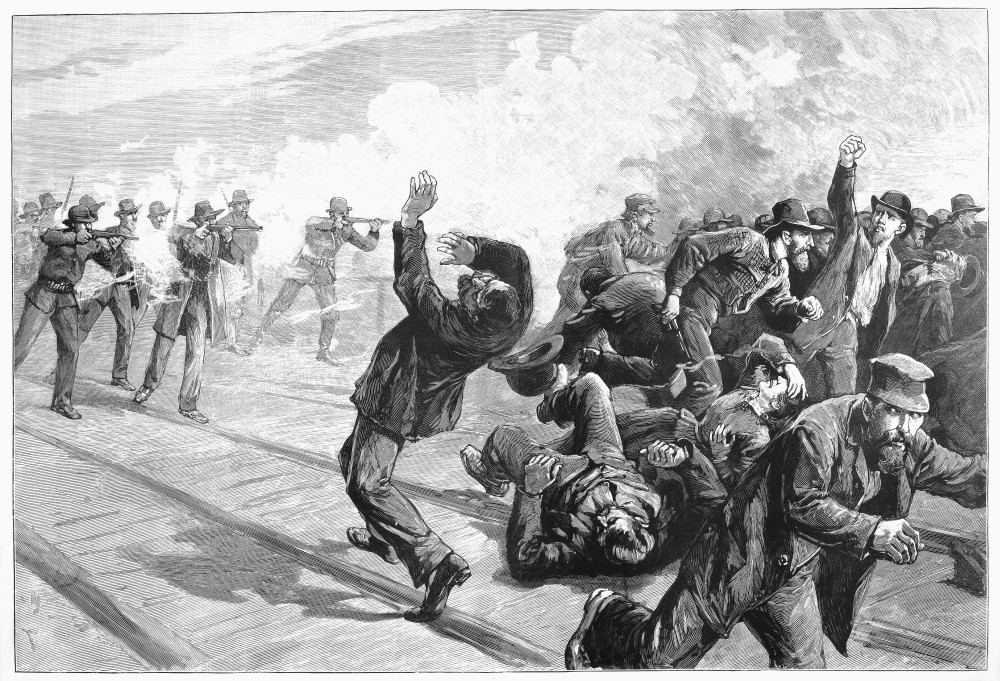
Thus the strike dragged on into April. Traffic was resumed gradually, but violence continued. In Illinois the governor ordered the National Guard to hold itself in readiness for immediate strike duty and made an investigation of the advisability of immediate military intervention in East St. Louis, where conditions were particularly acute.32 On April 9th a battle between strikers and police, militia and deputy sheriffs in East St. Louis resulted in the death of seven persons and the destruction of $75,000 worth of railroad property through fire. Only after 700 National Guardsmen were sent to the scene was order restored.33 In the farming communities of the interior the shortages of coal and of goods were even more serious. In many places “Law and Order Leagues” were formed against the Knights of Labor.34 The strike waned perceptibly. After the bloody riot of April 9th there was no more serious violence. The strike dragged on through April “without incident of any graver character than the occasional killing of an engine, derailment of a train, the moving of troops, the continued issuance of orders, and the passage of resolutions and correspondence of all sorts.”35
On April 12th the House of Representatives ordered an investigation of the trike and three days later a committee of seven left for a tour of the strike area. Long hearings were held and most of the principals in the strike testified. Irons stated that the strike had been called, not in the interest of one man, but for a principle; that the contract between the employes and the railroad, made through the mediation of the governors of Missouri and Kansas in 1885, had been violated. The press gave garbled and misleading summaries of his testimony. When asked what had been gained by the strike, Irons replied: “I think it is right smart…I think it has opened up the eyes of the public to the tyranny of the railroad corporations, both to their employes and to the citizens at large. It has opened up the eyes of Congress to see the necessity of sending you out as a committee to look into the matter.”36 The press featured the first sentence of his remarks, “I think it was right smart,” and tucked the rest of his testimony, if it was reported at all, in an obscure corner. Taken by itself, this sentence had an air of insolence and bravado, and gave an utterly false impression of Irons’ statement. The committee collected voluminous testimony abounding with instances of violence; wrote a report finding many of the strikers’ grievances justified and both sides at fault; but made no definite recommendations. On April 22nd President Cleveland sent a special message to Congress suggesting a scheme of voluntary arbitration for the settlement of similar disputes. Nothing that the government did, however, contributed in the least to the settlement of the strike.
The last days of the strike were enlivened by virulent denunciations of Gould and Hoxie and a lively correspondence between Powderly and Gould full of accusations and counter-accusations. Powderly uttered many brave words, but the strike was irredeemably lost. The Southwestern system was in full operation, and conditions were almost normal. The remaining few strikers were a forlorn band. Their ranks had been decimated by desertions and those who were still loyal to the strike faced a dark future. Only the official announcement of the General Executive Board of the Knights of Labor was lacking for the formal conclusion of the strike. On May 4th this was issued and the strike was ended.
Few, if any, strikers were rehired, and these only for special reasons. The Missouri Pacific reduced its employes from 13,393 to 10,737. No member of the Knights of Labor was rehired, nor anyone who had committed violence during the strike.37 “Martin Irons has done us more harm than a thousand Jay Goulds could,” an embittered ex-striker declared.38 Irons himself was ruined. He was blacklisted on the railroads and his source of livelihood was gone. Misfortune hounded his footsteps. His wife died during the strike and his furniture was seized for debt. He attempted to lecture but failed, and during his last years he was reduced to keeping a lunch counter in a small basement saloon in Kansas City and later in the old French Market in St. Louis. He died in 1900, a broken and forgotten man.39 Hoxie did not long survive his victory; he died at the end of 1886. “He has fallen a martyr to high duty and his name and example will be long cherished by his countrymen as those of a true hero,” piously declared the Nation.40 Gould rose in the estimation of his class, but his great unpopularity among the workers now became a bitter and unrelenting hatred. The strike emphasized the need for governmental regulation of the railroads, which began the following year when the Interstate Commerce Commission was established.
The disastrous ending of the strike hit the Knights particularly hard. “It was a complete capitulation and the severest blow the Order had suffered…From that day the Knights of Labor lost ground.”41 Coming at the time of the unsuccessful May Day strikes for the 8-hour day it speeded the crumbling of the power of the Knights. By August, 1886 the Knights of Labor as an organization had practically disappeared from the Southwestern system and was rapidly dying out on all western railroads. It lingered on elsewhere for several years, but only as a shadow of its former self. The passing of the Knights meant the rise to dominance of the American Federation of Labor, transforming American unionism.
NOTES
1. U.S. House of Representatives, 49th Cong., 2nd Sess., (1887) Report No. 4147. “Investigation of Labor Troubles in Missouri…” Part I, P. i. Report of the Committee. (Hereafter cited as Strike Investigation. Pages cited are from Part I unless otherwise indicated.)
2. John R. Commons et al., History of Labor in the United States, vol. II, p. 368.
3. Quoted in Strike Investigation, p. ii.
4. John R. Commons et all., op. cit., vol. II, p. 368.
5. Strike Investigation, p. ii.
6. Strike Investigation, p. iii-iv. See p. 6-7 for text of the strike settlement.
7. The Official History of the Great Strike of 1886 on the Southwestern Railroad System, compiled by the Bureau of Labor Statistics and Inspection of Missouri. p. 7, (hereafter cited as: Official History.)
8. F.W. Taussig, “The Southwestern Strike of 1886” in Quarterly Journal of Economics. January, 1887, Vol. I, p. 187.
9. Norman J. Ware, The Labor Movement in the United States, 1860-1895, p. 140.
10. John R. Commons, op. cit., vol. II, p. 368.
11. John Swinton’s Paper, August 23, 1885, quoted by Commons, op. cit., vol. II, p. 369.
12. John R. Commons, op. cit., vol. II, p. 369.
13. John Swinton’s Paper, August 30; September 13, 1885, quoted in John R. Commons, op. cit., vol. II, p. 369.
14. Ibid., vol. II, p. 370.
15. Carrol D. Wright, “An Historical Sketch of the Knights of Labor” in Quarterly Journal of Economics, January, 1887. vol. I, p. 156.
16. Strike Investigation, Part II, p. 438. Testimony of Martin Irons.
17. Ibid., Part II, p. 444. Testimony of Martin Irons.
18. Strike Investigation, p. xi.
19. Strike Investigation, pp. xi, xii.
20. Ibid., p. xii; Part II, p. 354. Testimony of Charles A. Hall. See F.W. Taussig, op. cit., pp. 190-191.
21. Official History, p. 21. F.W. Taussig, op. cit., pp. 194-195. 400.
22. F.W. Taussig, op. cit., p. 217.
23. Strike Investigation, p. xix.
24. Strike Investigation, pp. xviii-xix; Official History, pp. 54-56.
25. Official History, pp. 57-59; Strike Investigation, p. xix.
26. Strike Investigation, p. xix; Official History, p. 64.
27. Correspondence Between Jay Gould, Terence V, Powderly, et al. (n.d., n.p.) pp. 1-4.
28. Strike Investigation, pp. xx, 37.
29. New York Times, March 29, 1886.
30. Strike Investigation, p. 66.
31. Official History, pp. 87-88.
32. New York Times, April 6, 1886.
33. Official History, pp. 101, 104; Strike Investigation, pp. xxii-ill.
34. The Nation, April 15, 1886.
35. Strike Investigation, p. xxi.
36. Strike Investigation, pp. xx, and (Part II), 460.
37. New York Times, April 30, 1886. (Interview with Jay Gould.)
38. Railway Age, August 12, 1886.
39. J.F. Rhodes, op. cit., vol. VIII, p. 276. See Appleton’s Annual Cyclopedia for 1900 and the New York Herald, March 25, 1888.
40. The Nation, December 2, 1886.
41. Norman J. Ware, op. cit., p. 148.
Marxist Quarterly was published by the American Marxist Association with Lewis Corey (Louis C. Fraina) as managing editor and sought to create a serious non-Communist Party discussion vehicle with long-form analytical content. Only lasting three issues during 1937.
PDF of full issue: https://archive.org/download/marxism-today_october-december-1937_1_3/marxism-today_october-december-1937_1_3.pdf
 Revolution's Newsstand