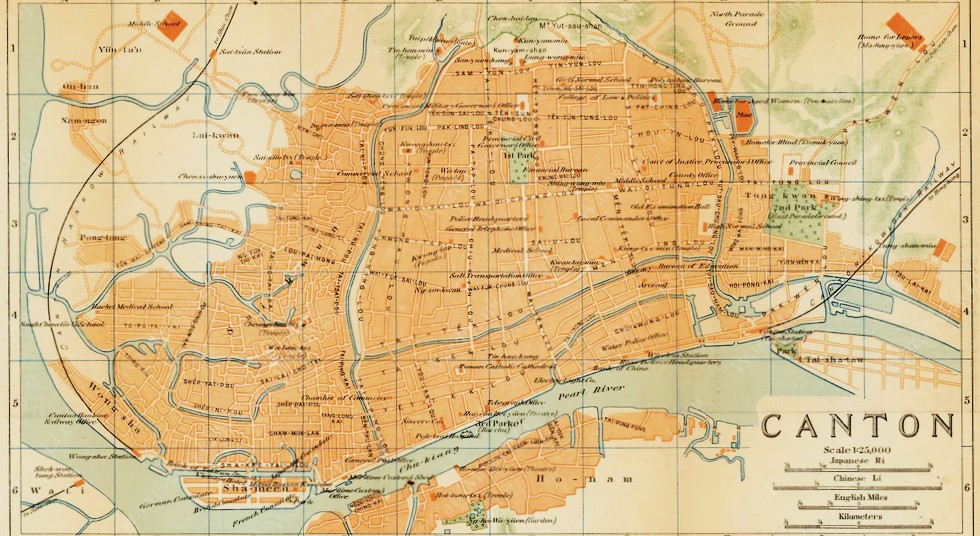
Pepper gives what would have then been an authoritative assessment from the Communist International’s leadership of the lessons of December, 1927’s disastrous Guangzhou Uprising before the February, 1928 E.C.C.I. meeting that would weigh the consequences and apportion responsibility. Veteran Hungarian revolutionary and Comintern representative on the U.S. Communist Party leadership, Pepper would be a lead factional supporter of Lovestone and come to power in the Comintern with the leadership of Bukharin after the removal of Zinoviev. For several year he would play a leading role in the International, serving on the Presidium of the E.C.C.I., associated with the Right, he was removed from positions of authority with Bukharin, Lovestone, and others in 1929. His past role guaranteed he would fall victim to the purges. He arrested in July, 1937 and executed one month before Bukharin on February 8, 1938.
‘After the Canton Uprising’ by John Pepper (József Pogány) from The Communist. Vol. 7 No. 3. March, 1928.
THE FEBRUARY PLENUM of the Executive Committee of the Communist International will have to occupy itself very deeply with the burning problems of the Chinese Revolution.
The independent revolutionary awakening of the working class, the constantly spreading peasant uprisings, which have taken on an increasingly radical aspect with the adoption of the slogans of the plebeian agrarian revolution, and the growing pressure of the imperialists have driven the “national” bourgeoisie into the camp of the counter-revolution. This fact is one of the most fundamental factors to be considered in judging the general situation of the Chinese Revolution. The ex-national bourgeoisie has formed an alliance with the imperialists and militarists against the workers and peasants. A certain consolidation of the forces of reaction is taking place in China. This consolidation by no means signifies the end of the immediate revolutionary situation in China. Neither economically nor politically have any of the problems of the revolution been solved. The working class and the peasantry have not been vanquished. Marx said: “The advance of the revolution consolidates the forces of the counter-revolution, but this only results in giving the revolutionary forces the possibility of overthrowing the entire counterrevolution.”
The peculiarity of the present situation in China consists precisely in the fact that the period of the bourgeois-democratic revolution has not by any means been terminated, but the bourgeois-democratic revolution has already begun to develop into the proletarian-Socialist revolution, and several characteristics of the proletarian revolution have already shown themselves. The tasks of the bourgeois-democratic revolution have not yet been solved: China is not united. China has not freed herself from the yoke of the imperialists. The destruction of the remnants of feudalism and the carrying out of the agrarian revolution are the basic tasks of the struggle of the masses. The period of the bourgeois-democratic revolution has not yet been terminated, but the leader of the revolution is already the proletariat, supported by its ally, the peasantry. The proletariat battles today for the establishment of the democratic dictatorship of the workers and peasants in the form of Soviets.
Signs are multiplying of late according to which a certain change in the policy of the imperialist powers in China is being prepared—a new “peaceful” imperialist intervention. The last interventions of the imperialists were carried out at the moment when the Nationalist armies, which at the time were still playing a revolutionary role, occupied Shanghai and Nanking. Intervention was aimed at that time against the national bourgeoisie allied with the workers and peasants. The situation has now radically changed. This is precisely one of the most important of the new characteristics of the Chinese situation. The ex-national bourgeoisie has fulfilled the two principal demands of the imperialists: the overthrow of the workers and peasants and the rupture with the Soviet Union. The Nanking Government of the Kuo Min Tang Party is today nothing else but a political “comprador” of the imperialist Powers. The new imperialist intervention is not to be carried out against the ex-national bourgeoisie of China but in agreement with the Chinese bourgeoisie. The intervention is to seem to bear a “peaceful” character; foreign troops are to form only the reserve, the so-called “national” armies of the Nanking Government constituting the principal forces. The Nanking Government, in some form or other, will be recognized, in order that there may be a government existent which will recognize in return the claims, privileges, and exploitation-rights of the imperialists.
The above-mentioned re-groupings of class forces and changes in political conditions, which are developing on the basis of the economic decline, the growing chaos, the endless militaristic wars, the increasing impoverishment of the masses of workers and peasants, are the factors which determine the position of the working class and also the relation of the Communist Party to the proletariat.
THE AUGUST CONFERENCE OF THE PARTY
The young Communist Party of China, which today forms the target of the combined forces of reaction and which must carry on its fight under the most brutal oppression of the vilest White Terror, passed during this period through a decisive, fundamental crisis. The August Conference of the Communist Party of China signified a ruthless reckoning with the whole system of opportunistic errors of the earlier period, freed the Party from the old opportunistic leadership, and in a definitely Bolshevist manner directed its course toward armed uprising. The Communist workers of China also in the earlier period carried on a series of heroic struggles, but the Party leadership made catastrophic, opportunistic errors. It sought to subordinate the class struggle of the proletariat to the national struggle. It saw only the various combinations of generals and politicians above and not the unfoldment of the struggles of the masses below. It neglected the main task of arming the proletariat. It shrank back before the great historic task of developing the plebeian agrarian revolution. It created a situation wherein the danger threatened that the Communist Party would become an appendage of the Kuo Min Tang. It is a sign of the indestructible vitality of the Communist Party of China that, with the help of the Comintern, it succeeded in overcoming these opportunistic dangers and in again taking its course along the main current of the revolution.
SIGNIFICANCE OF CANTON UPRISING
Without this definite settlement of accounts with opportunism the uprising in Nanchgang and the southern expedition toward Swatow would have been impossible. The August Conference created the conditions for the December uprising in Canton. The Canton uprising, however, not only demonstrates the complete heroism of the Chinese proletariat and the splendid fighting spirit of the Communist Party of China, but takes its place as one of the most important events of the Chinese Revolution. The establishment of the Soviet Republic in Canton possesses an historic significance, is the most glorious deed of the Chinese proletariat, and denotes the highest stage of development of the Chinese Revolution yet attained. The Canton uprising was put down, and the bourgeoisie of the whole world affirms with malicious joy that Canton has become “the city of the dead.” The bourgeoisie records only the defeats of the revolution, and refuses to see what a fundamental advance of the Revolution the establishment of Soviet authority in one of the most important centers of the Far East represents. There is a symbolic significance in the fact that Canton, the cradle of the bourgeois revolution, has now also become the cradle of China’s proletarian revolution. The Canton of Sun-Yat-Sen has now become the Canton of Lenin. Canton was defeated, but this defeat is the source and the guarantee of future victory.
The August Conference, which settled accounts with opportunism, the Swatow expedition and the Canton uprising are the great plus in the balance of the Communist Party of China in the period just elapsed.
In the analysis of the situation of the working class and of the relation of the advance guard of the proletariat to the working class it is also necessary to take into consideration those factors which represent the minus in the balance.
The defeats of the revolution (Shanghai, Wuhan, Swatow, Canton) have in many respects temporarily limited the activity of the working class during the recent past. The economic depression and the increasing fury of the White Terror have weakened the great mass organizations of the proletariat which were formed in the earlier period. The labor unions are perhaps not in condition to take in the broad masses of the proletariat; they are only skeleton organizations and often only leading committees. Many economic strikes embrace only a small number of workers and are often not sufficiently coordinated one with another. The strike movements carried on by the Shanghai workers during the last five months could not be carried through to victory. The peasant uprisings, which have taken place in many districts, have found for the most part no active support on the side of the workers’ movement. The Canton uprising did not result in any mass movements among the working class of the rest of China. The General Strike slogan of the Communist Party was not carried out anywhere. The counter-revolutionary Kuo Min Tang is seeking everywhere to split the workers’ ranks. It is setting up everywhere yellow labor unions, which are never genuine working-class organizations but simply appendages of the State apparatus, a section of the military forces. The yellow union of mechanics, during and after the Canton uprising proved an active counter-revolutionary force, vying with the generals in the slaughter of revolutionary workers.
This situation of the working class and the workers’ movement brings with it the danger of a rift arising between the broad underlying ranks of workers, who are suppressed by the White Terror and limited in their freedom of movement, and the active revolutionary minority—the Communist Party.
This danger becomes still greater on account of the social composition of the Communist Party. Since the Party (especially its leading strata) is still composed of more students and intellectuals than is desirable and of too few workers and peasants, the break with the Kuo Min Tang and the desertion of the petty bourgeoisie necessarily provoked a certain crisis in the work of the Party. During the period of great political strikes, mass meetings, and mass demonstrations the intellectual elements of the Party were also able to play a very great role among the real toiling masses. At the present time, however, when the workers are not out on the streets but are in the factories or, unemployed, have gone back to their villages, and when the leadership of economic struggles plays a great role, many sections of this intellectual circle cannot adapt themselves to the conditions of struggle and underrate such means of struggle as Mass persuasion, mass agitation, and mass propaganda.
SHORTCOMINGS IN PARTY’S WORK
This incorrect attitude, which, however, has by no means affected the whole Party and which should not be exaggerated under any circumstances, has resulted in a whole series of shortcomings in the daily work of the various organizations of the Communist Party. The most important of these shortcomings are:
1. Neglect of work in the labor unions; neglect of the struggle for the every-day demands of the working class.
2. Too close an alliance of the labor-union movement with the Communist Party. The correct line, whereby the labor unions must be under the political guidance of the Communist Party, has been distorted in practice, so that too close an organizational connection between the labor unions and the Party has been established, in many instances the labor-union and Party committees being identical, and the labor-union organizations are often only sections of the Party instead of embracing much broader masses of workers.
3. Often strikes are called without regard to the economic situation in the industries concerned and without regard to the given relation of forces, even when there is no possibility at all of any success.
4. Strikes are called without consulting the categories of workers concerned, many times even against the will and against the vote of the workers affected.
5. Strike movements are begun under the leadership of Communists without any attempt to negotiate with the capitalists, so that the yellow labor-union leaders are given the opportunity to seize upon the leadership of the strike movement and to carry on the negotiations with the employers in the name of the workers.
6. The Terror against the yellow labor-union leaders is often not accompanied by propaganda to unmask these leaders. No attempt is made to enlighten the mass of members of the yellow labor unions, by means of propaganda and agitation, regarding the traitorous activity of these leaders.
The above-described tendencies, which show themselves on many occasions in the various party organizations and which in general come from the neglect of the means of mass agitation and mass propaganda in the leadership of the labor unions, must be scrupulously exposed and overcome, since they bring with them the great danger of the broad masses of workers losing their confidence in the revolutionary labor unions and the Communist Party, of the leadership of the economic struggles passing into the hands of the yellow labor-union leaders, and of the revolutionary advance-guard isolating itself from the broad masses.
With the underrating of mass agitation and mass propaganda in the leadership of the working-class also goes the tendency of some party circles to a faulty understanding of the requisite conditions for an armed uprising as a means of class struggle in certain situations. This tendency manifests itself in the first place in the conception that armed uprisings can and must be called forth, everywhere and at all times, regardless of the given relation of forces. It is a conception, according to which one must “make haste” with the armed uprising, for otherwise, due to the economic decline in the country, the increase in the closing of factories, and the atomization of the proletariat, the revolution of the workers and peasants would come too late. The November theses of the plenum of the Central Committee of the Communist Party of China also take a stand against this tendency. The great problems of the correct choice of the moment for the uprising, of the ensuring of the broadest mass participation, and of the most careful, all-round political, organizational, and military preparations for the uprising must also be considered and discussed in connection with the Canton uprising. One of the most important tasks of the February plenum of the E.C.C.I. will also be to examine into those shortcomings which have been pointed out in this respect in connection with the Canton uprising. The lesson of the Canton uprising for the Chinese proletariat must not consist only in the establishment of its great major-historical significance but also in the drawing of those lessons which the next time, at future uprisings, will lead to a greater participation of the masses, to a more favorable choice of the moment.
These tendencies, which are manifested in many party circles in China, must be analyzed and overcome. The establishment of these tendencies, which incline toward a “revolutionary impatience,” does not, however, imply that at present there are no opportunistic dangers in the Chinese Party. The basis of opportunism was the faulty adaptation of the Party to the new conditions of struggle which were created by the agrarian revolution. The basis of the above-mentioned tendencies is the faulty adaptation of many party circles to the new conditions of struggle which were created by the present re-grouping of classes. The opportunistic danger has not yet been entirely overcome; tendencies to underrate the agrarian revolution are still present. There are still many opportunistic errors in the practical every-day work of the local organizations. This opportunism must be most sharply combatted in all its manifestations.
Only by overcoming both dangers can and will the Communist Party of China become the leader of a victorious uprising of the masses of workers and peasants.
THE TASKS OF THE PARTY
The present status of the Chinese Revolution and the relation today of the Communist Party of China to the working class determines also These tasks for the ensuing period are the following:
1. A definite course toward the uprising. The political slogan to be: Soviets!
2. No trifling with the uprising. A concrete analysis of each situation, in order to be able to determine the conditions which actually include the factors for a victorious uprising. Careful political, organizational, and military preparation for the uprising. Careful choice of the moment for the uprising. Absolute assurance of the greatest possible mass participation in the uprising.
3. The slogan must be raised: On to the masses! Only with the masses can a victorious uprising be carried out. The means of mass persuasion, mass agitation, and mass propaganda must be employed on a broad front.
4. The path of victory in China will lead through a series of armed uprisings in separate provinces, but this does not mean that in the carrying through of an uprising in one province one does not need unconditionally to assure the cooperation of the proletarian and peasant forces of all other parts of the country.
5. Organization of trade unions; their organizational reparation from the party organizations on a broad mass basis. Intensive work to win the masses of workers in the yellow labor unions.
6. Much more intensive binding and coordination of working-class actions with the movements of the peasantry. Organization of peasant leagues. A more determined course toward the plebeian agrarian revolution.
7. Work in the army. The Communist task of disintegrating the armies of the bourgeoisie and the militarists must become part of the daily work of the Party.
8. Building the Party: closer bonds between the Party and the masses, closer cooperation between the leading bodies and the membership of the Party, more democracy within the Party, change of the social composition of the Party in the direction of “proletarization.”
On to the masses, every-day detail work of mass agitation for the careful preparation of victorious uprisings—these are the tasks of the hour for the Communist Party of China.
There are a number of journals with this name in the history of the movement. This Communist was the main theoretical journal of the Communist Party from 1927 until 1944. Its origins lie with the folding of The Liberator, Soviet Russia Pictorial, and Labor Herald together into Workers Monthly as the new unified Communist Party’s official cultural and discussion magazine in November, 1924. Workers Monthly became The Communist in March,1927 and was also published monthly. The Communist contains the most thorough archive of the Communist Party’s positions and thinking during its run. The New Masses became the main cultural vehicle for the CP and the Communist, though it began with with more vibrancy and discussion, became increasingly an organ of Comintern and CP program. Over its run the tagline went from “A Theoretical Magazine for the Discussion of Revolutionary Problems” to “A Magazine of the Theory and Practice of Marxism-Leninism” to “A Marxist Magazine Devoted to Advancement of Democratic Thought and Action.” The aesthetic of the journal also changed dramatically over its years. Editors included Earl Browder, Alex Bittelman, Max Bedacht, and Bertram D. Wolfe.
PDF of full issue: https://www.marxists.org/history/usa/pubs/communist/v07n03-mar-1928-communist.pdf
 Revolution's Newsstand