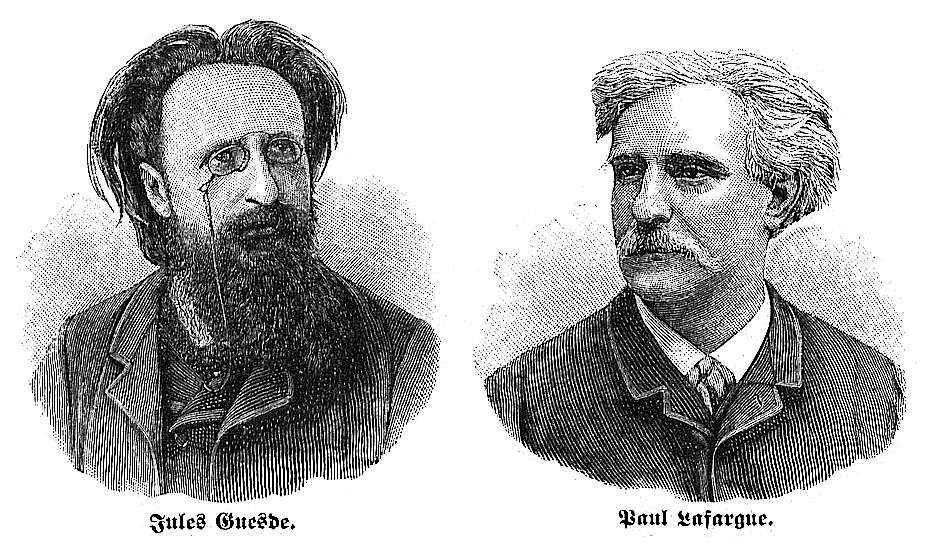
Traveling to Amsterdam as the S.L.P. delegate to 1904’s Congress of the International, Daniel De Leon receives and invitation from Paul Lafargue to participate in the Parti Socialiste conference in Lille before hand. He gives an account of the meeting, his brief remarks to the gathering, and the speeches of Guesde and Lafargue.
‘French Socialists Meet at Lille’ by Daniel De Leon from The Weekly People. Vol. 14 No. 22. August 27, 1904.
Express the Hope that It Will Turn a New Page–De Leon Adresses the Assemblage In French–Lafargue, Geusde, and Others Make Inspiring and Uncompromising Speeches–The Outlook As To What Will Be Done At Amsterdam.
Lille, France, August 9, 1904. The Amsterdam International Congress is not yet officially opened. That will happen on the 14th instant. But the precursor thereto is now under way in this city. It is this year’s national congress of the “Parti Socialiste de France”–the Socialist Party of France, which is the name adopted by the bona fide Socialist groups of France since the Millerandist confusionists forced these groups to consolidate. The congress, or convention, has important questions in hand, not the least of which is the demand that is to be made at Amsterdam on the fatal Kautsky Resolution of four years ago. The convention will open this morning. Last evening a magnificent demonstration greeted the occasion.
A monster procession of workingmen of this city, preceded by a band and torches met the assembled delegates before the railway station, and led them to the spacious hall of the workingmen’s headquarters (Hotel des Syndicats). Invited by Paul Lafargue to assist at the sessions of the convention, I came down from Antwerp and marched beside Lafargue in the procession. The cheers of the multitude, that lined the line of march, at the sight of their delegates told volumes in favor of the “narrow” and “impossiblist” propaganda, agitation and organization of the P.S. de F. It was a truly inspiring sight. Needless to say, both the processionists and the masses along the route sang continuously; it is the French style. The principal songs were “L’Internationale” and endless varieties of the “Carmagnole.” The procession wended its way, on purpose, I suspect, by the houses of leading party members and objectionable capitalists. Need I add that deafening were the cheers with which the former were greeted, and the howls and cat calls bestowed upon the latter? I noticed that the motormen on the tramways along the line joined in these manifestations.
The meeting hall at the workingmen’s headquarters is arranged like a theatre with two tiers of balconies. The delegates had seats on the platform. The meeting was opened with song, in which the whole closely packed mass in the audience joined.
The chairman, Henri Ghesquiere, opened the meeting with a review of the situation in France, and then introduced in succession the following speakers:
Delory, former Socialist mayor of Lille, and now member of the Chamber of Deputies.
Dubreuilh, the National Secretary of the party.
Greffier, delegate from Isere.
Walter, delegate from St. Denis.
Cachia, delegate from Gironde.
Mrs. Sorgue, delegate from Avignon.
Piger, delegate from Loire.
Gronssier, of Paris, former deputy.
Lafoul, delegate from Lorraine.
Daniel De Leon, delegate to the International Congress of Amsterdam from the Socialist Labor Party of America.
Rubanovitch, delegate to the International Congress of Amsterdam from the Revolutionist Party of Russia.
Bouveri, deputy of Montceau.
Bracke, Secretary of the Exterior of the party.
Roussel, present Mayor of Ivry.
De la Porte, present deputy of Sevres.
Dryfus, delegate of Belfort.
Paul Lafargue, of Paris.
Faure, of Dordogne.
Myrhens, of Haute Vienne.
Constans, present deputy for Allier.
Jules Guesde, delegate of Paris.
The delegates were introduced in the order given and with a few fitting words. The speeches were generally short. So was mine. I found it advisable to speak in French, and I said:
“Mr. President and you, revolutionary Socialist proletariat of the North of France–
“On my way to the International Congress of Amsterdam, as the delegate of the Socialist Labor Party of the United States of America, I received from the illustrious Paul Lafargue an invitation to assist at your national convention, the convention of the Parti Socialiste de France, here in Lille. I have come. Had my party in America known of his opportunity, I know it would have instructed me to greet you in its name. I know I act agreeable to its wishes, in greeting you, the revolutionist Socialists of France, as now I do; and in the name of the Socialist Labor Party to assure you that, when the hour shall have struck, America will do her duty. Perchance, on that day, this generation may witness the spectacle witnessed by the generation of 1776–France side by side. with America. In 1776, the oncoming capitalist revolution forced the hand of the then feudal government of France, compelling it to marshal itself with America when America rung the tocsin for the downfall of feudalism. I, for one, among my comrades in America, cast my eyes in Europe upon revolutionist France. Perchance, when the American revolutionary generation of to-day will, in its turn, ring the tocsin for the downfall of capitalism, this generation will see the spectacle of revolutionary France, the revolutionary Socialist proletariat of France, rising simultaneously beside us. But I have not come to Lille to speak. I have come to see and to hear. And when I return to America I shall be able to report to my party the French shading of that central principle upon which both the Parti Socialiste de France and the Socialist Labor Party of America are founded, labor, struggle, and are bound to triumph.”
It would take too long to sum up the short and the long speeches of the delegates giving interesting though local accounts of the movement. Two of these speeches–those of Lafargue and of Guesde–I think it well to sum up.
After having described the recent setback received by the Parti Socialiste de France, Lafargue said in substance:
“Now look at the Social Democratic party of Germany. For the last fifteen years it has steadily grown in votes. How is that? The reason is that while the German party is a Socialist party, yet it is especially a ‘party of opposition.’ Within that party are found all the reform aspirations of the German Empire. There is no other party for them to go to. Consequently all the intelligence of Germany is in that party. It is otherwise in France. The reform bourgeois aspirations here have their parties. We are, consequently, not a party of ‘opposition,’ but a party of ‘revolution.’ With such a party ups and downs are inevitable. But every seeming defeat is a signal for renewed efforts; while every single victory of our enemies wounds them in their vitals.”
Guesde, who closed the meeting, said in substance:
“There is but one Socialism. Behind it alone is organized and can be organized the proletariat. Socialism knows no compromise. Whoever deals with the enemy betrays the workingman. In this struggle we are hit hard, it is true. But thus, we, who were iron, now have become steel. An international congress is about to be held. We shall see whether elsewhere also such progress has been made, whether the music of the phrase has at last been silenced by experience, I hope that at Amsterdam a new page will be turned, that none but revolutionist Socialism, will be recognized.”
Guesde’s speech was punctuated with an applause that was of unmistakable tone.
In connection with his utterances I should also mention the speech of Marcel Cachin, the delegate from Gironde. He climaxed his arguments with the expression of the hope that at Amsterdam all the fusionists and confusionists will be fired out, and the international movement cleanse itself, the same as the Parti Socialiste de France did.
Nevertheless, from several other delegates I learn that there is little hope of a straight stand being taken at Amsterdam. The reason they give for this is that neither Austria, nor part of Italy, nor Holland, nor Belgium would be disposed to go so far. A majority of the Congress of Amsterdam, it is claimed, will do everything to avoid a rupture. Some few admit that eventually a rupture is bound to take place.
Last night’s demonstration looked essentially like an S.L.P. demonstration.
DANIEL DE LEON.
New York Labor News Company was the publishing house of the Socialist Labor Party and their paper The People. The People was the official paper of the Socialist Labor Party of America (SLP), established in New York City in 1891 as a weekly. The New York SLP, and The People, were dominated Daniel De Leon and his supporters, the dominant ideological leader of the SLP from the 1890s until the time of his death. The People became a daily in 1900. It’s first editor was the French socialist Lucien Sanial who was quickly replaced by De Leon who held the position until his death in 1914. Morris Hillquit and Henry Slobodin, future leaders of the Socialist Party of America were writers before their split from the SLP in 1899. For a while there were two SLPs and two Peoples, requiring a legal case to determine ownership. Eventual the anti-De Leonist produced what would become the New York Call and became the Social Democratic, later Socialist, Party. The De Leonist The People continued publishing until 2008.
PDF of full issue: https://www.marxists.org/history/usa/pubs/the-people-slp/040827-weeklypeople-v14n22.pdf
 Revolution's Newsstand