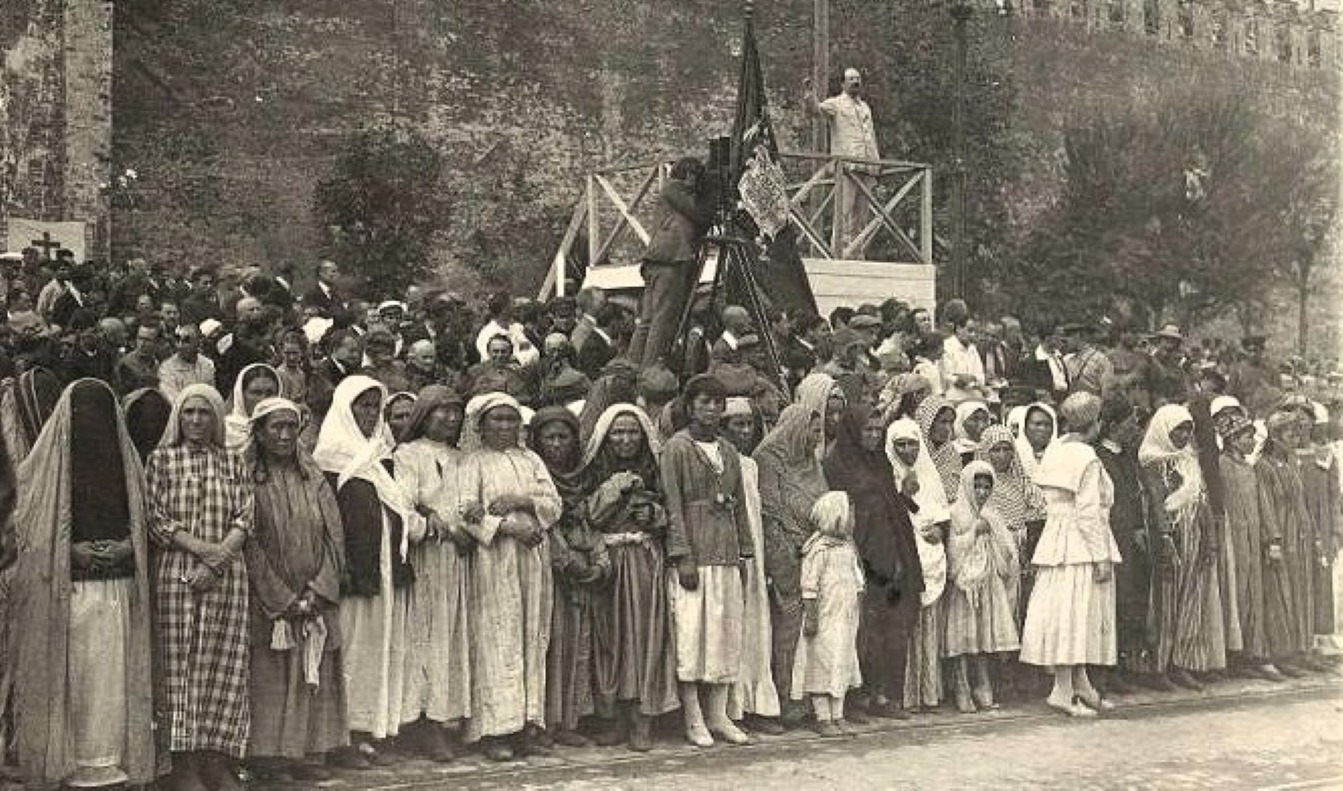
Lunacharsky speaks to the condition of Soviet women ten years on from the Revolution and in anticipation of the coming Working and Peasant Women’s Conference he would address.
‘The Working and Peasant Women’s Conference’ by Anatoly Lunacharsky from International Press Correspondence. Vol. 7 No. 55. September 29, 1927.
It was said by Lenin that it is impossible to build Socialism without the aid of one half of the human race, the women. He proudly pointed to the fact that our legislation, from the legal standpoint, emancipates the woman and extends to her full equality with the man, in an intimately higher degree than this is done by the legislation of the most progressive bourgeois countries.
At the same time he pointed out with a note of grief that the legal emancipation alone does not yet mean actual liberty and equality. The proper working of the law is hindered in actual life by three formidable forces: the economic dependence of the women, the social prejudices, and the cultural backwardness of the woman. It is on these three lines that the Soviet and public authorities have to carry on an unceasing campaign.
Whilst the proletarian woman directly employed in production has benefited much from legislation, the effect was considerably less in the case of the housewive, even if she is the wife of a worker. Lenin minced no words in denouncing the slavery of the private kitchen, the menial toil at the washboard, the lack of rational organisation in taking care of the children, and so on. We know quite well that the only complete deliverance from this slavery will come as the result of the organisation of model dwellings for the workers, large public dining rooms, steam-laundries, well-equipped creches and children’s homes, and the extension of all these activities from the town to the village.
Next to the economic conditions holding back the woman at the stage of the most petty and worse organised drudgery, are the deep-rooted social traditions which enhance the degradation of the woman as compared with the man.
Our equitable Marriage Laws do not preclude the possibility of the man frequently being a tyrant in regard to the woman, or of unscrupulous men taking advantage of the weakness of women and girls, destroying their lives in the pursuit of carnal lust. The situation is particularly bad among the nationalities where the woman is still considered an inferior being, and is treated as a captive and a slave. It is with tremendous difficulty that the new Soviet views on sex equality find their way through the thick layer of these prejudices that are frequently sanctified by religion.
Finally, it is necessary to make the working woman equal to the man in all respects, to render her equal in regard to earnings, in regard to the acquisition of the means of subsistence; to point out to her her human dignity, to let her understand in what ways she can protect herself against abuse and oppression; to allow her to stand firmly on her own feet and to be dependent on nobody, giving her affection and bearing children only to him whom she likes and with whom she can form a partnership on terms of equality; to extend to her the wide possibility of taking part in the whole of the political life of the country, to progress ever forward, by the side of the progress of the man.
All this will be possible only if the woman, whose average cultural level is still terribly low, is lifted to a higher stage of education. In all the aspects of State legislation, particularly in regard to popular education, we must survey all that has been done and outline the way for new progress, doing this in collaboration with the women themselves.
These were the reasons which prompted the calling of the important All-Union Conference of Working and Peasant Women. Great numbers of them are already active in the Soviets and as delegates on public bodies, and from the fairly numerous ranks of these awakened and open-eyed women there will be elected the hundreds of representatives who will make up the Conference. We lay great hopes on that Conference. We shall hear there the voice of the toiling women themselves, delivered by women who observe the conditions and events of public work. We shall probably hear a good many unpleasant things from these heralds from towns, villages, and hamlets. For we are not unmindful of the mass of darkness and grief that is still the burden of the woman in all the countries of our Union. But we shall probably hear from them also the story of the struggle of the woman for her emancipation, and the testimony how gradually the good seed of freedom and common sense scattered by the Soviet authorities over all the corners of our gigantic Union is bearing fruit. To them we shall submit our further plans, and they will give us the benefit of their counsel.
It is good that the Conference is to be started with a general address on the external and internal situation. Not in vain were uttered those famous, so oft repeated, words of Lenin that “every cook should learn how to govern the State”. Let the women appreciate this address of the government, the report of those to whom the whole people have entrusted to manage the affairs of the U.S.S.R., which will be delivered before the working and peasant women.
A good deal of importance is being attached also to the report which it has fallen to my lot to deliver. Material will be gathered not only on the R.S.F.S.R., but also on other countries of our Union, in order to report to the women on what has been achieved in the line of pre-school and school education, technical and higher schools, on political education, craft schools, and so on; on what has been done to pave the road of equality for the woman, to enable her to occupy a place of equality with the man. An account will be given as to how much the women, young women and little girls, have already benefited, and what hinders the government and the women from achieving even greater results, what is to be done to speed the progress of the Soviet women in this direction.
The days of the Conference will be days of the closest attention for the whole country in regard to the needs and grievances, as well as the achievements of the Soviet woman.
Let foreigners attentively watch this Conference, let the working and peasant women throughout the world realise what a great boon the October Revolution has been to the women of our country. And may our enemies also take note of this, who resort to calumny in the effort to discourage the October achievements.
On the eve of the celebration of our tenth anniversary of the Revolution it is both wise and expedient to survey the achievements of the campaign for the improvement of the lot of the women, and to cast a glance ahead, at the tasks that are yet to be accomplished in this domain.
International Press Correspondence, widely known as”Inprecorr” was published by the Executive Committee of the Communist International (ECCI) regularly in German and English, occasionally in many other languages, beginning in 1921 and lasting in English until 1938. Inprecorr’s role was to supply translated articles to the English-speaking press of the International from the Comintern’s different sections, as well as news and statements from the ECCI. Many ‘Daily Worker’ and ‘Communist’ articles originated in Inprecorr, and it also published articles by American comrades for use in other countries. It was published at least weekly, and often thrice weekly. Inprecorr is an invaluable English-language source on the history of the Communist International and its sections.
PDF of full issue: https://www.marxists.org/history/international/comintern/inprecor/1927/v07n55-sep-29-1927-inprecor-op.pdf
 Revolution's Newsstand