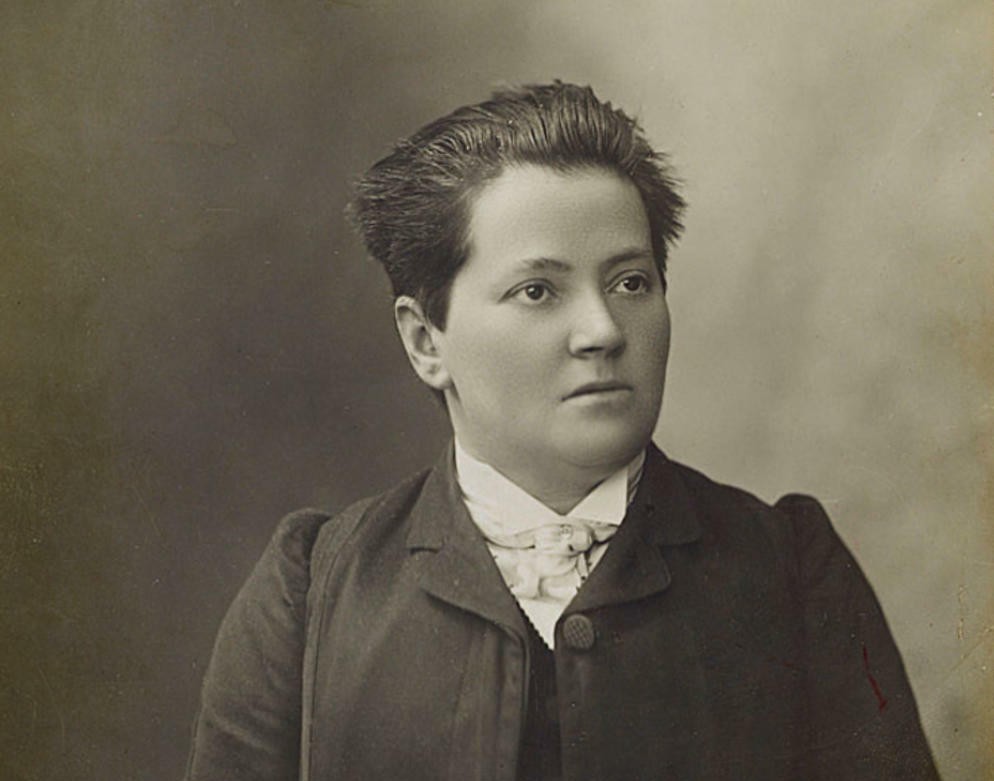
Rather than deny a ‘feminist’ approach, Madeleine Pelletier advocates for proletarian feminism in 1907.
‘Bourgeois Feminisme and Socialist Feminsme—A Difference with a Distinction’ by Dr. Madeleine Pelletier from The Weekly People. Vol. 17 No. 13. June 22, 1907.
[From the French in “Le Socialiste,” translated by Mary Miller, Mapleville, R.I.]
[Feminisme is defined in French dictionaries as a doctrine which holds woman the absolute equal of man and accords her the same rights.]
Because you are a socialist, said some comrades but a short time ago, you cannot remain a feministe; for there are, contradictions between feminisme and socialism.
I confess I was perplexed—what contradictions? I then opened the pamphlets by Guesde and read phrases such as this:
“The servitudes of the alcove are more degrading than these for the patrons.” In Guesde further and in Lafargue I read that socialism proclaimed equality of the sexes and, even in the present society it should work for the emancipation of the inferiorized sex.
But is not feminisme just this; and nothing but this?
Convinced however that in the domain, of ideas as in those of action, nothing happens without cause, certain that even the incoherence of Mr. Clemenceau could be traced to causes, I asked myself what could have provoked the repugnance of socialists for feminisme.
It was not hard to find. What the socialists object to is not feminisme but the feministes.
While philosophy moves always in the domain of speculation, politics is entirely in life. It gains in interest but losses in precision. What is in philosophy cold and conscientious analysis becomes in politics vague sentiment and impression. The theories take shape; the shape of the people one elbows daily; friend, adversary and ideas are so incorporated in the man that one no longer is clear if it is because of ideas that one combats or approves the man; or if it is the esteem or aversion for the man which makes us accept or reject the ideas. And the same as all other political theories, feminisme is incarnated in women and these women belong to the enemy’s camp.
The bourgeoisie emancipated itself before the proletariat, and their women also demanded their emancipation before the working women got the idea.
The workingman resigned himself to wage slavery and the working woman to marital slavery; and, to defend the rights of the oppressed sex there were but those whose privileged condition permitted them to cultivate their intelligence.
Naturally these women of the bourgeoisie, though fighting for their sex, remained none the less in their class; they reasoned and revindicated as though the entire feminine society was comprised of only these who had rents, and diplomas. Of the working woman they did not even speak; they were but the vile herd, fit only to work for them.
I explain and do not excuse. I hasten to say, not for an instant is the party to think of seconding the bourgeois feminisme. At the day of the social revolution, which I desire near, their feminisme will not entitle them to one tittle of clemency. We shall place them against the wall along with the anti-feminists of the same class. But even in politics, it were a mistake to let ourselves be influenced by persons so as not to see the justness of theories.
Feminisme is political and social equality of the two sexes; its triumph would profit all women; working women as well as others. The woman proletaire is twice slave; slave of her husband and slave of the patron; the success of the feministe revindication would make her a slave but once; that would be progressing.
The attitude to take toward feminisme is very simple; create at the side of the bourgeois feminisme the feminisme proletarian and socialistic.
The bourgeois feminisme is impotent anyway. The women of the bourgeoisie are saturated with prejudice which blocks their actions or makes them vain. They cannot venture on the street but in their carriages; and to talk loud seems to them the culmination of bad taste. To express her revindication the bourgeois feministe must have a salon, an audience decollete; it is not thus that laws are revoked or the customs of a whole society changed.
The proletarian feminisme would talk where it should, that is, in political meetings, in the public reunions, in the street. And it shall win the victory.
New York Labor News Company was the publishing house of the Socialist Labor Party and their paper The People. The People was the official paper of the Socialist Labor Party of America (SLP), established in New York City in 1891 as a weekly. The New York SLP, and The People, were dominated Daniel De Leon and his supporters, the dominant ideological leader of the SLP from the 1890s until the time of his death. The People became a daily in 1900. It’s first editor was the French socialist Lucien Sanial who was quickly replaced by De Leon who held the position until his death in 1914. Morris Hillquit and Henry Slobodin, future leaders of the Socialist Party of America were writers before their split from the SLP in 1899. For a while there were two SLPs and two Peoples, requiring a legal case to determine ownership. Eventual the anti-De Leonist produced what would become the New York Call and became the Social Democratic, later Socialist, Party. The De Leonist The People continued publishing until 2008.
PDF of full issue: https://www.marxists.org/history/usa/pubs/the-people-slp/070622-weeklypeople-v17n13.pdf
 Revolution's Newsstand