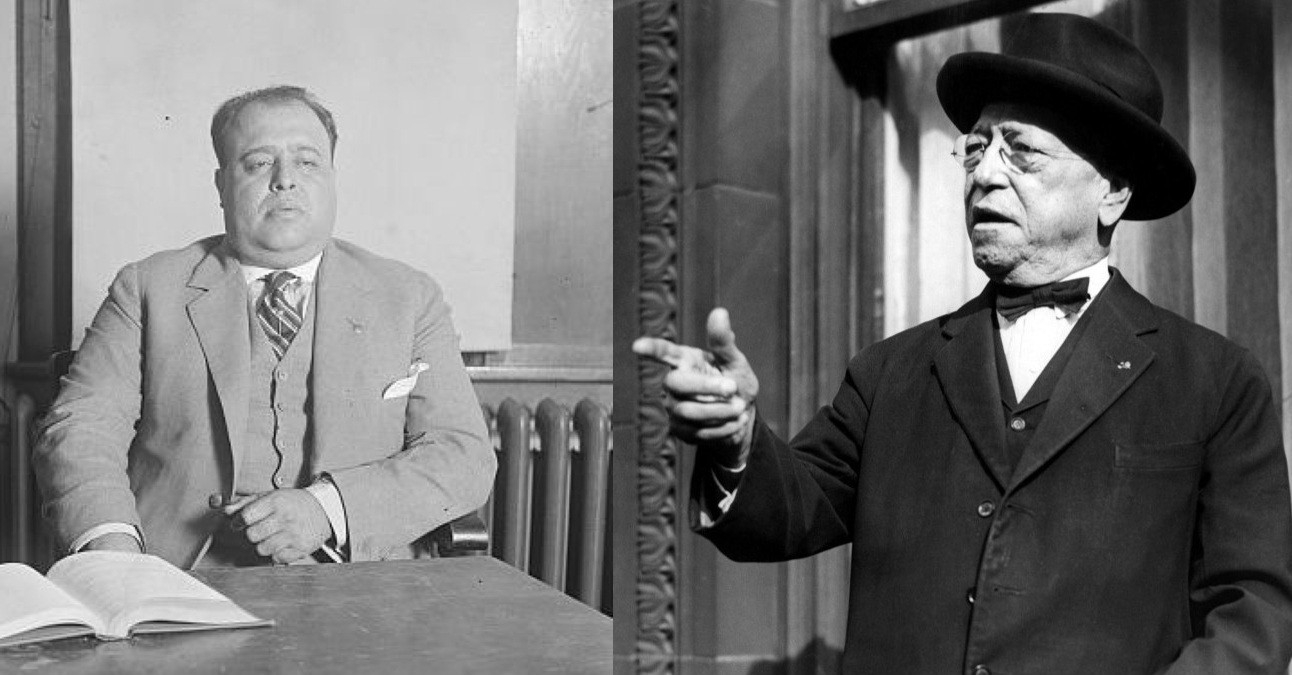
The story of Imperialism’s labor tool, Samuel Gompers, in concert with the C.R.O.M.s Luis Morones, being put to use in undermining Central and South American unions at the behest of bankers and U.S. foreign policy, creating the scab ‘Pan American Federation of Labor’ to rival indigenous and militant unions.
‘Pan-American Adventures of Sam Gompers’ by J. Ramirez Gomez from Labor Herald. Vol. 3 No. 7. September, 1924.
BETWEEN sessions of the American Federation of Labor convention in El Paso, Texas, this fall, Gompers will sandwich in some conferences with a sporty, fat-faced, diamond-studded Mexican gentleman by the name of Luis N. Morones. Gompers and Morones will decide upon some two score of Latin-American proteges with whom it is safe for Mr. Gompers to associate. They will also decide what should be said to these proteges, and what the proteges should be permitted to say in return. The Gompers-Morones confab at El Paso will constitute the “preliminary conference of the Pan-American Federation of Labor”–preliminary to a convention of that body which is scheduled to take place in Mexico City next December.
The name of the “Pan-American Federation of Labor” may have a strange sound to the average A. F. of L. member, who will perhaps be a bit surprised to find that the bona fide American labor movement has affiliations outside the United States. The A.F. of L. has kept primly aloof from the Red International of Labor Unions–and a few years back, Gompers went so far as to break off relations with the Amsterdam International, on the grounds that even that yellow organization was not yellow enough. Gompers’ foreign policy approximates that of Charles Evans Hughes.
The Monroe Doctrine in Practice
In the Western Hemisphere, however, conditions have forced a different attitude. This is the continent of Wall Street. When a Mexican goes on strike, it may be against Doheny, or Standard Oil, or the Guggenheimer Copper interests, or the Harvester Trust. The Big Boss behind a Cuban worker’s straw boss is likely to be the United States Shipping Board, or the American Tobacco Company, or the Sugar Trust. Every mail from Argentina brings stories of the bitter struggles in the meat packing industry, where Swift and Armour have more than $35,000,000 invested. In Central America, as in the islands of the Caribbean, there is the ubiquitous United Fruit Company. Everywhere there are the banks–Morgan banks, Rockefeller banks, or Morgan-Rockefeller banks, as the case may be.
To all intents and purposes, there is but one aggressive national capitalism with which the toiling masses of the western world have to contend; that is, American capitalism.
American capitalism goes into the Latin-American countries not for the glory of the “American Empire” nor in the interest of the American workers, but to pile up more capital for itself. All well-bred employers in this country are supposed to love the American working class but they do not love American wage-scales and working conditions. Big Business has contrived to escape from such annoyances by exporting an increasing proportion of its capital to Latin-America, where wages are lower and working conditions rottener. The cheap Latin-American output is then shipped back into the United States or into the other markets of the world, to compete with the products of American labor. To meet this kind of competition, the standard of living of the American workers is also forced down.
The Peon’s Fight for Organization
This process does not confine itself to the Western Hemisphere. Capital knows no boundary lines; it does not stop for oceans or mountain ranges. The class struggle of the workers is consequently a world wide struggle and that is why the Red International of Labor Unions is striving to unite the exploited masses on a world scale. Nevertheless, the situation in the Americas has special features of its own. Two Cuban general strikes within the past four years have been broken through the menace of American warships anchored in Havana harbor. Detachments of American marines are scattered all through Central America, where they “maintain law and order” in the interest of Wall Street investors and the threat of further invasions hangs constantly over the heads of every one of the weaker nations of Latin-America. This direct contact with the repressive machinery of American capitalism makes close co-operation of the labor movements of the Western Hemisphere a first essential, which does not take the place of affiliation to the general international movement represented by the R.I.L.U., but is a necessary supplement to it.
The toiling peons in the lands to the south of us are not accepting their lot without a struggle. They have built up some powerful labor unions. In Argentina there are nearly 125,000 organized workers, including metal workers, textile workers, leather workers, transport workers and agricultural workers. General strikes in Buenos Aires have tied up all traffic in that important port for seven and eight months at a time. In Chile and Uruguay, and also in Mexico, vigorous labor movements exist. The state of advancement of the labor movements in these countries should not be naively exaggerated, but the unions are making sturdy strides, especially in proportion to the development of industry.
In the course of the last few years the workers of North, South and Central America have been drawn into closer and closer association with each other. This is shown by the opposition of Cuban and Mexican unions to the time-honored system of engancho, under which Latin-American peons are brought into the United States in gangs to scab on their American fellow workers. It is further shown in the demand of the Argentine transport workers for international strike agreements. From the side of the United States, it is reflected in such things as the silent approval by the American workers of the stand taken by the American Federation of Labor officialdom against the uprising of De La Huerta in Mexico. Of course, it must be noted that this stand of the A.F. of L. bureaucracy harmonized exactly with the stand of the American capitalist government.
The Impulse Without Expression. The so-called Pan-American Federation of Labor arose out of the overwhelming impulse to all-American labor unity which was a direct consequence of the continual expansion of American capitalism. But it arose to distort and exploit this impulse, not to give it legitimate expression. It has never won the confidence of the Latin-American masses. And, despite the solid basis for co-operation of the labor movements of the Americas, the convention which is to meet in Mexico City next December will represent nothing but a paper organization, with hand-picked delegates decided upon by Gompers and Morones in private conference. Except for the A.F. of L., the only bona fide labor organization belonging to the Pan-American Federation of Labor is the Confederacion Regional Obrera Mexicana, dominated by Gompers’ prosperous ally, Morones. The main body of the Latin-American labor movement–as exemplified in the important federations of Argentina, Chile, Uruguay, etc.–has kept its distance.
It was Gompers who started the Pan-American Federation of Labor and his way of going about it provoked universal suspicion. He kept his finger on everything. He insisted on being the sole leader. but he refused to lead. Under his financial stewardship the Pan-American Federation has never indulged in a fight of any kind–least of all against American imperialism. In every convention where the Latin-Americans have raised mild protests against outrages committed by United States troops in Latin-American territory, Gompers has rushed to the defense of our national honor, delivering long homages to the American flag, like a newly-matriculated under-secretary of the diplomatic corps. At the first conference of the organization some of the ingenuous Mexican delegates, not yet entirely aware of what was expected of them, introduced a resolution calling for the liberation of political prisoners in the United States.
The avidity with which Old Sam sat on this proposition was edifying. The Mexicans never repeated the offense.
Reaction’s Restraining Hand.
In fact, the conviction is forced upon one that Gompers’ whole purpose in promoting the Pan-American Federation of Labor is to “lay a restraining hand on the Latin-American hotheads.” All over Latin-America the organization is looked upon as an adjunct of the American State Department, with the Monroe Doctrine as its inspired creed. Consequently, the P.A.F. of L. has remained insignificant, a mere private affair of Sam’s. He is content to have it so, rather than see it “contaminated” with a real fighting spirit. The American Federation of Labor foots the bills for the infrequent conferences or conventions, and Sam digs up the delegates, with the assistance of Morones, and the well-known Porto Rican labor faker, Santiago Iglesias. In between times, a young and enterprising opportunist named Canuto Vargas (who does not pretend to represent any organization) sits in the American Federation of Labor Building at Washington and broadcasts the precious outgivings of Samuel Gompers, in the name of the P.A.F. of L.
The last convention was held in Mexico City in January, 1921. It was to have been quite pretentious, and large sums of money were spent in preparation for it, but it only proved the enormity of the P.A.F. of L. failure. Argentina, Bolivia, Brazil, Chile, Cuba and Uruguay rejected invitations, in most cases roundly denouncing the whole business. Among those present, were three gentlemen from Santo Domingo, claiming to represent 2,500 members of a Dominican patriotic society; Estrada from Salvador, who claimed to represent 2,000 organized workers; Diaz and Solano of Guatemala, who claimed to represent 800 workers; Jacinto Albarracin, the dandy from Colombia, who had the gumption to declare that he and his frock coat represented no less than 200,000 toilers, all of them socialists! I do not give the names of the organizations because they are nearly all false. The membership figures are ludicrous. With one or two insignificant exceptions there are no real labor unions in Central America. Albarracin, the Colombian “socialist,” had with him an exhibit from the Bogota Chamber of Commerce, and he passed out cards inviting everyone to go up to his hotel room and see it.
The convention did not accomplish a single thing in the interests of the workers. The one exciting moment was when Gompers choked off some bitter criticism of American military rule in Nicaragua and Santo Domingo. For the original scathing resolutions, Brother Frey, who was on the job as usual as chairman of the Resolutions Committee, offered substitutes in which the United States was duly praised for the benefits supposed to have been conferred on the occupied territories and politely petitioned to withdraw its troops, “now that they are no longer needed there.”
What kind of a convention will Gompers and Morones arrange for at their Preliminary Conference in El Paso next October? Gompers is still Gompers (at least he was when this was written) and Morones is still Morones. The present proprietors of the P.A.F. of L. can never build a powerful all-American labor movement–firstly, because they do not want to; and secondly, because they have lost the respect of the Latin-American masses.
National labor federations in all parts of Latin-American have repeatedly passed resolutions calling for all-American unity, so it is not through lack of solidarity for the workers of this country that they have given a cold shoulder to the Pan-American Federation of Labor. A united movement of labor in North, South and Central America is not only possible but necessary. But such a movement, to have the confidence of the workers of Latin-America, would have to really voice the aspirations of all.
In the first place, such a movement would have to recognize the fact of the Class Struggle, as stressed by the Red International of Labor Unions. Not by any stretch of the imagination can the Latin-American toilers be brought to believe that their interests are identical with those of the capitalists who are exploiting them. Secondly, it would have to take a resolute stand against American imperialism, systematically showing up everything that Wall Street and Washington are doing in Latin-America, and preparing the workers for the idea of organized proletarian resistance. With United States troops actually on Latin-American territory, the fight against imperialism becomes an acid test of the sincerity and class consciousness of the workers of this country.
The Labor Herald was the monthly publication of the Trade Union Educational League (TUEL), in immensely important link between the IWW of the 1910s and the CIO of the 1930s. It was begun by veteran labor organizer and Communist leader William Z. Foster in 1920 as an attempt to unite militants within various unions while continuing the industrial unionism tradition of the IWW, though it was opposed to “dual unionism” and favored the formation of a Labor Party. Although it would become financially supported by the Communist International and Communist Party of America, it remained autonomous, was a network and not a membership organization, and included many radicals outside the Communist Party. In 1924 Labor Herald was folded into Workers Monthly, an explicitly Party organ and in 1927 ‘Labor Unity’ became the organ of a now CP dominated TUEL. In 1929 and the turn towards Red Unions in the Third Period, TUEL was wound up and replaced by the Trade Union Unity League, a section of the Red International of Labor Unions (Profitern) and continued to publish Labor Unity until 1935. Labor Herald remains an important labor-orientated journal by revolutionaries in US left history and would be referenced by activists, along with TUEL, along after it’s heyday.
PDF of full issue: https://www.marxists.org/history/usa/pubs/laborherald/v3n07-sep-1924.pdf
 Revolution's Newsstand