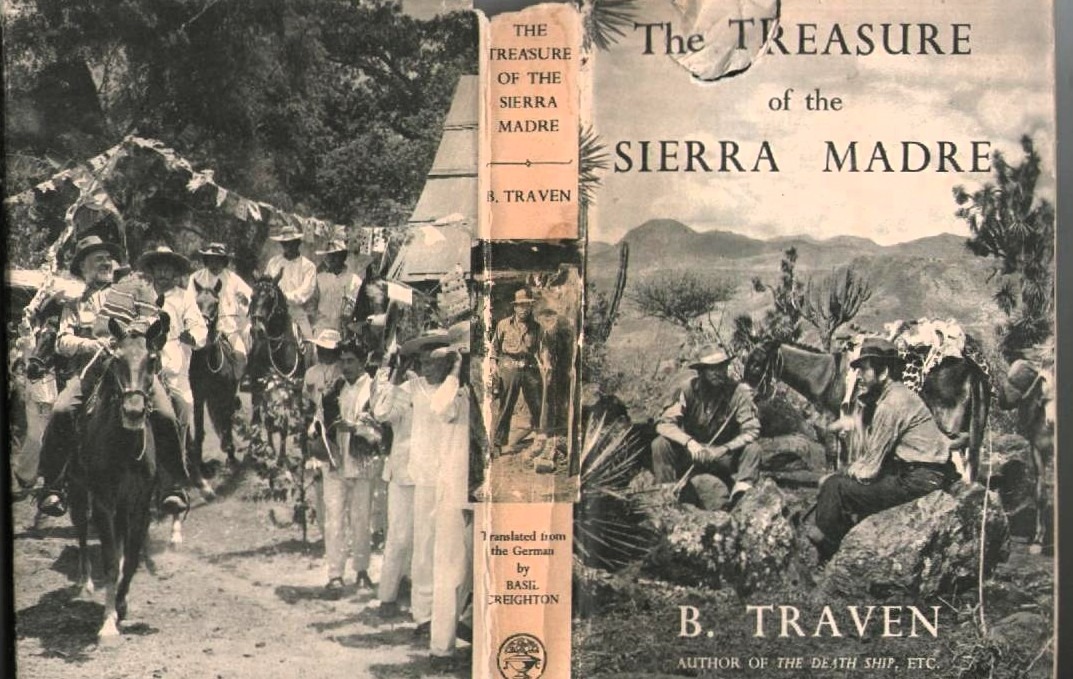
Granville Hicks reviews The Treasure of the Sierra Madre, written by one of literature’s mysteries–the left wing novelist ‘B. Traven.’
‘Proletarian Mystery: The Treasure of the Sierra Madre’ by Granville Hicks from New Masses. Vol. 16 No. 3. July 16, 1935.
THE TREASURE OF THE SIERRA MADRE, by B. Traven. Alfred A. Knopf. $2.50
The Treasure of the Sierra Madre follows The Death Ship, it begins to look as if the man who calls himself B. Traven was the finest story-teller of our times. Both of the novels prove that realism and irony and understanding are not incompatible with action and excitement.
The Treasure of the Sierra Madre begins with Dobbs, jobless and penniless in a Mexican town. After various adventures, Dobbs meets Curtin, who is also down and out. Together they meet an old prospector named Howard. The three start out together to hunt for gold. They find it, but not in fabulous nuggets. To extract it, they work: “Convicts in a chain-gang in Florida would have gone on hunger-strike, and not have minded the whippings either, had they had to work as these three men were doing to fill their pockets.” After months of such labor, they collect some $50,000 worth of dust. On their way back Howard resuscitates an Indian boy and as a result has to stay as a guest of the boy’s father. As the others proceed, Dobbs shoots Curtin. He is subsequently killed by bandits, who are killed by soldiers. Most of the gold is lost. Curtin recovers and is found by Howard, who has become the revered medicine man of the village. When they find a small amount of the dust, the partners consider many possible investments, but finally decide that they will be happier if they remain with the Indians.
It is as simple as that. This simplicity, this ability to tell a straightforward story, is one of the two important factors in the great success that Traven has had among the workers of Europe. The other factor is his complete class-consciousness. He is class-conscious not in his thinking alone, but in all his taste, in every single reaction of his body. He cannot touch a subject from flop houses to lotteries, from mining to murder, without illuminating the nature of the capitalist system. He does this not by generalizing but by being absolutely concrete. He presents phenomena in terms of exploitation and profit because experience has taught him that only in such terms can they be understood.
So natural is this way of looking at life that the whole exciting story might, though Traven very possibly has never read Marx, be regarded as a commentary on a sentence in Capital. Marx, it will be remembered, emphatically states that gold is no exception to the labor theory of value. At first glance this seems preposterous, for immediately we think of the sudden discovery of nuggets worth thousands of dollars and mines worth millions, and therefore we cannot believe that the value of gold is “determined by the labor time needed for its production.” Traven knows better. He knows just how much work that is unrewarded goes into prospecting and how much heartbreaking toil actual mining requires. “Perhaps you know now,” Howard says to Dobbs and Curtin, “why one ounce of gold costs more than a ton of cast iron. Everything in this world has its true price. Nothing is ever given away.”
Because this is the way Traven’s mind works, it makes no difference that there is little in the book about organized labor and nothing at all about revolution. The novel is so thoroughly revolutionary in all the implications that slogans are unnecessary. And certainly they would be out of place. Traven takes his characters as he finds them, and he finds that the degree of their class-consciousness precisely reflects their economic circumstances. When they are down and out, they think as proletarians, but “with every ounce more of gold possessed by them they left the proletarian class and neared that of property holders…The world no longer looked to them as it had a few weeks ago. They had become members of the minority of mankind.” It is because of his insight that Traven can afford to tell so straightforward a story. The art of story-telling has declined in bourgeois literature because simple events are no longer significant. The old-fashioned success story is as ridiculous as the old-fashioned love story. Even tragedy, as Dr. Krutch has pointed out, loses meaning in a world without values. Only the subtle sensibilities of a Joyce or a Proust’ can hold the bourgeois sophisticates and give them the illusion that something important is left in life. But Traven can write an adventure story that is as unpretentious and as absorbing as any that ever beguiled uncritical boyhood and is at the same time honest, revealing and significant.
It ought to be unnecessary to add that Traven cannot accomplish this feat merely by virtue of being a worker and paralleling Marx. He is a writer and an impressively skillful one. Even as a writer, however, he is unmistakably a proletarian. His figures of speech come from working-class experience. His dialogue is not good reporting but natural self-expression: it is less often verifiably accurate than say, James Farrell’s, but it is always consistent, always faithful to character. His sustained irony reminds one of workers’ tales and Wobbly ballads. The very movement of the narrative reflects, in some way that baffles description, the life of the transient worker.
It is a good thing for American proletarian literature and for the American proletariat that Traven’s works are being made available. The publishers are to be congratulated on following The Death Ship with The Treasure of the Sierra Madre and announcing The Carreta Government. But it is a pity that the books cannot be sold at prices workers can afford to pay. They could not find more exciting reading nor a better means of understanding themselves and the society in which they live.
The New Masses was the continuation of Workers Monthly which began publishing in 1924 as a merger of the ‘Liberator’, the Trade Union Educational League magazine ‘Labor Herald’, and Friends of Soviet Russia’s monthly ‘Soviet Russia Pictorial’ as an explicitly Communist Party publication, but drawing in a wide range of contributors and sympathizers. In 1927 Workers Monthly ceased and The New Masses began. A major left cultural magazine of the late 1920s and early 1940s, the early editors of The New Masses included Hugo Gellert, John F. Sloan, Max Eastman, Mike Gold, and Joseph Freeman. Writers included William Carlos Williams, Theodore Dreiser, John Dos Passos, Upton Sinclair, Richard Wright, Ralph Ellison, Dorothy Parker, Dorothy Day, John Breecher, Langston Hughes, Eugene O’Neill, Rex Stout and Ernest Hemingway. Artists included Hugo Gellert, Stuart Davis, Boardman Robinson, Wanda Gag, William Gropper and Otto Soglow. Over time, the New Masses became narrower politically and the articles more commentary than comment. However, particularly in it first years, New Masses was the epitome of the era’s finest revolutionary cultural and artistic traditions.
PDF of full issue: https://www.marxists.org/history/usa/pubs/new-masses/1935/v16n03-jul-16-1935-NM.pdf
 Revolution's Newsstand