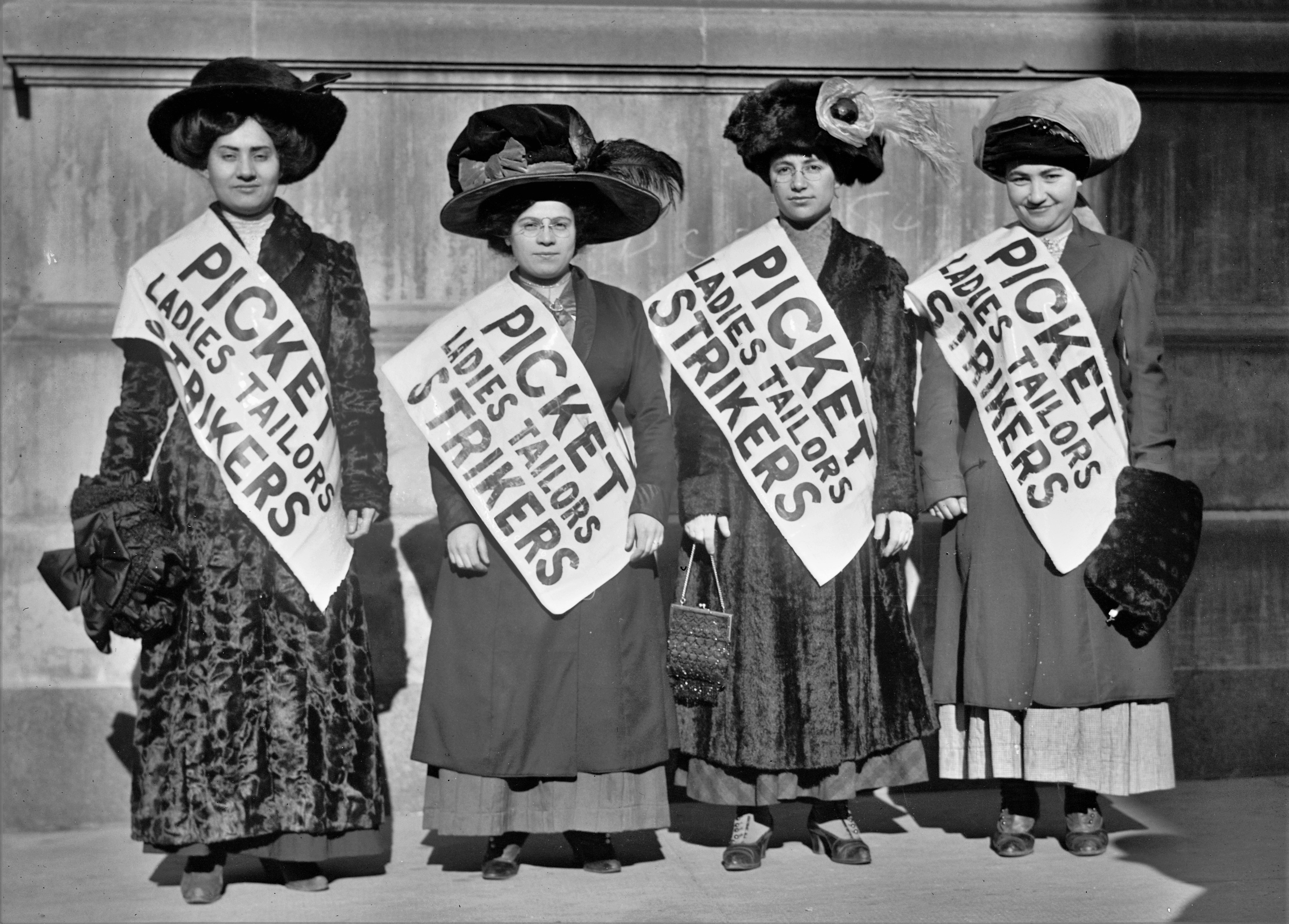
When we strike, we strike for ourselves, for future workers, and significantly, for those already gone. A worker feels the presence of the Triangle Fire victims of 1908 with the picketers during 1919’s New York general garment workers strike.
‘1919 Versus 1911’ by Elizabeth Hasonovitz from Justice (I.L.G.W.U.). Vol. 1 No. 11. March 29, 1919.
Early morning late in March.
In the warm air breezes are swimming, brushing against the passers by whispering into their ears the secrets of the forthcoming Spring. And the heart leaps with pleasant anticipation. For who does not long for the Spring with its romantic warmth, its fragrant beauty? who does not love the Spring which wakens all hidden desires and brightens life with new hope and courage.
But what clouded such cheerful morning? I watched the “Picket Line.” Another Strike for improvement of living conditions. The same old struggle, so old and still so new.
Line after line of feminine forms; pale, worn out, but eyes gleaming with faith, steps sounding with assurance, and on they marched before me. On they marched unmindful of the hired gangsters who would threaten to break their heads; unmindful of the police who arrest them in wholesale, unmindful of the judges who fine them without granting them a trial. On they marched fearless of the world, with belief in their righteousness.
My eyes followed them with admiration whilst thrills were running through me and my heart cried to them.
“I am proud of you little big fighters, proud of your patience and endurance, proud of you who shape the future path toward justice.”
Involuntarily my mind dug into the past struggles and a painful shudder embraced me. An exciting history our industry has. It is written with the flesh and blood of our brave warriors who wrestled for the realization of a better life; it is written with the heartrending loss of so many young victims, who were burnt alive on the altar of greed, on the altar of ignorance. Only eight years ago, in this month of March, on the 25th day, a hundred and forty-seven young workers were murdered through greed, murdered through carelessness by the Triangle Bosses. And on this day of March remember the “Triangle fire.”
Remember the scene of the burning building; the young unfortunates who were locked up and running around madly knocking at the locked-up doors and screaming for help; remember Those who tried to escape through the windows only to be smashed to pieces on the pavements. Who will make such disasters impossible in the future? In this day of your struggle, hearken to them whose ashes cry out to you!
“Sisters and brothers! over our dead bodies you built an organization, to secure your safety, to secure your self-respect. Eight years ago when we were so badly organized,” so weak, so helpless, we worked like slaves, we were kept behind locked doors so that no one could come in late or leave during working hours. We were not considered as humans of flesh and blood. Our life was valued only in terms of machine power, in terms of profits. We were treated as if we had no souls that could crave for the beauties of life, as if we had no hearts that could feel and ache, and love and desire, as if we had no bodies that could become weary and tired of the daily monotony from the buzzing machines, the imprisoning shop walls, and the watchful eyes of the foreman. Oh, we paid the price of our own ignorant subordination. But we paid the price not in vain! For we taught you that in Unity is your Salvation!
On this day of March together step forward with the torch of hope in your hearts, faith in the justice of your demands; by your present victory render impossible further murder, further starvation and further misery!
“Fear not the storm, it soon will be over and the sun will shine. Harken to the breezes that flutter in the warm air on this day of March. Listen to their whispers–they promise you the Spring. The Spring is coming and brings new light. Yours is that long awaited light and to you shall belong its glory.”
The weekly newspaper of the International Ladies Garment Workers Union, Justice began in 1909 would sometimes be published in Yiddish, Spanish, Italian, and English, ran until 1995. As one of the most important unions in U.S. labor history, the paper is important. But as the I.L.G.W.U. also had a large left wing membership, and sometimes leadership, with nearly all the Socialist and Communist formations represented, the newspaper, especially in its earlier years, is also an important left paper with editors often coming straight from the ranks radical organizations. Given that the union had a large female membership, and was multi-lingual and multi-racial, the paper also addressed concerns not often raised in other parts of the labor movement, particularly in the American Federation of Labor.
PDF of full issue: https://www.marxists.org/history/usa/pubs/justice/1919/v01n11-mar-29-1919-justice.pdf
 Revolution's Newsstand