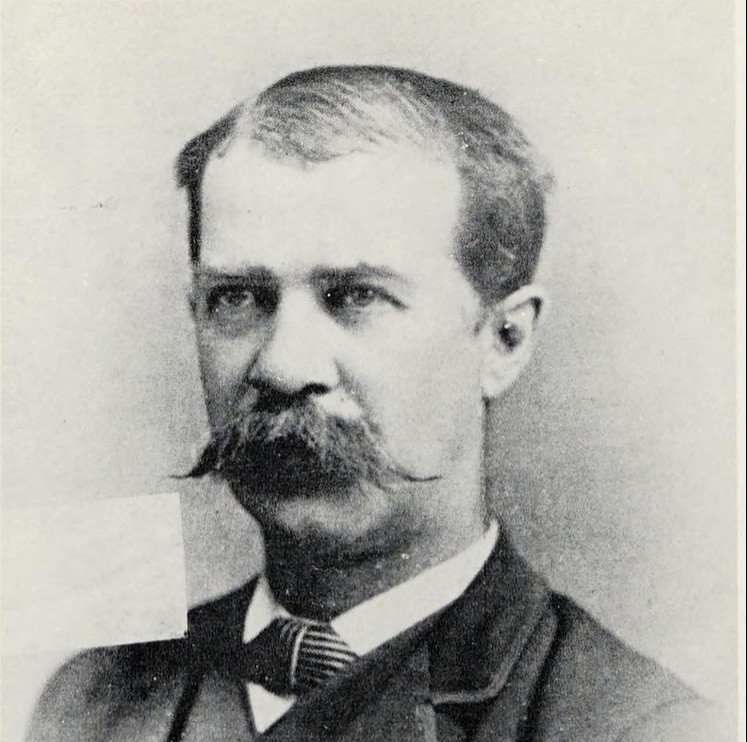
I am not sure when this missive from Lum, who died in 1893 at age 54, was written, but it is reproduced here at least two decades later by his old comrade Alexander Berkman during the First World War. One of the most remarkable revolutionary figures of the labor movement in the 19th century was Dyer D. Lum, who grew up in an abolitionist family and volunteered in his youth to destroy slavery in the Civil War with the 14th New York, captured (and escaped) twice by Confederates. In the 1870s he was a prominent in the post-war Eight Hour wave in Massachusetts led by the National Labor Union, with Wendell Phillips running as the NLU’s Labor Reform Party, winning 15% in 1870. Lum himself would run under Phillips for Lt. Governor as a Greenbacker in 1877, the same year he was serving as a secretary for Samuel Gompers during the Uprising of 1877. In 1880 he joined the Socialist Labor Party and soon fell in with Albert Parsons, who he would be most associated with in life and in history. Joining the International Working People’s Association in 1885, he was active with the Eight Hour Movement in the Knights of Labor in New York State when Haymarket occurred. With many IWPA leaders including Parsons arrested, and their newspaper The Alarm shut down, Lum restarted the paper to lead their defense as the November 11, 1887 executions loomed. Lum would become partners with Voltairine De Cleyre, and remain a central figure in the broad anarchist movement until his death, and as here, referenced long after. Committed to working class organization and a labor union approach, Lum supported the A.F.L., much to the chagrin of Johann Most and other anarchist critics. True to his catholic political philosophy, which included Buddhism, he combined his union work with support for ‘direct action’ against the ruling class, defending Russian, and U.S., Terrorists. Falling into poverty, he was living in New York City’s Bowery when he took poison, ending his life on April 6, 1892.
‘Patriotism’ by Dyer D. Lum from The Blast (San Francisco). Vol. 1 No. 7. February 26, 1916.
LOVE for home, for the spot around which cluster tender reminiscences of youth, where childhood’s happy years were passed and with which we associate memories of loved ones now gone from us, is one of the most sacred sentiments. In the extension of that sentiment to the larger home, to the association of those speaking a common language, having common interests and wants, and sharing the same joys and sorrows, where race and language united and government did not oppress, love for fatherland also naturally followed. The national was an extension of the home idea; it carried with it the same careful protection, the same sense of dependence, the same guidance of wayward feet and solicitude for personal welfare.
But the “children of larger growth” look back with different emotions upon their life course. Children are growing to maturity whose tenderest years were associated with want; where home was a tenement in which discord and penury ruled; where early years were associated with factory life; where a father’s love and a mother’s smile were overcast by care, scrimping anxiety and nervous exhaustion; where want overlaid sentiment with the sordid veneering of selfishness, and physical exhaustion but led to moral deterioration.
The genius of fatherland became transformed into a driving, relentless task-master, with strong arms to lay burdens, not to caress; with a purpose foreign to that of parental guidance, a purpose to which their lives were subservient, a purpose to which their days became weary round of exhaustive and ill-requited toil and their nights alone a period of relief; where blessing came in forgetfulness and despair with the return of wakefulness. Our patriot today is capital; beneath his guidance we learn to direct our feeble steps in infancy, employ our hands in youth, drag our wearied limbs in middle life, and bend our aching backs in age. The god of birth, it welcomes us as a unit in the supply of labor; the god of marriage, it presides over the law of supply and demand and counts on prospective gain through increased competition; as god of old age, it provides us with a work-house or a pauper burial.
The transformation is complete. Uncle Sam has doffed his blue swallow-tail for broadcloth. Grown paunch-bellied, his nether garments are cut to measure and we make them. His genial face is pinched by avarice, the idyllic love becomes insatiate greed, and his task-masters’ stripes, red with our blood, become the “flaunting lie” of civilization.
Awakened at last we refuse further obeisance to the American fetich—a striped rag!
Alexander Berkman’s incendiary-titled ‘The Blast’ began after Berkman left New York City, and his editorial position with Emma Goldman’s ‘Mother Earth’ he had held since his release from prion in 1906, to organize the ‘Anti-Militarist League’ and anarchists circles across the country in opposition to the war and associated repression. Published semi-monthly in San Francisco, California, beginning in January, 1916 with the first issue carrying a cover legendary cartoonist Robert Minor and this statement: ‘Before a garden can bloom, the weeds must be uprooted. Nothing is therefore more important than to destroy. Nothing more necessary and difficult…To destroy the Old and the False is the most vital work. We emphasize it: to blast the bulwarks of slavery and oppression is of primal necessity. It is the beginning of really lasting construction.’ Twenty-nine issues were published, with special attention paid to the war, political prisoners, and the labor movement in California. Berkman was arrested in June, 1917 for encouraging resistance to the draft and The Blast, like so many radical journals of the time, fell to Federal repression. Berkman spent two years in Atlanta Federal Prison before being deported to Russia in 1919.
PDF of full issue: https://hdl.handle.net/2027/coo.31924007352614?urlappend=%3Bseq=60%3Bownerid=13510798903357346-66
 Revolution's Newsstand