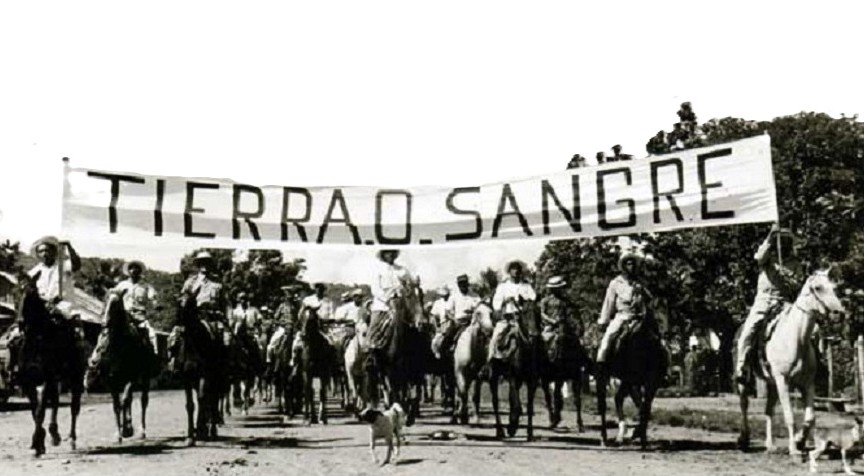
For richness of revolutionary tradition, few countries can boast of the class war history that Cuba’s workers, farmers, and students can. Just one of those traditions is ‘Realenga 18.’ Sent to Cuba to report on the Revolution there, Josephine Herbst wrote a series, ‘Cuba on the Barricades.’ In her first dispatch she travels to an agricultural commune in the mountains of Oriente, ‘Realenga 18’, headed by veteran peasant leader Lino Álvarez, and won in a fight against evictions. A well-known story in Cuba today, the struggles of those years, 25 years before 1959, would inform the land reform policies of the victorious revolution.
‘The Soviet in Cuba’ by Josephine Herbst from The New Masses. Vol. 14 No. 12. March 19, 1935.
This first article of Josephine Herbst’s series, “Cuba on the Barricades,” describes “Realenga 18,” where the peasants have taken over the land and set up a community described as the first Soviet in America. Her article was smuggled out of Cuba after the Mendieta government declared a military dictatorship and clamped down on the mails. Miss Herbst spent five days on horseback to travel into the mountains to “Realengo 18.” She was the first journalist ever to have made that trip. She returned to Havana just when the current fighting broke out and wrote up the first eyewitness account of “Realenga 18” while machine-gun fire raked the streets of Havana and many were killed.
Josephine Herbst was sent to Cuba a month ago as our correspondent when we received reports that the 1935 Zafra (sugar harvest) would reach an all-time low as a result of the Roosevelt Reciprocity Treaty.
The season in 1934 lasted 45 days. This year’s was even shorter. Thus hundreds of thousands of Cubans with no other means of livelihood were literally sentenced to death. Washington knew this. Conversations began between our Ambassador Jefferson Caffery, Col. Fulgencio Batista and President Mendieta, who had pledged allegiance to Wall Street to win his position. Expenditures for arms and soldiers shot sky high. The sugar centrals (where the grinding takes place) were converted to fortresses. The military budget surpassed the record set by the tyrant Gerardo Machado who was driven from Cuba in 1933. His army totalled 14,000 men. Mendieta’s is almost double. This excludes the ordinary police force and the private police of the big Yankee sugar companies (Wall Street owns most of the island). The secret service of Batista takes the place of Machado’s dreaded Porristas who did not hesitate to throw labor leaders to the sharks in the bay at Havana.
In the present revolutionary strike workers and peasants have rallied all over the island behind the 350,000 students and teachers who walked out first against the Mendieta regime. A “frente commun” (united front) was established. The objective is to get rid of the Mendieta-Batista regime, ta force the withdrawal of the death penalty in the sugar fields and mills, to regain civil liberties and to win improved living standards. Editor.
HAVANA. MARCH 7. I came down from the mountains of “Realengo 18” ten days ago. When I went there, five days before, people were saying that strikes were impossible in Cuba, outlawed by Mendieta’s decrees: A decree making death the penalty for sabotage in the sugar-cane fields and mills had been put in force just before the season of harvesting and grinding cane began. One third of a million teachers and students have been on strike for nearly three weeks. Machado, the great outlawer of strikes, fell by one, and today Mendieta’s government seems to be trembling as a new general strike slowly but surely gains momentum. Last night soldiers took possession of the university. Flocks of leaflets moved like quicksilver through the streets. Employes from the public service broadcasted their manifesto stating their demands, calling for a broad united front of all groups against military dictatorship, against imperialism. This strike that Batista is so certain he can stop with his army, comes from such deep needs and sores that no one can say where it will end. Talk floats around possible alignments, of A.B.C. and Autenticos, of old-line parties rallying together; but one must travel up and down this island, talk to teachers, lawyers, workers in cane fields, small farmers, clerks in stores, people sitting on park benches, to realize that no coalition, no political management or mismanagement will be of avail unless it brings freedom from military oppression and some better way of life to people so desperate to be free that bullets will not retard them.
“Realengo 18” is in the mountains of the eastern province of Oriente. It cannot be separated from the rest of the island, for all that. Hunger is the power that drives the farmer there, just as it is the power that runs the sugar mills. Call it electricity if you like. It’s the hunger that makes a worker cut cane for 20 to 80 cents (the latter is rare), makes him huddle in oneroom huts or barracks for a little rice, some beans, some coffee, all sold dear in the company stores, and when the brief season is over, slowly starve through the long “dead season.” This island, banded with pale green stripes of cane, dedicated to cane as if it were a ritual and all must worship, shows little land given to the raising of food in the long bus ride from Havana to Santiago.
But in “Realengo 18,” on mountain sides so steep it seems as if only flies could cultivate them, the deep tobacco colored soil teems with food. Coffee and bananas patchwork the mountainsides in lines neat as machine stitching. Tall palms shoot to the sky from valleys and along the mountain tops. A hundred herbs flower and provide the only medicine that the sick in these parts know. For “Realengo 18” is a country the government forgot. It is even hard to find, lost in the mountains at the end of narrow trails. No road ever came here, no teachers and no doctors. To reach “Realengo 18” one rides a horse, takes trails that go steeply up a mountain side through thick virgin forest and jungle, sprouting ferns and vines as tangled as hair. But from the ridge, the secret mountainsides of “Realango 18” appear, the deep valley, the many thatched huts of Realengo men, the terrifically tilled soil, where everything grows bigger; cane taller; vegetables that on the rest of the island weigh a few pounds here grow to 75 pounds; yucca, a vegetable root, becomes 6 feet long.
Here where food grows so well there is also misery of poverty, but it is different. The huts clustering around the sugar mill below live daily under the eye of the army. Here the army comes to spy but even the army withdrew from Lion Alvarez and his men, fighting last August to oust soldiers who had remembered “Realengo 18” only to try to grab it from the people who had cultivated it from a wilderness. “Land or Blood” is still the cry of “Realengo 18,” as it was then. Here where so much grows, the big sugar mills, the Royal Bank of Canada mills and others owned by companies in the United States, have tried to penetrate with troops to claim it for their own. One must remember the origin of realengos. In the old days, land division was made to the rich gentry in circular areas. The interstices between these contiguous circles belonged to the government, if anyone, and were known as realangos. “Realengo 18” is one of such divisions of land. The legal ownership is claimed by various companies but actually, after the Ten Years’ War for Independence, the soldiers who had fought were supposed to be rewarded with land in “Realengo 18.” The distribution was not perfected by the general in charge and the men took it over themselves. Following the Spanish-American war, the soldiers were paid off with an American loan and some Realengo men bought little businesses with their money in nearby towns. In 1914 the tide went back to the land again. Sugar companies were ruthlessly burning virgin timber over the island, planting every inch to cane. Cane crawled to the very door of huts, big blocks of land, never to be cultivated, were gobbled up by vast companies in the expectation of future usefulness. From over 30 percent of farms owned by individual: farmers in 1904, less than 10 percent control any land today. After sugar prices skyrocketed in 1920, the land was grabbed into a few big sacks, and the people of Cuba found themselves stripped bare.
But in “Realengo 18” the struggle to retain the land by the people who had cultivated it with such toil, began. Many of the Realengo men know the slavery of the sugar-cane fields. When they fight, they are fighting against the misery of the barracones. The iron ring of mills that squat in the valleys, forming a tight cordon around the Realengos, have no legal right to the land, and only an army backed by Batista can gain success. On one pretext or another they have tried to sneak away this land. By bribes and fraud and various manipulations they tried to gain title to mortgaged property.
Lion Alvarez vs. The Federals
IN 1920, Lion Alvarez came to a crisis in his life. Lion Alvarez was a teamster by trade, born in a little town near Santiago some 55 years ago. He was a youth at the time of the Spanish-American War and he came out with the title of lieutenant. All men in “Realengo 18” wear the machete, a broad swordlike instrument with which alone they cultivate the land and with which they also fight. But Lion Alvarez wears the silver-headed sword of a Spanish general whom he killed in the Spanish-American War. For years he worked for a big proprietor of land and mills and then, in 1920, this man tried to bribe Lion Alvarez to drive the people from “Realengo 18” and to turn the land over to him.
Instead, Alvarez began a long fight for his people and their land. He had saved several thousand dollars and he has spent it all. Convinced that the land really belonged, legally as well as morally, to the people, he and the men of “Realengo 18,” some 5,000 of them making with their families 18,000 people, formed an association known as Associacion de Productores Agricolas de Realengo No. 18 y Colindantes. This association, with letterhead and typewriter, has meetings regularly, in an old palm thatched shack, has officers, and at first tried legal methods.
In August, 1934, the army started to attack after Realengo men had driven out surveyors perched on mountain tops measuring the land. Lion Alvarez, at the head of some thousands of men, filled the forest, waited for the soldiers who could see the men behind the trees in the deep wood, machetes in hand. The officer at the head called out that he had orders to attack, but he was afraid to attack; there were so many trees that bullets seemed useless. At this moment, Lion Alvarez answered that he, too, had orders. His orders were to defend. The captain and his men withdrew from such stubborn resistance and so critical was the situation that honeyed diplomacy was tried. At Lima where a thousand Realengo men assembled and big shots of Oriente came to try demagogy since force had failed, promises were made to the people of Realengo. The men went home. None of the promises has been kept. Spies have been sent in, troubles brewed, attempts have been made to bribe some of the people. The 5,000 men have held out. Lately, since their struggle last August in which the workers of Santiago went on sympathetic strike, they have discussed joining the National Confederation of Labor. Lion Alvarez is being hunted today by army guards who hope to get him, thinking that if they do the struggle in Realengo will be over. They little know these people.
Most of the farmers in Realengo are real mountain people. Some of them came from nearby localities, many have worked on cane projects. Lion Alvarez is a very black Negro, small and compact, in a blue shirt, white coat and trousers tucked into military-looking boots. It is night, and Lion has come secretly over the trails to avoid soldiers who may be following in the darkness, to the house where I am staying. He has come alone and he stands suddenly outside the door where we sit inside around a single kerosene lamp lighted luxuriously for company that evening.
It is my second night in “Realengo 18.” This is the house of Gil Hierrezuelo. He is in Havana and we have been talking about him as it grows dark. His wife has just shown me his picture and for a few minutes we are two women, showing each other pictures of our absent husbands. Gil is in hold the fire on which sit pots.
Havana and the word lucha, struggle, is the one heard most often in “Realengo 18.” Gil is struggling there, he is talking to university students who have gotten to their feet at a mass meeting to pledge support of “Realengo 18”; he is talking to unions, he is learning much. “Always this struggle,” his wife says, “never any end. Struggle, struggle.” She is a white woman, he is a Negro. There is no race problem here. Two of her children are white, two colored. We came to her house in the broiling sun of midday. The house has a steep, thatched roof of the sweetsmelling vetiver, its sides are palm thatch. There is one big room, earthen floor; at the end is a long pyre of logs and stones; on top two railroad ties. The pots are tin cans. There are few dishes in Realengo homes. Clothes are few but some huts have sewing machines, and once I saw a party of women going to a funeral all dressed up in beautifully ironed modish clothes, with bundles balanced on their heads as they walked gravely along the path. Roosters peck at half a cocoanut under a table, pigs and a little goat move chummily around one’s feet under the table. But for all their toil, no tools are here; many have never seen a plow. Hands and the machete must do the work. Home-made implements help along; a log hollowed for a pestle makes a coffee grinder. Much coffee drinking goes on in “Realengo 18,” but the diet is monotonous; often there is hunger. Coffee and bananas, yucca and malango, fiame and beans are a pellagra diet. All of them have chickens, but a chicken’s neck is seldom wrung: they lay eggs.
We have chicken cooked with pimento tonight and there is order in this home, a basin of water to wash in and a clean towel. Two rooms here for sleeping, where most houses have one. The sheets are very clean, but at night it is cold to the bone; gunny sacks do not give much warmth. This land so rich to see, takes much and gives little to those who work it. A huge bunch of bananas brings 13 cents; 120 pounds of fiame, $r sometimes, oftener 40 cents; a barrel of balanga, 40 cents; 180 pounds of shelled corn $2. When it comes to buy, the merchants have them by the throat. Everything is very dear: $1.25 for poor shoes, $1.85 for overalls, a shirt $1.25, a sombrero $1.80.
We sit talking about prices and the way in which workers in factories and the farmers are bound up together; neither can live without the other. The mountains turn a lovely, iron blue. The first great star comes out above the palms. It is tranquil here but we have been talking of the misery in Santiago, of open sewers, of workers in jail, and Gil’s wife is quietly packing a little knapsack of food for the less well-off family of one of my companions. He was an actor in Santiago until 1925 and calls out the names of towns he played, in North and South America, as if announcing trains. Now his oratory is confined to lucha. A picture of himself hangs incongruously on the wall of his hut. Eight very intelligent and beautiful children, his wife and himself crowd into one small hut. At night the beds groan miserably with the cold of human bones, the actor in his hammock explodes suddenly in the dark in a short fierce speech of rebellion; the early morning is very cold and the fire in this house is on the open ground. Yet all around, the mountains have been cultivated with such indescribable toil. Up at dawn, water to be hauled from far-off springs, food to be gathered somewhere. Pigs and chickens are always hungry, fight each other for stray morsels, During the time I was in Realengo only one home had more than coffee for breakfast. That was the home of Gil Hierrezuelo.
But hospitality everywhere. The trails so steep the horse slips and corkscrews down as if he might pitch to the bottom, lead to homes where whatever is there, belongs to the guest. Talk is fine, and here where no trains have come, autos have scarcely been seen, the words “imperialism, struggle,” united front of workers and farmers,” are common as sun and air. Some farmers are slower than others, some do not see the clear implication of their tussle to hold the land, but all are united in their association and they are determined to fight before they give up.
Earlier in the day we had stopped at the home of Argimiro. Gainza, Realengo poet. A Haitian worker, speaking French, sat modestly listening with delight to the rest of us talk about Maxim Gorki. The wife served coffee in tiny cups. Two beautiful, naked little girls sat shyly on a stool. Big gourds held water, tin cans served for pots, but the sleeping-room had fewer beds than most, as this couple have as yet only two children. The majority of Realengo homes house ten.
No government schools ever came to “Realengo 18.” Recently a school with fifty children holds sessions every day, taught by a young teacher from the Anti-Imperialist League in Havana. Until lately she had no blackboards, but now workers are collecting books and pencils for this school. Not long ago the women got together to form a group to help in the struggle. Lanterns went up and down the steep blue mountains, way into the night. Fifty women met at the first meeting, were a little tongue-tied at first, but came to life when a speaker began to talk about the women’s movement in the Soviet Union. Then the women of Realengo decided to form one such group each night for a week until all the darrios or districts of “Realengo 18” were organized. Though the distance is far and the mountains steep, they toiled up and down for a week, starting new groups, the lanterns winking in the dark, moving their light from darkness to darkness.
Builders of the Soviet
WE are in the living room of Gil Hierrezuelo. The little, dark, terribly strong man is in the doorway. Everybody gets up with a glad cry; two of the men embrace their leader. We sit down and talk begins, practical talk, about Lion’s danger, about the necessity of never trusting a “guaranty.” Look what happened to Sandino, The names of Sandino and Pancho Villa come into the discussion often. Lion is not a bandit type. He is an excellent organizer and executive with a fearless eye. In his right arm are two bullets and in his left one from the guns of sugar companies. He takes out glasses from a little handmade case of red and white calico, unrolls receipts for taxes on the land. Legality still troubles him as a deep sore that broils and bubbles. He feels outraged to his bones for the humiliation of being right and being put in the wrong by the greed of companies who gave nothing but bribery and tricks for this land that cost so much sweat. Someone wants to know how he will prevent capture if they try. He smiles slowly and for the first and only time during the two times I saw him in Realengo. He slowly draws out a revolver, lays it deliberately upon the table, smiles brilliantly and convincingly. His men have learned military tactics since they had to defend themselves,—give up their land or die. Only that day, as we toiled over a mountain covered with virgin timber, we saw the lookout huts: covered with palm, where Realengo men lay last August waiting to spot the militia moving up from below.
These people are not fooled; they know their danger. They say and feel that they are a Soviet. Since the forming of the association, no further contracts have been made with the companies who had gained their title to the land through force and bribery. No rents are paid. The Realengo men hack out new trails. One person’s land is looked at critically; shouldn’t he cut that tree? A farmer jogs along on his horse, smoking a cigar, passes a man who has no cigar. “How about a puff,” says the cigarless one and the cigar changes hands, may change hands once more as the traveler stops in some hut and is looked at hungrily by a man in a hammock shelling corn into a big tin basin.
They know their danger. Even if they are brave as lions they know they need the workers of this island. Up here, so high, even in the darkness, one has only to step out of the room into the deceptively sweet night to feel the world. Far down below in daylight, one can see the sick green of cane spreading like a poison over this island, soaking into the bones of workers like an acid, keeping them impoverished for the profit of foreign capital. In Santiago, I saw bruised backs of workers beaten with machete blades because they belonged to syndicates, saw the bloodsoaked clothes of a student beaten with the butts of rifles, visited the highest institution of learning in Oriente, an old building—once a barracks with mouldy, dark rooms able to house perhaps 400 students while 3,000 clamor for: education. The tattered maps, a chemical laboratory with broken test tubes, empty bottles, lensless microscopes, pieces of an old telescope, moth-eaten birds with shattered wings, a tiny library with a few hundred books—in all Oriente province there aren’t 10,000 books—this garbage is the government’s offering to its people. Half the population on this island is illiterate, while Batista gets $500,000 more for new barracks and every soldier stands in nice, starched uniform with rain-cape and plenty of firearms.
“Impossible to harvest the zafra without the army,” say the government defenders claiming that terrorists had threatened to destroy the cane. But workers are jailed, are driven from their huts if they dare to lift their voices to ask for more wages or even to ask for wages already due them. This island is sick with sugar. It is sick of an ancient disease, and nowhere in the world have parasites flourished so abundantly in their day. Now even the foreign capitalists shiver for their investments. Profits have gone low, and under an iron rule the island strains and tugs. The street in Santiago, where the Negro hero Antonio Maceo was born, is full of ruts and open sewers, but the walls are scrawled with “Down with Batista. Down with imperialism. All out for the general strike.” School buildings are rotting, but from their walls hundreds of thousands of students have streamed in an unprecedented strike movement.
They asked for education and they received an army.
In Realengo, the forgotten country, no government schools bothered to come, but struggle has come, self-conscious, determined struggle and struggle is educating the uneducated. Cuba, forgotten for all except plunder, is teaching itself. Strikes in the last two years have slowly accumulated a steady power. Denied the right to strike, the masses are striking. Denied the right to meet, the masses are meeting in secret. Struggle is all the education that they seem to need.
Lion is sitting at the table. He is a model family man, they tell me, and has fourteen children. He is a very great man. He has just said quietly that before the men of “Realengo 18” give up their land, they will die; and before they will be allowed to die, the workers on this island, yes, and in other countries too—looking sharply at me—may have something to say.
General Strike in Havana
Havana, March 9.
SINCE I wrote the enclosed piece two days ago events have been moving rapidly. This morning no papers were allowed on the streets except Diario del Marino, the paper of the government. This newspaper, which catered to Spain during the Spanish-American War, now is the mouthpiece of the tottering Mendieta government. That government will not admit anywhere along the line that it is tottering. The United States embassy and Batista are agreed that a general strike cannot happen.
Last night, at half past eight, I went to Camp Columbia to see Batista. Soldiers at two gates barred the way, but inside the building itself a curious, homey atmosphere prevailed. A radio was playing, interestingly enough, a popular Cuban version of one of the revolutionary songs that Pancho Villa’s men sang as they roared over the hills toward Mexico City. A colored painting of two hands clasped, and the name of Batista’s birthplace, Baire, Oriente, 24 Feb. 1895, and of Camp Columbia, 4 Sept., Havana, 1933, celebrates the Colonel’s promotion in 1933. One of the officers sits down beside me as I wait. He says he is pretty tired since this strike started. He was up about all night. I had heard earlier that Batista had only gone to bed at seven that morning.
“Expect a lot of trouble?” I ask. “Oh, we got it in hand. Got a good distribution around. And this will just show them. Half of them went back to work and there will be new people in the other jobs today. Let them cry, they won’t get their jobs back.” He is pretty sore at the situation. But Batista is not sore. He is a powerful, handsome man, and so quick, so sharp that he relishes danger. He begins to talk, speaking slowly and repeating that one thing I must get clear: that they will stop at nothing to prevent a general strike. At nothing, if necessary.
He even smiles as he says that it may be a good thing to clear the government of a lot of useless people who won’t get their jobs back; in that way the government will be saved money. The Communists are back of the trouble, and they appear to have made an alliance with other radical groups, even A.B.C. and Autenticos; but underneath, Batista wants me to know, there is great disunity. They can’t win, he declares, because the army is solidly behind him (Batista) to a man. He smiles proudly, leans forward tensely, goes on saying that there is no chance of anything. I ask what his position would be in case Mendieta resigned, but he waves his hand. Impossible. Besides he is one wing of a bird of which Mendieta is the other. That bird intends to fly and it needs two wings. Then I wanted to know if it were not possible that the A.B.C. and the Autenticos (Grau San Martin’s group) might not make an alliance in order to gain control of the government; in which case what would he do, resign or try to go along? Again he smiles: impossible, the bird intends to fly.
We shall see. From labor sources there is every indication that by Monday the “impossible” general strike may begin. Mails have stopped today. Manuscript is smuggled out. Bus service across the island has stopped and new government departments have walked out today.
On Sunday, going to an artists’ exhibition, I saw two of Batista’s soldiers, very drunk, yelling, in spite of their new uniforms, “Down with Batista, down with Batista.” Two passersby took off their hats and arms and got them on a street car before the boys got into trouble, but even as they went up the steps they were grumbling and spluttering, half crying, “Down with Batista.”
The New Masses was the continuation of Workers Monthly which began publishing in 1924 as a merger of the ‘Liberator’, the Trade Union Educational League magazine ‘Labor Herald’, and Friends of Soviet Russia’s monthly ‘Soviet Russia Pictorial’ as an explicitly Communist Party publication, but drawing in a wide range of contributors and sympathizers. In 1927 Workers Monthly ceased and The New Masses began. A major left cultural magazine of the late 1920s and early 1940s, the early editors of The New Masses included Hugo Gellert, John F. Sloan, Max Eastman, Mike Gold, and Joseph Freeman. Writers included William Carlos Williams, Theodore Dreiser, John Dos Passos, Upton Sinclair, Richard Wright, Ralph Ellison, Dorothy Parker, Dorothy Day, John Breecher, Langston Hughes, Eugene O’Neill, Rex Stout and Ernest Hemingway. Artists included Hugo Gellert, Stuart Davis, Boardman Robinson, Wanda Gag, William Gropper and Otto Soglow. Over time, the New Masses became narrower politically and the articles more commentary than comment. However, particularly in it first years, New Masses was the epitome of the era’s finest revolutionary cultural and artistic traditions.
PDF of full issue: https://www.marxists.org/history/usa/pubs/new-masses/1935/v14n12-mar-19-1935-NM.pdf
 Revolution's Newsstand