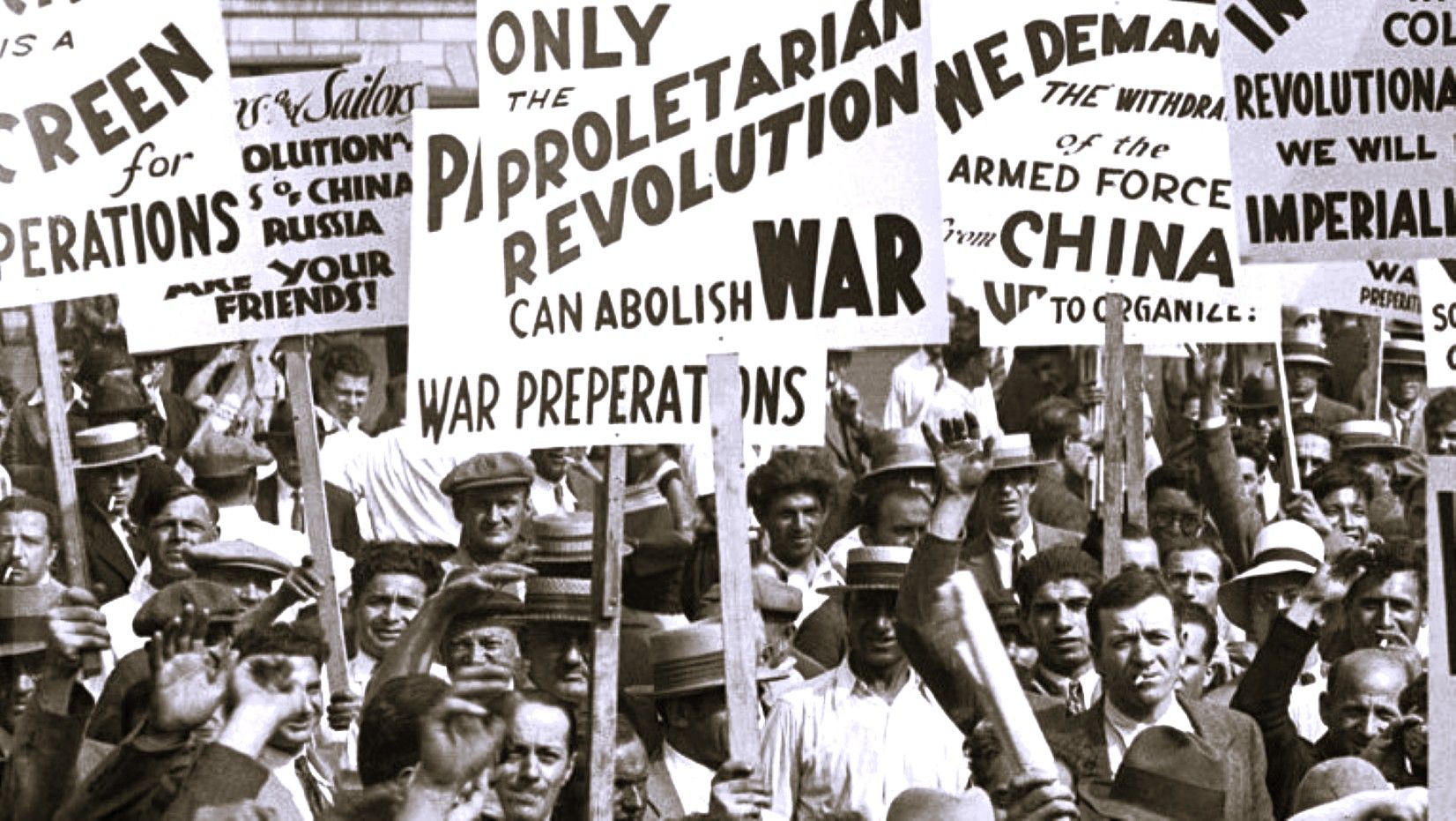
Many well-informed comrades thought the next World Word after the First would be fought between the United States and…Britain. Exerting its new-found positions at the end of WWI, the U.S. moved to formally conquer the hemisphere, with much of the 1920s a diplomatic-economic-military campaign to oust existing imperial powers and take new territories in the Americas. British imperialism was its main rival in that bloody process, which saw the two powers fight a series of economic and proxy wars with the U.S. directly intervening with more than a dozen invasions in that decade. 1927 would be a pivotal year in that process, and as it opened Young Workers League leader John Williamson speaks to the tasks of the organization in fighting U.S. imperialism and stopping a slide to a new world war, this time possibly between the fading British and the rising U.S. empires.
‘The Youth and the Fight Against Militarism’ by John Williamson from The Daily Worker Magazine. Vol. 4 No. 2. January 15, 1927.
IT is not enough that we study and know of Lenin, only as the leader of the mighty Russian Revolution. We must study the contributions of Lenin, both in theory and practice and be able to apply them to our respective situations. One of these basic questions is the attitude of the working class to militarism.
Thru our knowledge of the very basis of capitalism with its historical growth and its intensified antagonisms in the present imperialist epoch, we know that WAR is inevitable. Today the clashing economic interests of Great Britain, the United States and the all-powerful capitalist countries are driving them rapidly to a struggle, which can only find its ultimate expression in WAR. The immediate situation in relation to Wall Street and Latin America is not a contradiction to this rivalry between Britain and America, but one of the symptoms of its development and the preparation of the United States for such an event.
AT home we are acquainted with the internal preparations for such events. The rapid increase of 250 per cent in military, naval and aircraft expenditures within the U.S.A. from the years 1913 to 1925; the institution of C.M.T.C.’s on a growing scale each year; the R.O.T.C. system introduced into the public school system; the planned out scheme of economic reserves (factories, etc.) on a national scale and many other facts that could be piled up as proof.
“Pacifism” Raises Its Head.
The cries of “Disarmament,” “Pacifism,” “National Defense Only,” etc., have found loud expression recently, just as we have in the past found this agitation the keenest immediately prior to armed conflicts. History teaches us that these slogans and the people who advocate them generally “blow up” when confronted with concrete situations. In fact, the majority of them become the worst jingoes and enemies of the working class, vying with each other to demonstrate their patriotism and the sincere elements continue to raise their false slogans which only can help to create illusions in the minds of their audiences. We need only remember the jingoistic social patriots during the last war. TODAY in America this anti-militarist sentiment has unfortunately found too much leadership in the petty-bourgeois liberal elements. Such organizations as the National Student Forum, The League for Industrial Democracy, the Fellowship of Reconciliation, the American Federation of Youth and the dozens of other similar pacifist organizations have taken the helm. Our Communist Youth Movement partially fell into the mistake of allowing such elements to assume leadership in this activity–a most drastic mistake which must be changed.
What are the reasons for this popular anti-militarist crusade among the petty bourgeoisie. Primarily the fact that the burden of this great increase of armaments has been shifted, thru taxation, onto the shoulders of the working class and the petty bourgeoisie, and the latter have reacted more vigorously.
Other motives which contribute, are the general post-war horror of war and militarism, which especially finds expression in the ranks of the intelligentsia (students).
Amongst the unskilled workers, the fact that in every labor struggle, whether of local or national importance, the military is arrayed against them, creates resentment and bitterness.
As a last fact we must brand many of these efforts as a conscious policy of betrayal of the workers by presentation, of fine phrases and slogans and promises which divert their immediate attention from a militant policy against militarism.
THE basis of this agitator conducted and led by the petty bourgeois liberal elements is pacifism. Such a theory treats militarism as some separate phenomena which can be abolished at will, without recognizing the basic truth that militarism is one of the main pillars of capitalism and cannot be attacked without attacking capitalism itself. Pacifism, theoretically and practically, is a utopia.
The Leninist Position.
In the period of 1914-17 when the bulk of the Social-Democracy had capitulated and only a few left wing sections maintained their revolutionary program, the question of the attitude of the proletariat towards militarism was on the order of the day. At that time in the ranks of the revolutionary Socialist Youth movement, which was carrying on the attack against capitalist militarism under the leadership of Liebknecht, much confusion reigned. Today in our own Communist movement we can record the fact that the real Communist position towards militarism has received too little attention and no study by the militant workers.
In this period Lenin raised principal questions and today they represent the Communist position towards militarism:
1. Are we against all wars? Lenin answered, “Socialists cannot be against every war without ceasing to be Socialists.” He went on to explain that in the period of imperialism the national minorities and colonial peoples are suppressed by force and they in turn must answer by force. Such wars must receive the support of the proletariat. A case in question would be the present defensive hostilities by the Nicaraguan republican forces against the U.S. armed forces. The working class of America must do everything possible to aid such resistance to the armed forces of American imperialism. (This is a concrete case where the liberal slogans became worthless and they in turn will support American Imperialism).
Again there is the question of civil wars in those countries where the workers are seizing or have already seized power. The workers of Soviet Union have their Red Army in order to protect their revolution. The pacifist would have the workers and peasants of Russia lay down their arms and be drowned in blood, a la Finland, Hungary or Germany. The Communist, the working class position, has no such sophist illusions. The revolution must protect and guard itself by a better armed force as long as world capitalism exists. The Communist position is not a humanitarian one. As Lenin said, “An oppressed class which does not strive for the knowledge of arms, for the practice of arms, for the possession of arms, such an oppressed class is only worthy to be oppressed, maltreated and regarded as a slave class.”
2. The inevitability of wars under capitalism, especially in the epoch of imperialism. The contentions of the Communists on this point that all wars have their economic basis, either in securing new lands for exploitation or sphenes of influence for distribution of manufacturers’ products or for cheaper raw materials, etc., is now even proclaimed in various degrees in the flood of new bourgeois literature concerning the relationship of America and Europe in connection with the last war. The pacifists in their propaganda neglect this completely, and propagate the possibility of abolishing militarism without mentioning capitalism. Thus they create illusions of the worst character in the minds of the workers.
3. Unmerciful unmasking of bourgeois pacifism. Connecting this with the immediate American situation, we must in relation to the previous paragraph, unmask such organizations as the openly imperialistic Y.M.C.A. when it talks “peace,” and just as ardently expose the real character of the pacifists of all other brands.
4. Defense of the Fatherland. Experience has taught us that just these elements who raise pacifist meaningless slogans today, in time of crisis, are the conscious lackeys of big capital in mobilizing the workers for the slaughterfest between respective capitalist countries. At that time the slogan they use is, “Defense of the Fatherland.” Such a slogan is a death warrant to the workers. The workers have no “Fatherland,” under capitalism. Only by turning the imperialist wars into revolutionary civil wars will the proletariat have a workers’ “fatherland” like the present Soviet Union, which they will defend with all means and at all costs. This point is the kernel of the whole Communist attitude towards war, in recognition of the causes of war and the historical connection of war with the present social system. In order to further this, the Communist position is not to run away from the army but to work inside the army. Lenin said, “To preach the ‘demand’ or better, the dream of ‘disarmament,’ at the present time, when obviously and clearly before the eyes of all of us the only legitimate and revolutionary war, the civil war against the imperialist bourgeoisie is preparing in the hands of the bourgeoisie itself, is but the expression of despair” and again (referring to work inside the army), “If one has not prepared such a propaganda in connection with the present war one should cease to mouth the great phrases about the revolutionary international, about the war against war.”
The Communist Youth Movement is not alone interested in anti-militarism but together with the Communist Party conducts its activities in line with the policies of Lenin.
At this time the concrete application of these policies to America means work along the following general lines:
(a) The Y.W.L. as the leader of the working class youth must take the leadership of the anti-militarist movement out of the hands of the petty bourgeois liberal elements, such as the Students Forum, etc.
(b) In taking the leadership the young workers must be mobilized for the struggle together with the student elements but the first must be the basis.
(c) The policy of the Communist Youth Movement which it must never cease propagating must be that laid down by Lenin.
(d) United Front movements must be encouraged and promoted on a local scale on concrete issues. These must rally primarily the working class youth forces, either unorganized or thru the trade union movement.
(a) Continuation of a struggle against the C.M.T.C. and demanding in its place a four weeks paid vacation annually for all young workers. Oppose the R.O.T.C.
The Saturday Supplement, later changed to a Sunday Supplement, of the Daily Worker was a place for longer articles with debate, international focus, literature, and documents presented. The Daily Worker began in 1924 and was published in New York City by the Communist Party US and its predecessor organizations. Among the most long-lasting and important left publications in US history, it had a circulation of 35,000 at its peak. The Daily Worker came from The Ohio Socialist, published by the Left Wing-dominated Socialist Party of Ohio in Cleveland from 1917 to November 1919, when it became became The Toiler, paper of the Communist Labor Party. In December 1921 the above-ground Workers Party of America merged the Toiler with the paper Workers Council to found The Worker, which became The Daily Worker beginning January 13, 1924.
PDF of full issue: https://www.marxists.org/history/usa/pubs/dailyworker/1927/1927-ny/v04-n002-supplement-jan-15-1927-DW-LOC.pdf
 Revolution's Newsstand