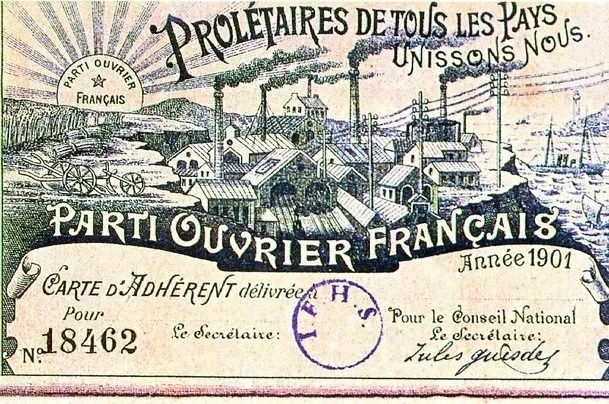
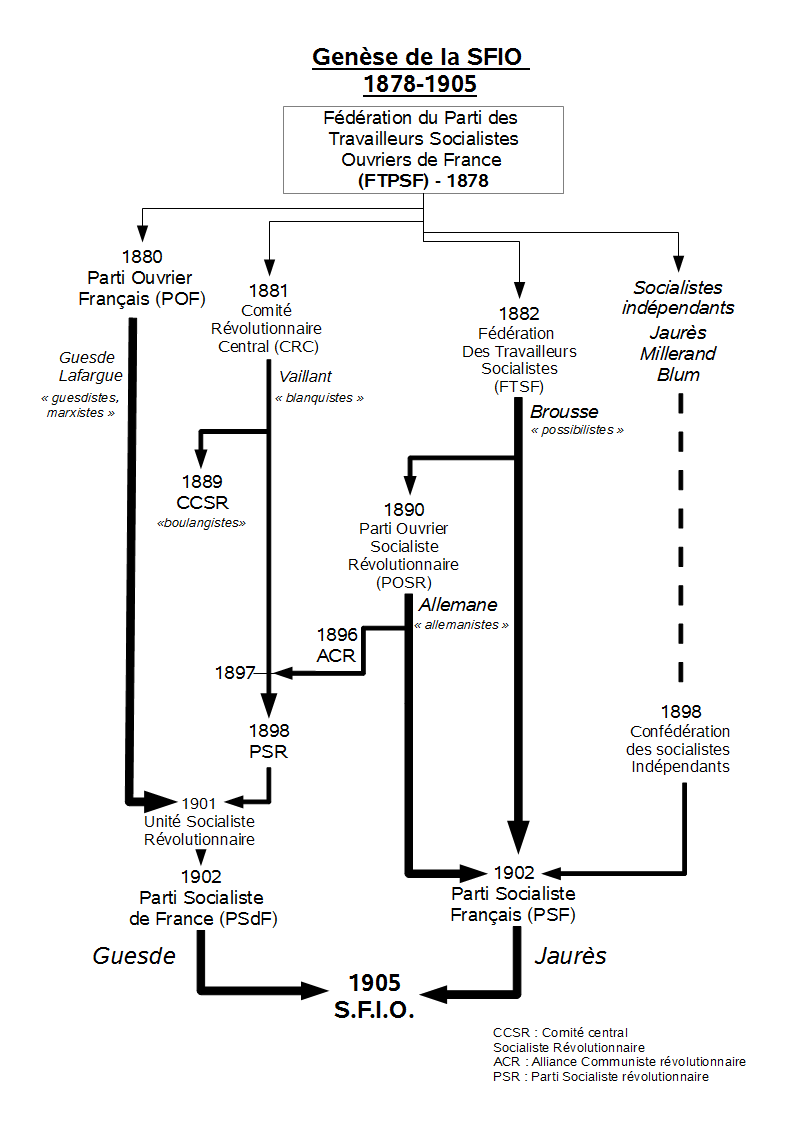
A post requiring an introduction. An invaluable primer on the early complicated, sometimes complementary, but nevertheless intractable conflict before reformist and revolutionaries in France’s workers movement. Transcribed for the first time. Written for a U.S. audience by a leader of the revolutionary Marxist wing of French Socialism in 1902, Henry Nivet (who almost 20 years later would be a founding French Communist) provides us with a fantastic critical look at the people, organizations, and politics of a divided French Left before the ostensible unity established in 1905. Published over a month in the S.L.P.’s Weekly People, the full text below. Given the size, a PDF of the entire work is also linked below. Includes a very useful diagram of organizational relations.
Before 1905, up to a dozen French parties and groups claimed to speak for the working class and the Socialist movement. The successful, in unstable, coming together in 1905 of most of the rival organizations and ideologies that made up French Socialism to form the French Section of the Socialist International (S.F.I.O.) was a years’ long and fraught process, but one of immense importance in creating a common organizational and political point of reference. Broadly speaking, the left around Lafargue and Guesde had been in the French Workers Party (P.O.F.) since forming 1893, and included the present author, Henry Nivet. Uniting in 1902 with the center-left Socialist Revolutionary Party of Eduard Vallaint, and Blanquists of the Socialist Revolutionary Party (S.R.P.) to create the Parti socialiste de France (P.S.F.), effectively uniting all those forces opposed to Millerand. Millerand was a Socialist participating as a minister in a bourgeois government between, causing a crisis in the French, and European, movement (and some of Rosa Luxemburg’s fiercest attacks on opportunism). Broadly speaking, Millerand’s move was support by the other, larger, possibilist, wing of French Socialism around Jaures’ uniting with the syndicalists of Jean Allemane’s Revolutionary Socialist Workers’ Party (P.O.S.R.) to create Parti Socialiste Français (P.S.F.) also in 1902. Under pressure, the various strands would unite French Section of the Socialist International (S.F.I.O.)
Embarrassingly, I know little about French Marxist history and nothing about the author of this important piece, Henry Nivet. Thankfully, there is the indispensable French biographical and reference site for that country’s enormous cast of left actors, ‘Maitron’ named after French historian and indefatigable researcher and compiler of the stories of thousands of activists whose contributions would be lost to a hostile history without his noble work. A machine translation of Niven’s story from ‘Maitron’ here:
“His real name was James Hait. In 1899, Nivet was secretary of the Collectivist Students of Paris and participated in the POF congresses in Épernay (1899) and Ivry (1900). In 1900, he belonged to the federal council of the Paris region federation of the POF and was a delegate to the national congresses in Épernay (1899) and Ivry (1900). He represented groups from Seine-et-Oise, Eure-et-Loir, and Guadeloupe at the first general congress in Paris, at the Salle Japy (1899), and the Chartres POF group at the congress in the Salle Wagram (1900). Having become a tutor at the Lycée Hoche in Versailles, he no longer appeared at congresses, but represented the Seine-et-Oise federation at the POF National Council in 1902. He contributed to Le Socialiste and, with advice from Laura Lafargue, wrote a popular Marxist pamphlet, Notions élémentaires d’économie marxiste (1904). He appears to have been active in the SFIO socialist federation of the Allier department and to have represented it, along with his wife, at the Saint-Étienne congress (1909). Henry Nivet was mobilized during the First World War, and his byline disappeared from the socialist newspapers of Eure-et-Loir from 1914 to August 1921. A member of the Communist Party, he resumed writing in Le Travailleur d’Eure-et-Loir, hailing the split “as a liberation”; he added: “The founding activists of the party in Eure-et-Loir understood this so well that they have all now joined the Communist Party” (Le Travailleur, August 6, 1921). After the demise of Le Travailleur. he contributed to Le Communiste du Nord-Ouest.”
‘Socialism in France: A Comprehensive and Analytical Review of French Conditions’ by Henry Nivet from The Weekly People. Vol. 12 Nos. 18-21. August 2-23, 1902.
Written for the DAILY and WEEKLY PEOPLE by Henry Nivet, Member of the “Parti Ouvrier Francais,” Secretary of the Federation of Seine-et-Oise, Adherent to the Socialist Party of France (Revolutionary Socialist Unity.)
Since the 15th of last May the “Petit Sou,” a Paris daily, has ceased publication. Neither the bourgeoisie, nor those who inflicted upon socialism the shame of ministerialism, left any efforts untried to bring about its downfall; blackmail, hideous calumnies, boycotts, in which all the influence and means of intimidation at the disposal of the government (1) were brought to bear, in a word, everything was done to crush the “Petit Sou.” It seems that Alfred Edwards, financier and formerly a rabid anti-socialist, had not the right to place one of his millions–without any conditions–at the disposal of a revolutionary socialist daily! The advance guard militants of revolutionary socialism the Guesdes, the Lafargues, the Vaillants and many others could not, it seems, accept this unhoped-for opportunity to express their convictions freely and untrammeled to the great French public without immediately falling under suspicion. Finally, because this paper was published only in the interest of the working class, and because it did not hold out the premium bait–that infamous means of super-exploitation exercised upon certain categories of male and female workers In France and in Belgium–it must be placed in interdict, and serve as a pretext to black-list those workers who dared read it, (2) and to calumniate those militant socialists who were devoting all their energies and ardor to revolutionary socialist propaganda!
The opinion of our comrades of the Socialist Labor Party has long since been formed upon these points. Several of them, when in Paris to attend the last International Congress, were refused space by every Paris paper except the “Petit Sou,” which gladly opened its columns, so that they might nail the calumnies vomited against them by the Kangaroos and their French allies. My purpose is not here to plead before them a case which is gained beforehand, but to reassure them upon the consequences of the disappearance of the daily central organ of the “Revolutionary Socialist Unity,” particularly as at the same time the entire press coalesced against revolutionary socialism, announced with great blare of trumpets its stagnation, and even its defeat, for so do they pretend to read the lesson taught by the recent elections. The reactionaries and opportunist republicans are sending up shouts of victory–these shouts, and I will show it, attain only those who believe themselves victorious; the radicals and ministerial and opportunist socialists are vouchsafing paternal councils full of touching commiseration to the militants who have remained revolutionary socialists and these, I shall also show, according to their custom, disdain the interested manifestations of regard.
Must we conclude that revolutionary socialism in France has entered a phase mere critical than the preceding ones, and that its penetration among the masses has been stayed to an alarming degree?
I am firmly convinced of the contrary, and I believe my American comrades will share this conviction when they have examined the facts which I shall place before them.
I. THE ELECTORAL CAMPAIGN OF THE PARTI OUVRIER FRANCAIS.
When one indulges in critical appreciations upon such or such an electoral campaign carried on by the Parti Ouvrier Francais, and that in particular the Party is represented as conceiving of socialist action only under the parliamentary form, one almost always forgets in virtue of what principles the P.O.F. has always publicly declared that it desired to act in election matters.
It is sufficient, however, if one is solicitous of exactitude, to consult the commentary on the “motives of the general program of the Party” (3)–drawn up by Jules Guesde and Paul Lafargue after discussion with Marx and Engels–which ends with the following lines:
“If the Parti Ouvrier electioneers, it is not for the mere purpose of electing deputies or but because during the electoral period our educational action reaches those portions of the masses that are the most indifferent and refractory during ordinary times; and also because during such times the chiefs of the bourgeoisie are compelled to show their hand, their role of candidates not allowing them to evade the issue.
“And if, peradventure, some of our men were to break into the representative assemblies it would only be to continue from a higher platform their collectivist propaganda and to force to the wall–to their own parliamentary wall our directing bourgeois, who are unit with our possessing bourgeois.
As we see an electoral campaign is for the Parti Ouvrier Francais only a means of illustrating the class struggle, and of awakening to class-consciousness the class that is economically exploited and politically dominated: i.e. the proletariat. It follows that wherever and whenever it is possible to oppose to the bourgeois candidates of all shades a candidate of the working class, it must be done. Until this year the battle could only be carried on in some locations, as we lacked financial resources and à sufficient number of candidates. In certain regions of France the words “socialism,” “Parti Ouvrier,” and “class-struggle” were unknown, or conveyed to the minds of the voters only fantastic abstractions. And yet in many localities remote from and poorly connected with the great centers a few isolated socialists are to be found, teachers, for instance, who, after having prosecuted their studies in the large cities, carried away with them very exact ideas of what revolutionary socialism is, also books and pamphlets dealing with the subject. Where these Socialists had remained silent it was because their condition of existence commanded silence. Our American comrades can form no idea how little the liberty to think is respected in the French Republic (4)–where the word “Liberty” is inscribed on every public edifice, even on the prisons. The numerous letters received by the different sections of the Parti Ouvrier showed that the field heretofore perforce neglected, was in proper condition to receive the seed of socialism. The National Congress held at Roubaix Sept. 15, 16, 17 and 18, 1901, therefore decided that, at the April-May elections of 1902, the Party would place candidates in every electoral district (581), excepting those pre-empted by groups that had adhered to the Revolutionary Socialist Unity.
Being given, however, the small resources–contributed by the sections and by voluntary subscriptions–at the disposal of the Party, the campaign I was carried on in two very distinct ways. On one hand, the National Council called upon tried and true members-at-large to stand as candidates in the districts assigned to them; letters were written by the National Council to all the isolated comrades requesting them to send in as many names and addresses as possible, written on wrappers furnished to them: by the National Council–this method, it goes without saying, was the one adopted for districts where no organization existed. The National Council thereupon sent to each address received two ballots, containing the name of the candidate nominated for that district, these ballots were enclosed in the following circular, which now belongs to the history of socialism in France.
“Appeal of the National Council of the “Parti Ouvrier Francais
“To the Voters.
“Citizens: You are called upon to vote for a deputy! How will you vote? How will you use the instrument of universal suffrage, that the Revolution of 1848 placed in your hands, and which makes you, the workers, the producers, for a day the masters of your destinies? “Your fate is in your own hands, what would you have it be? How will you choose from among the parties that are bidding for your yotes?
“Ask yourselves, before going to the ballot-box, what past elections have given you.
“For fifty years you have had the Ballot. For thirty-two years the Republic exists in France.
“For a century, each in turn, the most divergent parties have held power: monarchists, bonapartists, clericals, republicans of all colors, from the pinkest shade of liberalism and opportunism to the reddest shade of radicalism.
“What has it benefitted you? Has your condition improved?
“Far from being reduced your military obligations have been increased, accentuating still farther the inequalities between citizens; one year for the sons of the privileged bourgeoisie: three years for the sons of the working class.
“And that army represented as being for the defence of country, is in reality placed at the disposal of the financial, industrial, commercial and landed interests now used in colonial wars to open up at the price of the blood of your sons and brothers, new markets in which to dump those goods that you yourselves are too poor to purchase, and then again to administer the “rifle diet” to those workers who demand a alight betterment of their lot.
“To the campaign of Africa of the Monarchy of July, to the Mexican war of the second Empire have succeeded under the Republic, the expeditions to Guinesia, to the Soudan, to the Tonkin, to Madagascar, to China, etc.
“If under the Empire the workers were massacred at Aubin and at La Recamerie their blood also ran rivers under the third Republic at Fourmies, at Martinique, and at Chalon.
“Of all the reforms promised to capture your votes, not one has been realized.
“Far from growing better, your lot continually grows worse.
“Workingmen of the cities, you can live only on condition that you work and yet work is taken from you every day by improved machinery, by the women and children who are driven into the factories and shops and by the country people driven into the cities. Competition among yourselves causes a continuous fall in wages. And to ease your misery, christian charity and bourgeois philanthropy can only offer humiliating and impotent alms.
“Peasants, small farmers, the product of your labor becomes ever less capable of sustaining you. Competition from within and without ever lowers the price of your produce; glut of wheat, glut of wine, becomes a permanency.
“Your small holding are ever more threatened by the great farms with their improved machinery. You are but the nominal owners of your farms: taxes, mortgages and interest eat up your substance. (Mortgages on farm property: in 1820, 8 billions; in 1840, 12 billions; in 1868, 16 billions; in other words, the peasant proprietors must pay to the capitalists each year over one billion five hundred and fifty millions for interest charges.) Distress drives your children to the cities where they add to the glut in the labor market, and increase the general misery. “Small business men, you live in anguish and insecurity.
Bankruptcy stares you in the face. Giant capital is destroying you. The banks, be they Jewish, Catholic or Protestant, lends to you only at usurious rates, and engulf your savings in swindling operations. You gravitate at an ever accelerated rate towards the ranks of the working class into which you finally fall.
And this state of affairs can only become more aggravated for all. Instead of becoming happier, you see yourselves ever growing more miserable.
“And that, at a time when the progress of science and inventions every day multiplies production, when humanity has at its disposal means to abundantly supply the needs of all at an expense of efforts ever growing less. Not only does this progress not redound to your advantage, but it causes your death–and will continue to cause your death as long as those marvelous productive agencies remain the private property of the few, until they become the collective property of all.
“But, whose fault is it? It is your fault, the fault of all of you, who can, thanks to your number, at each general election, seize the production of the government, and effectuate the social transformation necessary for the happiness of all; instead of this, you betray yourselves by choosing for representatives, men who can only represent interests contrary to your own.
“Republicans or monarchists, clericals or free-thinkers, those to whom you periodically give the political or legislative power are but the delegates and servants of the class which, owning all the Instruments of production, uses them to live–without labor and upon the labor of others, your labor, and this class will only give up these instruments when compelled to do so by the force of your numbers awakened to class-consciousness.
“Their political quarrels into which they try to drag you, only mask their struggles over the division of the profits; but to exploit you, they always stand as a unit, and if you complain, when they make use of the government to maintain their domination of their class, they are justified in answering you: you gave your sanction to all of this at the ballot-box.
“It is up to you to refuse your sanction. It is up to you, who live by your work, you, the immense majority, to take your affairs in your own hands. It is up to you to see to it that the Republic becomes yours, the Republic of the workers; the laws will be made for yourselves, if they are made by yourselves.
“Give your votes only to the party of labor, to the Socialist party, the party of your class. Refuse it to all the other candidates, whatever be their names or their political standings.
“The Parti Ouvrier Francais decided at its Roubaix Congress to make it possible for all the workers, for all the real producers, in every legislative district, to vote for a candidate of their class. Your duty and your interest command that you VOTE AND AGITATE only for the candidate whose named is inscribed on the enclosed bulletin.
“If, throughout the country, the workers act as a unit, the Revolution is an accomplished fact, in the sense that masters of the state and of the law, you will be in position to RESTORE TO THE NATION its shops, its mines, its railroads and its other means of production. Then will they become AGENCIES FOR YOUR WELL BEING AND HAPPINESS, instead of remaining the INSTRUMENTS OF EXPLOITATION, that they are today.
“The Socialist Party, the party of the poor, has not at its disposal, the funds necessary for wide advertising and wholesale distribution of circulars.
“If you are conscious of what you owe to yourselves and to your class, you will explain to your fellows that without worrying, in the least, about the different bourgeois candidates, it is their duty to vote for the candidate of the working class, the candidate of the Social Revolution.”
This was the only propaganda carried on in over THREE HUNDRED electoral districts; the number of addresses obtained by the National Council did not exceed three hundred for each district that is to say about one in fifty of the registered voters. We shall examine together the results obtained. Now, on the other hand, the sections made impossible efforts to present EFFECTIVE CANDIDATES in their districts. In at least one half of these districts only a few addressed meetings were held–on account of the expense–most of the agitation was confined to posters got up by the Parti Ouvrier Francais for general use in the campaign; this poster read as follows:
THE PARTI OUVRIER FRANCAIS TO THE WORKINGMEN OF FRANCE.
Comrades:
Four years ago the bourgeois lined up in one solid mass against the proletariat and Socialism. From Rouboix to Carmaux, from Nantes to Grenoble, under the leadership of its Meline and its Waldeck, then in collusion, an onslaught was made upon collectionism, the only enemy, the only peril.
Today places have changed; this same capitalist bourgeoisie divided against itself will meet the working class of France in travail of social revolution and emancipation at the polls on April 27.
The struggle going on among our adversaries would cause us nought but rejoicings were it not that they have succeeded in sweeping off their feet and dragging into their quarrel a portion of the working class, that very portion which had begun to be touched by socialist propaganda.
For the purpose of prolonging economic regime that it knows is doomed, the most intelligent portion of the bourgeoisie has succeeded in enlisting the services of certain so-called Socialists, and thanks to the unholy ambitions of come and the lassitude of others it has succeeded–partially and momentarily–in covering with the flag of Socialism its most rascally means of government, from colonial brigandages and “rifle diet for the workers in times of strike, to the voting of increased appropriations for the clergy, the alliance with the Czar, the dilapidation of the public treasury in bounties of all kinds for the highwaymen of industry and commerce. This “new method” fortunately unmasked in time by the Parti Ouvrier Francais and the Parti Socialiste Revolutionnaire, has finally reacted against its machiavelian inventors. It is becoming more and more patent to the works that after three years’ application of the “new method” their condition has in no way been bettered, unless we count as betterment the “lay offs” received instead of old age pensions, and the occasional blood-lettings to which they have been subjected, the increase of “yellow syndicates,” and the reductions in wages in the government shops to conform to the standard of private shops. The workers are understanding that they are being duped again, that the only role assigned to them in the management of the government is to consecrate by their presence and to help consolidate the domination of the bourgeoisie.
The truth of what Jaures wrote in 1898 is dawning upon them: “Socialism cannot accept any part of the governmental power; it must await its entire possession. We may assist in bringing about reforms, but a party whose purpose is the complete reformation of society, the substitution of one principle of property and life, for another principle, can only accept the entire governmental power. If it has but part it has nothing; for this partial influence is neutralized by the dominant principles of the present society. The great hostile interests are alarmed, but cannot be reached; the new ideal is not realized, but is endangered, and from the resultant capitalist crises socialism does not issue forth.
Comrades unless the entire governmental power is snatched from the hands of the bourgeoisie and taken possession of by you, you can neither emancipate yourselves nor even better your condition. To accomplish the political expropriation of, the capitalist class- Indispensable preface to its economic expropriation the working class must depend upon itself alone.
To the divisions old and new that have been introduced and that are sought to be introduced among you you must oppose a more and more compact front by opening your ranks to all your comrades in misery, let them come from where they may, providing that, repudiating all the bourgeois parties, they rally to the support of their class, its program and its flag.
Standing behind and constituting the power of all the political parties of the bourgeoisie, be they nationalists, clericals, republicans or radical socialists, are to be found hundreds of thousands of workers, who by fighting for others are in reality fighting against themselves, and are responsible for the continuance of their economic expropriation.
It is to these the artisans of their own nmsery and of their own servitude that we appeal, that we say:
“What do you expect? What new deception must overtake you, what fresh crime against your class must be accomplished to compel you to abandon guard ever interests that are not yours, of interests that are the negation and suppression of your own?
Go to the politicians who have held you in domination for the furtherance of their interests and who endeavor to still hod you in subjection on the grounds that the Fatherland is to be saved; give answer that this Fatherland that they have monopolized and which they have made their thing and their victim does not yet exist for you, that it is yet to be constituted, and that your efforts shall hereafter be directed toward constituting it for all, by restituting to France, reconciled in all her children, that common and inalienable patrimony, that is, the factories, shops, machinery and soil. Go to the others who would dare claim you for the permanent service of defence of their Republic, give answer that the proletariat has other things to do besides periodically saving a Republic, ever driven by them upon the rocks; tell cent victory and a long step towards the emancipatory Revolution.
THE NATIONAL COMMITTEE. PARTI OUVRIER FRANCAIS.
(Here follow the signatures of the 35 members of the committee).
I have thought it necessary to quote these two documents in their entirety, because they synthetically represent in the most exact manner the adaptation of the revolutionary socialist doctrines to the actual political and economic situation existing in France.
As is seen, the Parti Ourvier, Francais took its stand squarely on the class struggle; of compromise or deviation it would have none.
No candidate of the P.O.F. was allowed to seek or to accept any political alliances whatever, no matter what the Petite Republique–central organ of the Ministerialists–may have said to the contrary. A tremendous impression was produced upon the governing class by the drumbeat of the P.O.F. resounding in every Congressional district, calling upon all the exploited of France to march to the ballot box and vote against their oppressors. It caused them to awaken to a realization of the power and vitality of the Revolutionary Socialist Unity. That collectivism, whose progress it was thought had been stayed, thanks to the dastardly attempt of governmental corruption, remains there more strongly rooted, more flourishing than ever! Was it possible that in the face of the storms that had swept the political arena, the idea should have continued its victorious march! A cry of alarm went up from the whole capitalist class of France, and each in turn, every political leader of every wing of the bourgeoisie, denounced the red peril.
“Undoubtedly,” said M. Ribot, leader of the centre, in a speech delivered at the Theatre of Marseilles, “undoubtedly the minister of commerce (Millerand) has been in no hurry to realize this program (the Socialist program) since he has left the ranks of the opposition, he now repudiates the employment of revolutionary means, but the working masses to whom it is being continually repeated that the regime of private property is doomed, that the mines, the factories, the land must be returned to the nation, these masses to whom the social revolution is every day promised, these masses will not always continue to patiently await for a pacific evolution for the realization of their hopes.
On the 9th of March at the Coliseum of Rouen M. Pointearre, another great leader of the capitalist class, in speaking of the “Milleraud case,” said:
“I believe that there are people who believe that the accession of Socialism (?) to a place in the government has inoculated the nation with a sort of attenuated virus which protects it from contagion. I myself view with much suspicion these political vaccinations, and I fear that their effect will only be to hasten and spread the disease they are destined to cure. It is a grave mistake to imagine that by taming men you also tame the idea they represent.
On the 1st of April the great M. Mihue, addressing his constituents at kemiremont, said: “The presence of M. Millerand in the ministry has completely transformed the character of the conflicts between labor and capital. Great strikes have become purely revolutionary movements.” And yet we shall see a little further along how, according to the capitalists themselves, the Socialist (?) Millerand compromised the cause of Socialism and also incidentally to what degree he was “tamed.”
It remained for the radicals, the “most advanced representatives of democracy,” to strike the only note left unstruck against us. “Where does the money come from?” cried all the radical Socialist leaders in chorus. According to these gentlemen and their republican and clerical congeners, it is impossible to conduct a campaign without money, very much money–it is estimated that, on an average the minimum expenses of a bourgeois candidate are 15,000 francs. To carry on a campaign all over France the P.O.F. must have an immense sum in its treasury. Now, as it is quite evident that an immense sum can not be contributed by the membership, the natural consequent inference is that the P.O.F. has impure sources of revenue. The rascality of our adversaries, particularly the radicals, passes description. Their press worked overtime vomiting against us infamous and rascally lies. “We were in the pay of the clericals;” “we were only disguised nationalists,” to only mention some of their most polite lies. The fact is the working class is rapidly losing faith in the radicals. The seats of these gentlemen trembled in the balance; something, anything, everything had to be done to preserve them.
II. THE ELECTORAL CAMPAIGN OF THE REVOLUTIONARY SOCIALIST UNITY.
For the first time during the campaign just closed only one revolutionary Socialist candidate was nominated to stand in each legislative district; for the first time the unity of all the revolutionary forces of France was affirmed on the electoral field. If in some districts the P.O.F. did not place a candidate, it was because some other revolutionary Socialist organization had already placed. one there. Do that no interloper might crawl in and create confusion, the revolutionary Socialist Unity National Committee published and posted its list of candidates and published and posted the following declaration, which each candidate was required to sign: “Declaration of the National Committee of the Revolutionary Socialist Unity. “Citizens–The Revolutionary Socialist Farty of France declares that all its candidates are required to subscribe to the following:
“The Revolutionary Socialist Party of France fraction of the organized international proletariat–pursues the emancipation of the working class upon the following basis”
“International understanding and action of the working class; economic and political organization of the proletariat into a class party for the conquest of the political power and the socialization of the means of production and exchange; that is to say, the transformation of capitalist society into a collectivist or communist society.
“Contrary wise to those who postpone to some indefinite period, the advent of the new society, the Revolutionary Socialist Party affirms that the material or economic elements of this new society exist already today; that the human elements alone are lacking; that is to say, the action of a class-conscious and organized proletariat, and this action also is today possible.
“Party of revolution, and consequently of irreconcilable opposition to the bourgeois State, while fighting to force from the bourgeoisie any reform capable of benefiting the working class under the present trying conditions of the class struggle, it will under no circumstances, by participating in the central governmental power, by voting the budget, or by alliances with bourgeois parties, furnish any of the means whereby may be prolonged the domination of the enemy, the capitalist class.
All the candidates of the Revolutionary Socialist Unity were backed by the P.O.F. on an equality with its own candidates. The speakers of the different parties constituting this unity visited indifferently the electoral or such another district, according to the necessities of the men in it.
In the face of and hounded by the threats of all the forces that make for the conservation of capitalism, the forces of revolutionary Socialism for the first time acted as a unit and gave the measure of their power.
III. The Campaign of the Ministerial Socialists.
Until now, in the French elections, we bad seen springing up in opposition to the ticket of organized socialism a most variegated and abundant crop of socialist candidates, all vying with one another in their “independence”: christian socialist, patriot socialists, revisionist socialists, anti-collectivist socialists (c), anti-sectarian socialists, etc., etc. Only one brand was lacking to this interesting collection: the official socialist candidates of the government. The French ministerialists took the matter in hand and brought it into being. Much over one half of the candidates presented by the thing calling itself “French Socialist Party were supported by the Waldeck-Rousseau ministry, under pretext of defending the Republic threatened by their bourgeois competitors. In other words socialism was only the label destined to deceive the working, class and to cover up the most rascally log-rollings. It is quite plain that under such conditions the class-struggle was entirely thrust aside and no pretext for the unification of the socialist forces could be invoked. It is true that at the Congress held at Tours, March 2nd, 3rd and 1902, the ministerial groups unanimously adopted the long and nebulous declaration of Principles” drawn up in the spur of the moment by Mr. Jaures. They also adopted, instead of the program carefully prepared by a few Marxists who had strayed into their oks a wordy one beginning with this somewhat comical phrase, The Socialist Party is not the party of all, or nothing.” They also adopted, at the instigation of Mr. Briand, a measure most dangerous to themselves. They federated. In other words they dissolved the organization (2) and made of their federal committee a simple information bureau without any authority. Thus each fragment preserves its independence, and acts as it sees fit. The “French Socialist Party is thus divided into Socialists of the North, Socialists of the South, journalist Socialists, cooperative Socialists, etc., etc. During the campaign the poor candidates of the Socialist Party” fell heirs to the declaration of principles, while the others went it alone and covered the walls of France with the most wonderful variety of original declarations; for instance in Paul Lefargue’s—as he was not a candidate–were to be found in every direction containing the special programme of that special Socialist Party candidate; its one theme was advocacy of sweeping reforms to better the lot of the “firemen.”
The most typical example, however, was furnished by the author of the Declaration of Principles,” Mr. Jaures. It is a well known fact that this “great tribune” has for the last three years applied himself with ardor to the task of repudiating all the speeches and all the writings which had made him famous in the revolutionary Socialist movement. Today, not satisfied with advocating accidental alliances with the “most advanced” bourgeois parties, he urges the necessity of permanent alliances between all the classes that desire to see capitalism work out its ends harmoniously and “normally.” Instead of relying upon crises to hasten the coming of the social revolution, his preoccupation is how to avoid them by the combined action of the working class and middle class. In truth his audiences falling off, and if he does not mend ways he, in appearance, the most dent champion of “unity” is destined become the “grand solitaire.” On the other hand, the bourgeoisie is beginning to understand to what an extent his contestable talents may serve to demoralize and render inert the working class. Long before the elections the largest and most influential paper of south-western France, “La Depeche de Toulouse” adjudged the Republicans to run no candidate in opposition to Mr. Jaures who thus made the race alone against the reactionary Marquis of Balages. On his side Mr. Jaures was in way embarrassed to make plain to voters that he was first and foremost the candidate of “Republican unity.” So that my American comrades may judge, I here subunit his declarations of principles:
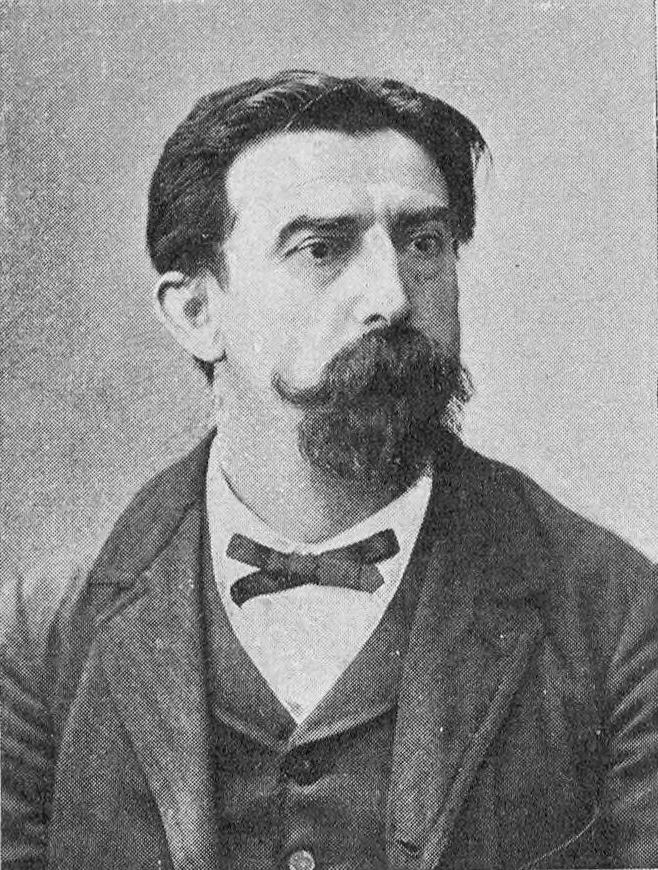
“To the voters of the second district of Albi (Taru).
“Citizens: As a Republican and Socialist, I again come to ask that you commission me to defend the Republic, to fortify the democracy, to organize, and emancipate the industrial and agricultural workers.
“Four years ago we were defeated by violence and calumny.
“You will recall the odious brutalities made use of to suppress free speech in 1808.
“And while the reactionists were silencing my voice. I was being odiously denounced for my zeal in the Dreyfus fair. I was a Judas, I had sold out to the enemies of France.
“Today all France knows the truth. She knows that an innocent man had condemned to prison by mistake, that he was being kept there by rascally maneuvers, by lies, by perjuries and by forgeries.
“Today, France knows of the treason of Easterhazy [sib?], the rue culprit, she knows of the confession of Henry, the forger, she knows the decision of the court of [unreadable].
“I am proud of having contributed to free an innocent man, and unmask the traitors.
“That which imputed to me a crime by clericals or their dupes, I claim honor of my life.
“Under cover of the confusion created, the reaction tried once again, four years ago, to strangle the Republic, to kill in France the spirit of the Revolution.
By a close union of all republicans, the assault was repulsed.
This necessary and loyal union which the coming general elections will affirm under various forms, but with equal force and equal success implies for no republican and confusion or any abdication. When moderate republicans, radicals and socialists all vote together against the reaction it does not mean that moderates and radicals subscribe to socialist principles, nor does it mean that the socialists have abandoned one single plank in their platform. It is the simple affirmation of the fact that the republican liberty for which they stand as a unit is their common patrimony, and this common patrimony the absolute condition necessary for the regular evolution of democracy.
“The Socialist Party, whose doctrine and whose entire program I shall always defend with passionate fidelity, has the right to appeal to all republicans, because in times of crisis the Socialist Party has always fought in the front ranks for liberty and because it has always taken part in bringing about all reforms that could make the Republic beloved.
“Never will the Socialist Party abandon its ideal, never will it fetter itself by adopting an uncompromising attitude that can only strike it with impotency. It will second all good intentions, it will encourage all those who hesitate, and it will crush with all the power of the organized proletariat all selfish resistances.
“Citizens:
“In all my meetings, always open to the public, held during the past forty-two days, I have explained before you what reforms I shall advocate if elected, i.e., tax reforms, reduction of the military service and transformation of the whole military institution. I also explained how would be realized the first stages of collectivism which is destined to save the nation and the workers, urban and rural–from the domination and exploitation of capitalism.
“These explanations are again given, and more at length, in the circular that I have mailed to every voter.
“But here and how I wish to reply to the calumnies and sophisms of the reaction.
“They no longer, hardly dare accuse us of wanting to divide up, of wanting to take the land from the farmers. Your Round common sense has spiked this ridiculous accusation. Inasmuch as I am concerned I shall answer them by acting. I want to organize the rural population of this region, farmers and tenant farmers, into federated syndicates for mutual credit assistance. I wish to teach, the country people, so suspicious of one another, so tightly bound up in a narrow individualism, what incomparable power for them resides in association when that association is backed by the local government and by the republican socialist state. (?)
“But the reaction does not renounce calumny because that one special calumny is no longer usable.
“The reaction lies when it says that the progressive income tax will merely be added to the other taxes, and that it will weigh particularly hard on the farmers.
The progressive income tax will replace the unjust taxes–particularly the tax on land–of today will fall upon the capitalist class that with our present system does not pay its just share.
“The reaction lies, when in order to excite religious fanaticism against us, when in order to turn the people away from reforms, it says that we want to destroy by force religious beliefs, that we Want to close and demolish churches. Religious freedom is an essential article in the Republican and Socialist programs.
“Religion is a private matter, for which a man owes an accounting to nobody. The State has no more right to endeavor to destroy it than to force it upon any one.” (Men of the convention of 1793, where are you?)
“But the Republican nation, that can only live by liberty, and can only progress by science, must assure to every child in every school teachings in conformity with the principles of liberty and the facts laid down by science. It cannot allow factious financier-monks, who go in for politics to prepare civil wars and coups d’etat by their counter-revolutionary teachings. The Republican State must reassume the right of sovereign control and effective direction over all matters pertaining to the schools, control of which was despoiled by the Jesuitic manoeuvers of 1850 that prepared the “second of December.” (Mr. Jaures, though a university man himself, formerly professor of philosophy, appears to forget the position occupied by the professors with respect to the clergy.)
“The reaction lies when it says that I am a fomenter of strikes. During the four years that I was a deputy not a single strike occurred in the mines of my district, and if, at the outset of the struggle, the big glass factory owners had manifested the same spirit of conciliation shown by the men, they would have saved themselves, the workers, and the city, the long contest that followed, and from which the rights of the workers issued triumphant. The real agitators, the real strike fomenters, are those who since 1885 have endeavored to use the miners for purposes of political domination.
“You will not let yourselves be humbugged, and led astray by the clamor of the counter-revolutionists. All the Socialists, all the Republicans, acting together as a unit, will overthrow the enemy.
“The reaction, at one and the same time, lazy and violent, incapable and intermeddling, has, in no way, served your interests and your rights. It has only known how to sow seeds of discord by introducing politics into the mine and into the glass works.
“A Republican and Socialist victory in this district will be the signal of final reconciliations between the mine workers and the glass workers.
“Forgetting their divisions and quarrels of yesterday, they will work with vigilance and wisdom in peace for the common emancipation.
“The Socialist Republic forever!
“Jean Jaures.”
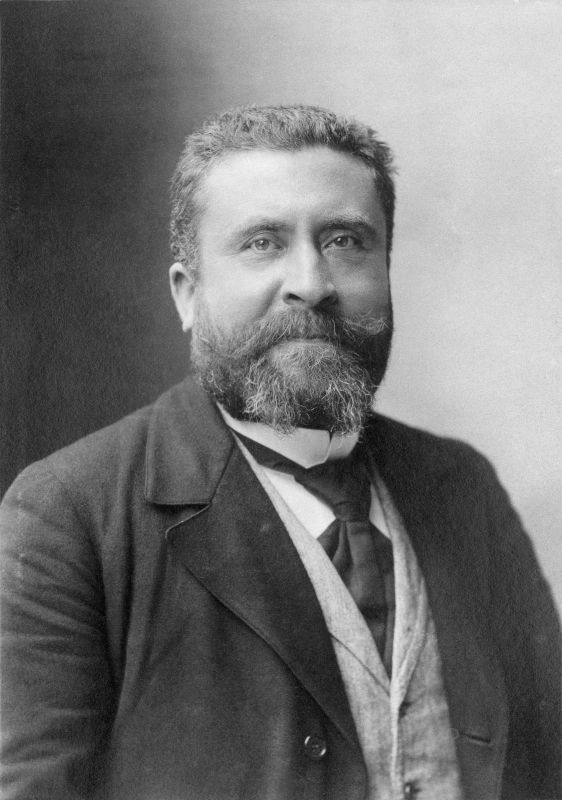
Here we find a compromise of principles; elsewhere we find the government and the ministerial Socialist cheek by jowl; in fact, as for instance when Waldeck-Rousseau made the celebrated St. Etienne speech for M. Briand, or when again the President of the Council of Ministers presided at the meeting in the Eighteenth District of Paris on January 19, so as to give the stamp of official recognition to the candidacy of the leader of “possibilist Socialism,” M. Rouanet.
The “independence,” or, if you prefer the “autonomism” of the federated” Socialists went so far as to advise the Socialist workingmen of Orleans to vote for the radical on the first ballot, the same radical that the P.O.F. has been fighting for the past twelve years, and who today, armed with the approval of the ministerial Socialists is in a position to create untold confusion in the minds of the voters in his district. But the limit was reached when at Dragurguan M. Neton, the “Socialist party” candidate declared himself in his posted declaration of principles in the public press and in his speeches unalterably opposed to collectivism. M. Neton was nothing more or less than secretary to the minister of foreign affairs, he resigned to make the run on the Socialist ticket.
These are but a very few facts among many; space forbids my mentioning more, but those cited suffice to show what a ferment of corruption for Socialism ministerialism has been. The contrast between the campaigns carried on by the “Parti Socialiste Francais” (French Socialist Party), and the “Unite Socialiste Revolutionnaire” (Revolutionary Socialist Unity), is sufficiently established to make it unnecessary to dwell longer upon the subject.
There was not only contrast but most violent antagonism all through the campaign. The candidates of the Revolutionary Socialist Unity were the enemy for all the bourgeois parties; it was consequently quite natural that the ministerial Socialists should tumble over themselves in their endeavors to do us harm. Wherever dirty work was to be done for the bourgeoisie, the “Socialist Party” were zealots. The central organ of the gang, the “Petite Republique,” poured out a steady stream of vomit against those of our candidates who had accepted to run against their notables. For instance, our friend, Rene Chauvin, who made the race on the platform of the class struggle against the “Socialist” minister candidate Millerand was likened unto a common criminal; for the benefit of my American comrades, let it be stated that Messrs. Jaures and Geraut-Richard are the editors of the “Petite Republique.” In the department of the North another daily, the “Reveil du Nord,” whose editor, Mr. Delessable, had been kicked out of the P.O.F., was untiring in lying about and traducing our comrades–our party in this district has 9,000 members in good standing.
On account of our strength the “Reveil du Nord” did not dare to come out openly and advise voting for the radicals, but, by insinuation, by innuendo, it endeavored to excite the workers against us, and create a current of sympathy for the bourgeois candidates. And it has not been proven that it was not in the offices of the “Reveil du Nord” that was concocted the circular directed against our venerated comrade, Jules Guesde, and of which 250,000 copies were distributed at Waterloo and Roubaix during the few hours immediately preceding the elections.
We were accused of having made a secret compact with the Nationalists, with the reactionists, etc., but space forbids us to state more. Let our comrades of he “Socialist Labor Party” contemplate the Kangaroos if they wish to form an idea of the French product.
The ministerial episode is the most disgraceful affair in the annals of Socialism in France.
RESULTS.
At the present writing the exact totals of votes polled by the Revolutionary Socialist Unity is not known to us; the minister of the interior holds the secret. As yet we are unacquainted with the results posted in the city halls in districts where we have no sections, and the bourgeois press is as still as a mouse on the subject. The results will be published in full by the National Council of the P.O.F. But according to what is already known, the Revolutionary Socialist Unity polled 300,000. A review just out gives the “French Socialist Party” 376,130 votes, and the candidates who repudiated ministerialism it attributes 487,021 votes: The elected candidates of the “French Socialist Party” are 28 in number, representing 166,000 voters, the elected candidates of Revolutionary Socialist Unity are 14 in number, representing 122,854 voters. The names of our 14 elected candidates are, Allard, Denezech, Bouvere, Chauviere, Constant, Coulaut, Dejente, Delory, Dufour, Selle, Sembat, Thurier Vaillant, Walter. The number of our representatives has not diminished, and we would have cause for nothing but rejoicing were it not for the fact that Groussier and Zevaes (formerly deputies) were defeated. Comrade Groussier was defeated by a nationalist, and comrade Zeraes by the architect of the Grande-Chartreuse”. Groussier’s defeat is due to accidental causes, it is one of the last effects of the craze fomented in Paris by the ministerialists and the nationalists. There are still hundreds of the little storekeepers simple enough to imagine that the political shade of their deputy influences their receipts. The cure is at work, The defeat of Zavaes is due to coalition of all the bourgeois forces. The P.O.F. stand on the class struggle could not but group against it all the “law and order” forces. But, if we experience only defeats such as the one that overtook Zevaes it will argue well for the proximity of the Social Revolution: in 1898, at the first ballot, Zeaves. obtained 7,198 votes and was elected on the second by 9,000 votes; at the recent elections he obtained 9,808 votes on the first ballot, and went down to defeat with 10,934 on the second ballot.
There is another defeat over which the bourgeois should shout itself hoarse with joy: the defeat of Guesde. The following figures tell the story and vindicate the scope of the bourgeois victory. Guesde was elected in 1893 by 6,887 votes, defeated in 1898 with 7,998 votes and again defeated this year with 8,728 votes. It would be appreciating results in a very superficial manner were we to attribute the defeat of some of our comrades and the momentary slow increase of the number of revolutionary socialists to the kind of campaign that was conducted against us. The principal reasons for the actual conditions are more general and are to be sought for elsewhere. They are essentially economical in their nature. In the first place they hold to the rapidly increasing difficulties that weigh so heavily on the little bourgeoisie and the small peasants; the little business man, the little shop owner, the small farmer feels himself doomed, but the causes of this remain a mystery. Socialism, every day presented to them as something awful, is still looked upon as an enemy,–but as a distant enemy, a future enemy. On the contrary, the direct enemy, the one that is visible ant that can be attacked as the sum total of our political institutions and those who direct them; as a consequence they are predisposed towards non-socialist political oppositions. But at the same time in a dim, confused way they perceive that the international market where prices are made is the irremediable cause of their misery; as a consequence they are at the mercy of the nationalist journalists, who denounce the Jews and the foreigners as the responsible cause of all woe and misfortune. This is sufficient to occasion a strong retrograde and nationalist current of ideas, without any depth, certainly, but all the more violent as it is the result of nothinking exasperation. On the other hand, the wage workers form the immense majority of the nation; quite a large proportion are piece workers or are employed in small shops, where the ever-increasing shortage of work transforms these workers into dependents upon the small store keepers, who alone, give credit. The class-instinct, the solidarity in demands resulting from solidarity in exploitation, does not exist for them, except as a lightning flash when brutal economic crises throw them in masses into the street. They are consequently intellectually tributary upon small industry and small commerce. Finally, where, as in Roubaix, this material situation exists only for a minority of the workers, the capitalists employ methods against the workers that can only be smashed in revolution. In effect, there, nearly one half the children go to clerical schools–the inducements for the parents to send them are the clothing given the children and the many gifts in kind they receive. The clergy, in its house to house visits, soon become acquainted with the degree of misery suffered by the different families, and they advise the capitalists when a donation here, there, or elsewhere should be made. Under such conditions the municipal reforms instituted by the Socialist council of Roubaix remained without any effect for a considerable proportion of the population. The same is the case in many other cities. Such things make the Radicals howl when they occur in towns under their control, but they look on with complacency when it happens elsewhere.
Finally, ministerialism is one of the most terrific blows ever directed against the recruiting of Socialists in France. After the shameful retreat of the radical Bourgeois Donner Ministry in 1896, an immense number of workers came down out of the clouds and joined the ranks of socialism, they finally saw that the battles carried on between the radicals and anti-radicals were fights in form only whose value was about zero in as far as they were concerned, they hoped that the name socialism would be a safeguard against the successive bankruptcies that had marked the parliamentary action of the radicals, from the point of view of their promises only, be it understood. Now this is the manner in which the Minister Millerand answered their hopes.
“Mr. Millerand–goes on to say Mr. Barthon, the opportunist leader in his speech at Orleans on the 6th of April–needed but scant time to rejuvenate the saying of Mirabeau and to demonstrate that a collectivist who becomes a minister is not a collectivist minister. Certaily, the Minister of
Commerce, held by tactical necessities, and obedient to powerful and necessary friendships, has not ceased to affirm his fidelity to the program of St. Maade. But at the same time, he has realized so clearly the necessities of government and the exigencies of power that little by little his attitude, at first ardent and imperious, submitted to, and was finally dominated by the doctrines, the methods and even the politics of M. Waldeck Ronsseau. In speaking of these things I in no way intend to blame the Minister of Commerce, quite the contrary, this evolution is all in his favor, I only mention them, to explain how by dissipating our suspicions this evolution made it possible for certain Republicans, among whom was myself, to rally to the support of M. Waldock-Rousseau in his task of Republican defense and Republican action.”
“I could cite, were it necessary to do so, decisive proofs upon decisive proofs, gathered day by day during the course of events. I shall only mention a few.
“It means something when M. Milleraud, on three separate occasions, votes to maintain the Vatican embassy when he votes the religious budget, the appropriation of the secret fund, and rejects the gradual income tax. But still more fraught with significance is the fact that he participated, involving to the full extent, his ministerial, responsibility and solidarity, in the attitude, so courageous, so proud, so patriotic, adopted by the Chief of the Ministry, upon the question of the extension to all the missionaries of the indemnity advanced upon the promises of China, to the victims of the Boxers. I imagine that M. Leyguis rejoiced when a few days later, his collectivist colleague adhered to the position he took in his speech when he denied to the university professors in the face of the threats (?) made by M. Jaures, the right of doing and–of talking as they saw fit outside of their classes.
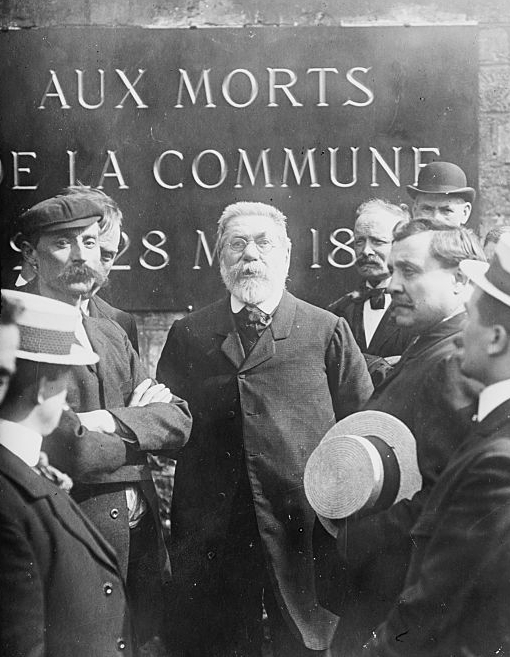
“But still other facts come back to my memory, facts all the more worthy of being retained because they concern a Socialist. Without mentioning his broken promises to the lace-workers of Calais, it is a fact that the Minister of Commerce saw no reason why he should, interpolate his colleague, M. Baudin, on the occasions of the Carmaux. Mouceu-les-mines strikes, he did on a certain action in 1894 when in the ranks of the opposition and incidentally, let it be said, that at that time his interpretation of the law. was erroneous. In a similar manner when during the labor troubles at Marseilles M. Waldeck-Rousseau expelled an Italian deputy and several Italian agitators. Mr. Milleraud did not seem to remember that on a similar occasion, a few years ago, he addressed a violent interpellation to the then Minister of the Interior. Finally, at the time of the threatening strike to the miners. I cannot recall that he endeavored to foist upon the ministry the opinions about the use of the military that he so frequently gave expression to when in the ranks of the opposition and—”
I could, if necessary, make other citations covering happenings since the elections as going to show that the only ones attained, the only ones discredited by the events of the last campaign are the moguls of the “Parti Socialiste Francais.” I believe our American comrades will be satisfied with what has already been presented. They who were with us, the “intolerants,” at the beginning of the ministerialist crises will find in the last citation taken from one of our bitterest foes good reason for maintaining unshakable confidence in the uncompromising attitude they have assumed.
***
Out of the last electoral campaign (May 1902) the Revolutionary Socialist Party has come forth strengthened and purified. There now exists in France a compact and numerous army corps to guide the proletariat to emancipation. Contrary wise those who hope to see salvation issue forth from a series of parliamentary reorganizations, gradually leading up to the harmony of tomorrow, spontaneously spring from out of the economic anarchy of today. We, the revolutionary Socialists, know that the battles of today are but skirmishes preparatory to the decisive struggles of tomorrow, we know that these are not dependent upon the concerted volition of such or such other groups of militants declaring that the clock of time has struck, the hour, but that they will be the natural consequences of the economic upheavals visited upon the old world by the irresistible and leveling competition of the new. The class conscious Socialist has cause for rejoicing, we have just weathered a gale that would have swept to destruction any part not anchored to the class struggle. If tomorrow circumstances should arise compelling the exploited of France to turn towards us, just as 800,000 bourgeois suffered in 1789-03 to raise to the ground the superannuated institutions of the ancien regime, so will the 360,000 class conscious Socialists of the France of today suffice to hurl into the abyss of time the capitalist system and its last supporter Speed the day!
Notes
(1) The newsstands of Paris form part of the government patronage.
(2) In France every wage worker is furnished with a card by the authorities; when he starts to work for an employer and when he quits the job, he must present this card to his employer to sign. This makes black-listing very easy.
(3) “Le Programme du Parti Ouvrier, ses considerants et ses articles,” by Jules Guesde and Paul Lafargue.
(4) Evidently Comrade Nivet has run against the “American never boss.”
New York Labor News Company was the publishing house of the Socialist Labor Party and their paper The People. The People was the official paper of the Socialist Labor Party of America (SLP), established in New York City in 1891 as a weekly. The New York SLP, and The People, were dominated Daniel De Leon and his supporters, the dominant ideological leader of the SLP from the 1890s until the time of his death. The People became a daily in 1900. It’s first editor was the French socialist Lucien Sanial who was quickly replaced by De Leon who held the position until his death in 1914. Morris Hillquit and Henry Slobodin, future leaders of the Socialist Party of America were writers before their split from the SLP in 1899. For a while there were two SLPs and two Peoples, requiring a legal case to determine ownership. Eventual the anti-De Leonist produced what would become the New York Call and became the Social Democratic, later Socialist, Party. The De Leonist The People continued publishing until 2008.
PDF of ‘Socialism in France: A Comprehensive and Analytical Review of French Conditions’ by Henry Nivet from The Weekly People. Vol. 12 Nos. 18-21. August 2-23, 1902.
 Revolution's Newsstand