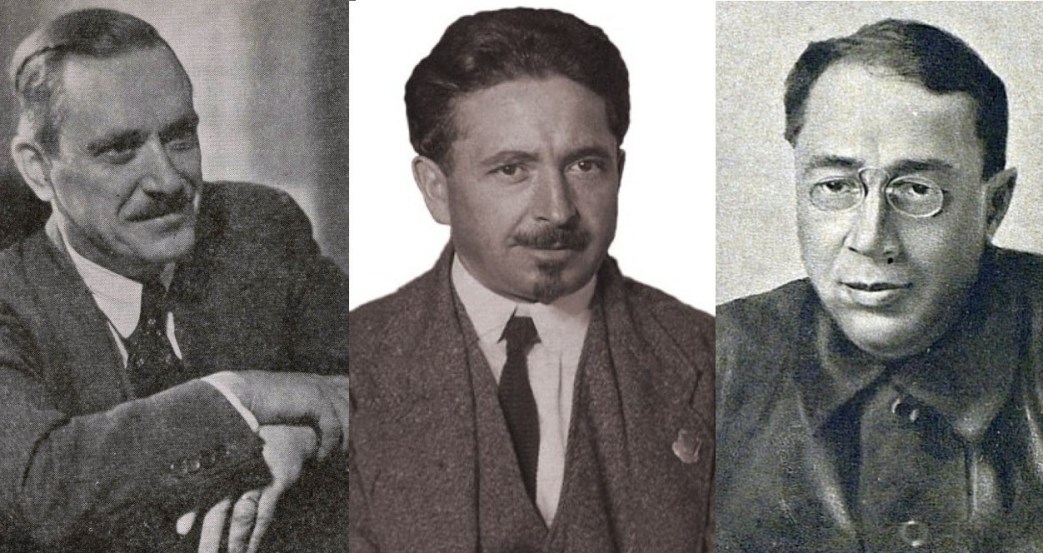
‘The Fourth Convention of the Workers (Communist) Party by Mex Bedacht, Earl Browder, and Sergei Gusev from International Press Correspondence. Vol. 5 Nos. 71 & 75, September 24 & October 22, 1925.
The Fourth Communist Party congress held in August of 1925 saw major changes to the U.S. movement. Most importantly, for the first time the Comintern’s leadership, in defiance of the U.S. Party’s votes, determined the final makeup of the Party’s leadership. As such, it annulled the Foster-Cannon ‘left’ majority (counting 40 of the 61 conference delegates elected), and replaced it with the ‘right’ led by Ruthenberg and Lovestone, also associated with the larger, dominant, right trend in the International of the time. Second, it officially inaugurated Bolshevization, the transformation of the Comintern’s sections into a uniform political, organizational, and leadership directly determined by the Comintern’s larger policy. In the U.S. Party of 1924, C.E. Ruthenberg was Executive Secretary of the Party, but of the minority, with the Central Executive Committee of 13 members controlled by the Chicago-based majority of 7 (which met on its own); William Z. Foster, Alexander Bittelman, Earl Browder, Fahle Burman, James P. Cannon, William F. Dunne, and Martin Abern. The minority were J. Louis Engdahl, Benjamin Gitlow, Jay Lovestone, John Pepper, and Ruthenberg. Despite the Foster group’s unassailable elected 65% majority at the conference, a new 20-person C.C was mandated to include a new majority of 10 from the previous ‘right’ minority, and stripping the ‘left’ its duly legitimate majority, appointing them just 9 seats. Just to make sure, unelected Comintern representative Sergei Gusev (P. Green) was made the 20th vote, assuring an 11 to 9 majority for the Comintern and the ‘right.’ Ludwig Lore, veteran of the S.P. Left Wing and founder of U.S. Communism, and his supporters were members of neither faction. Despite not being ‘Trotskyists’ (in 1925 U.S. supporters of the Left Opposition in Russian—like Antoinette Konikow–could be counted on one hand) would function as stand-ins for the international campaign against Trotskyism, with ‘Loreism’ (I am still unsure what that is) and Lore expelled at the conference from the Party.
Below are three notices of the meeting. From the former minority, now majority, comes a report from Max Bedacht; Earl Browder represents the former majority, now minority. And Sergei Gusev (P. Green) gives the Comintern assessment and directions.
‘The Fourth Convention of the Workers (Communist) Party by Mex Bedacht, Earl Browder, and Sergei Gusev from International Press Correspondence. Vol. 5 Nos. 71 & 75, September 24 & October 22, 1925.
‘The Fourth Convention of the Workers’ (Communist) Party of America’ by Max Bedacht from International Press Correspondence. Vol. 5 No. 71, September 24, 1925.
The Workers Communist Party of America held its Fourth National Convention beginning August 21st. The Convention lasted fully ten days and was significant in more than one respect.
For several months prior to the opening of the Convention, a bitter fractional struggle was carried on within the Party. The basis for this struggle was a fundamental difference that had gradually developed among the leading groups of the Party. Some comrades of the leading strata, mostly engaged in the trade union work of the Party, displayed a distinct trades union ideology. In the terminology of these comrades, the working class is synonymous to the workers organised in trades unions, and the labour aristocracy is synonymous to the labour bureaucracy. But the misconceptions resulting from such confusing premises are not the only ones. These comrades insist, if not in theory, but surely in practice, that the Party is merely an instrument for the conquest of the trades unions.
This trade union ideology resents the “interference” of political policies and campaigns in the trades union work. When a political united front manoeuvre of the Party leads to the unmasking of fake progressives in the trades unions, then these comrades do not so much attack the “progressives” for their treachery, but they centre their attacks on the “politicians” in the Party for having unmasked them.
Such a manoeuvre, that of the conference of July 3rd, 1923 in Chicago, which ended in the formation of the Federated Farmer Labour Party, led to the unmasking of the “progressive” leadership of the Chicago Federation of Labour. Some of the comrades leading in the trades union work of the Workers Party were connected by ties of personal friendship with those Chicago “progressives”. The break with them was felt by these comrades not as a politically inevitable event, but as a personal injury to themselves. So these comrades decided that if the political direction of the Party would determine finally the manoeuvres of the Party workers in the trades unions, then they would wrest the leadership of the Party from the “politicals” and thus prevent further interference of “politics” in the Party’s trades union work. Consequently, these comrades organised a “revolt” which led to their getting a majority of the delegates at the Third Convention of the Party in the New Year, 1924. In this Convention, the Party witnessed the anomaly that the report of the C.E.C. was adopted unanimously, that the political theses of the C.E.C. were accepted almost unanimously, but that the C.E.C. failed to get a majority in the elections for a new Central Committee. The “trades union wing” had no political programme with which to defeat the Central Executive Committee. But it got the votes. The political unripeness of our Party manifested in this incident, finally led to the recent fractional struggles in the Party.
The new majority of the C.E.C. elected at the Third Convention suffered from a lack of a unifying lack of a unifying concept. It saw all phenomena and manifestations of the class struggle separate and distinct from each other without understanding, or looking for, the inner connections between these events. One of the results of this lack of Marxian-Leninist understanding is a complete misunderstanding and misapplication of the united front policy. Instead of using the united front policy as an instrument of unification, not only unifying the isolated and sporadic struggles of the workers, but also teaching the workers the inner connections of all the causes for the various struggles, these comrades reduced the united front to an empty phrase. A system of multiple united fronts was initiated which began by promising to set up a new and separate united front for everything, and which ended in destroying the only big political united front movement our Party was engaged in since the “political” C.E.C. initiated the Labour Party policy and campaign in 1922.
When this somersault was performed by the Central Committee, the differences in the Party crystallized into distinct factional formations.
In October 1924 the majority of the Central Committee rejected the proposal of the pro-Labour Party group to introduce through the left wing in the American Federation of Labour Convention a resolution demanding the formation of a Labour Party.
A few days after the conclusion of the presidential elections in November, the majority of the Central Committee passed, over the protests of the then minority, a declaration that the Labour Party movement is dead.
Finally, later in November 1924, the then majority adopted a thesis declaring against the Labour Party policy and campaign and denouncing the pro-Labour Party group in the Committee as opportunists, liquidators, and reformists.
The differences in the Party were finally submitted to the Communist International. But not after some struggle. The combined experience of our World Party was to help our American Section out of its entanglement.
The Comintern decided for a Labour Party. But that did not settle the controversy. The “trades unionist” anti-Labour Party group of the Central Committee realised that the decision of the Comintern was a political defeat, which in any ripe communist Party would lead to the defeat of the Executive Committee in a convention. To avoid such a defeat our right wing therefore decided to raise false issues and to claim a victory at the Comintern. The C.I. in its decision declared that it had detected errors on both sides. This sentence was ridden to death. The anti-Labour Party group completely forgot its political duty toward the Party. It had submitted to the Comintern a general orientation for judgment; so had the left wing of the party. The Comintern accepted the general line of the left wing and rejected that of the right. While the general line of the left was found correct, the Comintern rightly criticised tactical errors made by that group in applying a correct line. The right wing seized upon these criticisms as the main issue and thus prevented a thorough discussion of its major error. Thus it prevented the Party from really learning to understand not only that the old C.E.C. majority had made a mistake, but the nature and basis of the mistake. Only a clear understanding of the nature and the basic causes of a mistake is a guarantee against the repetition of it. The right wing prevented this Leninist self-criticism in order to be able to further exploit the prejudices which it had created against the left wing on the basis of its former demagogic accusations of reformism, opportunism, and pink flagism.
But the comrades of the then majority of the Central Committee were not satisfied with a politically dishonest fight against the left wing. They were determined to retain the leadership of the Party at all costs. With this aim in mind, they initiated a campaign of suspensions and expulsions. In Cleveland this campaign found its classic climax. Branches which supported the left wing of the C.E.C. were changed into supporters of the anti-Labour Party group by suspending from membership as many as thirty left wing adherents in one single branch. When these suspended comrades were reinstated by a decision of a Parity commission established by action of the C.I. the District Organiser found new ground for suspension. The District Organiser in this district. to assure his domination took upon himself even the right of two votes in committees.
With such actions as a preliminary the Fourth Convention of the Workers Communist Party began under dangerous auspices. Dual delegations presented themselves from the most important districts, like Boston New York, Philadelphia. and Cleveland.
The political theses and resolutions submitted to the convention were adopted unanimously in the Parity Commission. The struggle in the Convention therefor centred on the credentials and on the past actions of the Executive Committee.
The report of the minority of the credentials committee disclosed such utterly uncommunist manoeuvres that it seemed impossible to appease the outraged delegation of the left wing and prevent a split.
But the fever heat of resentment was overcome by the loyalty to, and the confidence of the comrades in the Comintern. The left wing delegation returned from its caucus to the convention and declared that under no conditions will it permit itself to be provoked into a split.
All throughout the debates of the convention, the fundamental differences between the groups manifested themselves. The lack of a political concept which could unify all the activities and all the analyses of the Party manifested itself on the one hand, and an effort to give such a unifying concept was apparent on the other hand.
The debates were bitter but contributed to the clarity of the Party. The role of the Party in the class struggle was discussed, on the concrete basis of American conditions. A clear understanding of the resolution of the Second World Congress of the Comintern on that matter was thus created.
The real object of the Party’s work in the trades unions, not as industrial, but as political work was made clear. This will contribute to a more conscientious application of the Party’s forces to this task. It will help to eliminate the dangerous ideological division of the Party into trades unionists. and politicals. It will establish as the most important prerequisite and fundamentally necessary qualification for a Party member. that of being a Communist.
The Convention took up the problem of a serious reformist crystallization in the Party. This social democratic wing centred around Ludwig Lore, the editor of the New York Volkszeitung. Lore was an ally of the “trades unionists” in their revolt against the “politicals” in the Third Convention of the Party. As a true opportunist he supported the criticism of the “trades unionists”, by the “politicals”, but voted with the former to oust the latter from leadership. From the convention in January 1924 Lore wired to his paper that “the Trotskyites have won the Party”. This was never repudiated by the majority. Lore and his adherents became an integral part of the majority caucus.
itself in an ever-accelerating tendency away from abstractions. With the bolshevization of the Party, which manifested and toward concretization and action, the social-democratic remnants in the Party came into an ever sharper conflict with the Party’s policies. Opposition to these policies became fundamental opposition to action. In the period when this reformist crystallization took definite form, it was imperatively necessary that the Party should join issue with it and thus preserve the unity and the purity of the Party. But the fact that the Lore group was an integral part of the leading group in the Central Committee favoured this opportunist crystallization.
The then minority took up the question of Loreism with the Comintern at the Fifth World Congress in April 1924. The C.I. supported the left wing and condemned Lore and Loreism. Put the alliance of the “trades unionist” majority with Lore continued. Only a new decision of the Comintern made at the last Enlarged Session of the Executive Committee in April 1925 at the urgent request of the left wing severed the ties between Lore and the majority. But the division is by no means definite. The bulk of the rank and file which is under the ideological influence of Lore and Loreism, together with the least active sections of our Party, supported the anti Labour Party right wing in its struggle for further leadership before the convention. But the decision of the Comintern succeeded in driving home to the Party as a whole the seriousness of the Loreistic disease of our Party. As a result of this it was possible to unite the majority and minority fractions for a unanimously accepted proposal to expel Lore from the Party. On the initiative of the left wing the removal of Askeli, another Loreite, from the position of editor on the Finnish Daily, “Tyomies”, was also decided unanimously.
The pro-Labour Party left wing did everything in its power to keep the discussion on the level of a political debate. This was very hard because of the right wing’s persistent efforts to lead the discussion away from political fundamentals into the field of petty details. But in spite of all that, the Convention proceeded under the slogan of bolshevization. The very debates of the convention were a contribution to bolshevization. Whatever efforts might have been made to divert this main aim were finally frustrated by the Comintern when it made and transmitted to the convention an eleventh hour decision in which among other things it stated categorically that:
“It has finally become clear that the Ruthenberg group (pro Labour Party left wing group) is more loyal to the decisions of the Comintern and stands closer to its view.”
This C.I. decision had the effect of a bombshell in the convention. The majority, which, by its questionable methods characterized by the C.I. as “excessive mechanical and ultra fractional”, had succeeded in having a majority of the delegates, after a long struggle in its caucus submitted to this decision. A Central Executive Committee was elected, with equal representation from both groups and a representative of our World Party as chairman.
Under the leadership of this Committee, the decisions of the Fourth Convention will be put into effect. The reorganisation of the Party as a necessary pre-requisite to its bolshevization will be the immediate task. Out of a union of numerous language federations, each one in itself a political party, this Executive Committee will weld a unified centralised Communist Party, worthy of membership in the Comintern and adapted to the tremendous tasks awaiting it in the American class struggle.
‘Fourth National Convention of the Workers (Communist) Party of America. by Earl R. Browder from International Press Correspondence. Vol. 5 No. 73. October 8, 1925.
In No. 71 of the “Inprecorr.” (24th September 1925) there was published an article on the Fourth Convention of the Workers Party of America by Comrade Max Bedacht, representing the Ruthenberg (pro-Labour Party) group in the Workers Party of America. This group has the support of the Executive Committee of the Communist International. We publish the following article by Comrade Earl R. Browder representing the Foster, (anti-Labour Party) group, in order that readers may be fully informed regarding the attitude of the two groups. Ed.
From August 21 to 29, 61 delegates of the Workers (Communist) Party met in Chicago in the Fourth National Convention. The results of this gathering were quite unexpected to the entire Party membership.
The political resolutions for the convention had been unanimously adopted before the convention by a commission composed of equal representation from the two major groups of the Party, the majority (or Foster group) and the minority (or Ruthenberg group), with the representative of the ECCI. as chairman. The delegates to the convention were unanimous in acceptance of the set of 13 unanimous resolutions covering every aspect of Party activity.
With such political unanimity, the election of delegates to the Convention occurred, however, in an atmosphere of intense factional strife. This was because the Ruthenberg group went to the Party with an appeal to repudiate the leadership of the former executive committee headed by Foster. In the struggle that took place, the Foster group elected 39 delegates to the convention, and the Ruthenberg group 15 delegates, out of the total of 54 provided in the arrangements.
The Ruthenberg group contested the elections in several districts, making a demand for 8 more delegates which, if all their claims had been allowed, would have left the comparative strength in the convention. 31 for the Foster group and 23 for the Ruthenberg group. On the other hand, the Foster group claimed one of the delegates assigned to the Ruthenberg group in the election, on the basis of election irregularity.
Throughout the pre-convention period, efforts were made to pacify the struggling groups, and come to agreement, but without avail. Before the eleven district conventions met, which elected the delegation to the national convention, the chairman of the Parity Commission, Comrade Green, called both sides together and obtained a written agreement, establishing the fact that the Foster majority group had obtained a majority in the Party, and that the election of the new Central Executive Committee should be upon the basis of 13 for the majority and 8 for the minority, and that there should therefore be no splits or competing delegation from the district conventions. This agreement was, however, not observed by the Ruthenberg group.
When the convention delegates gathered on Aug. 21, the policy of ultimatums pursued by the Ruthenberg group was tantamount to holding the threat of a split over the convention. In an effort to prevent such a calamitous occurrence, the majority agreed to seat in the convention all the contesting delegates (with the single exception of the claim of two from Chicago, where the minority had but 28 votes out of a total of 101), to grant additional representation on disputed district committees, and to give further representation up to one-half after the convention, when it was assured that the struggle was ended. The chairman of the Parity Commission declared that this was “an honourable offer which could be accepted”. The Ruthenberg group refused, however, and only at the end of the third day, after long negotiations, declared their readiness to submit to the decisions of the convention.
The convention was then organised, upon the basis of 40 delegates for the majority and 21 for the minority.
A great deal of the bitterness of the struggle between the two groups had arisen from the mutual charges of manipulation of the right wing by one group against the other. The Ruthenberg group pointed to the fact that Lore, ideological leader of the right wing, had supported the Foster group since the last convention. The Foster group pointed to the close association between the Ruthenberg group and Lore, previous to the last convention, when Ruthenberg and Pepper had controlled the Party, expressed in electing Lore on the Politbureau and excluding Cannon, electing Lore on the directing committee of the Farmer-Labour Party convention in 1923, publishing Lore’s articles on the German October occurrences as leading articles in the official organ, and the placing of Lore on their list for f the Central Executive at the last convention. On the other hand, the Foster group had given Lore no political consideration, but had publicly combatted his views.
Another source of much bitterness was the interpretation of the C.I. decision on the questions involved in the Party’s attitude towards the formation of a Labour Party in the United States. The Comintern decision declared that both sides had made mistakes in this controversy, and laid down a correct line which was accepted by both sides. The Foster group admitted its error in the proposal to discontinue the use of the slogan of the Labour Party. But the Ruthenberg group, declaring that the Comintern had upheld its basic conception of the Labour Party policy, demanded complete leadership of the Party upon that basis. This was stoutly resisted by those, who for three years had energetically combatted the opportunist and adventurist tendencies in the Ruthenberg group, which the Comintern decision had finally rejected.
The verdict of the rank and file membership of the Party had been overwhelmingly in favour of the Foster group. But for the provision agreed upon by both sides, in the Parity Commission, for minority representation from each district, there would have been but a handful of delegates at the convention for the Ruthenberg group.
It was with this background that the Convention had gone through its order of business, except for some items upon which agreements were still in process of being reached, and toward the last hours of the Convention, that the representatives of the ECCI. transmitted to the delegates of the Convention a cable received from ECCI.
The message declared that “it has finally become clear that the Ruthenberg group is more loyal to the decisions of the Comintern and stands closer to its views”, and demanded concessions to the Ruthenberg group.
The majority group, through its leader Foster, immediately declared that it considered the decision of the Comintern as law which must be immediately carried out. But under the circumstances, in which the cable appeared as a declaration of lack of confidence by the Comintern, the majority could not take the responsibility of leading the Party. It therefore proposed an equal committee, ten from each side, with the representative of ECCI. as chairman. This was adopted unanimously by the convention, after Foster had declared, for the majority of the convention, that the decision would be appealed to the Comintern. The Committee selected was: From the Foster group, Foster, Cannon, Bittelman, Dunne, Browder, Abern, Berman, Reynolds, and Aronberg; and a representative of the YWL; for the minority, Ruthenberg, Lovestone, Bedacht, Engdahl, Gitlow, Ballam, Minor, Weinstone, Withe and Schmees.
At the first meeting of the new Committee, the chairman voted with the Ruthenberg group, and the old minority became a majority of the Committee. It proceeded to place the administration in the hands of a Politbureau of 5 members (Ruthenberg, Lovestone, Bedacht, Cannon and Foster), from which the former political secretary (Bittelman) was excluded over the protest of the Foster group. The position of chairman of the Party, formerly occupied by Foster, was abolished. Ruthenberg was named “General Secretary” and given general administration of all Party affairs. The Ruthenberg group took charge of all departments, except the industrial, where Foster was left nominal head with a majority of Ruthenberg’s group in a committee to direct the work, and the Research Department, to which Browder was removed from the editorship of the monthly magazine.
On Sept. 6, at a meeting of the Jewish section of the Party, Ruthenberg presented a resolution declaring that the cable from the C.I. “lays the basis for the future development of the leadership of our Party” and represents “the best interests of the Party”. An amendment was proposed by the majority of the delegates to accept the decision and loyally carry it out, but a the same time to endorse the appeal to the Comintern. This amendment was declared “out of order” by Ruthenberg, who ruled that “the comrades have a right to appeal” but that “the Central Executive Committee will not permit it to come before the units of the Party for action”.
The results of this sudden upheaval in the leadership of the Party, and the drastic actions of the new majority of the Central Committee, have created such confusion and dismay among the Party membership. The Workers (Communist) Party of America has not solved its crisis, as it had expected, at its Fourth National Convention. Instead it has entered upon a crisis even deeper than that which existed before. The appeal of the Foster group to the C.I. should be made the occasion for clarifying the present confused situation and for removing the difficulties at present confronting the Party.
‘Internal Situation of the Workers Party of America’ by P. Green (Sergei Gusev) from International Press Correspondence. Vol. 5 No. 75, October 22, 1925.
The report of the New York membership meeting makes it urgent for me to give the party a short report of the work of the Parity Commission on the basis of unquestioned facts and documents.
At the beginning of the work of the Parity Commission (beginning of July) there existed a split in the party; in Cleveland there were two organisations; a similar situation existed in Philadelphia; in Chicago and New York the situation was extremely sharp. The party had two central committees, two independent organisations with their own finances and connections and their own internal discipline.
This actual split was liquidated by the Parity Commission. The Parity Commission did not detect any fundamental differences in political questions between the two factions. All political resolutions were adopted unanimously.
The election campaign before the party convention was the basis for an extreme sharpening of the factional struggle. The dangers of a split grew to a high pitch.
The representatives of the minority foreseeing the possibilities of a split, made the proposal to the Parity Commission to settle the most touchy questions of the individual composition of the Central Committee and the District Committees. They agreed to form a minority in the Central Committee although the result of the elections was not yet clear. By these means they hoped to avoid a split. The proposal was accepted by the Parity Commission. The number of members in the Central Committee for the Foster group was fixed at 13 while 8 were assigned to the Ruthenberg group. Irrespective of this decision there developed an actual split in three districts. The Parity Commission succeeded in liquidating this split.
The decision of the Communist International coincided in the most important practical proposals and decisions with those of the Parity Commission, not less than 40% for the representatives of the minority of the Central Committee (the decision of the Parity Commission was 38%), maximum of the parity principle in all executive organs, (the decision of the Parity Commission was not less than one-third for the minority). But the political appraisal of both factions by the Comintern, contained in the resolution of the E.C.C.I., created a crisis within the majority faction. The faction split in two parts; first the group of Comrade Foster which in the beginning declared itself for non-participation in the Central Committee and later proposed not to take the majority in that committee, and second, the group of Comrade Cannon which made the proposal to organise the Central Committee on the basis of the parity principle. The view of Comrade Cannon was victorious and his proposal was accepted unanimously by the faction after a long discussion.
A new session of the majority faction designated as candidates for the politbureau Comrades Foster and Bittelman. (During all this time Comrade Bittelman supported Comrade Foster.)
In the meeting of the new Central Committee–thanks to my vote the majority of the politbureau and the secretariat was secured for the Ruthenberg group and instead of Bittelman, Cannon was elected to the politbureau and the secretariat for the Foster group.
Let us try to analyze the above cited facts.
The first thing one is impressed with is that the party has gone through a very severe crisis and that it had sufficient strength to overcome the danger of a split between the former majority and minority. That does not mean that the danger of a split is completely eliminated or even considerably lessened. It only means that the crisis of the party has been moved onto a new track; the former divisions in the party are giving way to new divisions. It is no secret in the party that there are serious differences between the Foster and Cannon groups. These differences are not less serious than those that had existed between the former majority and minority. The formal division of the former majority group into two groups is only a question of time. That is the first thing.
Second: The differences between the new groups in the party follow a new line. That does not mean that the former differences are fully overcome. It merely means that new questions arise as the center of the inner party controversy. Now it is no longer the question of the labour party that is being discussed but the question of Bolshevization and reorganisation of the party and first of all the question of the relation of the party to the Communist International.
Therefore, if a split does come, it will take place on a new line; only part of the former majority will split off from the party. Third: What importance can be attached to the fact that the former majority faction accepted unanimously the resolution of Cannon but proposed as members of the politbureau and the secretariat Comrades Foster and Bittelman?
Here we find a tremendous irreconcilable contradiction between the words and the deeds of the former majority. It has long been established that judgment of political parties and groups must be based not upon their words, their declarations, their promises, their resolutions and their programmes, but upon their deeds, upon their practical activities. The resolution of Cannon was accepted (for the C.I.) but as candidates for the politbureau there were selected Comrades Foster and Bittelman who took a position against the C.I., against the decision of the Comintern. In words therefore, they were for the C.I., in action against it, in words for Cannon, in deeds for Foster and Bittelman.
The last membership meeting of the New York party organisation where Comrades Zack, Krumbein and Aronberg made open declarations against the C.I. declaration, and declared themselves openly against cooperation with the Ruthenberg group, has clearly proven that part of the former majority have begun to travel a road that does not lead toward the Comintern, but in an entirely different direction. A number of facts from party life after the party convention prove that the contradictions within the former majority which has never been a homogeneous group are sharpening. From the one side the social democrat and Loreist elements begin to raise their heads and openly oppose reorganisation. On the other hand, part of the former majority is fully aware of the impossibility of following the road selected by Comrades Foster and Bittelman, the road which does not lead toward the Comintern. This part of the former majority is beginning to desert its leaders and to approach the Ruthenberg group.
Comrades Foster, Bittelman, Krumbein, Aronberg and Zack declared that they are for the Comintern, while in fact they are following a political policy against the Comintern. Such a system of double accounting, where one account belies the other, cannot be continued for any length of time. Already the unanimous acceptance of the political resolutions in the Parity Commission was somewhat suspicious. This unanimity smelled very much like double accounting. The acceptance of the Cannon resolution and the election of Foster and Bittelman into the politbureau has clearly brought to life this double accounting. It became clear then that a parity policy in the C.E.C. was impossible. One cannot give equal rights to that group which is for the Comintern and that group which carries on a policy against the Comintern. It is necessary to preserve the leading role in the party for that group which stands for the Comintern not only in words, but also in deeds and which was characterized by the Comintern as being “nearer and more loyal to it.”
Objectively the situation in the party is as follows: Lore accepted the resolution of the party congress about his expulsion from the party with a light heart. He did not make any attempt to protest against this decision to the C.I. which only proves that the Comintern is thoroughly foreign to him. Now he is openly working against it. Though Lore alone is not a big power, yet we must not forget that he is the spokesman of those social democratic Loreist and half-Loreist elements which are still very numerous in cur party.
Foster and Bittelman are actually following a line against the Comintern although they declare that they are for the Comintern. They are gathering the right wing of the party around them. The elections to the convention prove that..
By remaining longer in the Foster faction, the Cannon group, which is supported by the healthier part of the former majority, which actually is for the Comintern, risks in this situation to be thoroughly discredited. Neither the party nor the Comintern could interpret such a further adherence in any other way than as a support to the Foster-Bittelman group. After the New York membership meeting which has proved that the Foster-Bittelman group has made a further step against the Comintern, a firmer formal unity of the Cannon group with the Foster-Bittelman group is objectively a support of the right wing of the party.
There is a lot of talk in the party at the present time that the last decision of the Comintern was the result of incorrect information and of foreign influences. The talk goes around that the Comintern will annul this decision. This is ridiculous humbug. But facts are stubborn things. No rumor can eliminate or hide them. Is it not a fact that Comrades Foster and Bittelman are now taking a position against the C.I.? Is it not a fact that they are supported in the Party by the right elements? These facts cannot be hidden by any resolution and even the C.I. does not have the power to do that.
The party has still many difficulties ahead of it until it stands on the firm ground of Bolshevism. But it will overcome these difficulties if it learns to judge the groups and factions not by their words but by their deeds. This is all important.
Montreal, Sept. 30, 1925.
International Press Correspondence, widely known as”Inprecorr” was published by the Executive Committee of the Communist International (ECCI) regularly in German and English, occasionally in many other languages, beginning in 1921 and lasting in English until 1938. Inprecorr’s role was to supply translated articles to the English-speaking press of the International from the Comintern’s different sections, as well as news and statements from the ECCI. Many ‘Daily Worker’ and ‘Communist’ articles originated in Inprecorr, and it also published articles by American comrades for use in other countries. It was published at least weekly, and often thrice weekly.
PDF of full issue: https://www.marxists.org/history/international/comintern/inprecor/1925/v05n71-sep-24-1925-inprecor.pdf
PDF of issue 2: https://www.marxists.org/history/international/comintern/inprecor/1925/v05n73-oct-08-1925-inprecor.pdf
PDF of issue 3: https://www.marxists.org/history/international/comintern/inprecor/1925/v05n75-oct-22-1925-inprecor.pdf
 Revolution's Newsstand