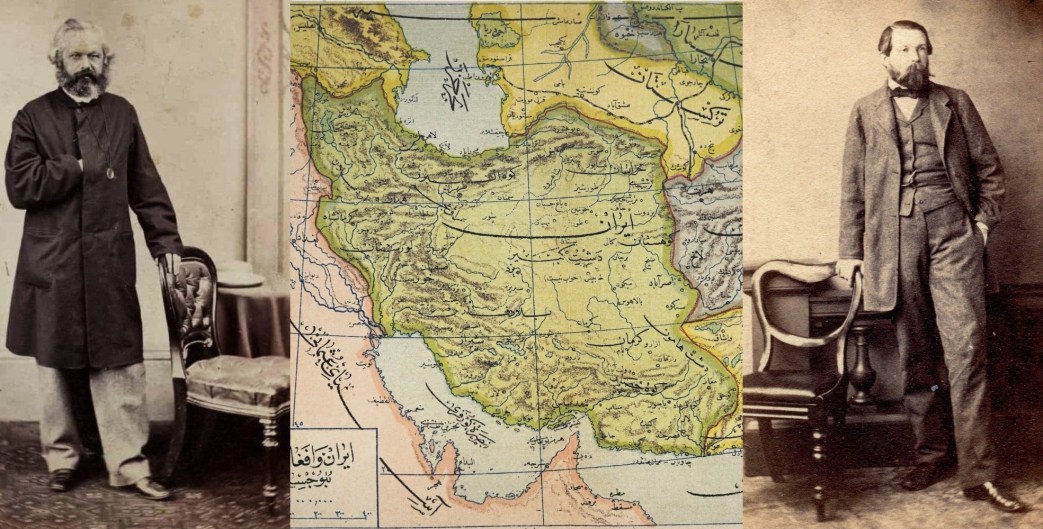
Four articles from Marx and Engels on the ‘Anglo-Persian’ war of 1857. While obviously not directly relevant to today’s war, they nevertheless provide valuable historical background. Following shortly on the end of the related Crimean War between Imperial Russia and Imperial Britian, the so-called Anglo-Persian war of 1856-57 continued imperialism’s ‘Great Game’ by rival powers to control and Western and Central Asia. Britain’s primary goal was to counter Russia’s influence in Qajar Persia, a formidable and independent but waning power, and to expand from India into Afghanistan. The Afghan region of Herat became the flashpoint as Britain’s laughable concern over Herat’s independence was the excuse to take it for themselves. The war ended largely with British victory, the control of Herat, but saw them forced from Persian territory. While all four articles were originally attributed to Marx, as usual with the Tribune many were written—at Marx’s request—by Engels. The differences in both style and content will be obvious to readers as ‘The General’ talks tactics and Marx talks diplomacy.
‘The War Against Persia: Four Articles’ by Karl Marx and Frederick Engels from The New Yorker Daily Tribune. February-June, 1857.
‘The War Against Persia’ by Karl Marx from the New-York Daily Tribune. No. 4937. February 14, 1857.
To understand the policy and object of the war lately undertaken by the British against Persia, and which, according to the most recent accounts, has been so energetically pushed as to lead to submission on the part of the Shah, it is necessary to take a slight retrospect of Persian affairs. The Persian dynasty, founded in 1502 by Ismael, who claimed to be descended from the ancient Persian kings, after maintaining for more than two centuries the power and dignity of a great State, received, about 1720, a severe shock in the rebellion of the Afghans inhabiting its eastern provinces. Western Persia was invaded by them, and two Afghan princes succeeded in keeping themselves for a few years on the Persian throne. They were, however, speedily expelled by the famous Nadir, acting at first in the capacity of General to the Persian claimant. Afterward he assumed the crown himself, and not only reduced the rebellious Afghans, but by his famous invasion of India contributed much to that disorganization of the declining Mogul empire, which opened the way for the rise of the British power in India.
Amid the anarchy that ensued in Persia after the death cf Nadir Shah in 1747, there sprang up, under the rule of Ahmed Duranee, an independent Afghan kingdom comprising the Principalities of Herat, Cabul, Candahar, Pechawur, and the whole of the territories afterward owned by the Sikhs. This kingdom, only superficially cemented, collapsed at the death of its founder, and was again broken up into its constituent parts, the independent Afghan tribes with separate chiefs, divided by interminable feuds and only exceptionally rallied under the common pressure of a collision with Persia. This political antagonism between the Afghans and Persians, founded on diversity of race, blended with historical reminiscences, kept alive by frontier quarrels and rival claims, is also, as it were, sanctioned by religious antagonism, the Afghans being Mohammedans of the Suni sect, that is to say, of the orthodox Mahometan faith, while Persia forms the stronghold of the heretical Shiites.
In spite of this intense and universal antagonism, there existed one point of contact between the Persians and Afghans—their common hostility to Russia. Russia invaded Persia for the first time under Peter the Great, but without much advantage. Alexander I, more successful, deprived Persia, by the treaty of Ghulistan, of twelve provinces—the greater part of them south of the Caucasus. Nicholas, by the war of 1826-27, ending in the treaty of Turkmanchai, stripped Persia of several additional districts, and interdicted her from the navigation on her own shores along the Caspian Sea. The memory of past spoliations, the endurance of present restrictions, and the fear of future encroachments, alike concurred to spur Persia into deadly opposition to Russia. The Afghans, on their part, although never involved in actual quarrels with Russia, were used to consider her as the eternal foe of their religion, and a giant which was to swallow Asia. From considering Russia as their natural foe, both races—Persians and Afghans— were induced to consider England as their natural ally. Thus, to maintain her supremacy, England had but to play the benevolent mediator between Persia and Afghanistan, and to prove the decided adversary of Russian encroachment. A show of amity on the one hand, and an earnest of resistance on the other—nothing else was required.
It cannot be said, however, that the advantages of this position have been very successfully improved. In 1834, in the matter of the selection of an heir to the Shah of Persia, the English were induced to co-operate in favour of the prince proposed by Russia, and the next year to aid that prince with money and the active assistance of British military officers in maintaining his claim by arms against his rival. The English Ambassadors dispatched to Persia were charged to warn the Persian Government against allowing itself to be pushed on to make war against the Afghans, which could only result in a waste of resources; but when these Ambassadors earnestly called for authority to prevent a threatened war of this sort, they were put in mind by the Ministry at home of an article in an old treaty of 1814, by which, in case of war between Persia and the Afghans, the English were not to interfere unless their mediation should be solicited. The idea of the British envoys and of the British Indian authorities was that this war was planned by Russia, which power desired to employ the extension of Persian authority eastward as the means of opening a road by which at some time or other a Russian army might enter India. These representations seem, however, to have made little or no impression on Lord Palmerston, then at the head of the Department of Foreign Affairs, and in September, 1837, a Persian army invaded Afghanistan. Various small successes carried it to Herat, before which town it encamped and began siege operations under the personal direction of Count Simonich, the Russian Ambassador at the Persian Court. During the progress of these warlike acts, McNeill, the British Ambassador, found himself paralyzed by contradictory instructions. On the one hand, Lord Palmerston enjoined him “to refrain from making the relations of Persia” with Herat a “subject of discussion,” as England had nothing to say between Persia and Herat. On the other hand, Lord Auckland, the Governor-General of India, wanted him to dissuade the Shah from pushing on his operations. At the very outset of the expedition Mr. Ellis had recalled the British officers serving in the Persian army, but Palmerston had them reinstated. So, again, the Indian Governor-General instructing McNeill to withdraw the British officers, Palmerston again reversed that decision. On March 8, 1838, McNeill proceeded to the Persian camp and offered his mediation, not in the name of England, but of India.
Toward the end of May 1838, the siege having now lasted about nine months, Palmerston sent a menacing dispatch to the Persian Court, for the first time making the affair of Herat a subject of remonstrance, and for the first time inveighing against “Persia’s connection with Russia.” Simultaneously, a hostile expedition was ordered by the Indian Government to sail to the Persian Gulf and seize upon the Island of Karak—the same lately occupied by the English. At a still later epoch the English Envoy withdrew from Teheran to Erzeroum, and the Persian Ambassador sent to England was refused admission. In the mean time, in spite of a very protracted blockade, Herat had held out, the Persian assaults were beaten back, and on Aug. 15, 1838, the Shah was forced to raise the siege and to retreat in hurried marches from Afghanistan. Here one would have supposed the operations of the English might have ended; but so far from that, matters took a most extraordinary turn. Not content with repelling the attempts of Persia, made, it was alleged, at the instigation and in the interest of Russia, to seize a part of Afghanistan, the English undertook to occupy the whole of it for themselves. Hence the famous Afghan war, the ultimate result of which was so disastrous to the English, and the real responsibility for which still remains so much a mystery.
The present war against Persia has been undertaken on grounds very similar to that which preceded the Afghan war, namely, an attack upon Herat by the Persians, resulting, on the present occasion, in the capture of that city. A striking circumstance, however, is that the English have now been acting as the allies and defenders of the same Dost Mohammed, whom, in the Afghan struggle, they so unsuccessfully undertook to dethrone. It remains to be seen whether this war is to have sequences as extraordinary and unexpected as those which attended the former one.
‘The Prospects of the Anglo-Persian War’ by Frederick Engels from the New-York Daily Tribune. No. 4941. February 19, 1857.
It is the question of the possession of Herat, an Affghan principality, but lately occupied by the Persians, that has given occasion to the occupation by the English, acting in the name of the East India Company, of Bushire, the principal Persian port on the Persian Gulf. The existing political importance of Herat is derived from the fact of its being the strategical center of all the country intervening between the Persian Gulf, the Caspian Sea and the Jaxartes on the west and north, and the Indus on the east; so that in the event of a great struggle between England and Russia for supremacy in Asia—a struggle which the English invasion of Persia may tend to precipitate—Herat will form the chief object of contention, and probably the theater of the first great military operations.
That the importance ascribed to Herat is not unfounded, must be apparent to all who understand its geographical position. The interior of Persia is formed by an elevated plain, surrounded on all sides by mountain chains, allowing no egress to the waters flowing down into it. These waters are not of sufficient importance to form one or more central lakes; they either lose themselves in vast morasses, or gradually vanish in the arid sand of the great desert which fills up by far the greater portion of the Persian plateau, and forms an almost impassable barrier between Western and Northeastern Persia. The northern boundary of this desert is formed by the hills of Khorassan, stretching along from the south-eastern corner of the Caspian almost due east, the connecting link between the Elburz and the Hindoo-koosh Mountains; and it is just where these hills send a branch to the south dividing the Persian desert from the better watered regions of Affghanistan that Herat is situated, surrounded and supported by a valley of considerable extent and exuberant fertility. To the north of the Khorassan hills we find a desert similar to that at their southern foot. Here, too, mighty rivers like the Murghab are lost in the sand. But the Oxus and Jaxartes are powerful enough to traverse it, and in their lower course form valleys capable of cultivation and of large extent. Beyond the Jaxartes the desert gradually takes the character of the steppes of Southern Russia, in which it is finally lost altogether. Thus. we have three distinct seats of comparative civilization intervening between the Caspian Sea and British India. First, the towns of Western Persia: Shiraz, Shuster, Teheran, Ispahan; secondly, the Affghan towns: Caboul, Ghazna, Candahar; thirdly, the towns of Turan: Khiva, Bokhara, Balkh, Samarcand. Between all these there is a considerable intercourse, and the center of all this intercourse is necessarily Herat. The roads leading from the Caspian to the Indus, from the Persian Gulf to the Oxus, all meet at that city. Between Caboul and Teheran, between Shiraz and Balkh, Herat is the half-way house. The line of oases marking the great caravan route across the Persian desert by Yezd and Shehustan, debouches in a straight line on Herat; and, on the other hand, the only road leading from Western to Eastern and Central Asia, avoiding the desert, is that through the Khorassan hills and Herat.
Thus Herat is a point which, in the hands of a strong power, can be used to command both Iran and Turan—both Persia and Transoxiana. It gives to its possessor, in the very highest degree, all the advantages of a central position, from which radiating attacks in all directions can be made with greater facility and chance of success than from any other town in either Iran or Turan. At the same time, the difficulties of intercommunication between any two of the towns of Astrabad, Khiva, Bokhara, Balkh, Caboul and Candahar are so great that a combined attack upon Herat, even from all of them, would have but little chance of success. The various columns, once marching upon Herat, would have scarcely any chance of communication with each other, and could, by an active general at Herat, be fallen upon and defeated one after the other. Stull, in such a case, columns coming from Candahar, Caboul and Balkh, would certainly have a better chance than an attack concentrating from the starting points of Astrabad, Khiva and Bokhara; for the attack from the side of Affghanistan would descend from the mountains into the plain, and completely avoid the desert, while the attack from the side of the Caspian and Araxes would have only one column (that from Astrabad) avoiding the desert, while all the remainder would have to pass it, and thereby altogether lose their communications one with the others.
The three centers of civilization which have their common center in Herat, form three distinct groups of States. On the west is Persia, which the Treaty of Turkmantchai has converted into a vassal of Russia. On the East are the States of Affghanistan and Beloochistan, the most important of which, Caboul and Candahar, we may class for the present with the vassal States of the Anglo-Indian Empire. On the north are the Khanats of Turan, Khiva and Bokhara, States nominally neutral, but almost sure, in the case of a conflict, to go with the conquering party. The actual dependence of Persia on Russia, and of Affghanistan on the English, is proved by the fact that the Russians have already sent troops into Persia, and the English into Caboul.
The Russians hold the whole of the western and northern shores of the Caspian. Baku, 350 miles, and Astrakhan, 750 miles from Astrabad, offer two capital points for the establishment of magazines and the concentration of reserves. With the Russian fleet on the Caspian in command of that lake, the necessary stores and re-enforcements can, with great facility, be brought down to Astrabad. The points on the eastern shore of the Caspian, whence start the roads to Lake Aral, are occupied by Russian forts. Further north and east, the line of Russian forts marking the line of the Ural Cossacks had been advanced, as far back as 1847, from the river Ural to the rivers Emba and Ulu Turgai, some 150 or 200 miles into the territory of the tributary Kirghiz hordes, and in the direction of the Lake Aral. Since then, forts have actually been established on the shores of that lake, which, as well as the river Jaxartes, is at this moment plowed by Russian steamers. There have been rumors even of an occupation of Khiva by Russian troops, but they are at least premature.
The line of operations the Russians have to follow, in any serious attack on Central or Southern Asia, is pointed out by nature. A land march from the Caucasus around the southwestern corner of the Caspian would find great natural obstacles in the hills of Northern Persia, and would take the invading army over 1,100 miles of ground before the chief object, Herat, was reached. A land march from Orenburg toward Herat would have to pass not only the desert in which Perowski’s army, on its expedition to Khiva, was lost, but two more deserts quite as inhospitable. The distance from Orenburg to Herat is 1,500 miles as the crow flies, and Orenburg is the nearest place which the Russians, advancing from that direction, could take as a base of operations. Now, both Russian Armenia and Orenburg are places all but cut off from the center of Russian power—the first by the Caucasus, the second by the steppes. To concentrate in either of them the material and men necessary for the conquest of Central Asia, is entirely out of the question. There is but one line remaining—that by the Caspian, with Astrakhan and Baku for bases, with Astrabad, on the south-eastern border of the Caspian for the point of observation, and with a march to Herat of but 500 miles. And this line combines all the advantages that Russia can wish for. Astrakhan is to the Volga what New-Orleans is to the Mississippi. Situated at the mouth of the greatest river of Russia, the upper basin of which actually forms Great Russia, the center of the Empire, Astrakhan possesses every facility for the transmission of men and stores to organize a grand expedition. In four days by steam, in eight days by sailing vessels, the opposite extremity of the Caspian at Astrabad can be reached. The Caspian itself is undisputably a Russian lake; and Astrabad, now placed by the Persian Shah at the disposal of Russia, is situated at the starting point of that only road from the west to Herat which, by passing through the Khorassan hills, totally avoids the desert.
The Russian Government acts accordingly. The main column, destined in the case of further complications to act against Herat, is concentrating at Astrabad. Then there are two flank columns, the co-operation of which with the main body is at best but problematical, and each of which has, therefore, a definite object of its own. The right column concentrating at Tabreez is destined to cover the western frontier of Persia against any hostile movements of the Turks, and eventually to miarch toward Hamadan and Shuster, where it covers the capital, Teheran, both against Turkey and the English troops landing in the Persian Gulf at Bushire. The left column, starting from Orenburg and very likely intended to receive reinforcements sent from Astrakhan to the western shore of the Caspian, will have to secure the Aral country, to march on Khiva, Bokhara and Samarcand, to secure either the passivity or the assistance of these States, and if possible, by a march up the Oxus to Balkh, menace the flank and rear of the English at Caboul or near Herat. We know that all these columns are already on the road, and that the central and right columns are already at Astrabad and Tabreez. Of the progress of the right column we shall probably not hear anything for some time.
For the English, the country of the upper Indus is the base of operations; and their magazines must be fixed at Peshawur. Thence they have already moved a column on Caboul, which town is distant four hundred miles from Herat as the crow flies. But in a serious war they must occupy, beside Caboul, Ghazna and Candahar, as well as the mountain forts guarding the Affghan passes. In this they will scarcely find any more difficulty than the Russians have done in occupying Astrabad, for ostensibly they are supporting the Affghans against Persian invasion.
The march from Caboul to Herat will offer no insuperable difficulties. There will be no need of any detached flank columns, for neither of the Russian flank columns will be able to come up; and if, after a couple of campaigns, the Orenburg column should debouch from Bokhara toward Balkh, a strong reserve at Caboul would soon give a good account of it. The English have this advantage, that their line of operations is comparatively short; for, though Herat lies exactly half-way between Calcutta and Moscow, yet the English base, at the confluence of the Caboul. and Indus rivers, is but 600 miles from Herat, while the Russian base at Astrakhan is 1,250 miles off. The English, at Caboul, have got the start of the Russians at Astrabad, by a hundred miles, as far as Herat is concerned; and so far as the country is known, they pass through a better cultivated and more populous district, and by better roads than the Russians would find in Khorassan. As to the two armies, that of the English is undoubtedly the better so far as standing the climate is concerned. Its European regiments would undoubtedly act with the same unflinching steadiness as their comrades at Inkermann and the sepoy infantry is by no means to be lightly spoken of. Sir Charles Napier, who saw them in many a battle, had the highest opinion of them, and he was a soldier and a general, every inch of him. The regular Indian cavalry is worth very little, but the irregulars are excellent, and under their European officers decidedly preferable to the Cossacks.
It is, of course, quite useless to speculate any further on the chances of such a war. There is no possibility of guessing at the forces that may be put in motion on one side or the other. There is no way of anticipating all the accidents which may happen if such important events come to pass as now seem to be drawing nigh. One thing only is certain, from the tremendous distances either party has to traverse, that the armies which will decide the contest at Herat, the decisive point, will be comparatively small. A great deal will also depend upon diplomatic intrigues and bribery at the courts of the various potentates grouped around Herat. In these matters the Russians are almost sure to have the best of it. Their diplomacy is better and more Oriental; they know how to lavish money when it is required, and above all, they have a friend in the enemy’s camp. The British expedition into the Persian Gulf is but a diversion which may draw upon it an important portion of the Persian army, but which, in its direct results, can accomplish but little. Even if the 5,000 men now at Bushire be tripled, they could at the utmost march only to Shiraz, and there halt. But this expedition is not meant to do more. If it gives the Persian Government an idea of the vulnerability of the country on the seaside, it will have attained its object. To expect more, would be absurd. The line on which the fate of all Iran and Turan must really be decided, leads from Astrabad to Peshawur, and on this line the decisive point is Herat.
‘Persia-China’ by Frederick Engels from The New-York Daily Tribune. No. 5032. June 5, 1857.
London, May 22, 1857
THE English have just concluded an Asiatic war, and are entering upon another. The resistance offered by the Persians, and that which the Chinese have so far opposed to British invasion, form a contrast worth our attention. In Persia, the European system of military organization has been engrafted upon Asiatic barbarity; in China, the rotting semicivilization of the oldest State in the world meets the Europeans with its own resources. Persia has been signally defeated, while distracted, half-dissolved China has hit upon a system of resistance which, if followed up, will render impossible a repetition of the triumphal marches of the first Anglo-Chinese war.
Persia was in a state similar to that of Turkey during the war of 1828-9 against Russia. English, French, Russian officers had in turns tried their hands at the organization of the Persian army. One system had succeeded another, and each in its turn had been thwarted by the jealousy, the intrigues, the ignorance, the cupidity and corruption of the Orientals whom it was to form into European officers and soldiers. The new regular army had never had an opportunity of trying its organization and strength in the field. Its only exploits had been confined to a few campaigns against Kurds, Turcomans and Afghans, where it served as a sort of nucleus or reserve to the numerous irregular cavalry of Persia. The latter did most of the actual fighting; the regulars had generally but to impose upon the enemy by the demonstrative effect of their seemingly formidable arrays. At last, the war with England broke out.
The English attacked Bushire, and met with a gallant though ineffective resistance. But the men who fought at Bushire were not regulars; they were composed of the irregular levies of the Persian and Arab inhabitants of the coast. The regulars were only concentrating, some sixty miles off, in the hills. At last they advanced. The Anglo-Indian army met them half way; and, though the Persians used their artillery with credit to themselves, and formed their squares on the most approved principles, a single charge of one single Indian cavalry regiment swept the whole Persian army, guards and line, from the field. And to know what these Indian regular cavalry are considered to be worth in their own service, we have only to refer to Capt. Nolan’s book on the subject. They are, among Anglo-Indian officers, considered worse than useless, and far inferior to the irregular Anglo-Indian cavalry. Not a single action can Capt. Nolan find where they were creditably engaged. And yet, these were the men, six hundred of whom drove ten thousand Persians before them! Such was the terror spread among the Persian regulars that never since have they made a stand anywhere-the artillery alone excepted. At Moharnmerah, they kept out of harm’s way, leaving the artillery to defend the batteries, and retired as soon as these were silenced; and when, on a reconnaissance, the British landed three hundred riflemen and fifty irregular horse, the whole of the Persian host marched off, leaving baggage, stores and guns in the possession of the—victors you cannot call them—the invaders.
All this, however, neither brands the Persians as a nation of cowards, nor condemns the introduction of European tactics among Orientals. The Russo-Turkish wars of 1809-12 and 1828-9 offer plenty of such examples. The principal resistance offered to the Russians was made by the irregular levies both from the fortified towns and from the mountain provinces. The regulars, wherever they showed themselves in the open field, were at once upset by the Russians, and very often ran away at the first shot; while a single company of Arnaut irregulars, in a ravine at Varna, successfully opposed the Russian siege operations for weeks together. Yet, during the late war the Turkish regular army have defeated the Russians in every single engagement from Oltenitza and Citate to Kars and to Ingur.
The fact is that the introduction of European military organization with barbaric nations is far from being completed when the new army has been subdivided, equipped and drilled after the European fashion. That is merely the first step towards it. Nor will the enactment of some European military code suffice; it will no more ensure European discipline than a European set of drill-regulations will produce, by itself, European tactics and strategy. The main point, and at the same time the main difficulty, is the creation of a body of officers and sergeants, educated on the modern European system, totally freed from the old national prejudices and reminiscences in military matters, and fit to inspire life into the new formation. This requires a long time, and is sure to meet with the most obstinate opposition from Oriental ignorance, impatience, prejudice, and the vicissitudes of fortune and favour inherent to Eastern courts. A Sultan or Shah is but too apt to consider his army equal to anything as soon as the men can defile in parade, wheel, deploy and form column without getting into hopeless disorder. And as to military schools, their fruits are so slow in ripening that under the instabilities of Eastern Governments they can scarcely ever be expected to show any. Even in Turkey, the supply of educated officers is but scanty, and the Turkish army could not have done at all, during the late war, without the great number of renegades and the European officers in its ranks.
The only arm which everywhere forms an exception is the artillery. Here the Orientals are so much at fault and so helpless that they have to leave the whole management to their European instructors. The consequence is that, as in Turkey so in Persia, the artillery was far ahead of the infantry and cavalry.
That under these circumstances the Anglo-Indian army, the oldest of all Eastern armies organized on the European system, the only one that is subject not to an Eastern, but an exclusively European government, and officered almost entirely by Europeans-that this army, supported by a strong reserve of British troops and a powerful navy, should easily disperse the Persian regulars, is but a matter of course. The reverse will do the Persians the more good the more signal it was. They will now see, as the Turks have seen before, that European dress and parade-drill is no talisman in itself, and, maybe, twenty years hence, the Persians will turn out as respectable as the Turks did in their late victories.
The troops which conquered Bushire and Mohammerah will, it is understood, be at once sent to China. There they will find a different enemy. No attempts at European evolutions, but the irregular array of Asiatic masses, will oppose them there. Of these they no doubt will easily dispose; but what if the Chinese wage against them a national war, and if barbarism be unscrupulous enough to use the only weapons which it knows how to wield?
There is evidently a different spirit among the Chinese now to what they showed in the war of 1840 to ’42. Then, the people were quiet; they left the Emperor’s soldiers to fight the invaders, and submitted after a defeat with Eastern fatalism to the power of the enemy. But now, at least in the southern provinces, to which the contest has so far been confined, the mass of the people take an active, nay, a fanatical part in the struggle against the foreigners. They poison the bread of the European community at Hong Kong by wholesale, and with the coolest premeditation. (A few loaves have been sent to Liebig for examination. He found large quantities of arsenic pervading all parts of them, showing that it had already been worked into the dough. The dose, however, was so strong that it must have acted as an emetic, and thereby counteracted the effects of the poison). They go with hidden arms on board trading steamers, and, when on the journey, massacre the crew and European passengers and seize the boat.
They kidnap and kill every foreigner within their reach. The very coolies emigrating to foreign countries rise in mutiny, and as if by concert, on board every emigrant ship, and fight for its possession, and, rather than surrender, go down to the bottom with it, or perish in its flames. Even out of China, the Chinese colonists, the most submissive and meek of subjects hitherto, conspire and suddenly rise in nightly insurrection, as at Sarawak; or, as at Singapore, are held down by main force and vigilance only. The piratical policy of the British Government has caused this universal outbreak of all Chinese against all foreigners, and marked it as a war of extermination.
What is an army to do against a people resorting to such means of warfare? Where, how far, is it to penetrate into the enemy’s country, how to maintain itself there? Civilizationmongers who throw hot shells on a defenceless city and add rape to murder, may call the system cowardly, barbarous, atrocious; but what matters it to the Chinese if it be only successful? Since the British treat them as barbarians, they cannot deny to them the full benefit of their barbarism. If their kidnappings, surprises, midnight massacres are what we call cowardly, the civilization-mongers should not forget that according to their own showing they could not stand against European means of destruction with their ordinary means of warfare.
In short, instead of moralizing on the horrible atrocities of the Chinese, as the chivalrous English press does, we had better recognize that this is a war pro aris et focis, a popular war for the maintenance of Chinese nationality, with all its overbearing prejudice, stupidity, learned ignorance and pedantic barbarism if you like, but yet a popular war. And in a popular war the means used by the insurgent nation cannot be measured by the commonly recognized rules of regular warfare, nor by any other abstract standard, but by the degree of civilization only attained by that insurgent nation.
The English are this time placed in a difficult position. Thus far, the national Chinese fanaticism seems to extend no farther than over those southern provinces which have not adhered to the great rebellion. Is the war to be confined to these? Then it would certainly lead to no result, no vital point of the empire being menaced. At the same time, it would be a very dangerous war for the English if the fanaticism extends to the people of the interior. Canton may be totally destroyed and the coasts nibbled at in all possible points, but all the forces the British could bring together would not suffice to conquer and hold the two provinces of Kwangtung and Kwang-si. What, then, can they do further? The country north of Canton, as far as Shanghai and Nanking, is in the hands of the Chinese insurgents, whom it would be bad policy to offend; and north of Nanking the only point of attack on which might lead to a decisive result is Peking. But where is the army to form a fortified and garrisoned base of operations on the shore, to overcome every obstacle on the road, to leave detachments to secure the communications with the shore, and to appear in anything like formidable strength before the walls of a town the size of London, a hundred miles from its landing place? On the other side, a successful demonstration against the capital would shake to its ground—works the very existence of the Chinese Empire—accelerate the upsetting of the Manchu dynasty and pave the way, not for British, but for Russian progress.
The new Anglo-Chinese war presents so many complications that it is utterly impossible to guess the turn it may take. For some months the want of troops, and for a still longer time the want of decision, will keep the British pretty inactive except, perhaps, on some unimportant point, to which under actual circumstances Canton too may be said to belong.
One thing is certain, that the death-hour of Old China is rapidly drawing nigh. Civil war has already divided the South from the North of the Empire, and the Rebel King seems to be as secure from the Imperialists (if not from the intrigues of his own followers) at Nanking, as the Heavenly Emperor from the rebels at Peking. Canton carries on, so far, a sort of independent war with the English, and all foreigners in general; and while British and French fleets and troops flock to Hong Kong, slowly but steadily the Siberian-line Cossacks advance their stanitzas from the Daurian mountains to the banks of the Amur, and the Russian marines close in by fortifications the splendid harbours of Manchuria. The very fanaticism of the southern Chinese in their struggle against foreigners seems to mark a consciousness of the supreme danger in which Old China is placed; and before many years pass away we shall have to witness the death struggles of the oldest empire in the world, and the opening day of a new era for all Asia.
‘The Persian Treaty’ by Karl Marx from The New-York Daily Tribune. No. 5048. June 24, 1857.
London, June 12, 1857
Some time ago, when a question respecting the Persian war was addressed to Lord Palmerston in his own House of Commons, he tauntingly replied: “As soon as the peace is ratified the House may express its opinions on the war.” The treaty of peace signed at Paris, March 4, 1857, and ratified at Bagdad, May 2, 1857, has now been laid before the House. It consists of fifteen Articles, eight of them being freighted. with the usual treaty-of-peace ballast. Article V. stipulates that the Persian troops are to withdraw from the territory and city of Herat, and from every part of Affghanistan, within three months, from the date of the exchange of the ratifications of the treaty. By Art. XIV. the British Government, on its part, engages, so soon as the above stipulation be carried into effect, “to withdraw without delay the British troops from all ports, places and islands belonging to Persia.”
Now it should be recollected that the evacuation of Herat by the Persian troops was spontaneously offered by Feroukh Khan, the Persian Embassador, during his protracted conferences at Constantinople with Lord Stratford de Redcliffe, and before the capture of Bushire had yet occurred. The only new profit accruing to England from this stipulation is, therefore, limited to the privilege of enchaining, during the most unhealthy season, her troops to the most pestilential spot of the Persian Empire. The terrible ravages the sun and swamps and the sea inflict during the summer months, even on the native population of Bushire and Mohammerah, are chronicled by old and modern writers; but why refer to them, since a few weeks ago, Sir Henry Rawlinson, a very competent judge, and a Palmerstonian too, publicly declared that the Anglo-Indian troops were sure to sink under the horrors of the climate? The London Times, on receiving the news of the Mohammerah victory, proclaimed at once the necessity of advancing despite the treaty of peace to Shiraz, in order to save the troops.” The suicides, too, of the British Admiral and General, placed at the head of the expedition, were due to their profound anxiety as to the probable fate of the troops, whom, by Governmental instruction, they were not to push beyond Mohammerah. A Crimean catastrophe on a smaller scale may thus be safely expected; this time proceeding neither from the necessities of war, nor from the blunders of the Administration, but from a treaty written with the sword of the victor. There occurs one phrase in the articles quoted which, if it suit Palmerston, may be worked into “a small bone of contention.”
Art. XIV. stipulates the “withdrawal of the British troops from all ports, places and islands belonging to Persia.” Now it is a controversial matter whether or not the town of Mohammerah does belong to Persia. The Turks have never renounced their claims to that place, which, situated on the Delta of the Euphrates, was their only seaport on that river always accessible, the port of Bassora, being at certain seasons too shallow for ships of large burden. Thus, if Palmerston pleases, he may hold Mohammerah on the pretext of its not “belonging” to Persia, and of waiting for the final settlement of the boundary question between Turkey and Persia.
Art. VI. stipulates that Persia agrees to–
“relinquish all claims to sovereignty over the territory and city of Herat and the countries of Affghanistan;” to “abstain from all interference with the internal affairs of Affghanistan;” to “recognize the independence of Herat and the whole of Affghanistan, and never to attempt to interfere with the independence of those States;” to refer, in case of differences with Herat and Affghanistan, “for adjustment to the friendly offices of the British Government, and not to take up arms unless these friendly offices fail of effect.”
The British Government, on their part, engage–
“at all times to exert their influence with the States of Affghanistan to prevent any causes of umbrage being given by them,” and “to use their best endeavors to compose differences in a manner just and honorable to Persia.”
Now, if this article is stripped of its red tape, it means nothing beyond the acknowledgment by Persia of the independence of Herat, a concession to make which Feroukh Khan had declared himself ready at the Constantinople conferences. It is true that, by virtue of this-article, the British Government is appointed the official intermeddler between Persia and Affghanistan, but that part it was, since the commencement of this century, always acting. Whether it be able or not to continue it, is a question, not of right, but of might. Besides if the Shah harbors at the Court of Teheran any Hugo Grotius, the latter will point out that any stipulation by which an independent State gives a foreign Government the right of interfering with its international relations is null and void according to the jus gentium, and that the stipulation with England is the more so, since it converts Affghanistan, a merely poetical term for various tribes and States, into a real country. The country of Affghanistan exists, in a diplomatic sense, no more than the country of Panslavia.
Art. VII., which stipulates that, in case of any violation of the Persian frontier by the Affghan States,
“the Persian Government shall have the right […] to undertake military operations for the repression and punishment of the aggressors,” but “must retire within its own territory so soon as its object is accomplished,”
is but a literal repetition of just that clause of the treaty of 1852 which gave the immediate occasion for the Bushire expedition.
By Art. IX. Persia admits the establishment and recognition of British Consul-General, Consuls, Vice-Consuls, and Consular Agents, to be placed on the footing of the most favorite nation; but by Art. XII. the British Government renounces–
“the right of protecting hereafter any Persian subject not actually in the employment of the British mission or of British Consuls-General, Consuls, Vice-Consuls and Consular Agents.”
The establishment of British Consulates in Persia being agreed to by Feroukh Khan before the commencement of the war, the present treaty adds only the renunciation, on the part of England, of her right of protectorate over Persian subjects, which right formed one of the ostensible causes of the war. Austria, France and other States have obtained the establishment of Consulates in Persia without recurring to any piratical expeditions.
Lastly, the treaty forces Mr. Murray back on the Court of Teheran, and prescribes the apology to be made to that gentleman, for being characterized in a letter addressed to Sadir Azim by the Shah, as a “stupid, ignorant and insane man,” as a “simpleton,” and as the author of a “rude, unmeaning and disgusting document.” The apology to be made to Mr. Murray was likewise offered by Feroukh Khan, but then declined by the British Government, who insisted upon the dismissal of Sadir Azim, and Mr. Murray’s solemn entry into Teheran “to the sound of cornet, flute, harp, sackbut, psaltery, dulcimer, and all manner of music.” By accepting, as Consul-General in Egypt, personal favors from Mons, Barrot; by sending, on his first landing at Bushire, the tobacco then presented to him in the Shah’s name to the bazaars, there to be publicly sold; by acting the knight-errant of a Persian lady of dubious virtue, Mr. Murray has failed to impress on the Oriental mind very high notions of British integrity or dignity. His forced readmission at the Persian Court must, therefore, be considered a rather questionable success. On the whole, the treaty contains, beyond the offers Feroukh Khan made before the outbreak of the war, no stipulations worth the paper they are written upon, and still less the treasure spent and the blood shed. The clear profits of the Persian expedition may be summed up in the odium incurred by Great Britain throughout Central Asia; the disaffection of India, increased by the withdrawal of Indian troops, and the new burdens thrown on the Indian Exchequer; the almost inevitable recurrence of another Crimean catastrophe; the acknowledgment of Bonaparte’s official mediation between England and Asiatic States; lastly, the acquisition by Russia of two strips of land of great importance—the one on the Caspian, the other on the north-coast frontier of Persia.
Karl Marx and Frederick Engels (for Marx) wrote hundreds of articles in English for the New York Daily Tribune which ran from 1841 and was closely associated with Horace Greeley and, until the founding of the Republican Party, progressive Whigs. Marx contributed from August 1851 to March 1862 as the Tribune’s London correspondent. One of the largest papers in the U.S., Marx’s work was read widely, including by Lincoln who was a subscriber. The Tribune was an important outlet for Marx’s political ideas in the years of European reaction between the failure of ’48 and the International. Marx would break with the paper in 1862 over its increasing conservatism and compromising attitude towards the abolition of slavery during the Civil War. The ten years of political writings for the Tribune in the 1850s, often covering European wars, empires and politics, show Marx’s evolving understanding of imperialism, particularly his work on India and China.
 Revolution's Newsstand