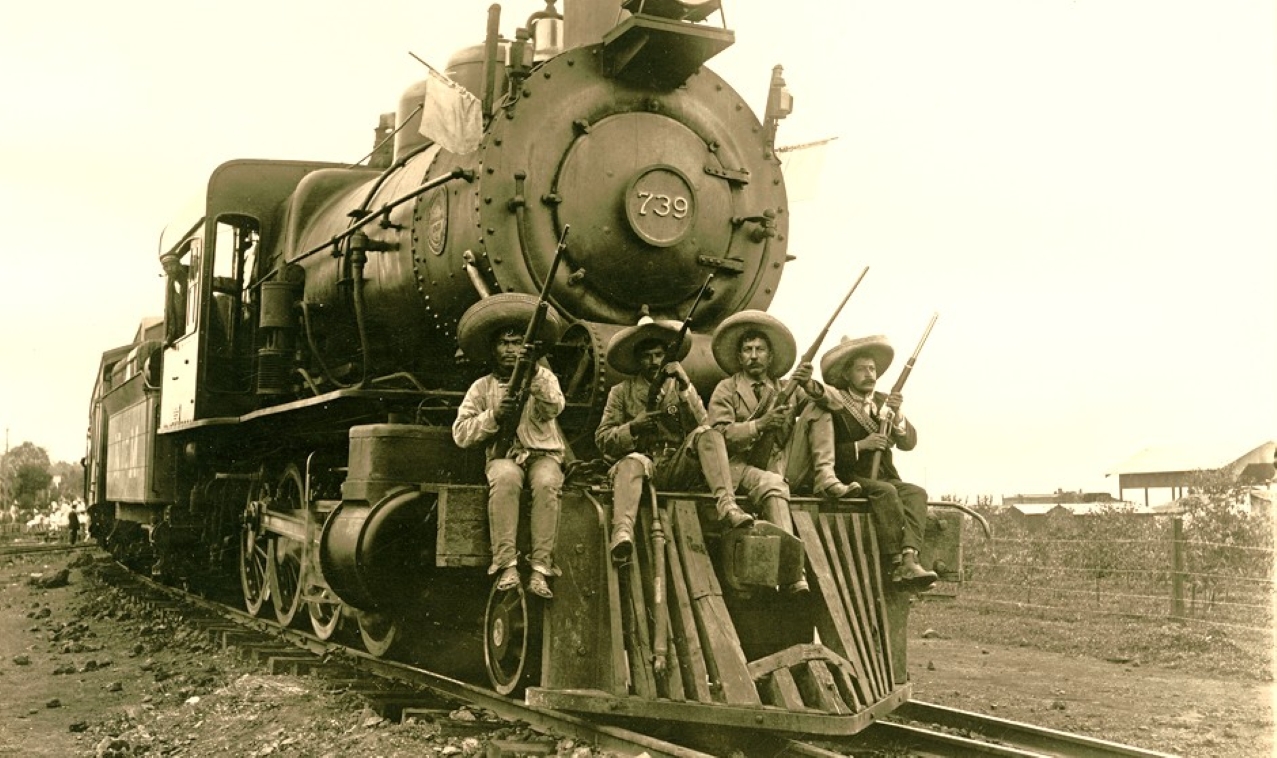
An excellent two-part political, economic, military, and social survey on the relationship between U.S. Imperialism and one of the Great Revolutions in human history—Mexico’s exuberant, comprehensive, often bloody, and inspiring world changing emancipation struggle, yet completed work. Charles Phillips took the name Manuel Gomez (also known as Frank Seaman, Charles Shipman, and Jesús Ramírez) while living and politically active in Mexico as a draft-evading exile evading arrest during World War One. He remained an important link between the U.S. Communist Party and the Spanish-speaking Americas through the 1920s, initiating the Pan-America Anti-Imperialist League in January, 1925 (changing the name shortly to “All-America”). A regional precursor to the global League Against Imperialism, also serving as lead figure, working closely politically and organizationally with Cuba’s Julio Mella. An intellectual, a fine and prolific writer, he helped to orient the U.S. Party to the anti-imperialist struggle, including relations with oppressed communities in the U.S. Phillips was a founder of the Mexican Communist Party, attending the 2nd and 6th Comintern Congresses. He also identified with the International’s Left Wing and in the U.S. was associated with the Foster-Cannon faction, serving as the main antagonist in debates with Jay Lovestone and Bertram Wolfe on the nature of U.S. imperialism and its political and social effects on the U.S. working class. These articles see Pillips analyzing the Revolution from its start around 1911 through the 1924 Presidency of Calles, whose term saw the ending of the active Revolution exemplified by the founding of the P.R.I.—the ‘Institutional’ party of an institutionalized Revolution—and the Civil War launched by the forces of Catholic reaction erupting shortly after these articles were published. Valuable facts and insights for students of the Mexican Revolution and U.S. intervention in the Americas, this essay is a real addition to a fuller comprehension of those world-changing events we all continue to live among the consequences of.
‘The Persistent “Mexican Question”’ by Manuel Gomez from Workers Monthly. Vol. 5 Nos. 7 & 9. My & July, 1926.
NO better example of the conspiratorial obscurity of the American capitalist press on matters of imperialist foreign policy can be found than the reports of the present Mexican situation. All one sees in the newspapers is that somehow or other, as if by magic, the differences Mexico’s oil and land laws have been “ironed out.” The U.S. state department, which denounced the laws as inimical to American vested interests and loosed a furious assault against the Mexican government because of them, is now reported as completely satisfied. President Calles’ regulations for applying the laws cause the New York Times to say that the conflict between the United States and Mexico “has reached an apparently amicable conclusion.” To those whose memory extends over a period greater than 24 hours this happy solution must be extraordinarily puzzling. The laws were in accordance with Mexico’s national-revolutionary constitution of 1917. As passed by both houses of the Mexican congress, they imposed important limitations—particularly with regard to the oil-bearing area near the seacoast on the investment rights of foreigners in Mexico. Moreover, they provided that the foreign interests could not operate in Mexico under any conditions unless they first agreed to give up their old tactics of diplomatic bullying; that is, they would have to sign a statement agreeing to consider themselves as Mexicans before the law and pledging themselves to refrain from appealing to the diplomatic support of foreign representatives. American imperialism has indicated plainly during the last five months that it was ready to commit direct assault upon the sovereignty of Mexico rather than tolerate the oil and land laws. The Mexican government declared publicly that it would insist upon its national claims. How have President Calles’ “regulations” reconciled these apparently irreconcilable differences? In other words, what is the present status of the “Mexican question?”
The newspapers are most unwilling guides here. One must wrench the truth from them. It is necessary to read carefully between the lines, to look for significant paragraphs buried deep in documents, to pick out sentences in speeches. When this is done it suddenly becomes plain that the “amicable” settlement of the U.S.-Mexican conflict is based upon the abandonment by the Mexican president of every important position that he had maintained.
Calles’ “Regulations.”
President Calles’ regulations leave the American interests in undisturbed possession of their holdings, both within and without the so-called prohibited zones. They are permitted to extend their possessions also. In short, things are to be about as they were before the oil and land laws were passed. For all immediate purpose the laws are nullified in the supplementary regulations, issued ostensibly to put them into effect. Article 27 of the Mexican Constitution is to remain a dead letter, at least insofar as protection of Mexico against foreign capitalist monopolization is concerned.
Calles’ Defiance Collapses.
During the course of the open and secret diplomatic offensive against Mexico—which had behind it the thoroughly aroused forces of Wall Street and Washington and which included threats of a break in diplomatic relations, hints of possible invasion to protect American “rights,” financial pressure of all sorts and hurried visits of oil magnates to Mexico City—there were repeated indications of a collapse on the part of the Mexican government. All Mexico, all Latin America, was behind President Calles in his public defiance of American imperialism. Organizations such as the All-America Anti-Imperialist League, with national sections in nine countries of Latin America as well as in the United States itself, rallied to his support in an effort to stiffen his resistance thru the pressure upon him of the united anti-imperialist front. But the counter-pressure from Wall Street and Washington was too strong. Calles continued to bluster that he would allow no outside power to dictate Mexico’s laws to her, but he began to dangle more and more before Secretary Kellogg the promise of the forthcoming “regulations.” In private his capitulation was much more definite.
The official correspondence, comprising ten notes and memoranda made public at last on April 11, shows, says the New York Times, “that the major American objections to the Mexican attitude have been removed.”
The last Mexican note, dated March 27, gives a pledge that American interests in Mexico will not be deprived of their property but will be given renewable concessions confirming their old ownership titles.
Regarding the section of the land law dealing with agricultural property—which provided, among other things, that foreigners could under no circumstances own more than 49 per cent of the capital in any corporation owning Mexican agricultural lands—the note of March 27 makes the following complete about-face:
“It is true that an alien who, prior to the going into effect of the law, represented 50 per cent or more of the total interest of any kind of association holding rural property for agricultural purposes, may retain the said interest without complying with Article 2 and that the right of his heirs to such interest in excess of 49 per cent is provided for in Article 6.”

One of the most popularly prized sections of the land law (and one specifically provided for in Article 27 of the Constitution) is that which declares foreign landholders must agree not to invoke the aid of their governments in matters relating to their Mexican properties. Politicians had won much applause in Mexico by insisting vehemently that this provision was a basic principle of Article 27. However, in the correspondence with the U.S. state department, Mexico’s foreign minister concedes:
“…Even though an individual should renounce applying for the diplomatic protection of his government, the government does not forfeit the right to extend it in case of a denial of justice.”
Thus every essential demand of American imperialism has been denied in words and conceded in fact. Mexico is in one sense worse off than before the oil and land laws were passed; for now the nine years’ struggle to set up enabling acts for Article 27 has ended in disillusionment. The dreaded Article 27 has become something quite different. Equipped with enabling legislation at last, it has at the same time been stripped of its vital parts and its power to strike fear into the hearts of foreign capitalists has been destroyed. American imperialism has scored an important triumph.
The Mexican Question Remains.
What now becomes of the “Mexican Question?” Is it removed from the order of business of American imperialism? No one familiar with the situation will think of answering in the affirmative. The aims of Wall Street and Washington have been by no means attained in Mexico and the challenging aspirations of the Mexican people still stand in the way. Conflict is more certain than ever. The eventual outcome depends upon how soon the American working class realizes the necessity of militant support to Mexico, as the center of gravity for all Latin America in the common struggle against Wall Street.
The Significance of Mexico’s Independence.
That Mexico, with her ore-studded and oil-rich territory lying contiguous to the greatest imperialist power in the world, should have been able to preserve her independence while all the little nations around her have fallen absolutely under the Wall Street yoke is a fact whose significance has never been sufficiently estimated. The stubborn resistance of the republic immediately to the south of us has had consequences far beyond her own borders. It has acted to impede the rapid spread of U.S. imperialism over the South American continent.
Mexico’s independence is no mere convenient camouflage, as in the case of Cuba, Santo Domingo or the Central American “republics.” Economically, it is true, Wall Street has already intrenched itself in the country. Politically, while Mexico can scarcely be called a free agent (what small nation can?), she still stands unconquered. Her vigorous and enduring fight against foreign monopolists, her resistance to armed intervention, her neutrality in the war against Germany, her recognition of Soviet Russia—these things are unmistakable evidence of Mexico’s independent line. The United States government, which appoints financial “advisers” as far south as Bolivia and which officially directs entire government departments in Peru, cannot boast as much control in Mexico as is implied in the term “sphere of influence.”
The Beginnings of the “Mexican Question.”
The “Mexican Question” has been before the American people, with brief intermissions, since the time of Porfirio Diaz. Mexico’s revolution against feudalism, which was favored in its initial stages by the big capitalists of the United States, broke out before Mexico was a great outproducing country. In 1911, when Diaz was overthrown, the production of crude oil in Mexico was 12,552,798 barrels; in 1921, when the output reached its peak, 193,397,587 barrels were produced. Ninety-nine per cent of all the oil produced in Mexico has been obtained since 1911. Oil was sufficiently important even in 1911 to be a factor in the revolution—with the British interests favored by and favoring Diaz, and the American interests backing Madero—but it was not the lure that it is today. American aggression at that time was therefore limited in its conscious objectives. It was limited not only because the temptation was not great enough but also because American imperialism itself, while already a mighty power going forward under the banner of the Rooseveltian traditions, had not yet really come into its own. In addition there was the rivalry of the British to consider; for the British occupied a strong position in Mexico, dominating railroads, public utilities and oil industry. Later, when American imperialism became surer, it determined to take over the country without further ado. The Pershing expedition and the occupation of Vera Cruz were tentatives in this direction. However the national-revolutionary forces of opposition in Mexico had also grown. These might have been swept aside if it were not for the approaching entry of the United States into the World War, which claimed undivided attention.
The Balance of Forces in Mexico.
The result of all this has been to create a peculiar jockeying position, a delicate balancing of forces, which left Mexico able to keep her head above water as an independent nation in spite of the indirect offensives that were hurled against her and in spite of serious encroachments on the part of American imperialism. Wall Street sought to play off one section of the Mexican revolution against the other, at the same time making use of the situation to completely displace her British rival. Armed intervention came more and more to the front as the ultimate desideratum of the imperialists, but in practice Wall Street was obliged to maneuver for control in Mexico thru financial and diplomatic pressure, thru bribery, intimidation, withholding of credit and subsidizing of counterrevolution.
Out of the policy of indirect offensive based upon a conscious program of ultimate invasion, come those recurrent conflicts which have been the distinguishing marks of what is spoken of in the United States as the “Mexican Question.” The “Mexican Question” persists precisely because, with all the strength at the command of American capitalism, Mexico has not yet been made an integral unit of the American empire.
Mexico’s Lure.
Copper, lead, silver and gold were the principal considerations of American capitalism in Mexico in 1911, and they are still of very great importance. Mexico occupies first place in the world as a producer of silver, second place as a producer of lead, fourth place as a producer of gold and a fifth place as a producer of copper. The bulk of the mining industry is in American hands, being completely dominated by the Guggenheim, Harriman and Ryan-Rockefeller interests.
Oil!
Oil, however, has long since come to the front as the most ardently coveted of Mexico’s resources. The phenomenal development of oil as a fuel and the limited extent of the world’s known resources have made this precious substance the gage of battle for rival imperialists from Mosul to Argentina. Great Britain and the United States are the chief antagonists everywhere in the world. Mexico, second only to the United States itself as a producer of oil, is an area of prime importance in the struggle. The United States, despite its own immense production, is importing $200,000,000 worth of oil and by-products from Mexico yearly. Much has been made of the decline in Mexican oil production since 1921. Some of this has been due to exhaustion of the wells but some is due to “pinching in” of wells to keep up prices on the world market. Nevertheless, Mexico’s output last year exceeded 115,700,000 barrels. According to figures recently published by the Mexican government, Mexico has an extension of about 150,000,000 acres in the petroleum zone, and so far only 15,000 acres have been exploited. When we consider that this small portion has yielded a grand total of 1,260,368,720 barrels of oil with an estimated value of $1,054,353,306, we realize the untold wealth yet in store for oil seekers, and the high returns received by the oil interests in Mexico. Standard Oil, which recently absorbed Doheny, dominates the field. Nearly 60 per cent of Mexico’s oil output is controlled in the United States and American interests have an overwhelming preponderance in the ownership of the undeveloped oil lands. This control has not come without effort. The oil men have supplied a considerable portion of the “fuel” to the Mexican Question. Besides angling for special privileges with men inside the government, they had their hand in every rebel movement in Mexico during the past fifteen years. They have, on occasion, refused to pay taxes to the Mexican government, and on other occasions they have subsidized banditry in order to bring the government to terms. For months they maintained the bandit, Manuel Pelaez, in control of the oil fields against Carranza. The National Association of Petroleum Producers of Mexico has been in the forefront of the interventionist propaganda in this country.
Other Mexican products, such as zinc, sisal, ixtle, chicle, etc., are also of first-rate importance to American imperialism, which controls the market in each case.
Mexico’s Foreign Trade.
Consideration of Mexico’s foreign trade is most illuminating. In 1924 exports to the United States represented 80.16 per cent of the total, followed by Great Britain with 5.63 per cent, Germany 2.85 per cent, Cuba 2.62 per cent and France 1.36 per cent. Of the imports the United States furnished 73 per cent, Germany 7.25 per cent, Great Britain 7 per cent, France 5 per cent, Spain 2.33 per cent and other countries 5.42 per cent. Only three other countries do a greater volume of business with the United States than Mexico. The U.S.-Mexican trade in 1924 was valued at $363,209,313. In 1925 it was $302,162,269. This is a tidy sum, an item hardly to be sneered at, and one which clearly reflects the dominant position of the United States in the Mexican market.
However, it is the character of the trade quite as much as the volume which makes Mexico such an important factor in the economics of American imperialism. Mexico sends to the United States raw materials necessary for American industry. She imports manufactured products. Furthermore her imports from this country include about $20,000,000 of machinery, $13,000,000 of iron and steel foundry products and $12,500,000 of automobiles, tires, vehicles and rolling stock. This represents to a considerable degree fixed capital which links up the American iron and steel industry more and more tightly with Mexico’s industrial development—and which many times is actually merely an addition to direct American investment in the country.
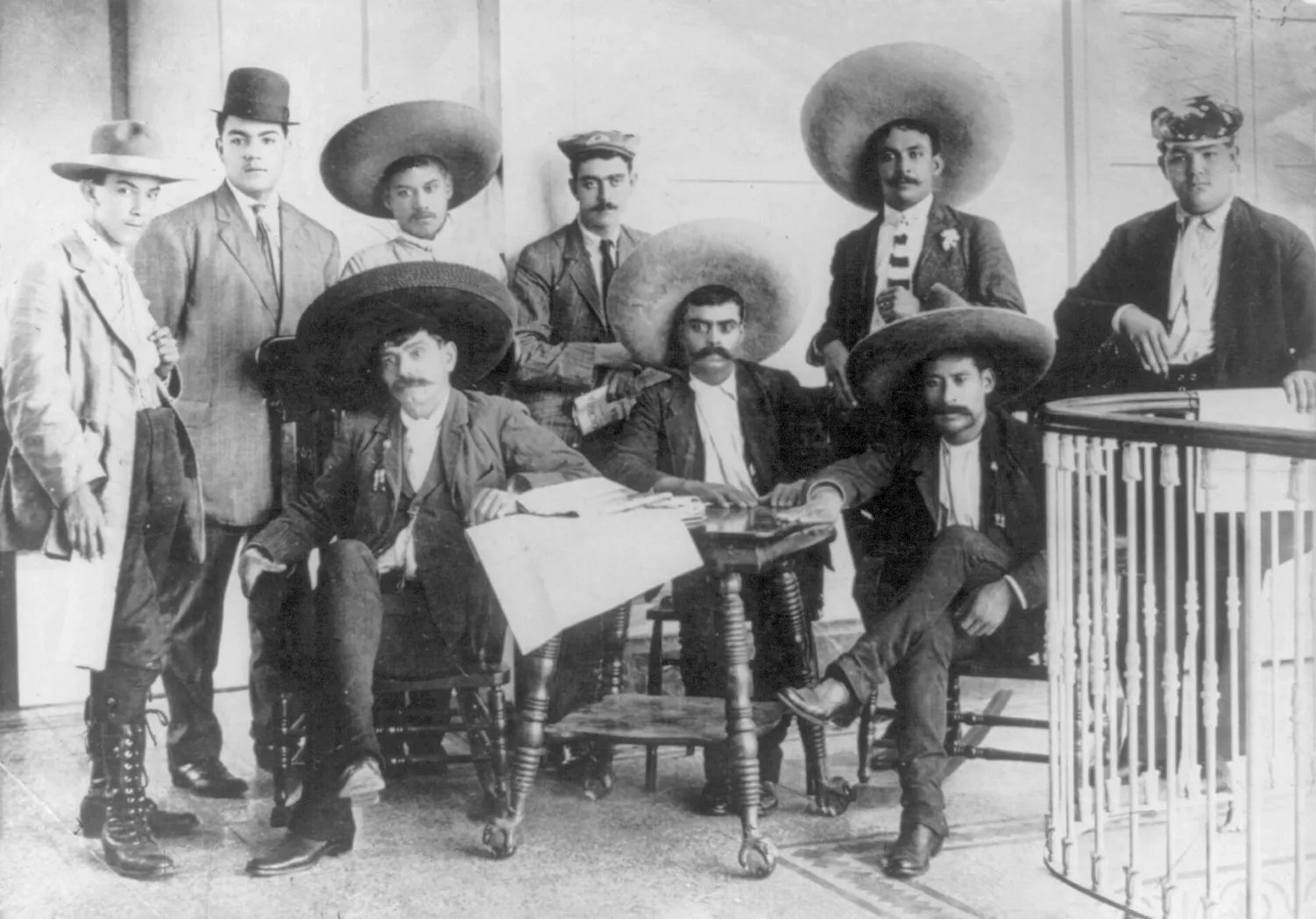
Mexico fits “naturally” into the economic order of American imperialism. The results achieved by American finance-capital under present conditions already show vividly the gains to be secured by direct imperial monopolization.
These are some of the reasons why the Mexican Question could not be and is not now a dead issue.
II.
THE “Mexican Question” came permanently to the fore in our generation not simply, as the amiable writers of travel books would have it, because the Mexicans do not understand English and the people of the United States do not eat chili, but because of the requirements of U.S. capitalist industry expanding upon an imperialist basis. Mexico as a source of important raw materials and as a field for the investment of surplus capital were the first considerations in twentieth century U.S. aggression.
Mexico and the U.S. Empire.
To the economic-business factors confined to direct exploitation of Mexican territory were added strategic factors. American imperialism developed further. Even while individual groups of capitalists were pursuing strictly limited purposes in Mexico, the political subjugation of Caribbean and Central American countries was under way. Swiftly and unmistakably the schematic outline of empire in the western hemisphere began to unfold itself with Mexico as an obvious converging point. Cuba, Porto Rico and Panama had already been seized by the United States. American marines planted the stars and stripes in the territory of Nicaragua. Santo Domingo was occupied. The Negro republic of Haiti was “pacified.” The policy of military intervention in Latin America became a definite part of the concept of the Monroe Doctrine.
But war is another matter—and everyone agrees that large-scale intervention in Mexico means war. How costly such an undertaking would be was indicated in the tests of the Pershing expedition and the occupation of Vera Cruz. Mexico is a country of 15,000,000 people with a territory as large as all the states of the United States east of the Mississippi. General Peyton C. March has declared that it would take 1,000,000 men and two years to conquer and “pacify” the Mexican nation. Thus Mexico escaped the fate of those around her.
Nevertheless, Mexico, whose rich territory lies contiguous to the United States and is a vital connecting link with the coveted lands farther south, plays a primary role in all imperialist calculations in this country. For economic business reasons, for strategic reasons of empire—Wall Street desires Mexico more ardently than it desires any other unconquered area in the western world.
Mexico’s Line of Development.
Meantime, Mexico continues to follow a line of development of its own. Our neighbor on the south is making use of its present unique position to fortify herself for the future. While awaiting the next political assault from the “colossus of the north,” Mexico is grappling earnestly with the all-important problem of economic self-sufficiency, of independence from foreign bankers and industrialists. She has embarked upon a program of economic resistance constituting a serious challenge to the program of foreign capital—and this circumstance makes the “Mexican Question” all the more urgent for American imperialism, for it foreshadows a possible ultimate development which would allow Mexico to slip thru its fingers entirely.
Fundamental factors in the progress of Mexican economic development provide the mainspring for what is going on.
The revolution which overthrew Porfirio Diaz was anti-feudal and agrarian, but not anti-foreign. When Carranza rose in arms against Huerta, the Mexican revolution had already taken on a consciously nationalistic form. Indeed, if Calles should conduct his foreign relations in the same bellicose manner as Carranza—today when the aggressive imperialism of the United States is one of the marks of the epoch—the intervention avalanche from the north would be upon him in no time. Nevertheless, the economics of the present situation in Mexico embody a more serious challenge to Wall Street and Washington than all the stubborn blustering of Carranza. There are two principal reasons for this. First, the signs of a developing native capitalism in Mexico; and second, the beginnings of development of an independent national economy with a base broader than that of the strictly capitalistic classes.
The Beginnings of a Native Mexican Bourgeoisie
Great changes have taken place in Mexico in these last few years, visible even at the first glance. Capital cities of most of the states have enlarged their suburbs on the near plains and in the capital city of the republic the population has increased tremendously. Walking thru the streets of Mexico City at the hour when workers are going home from their jobs, you cannot fail to be impressed by the rush of crowded street cars and “camiones” branching out in all directions. According to official government figures, the Mexican republic now has 112 sugar refineries, 142 cotton mills, 36 woolen mills, 75 large shoe factories, 222 cigar and cigarette factories operating on a commercial scale, 68 hydro-electric plants, as well as important paper mills, iron and steel foundries, soap factories, etc. Like the mining and oil industries, most of the industries listed here are under the domination of foreign capital but great numbers of large individual plants are owned by Mexicans. This is especially true in the cotton industry, the shoe industry, the paper industry, the sugar industry, the cigar industry and the soap industry. In the very shadow of the foreign enterprises, which still dominate Mexican economy and which in fact press forward more surely than ever, native enterprises are springing up.
Only a few years ago revolutionists were insisting, not without reason, that there was no national bourgeoisie in Mexico. In the larger sense even today the Mexican bourgeoisie is still struggling to be born. But there is quite a definite middle class crystallization. The Mexican chambers of commerce now have a relatively large Mexican membership. Reinforced by a whole army of petty bourgeois bureaucrats, professional men and intellectuals, the bourgeois elements have acquired something like a uniform ideology and are pushing forward on all fronts. They find themselves in direct conflict with the imperialism of the United States. The struggle of the Mexican national bourgeoisie to be born is a struggle against foreign monopoly of Mexican resources, industrial production and credit.
“We must insist by all means in our defense against the imperialistic capital,” wrote Senor Rafael Nieto in March of this year, shortly before his death. “I have the absolute conviction that if we allow another billion dollars of foreign capital to be invested in Mexico, in the same form it has been invested thus far, that is by buying outright the land and its natural resources, and securing the undisputed control of our industry, We might as well resign our economic independence right now. A few bitter instances in our contemporary history justify this dread.
“We need the foreign capital, but we must not secure it by surrendering to it our economic independence. The Mexican government intends to solve this giant problem—with the Law of Foreigners, the Oil Law, the Irrigation Law, etc.—and the logical result will be that the future foreign investments will satisfy themselves with securing a reasonable profit and little by little they will delegate to Mexicans the responsibility and control of their industries. This is absolutely necessary for the future autonomy of the republic.”
Senor Nieto, a former Assistant Secretary of Finance in Mexico and a typical representative of the middle class, expresses the ideology which is dominant in this class in Mexico today. He died last April while serving as Calles’ minister to Italy.
The Policy of Calles.
It is necessary to appreciate recent capitalist development in Mexico to understand the government of President Calles. Calles will be accused of giving in to U.S. imperialism in the recent conflict over the oil and land laws. Of course, he did give in. Yet it is a mistake to brand him as an agent of imperialism, as many radicals in this country and Latin America have been doing. There is too much in the administration of President Calles that does not go with such a characterization.
I have myself frequently insisted that the classic representative of petty bourgeois nationalism in the Mexican revolution was Carranza, who was opposed more determinedly by the United States than any other leader. Carranza was overthrown by the Obregon-de la Huerta-Calles combination and this was a defeat for nationalism, greeted with unconcealed joy in Wall Street and Washington. However, the Obregon-de la Huerta-Calles support was of a dual nature. It included workers and peasants systematically and stupidly rendered hostile by the Carranza regime, whose reasons for revolt were quite different from those of the favored friends of foreign capital.
The agrarian revolution—with its inevitably anti-imperialistic orientation—continued to develop further. The working class of the towns found itself in a strategic position as a result of the confusion reigning in the ranks of its bourgeois enemies after the collapse of Carranza. Although Obregon tried to change it, the Mexican atmosphere continued to be “radical.” It became still more so after the failure of the reactionary uprising of de la Huerta in the last weeks of 1923.
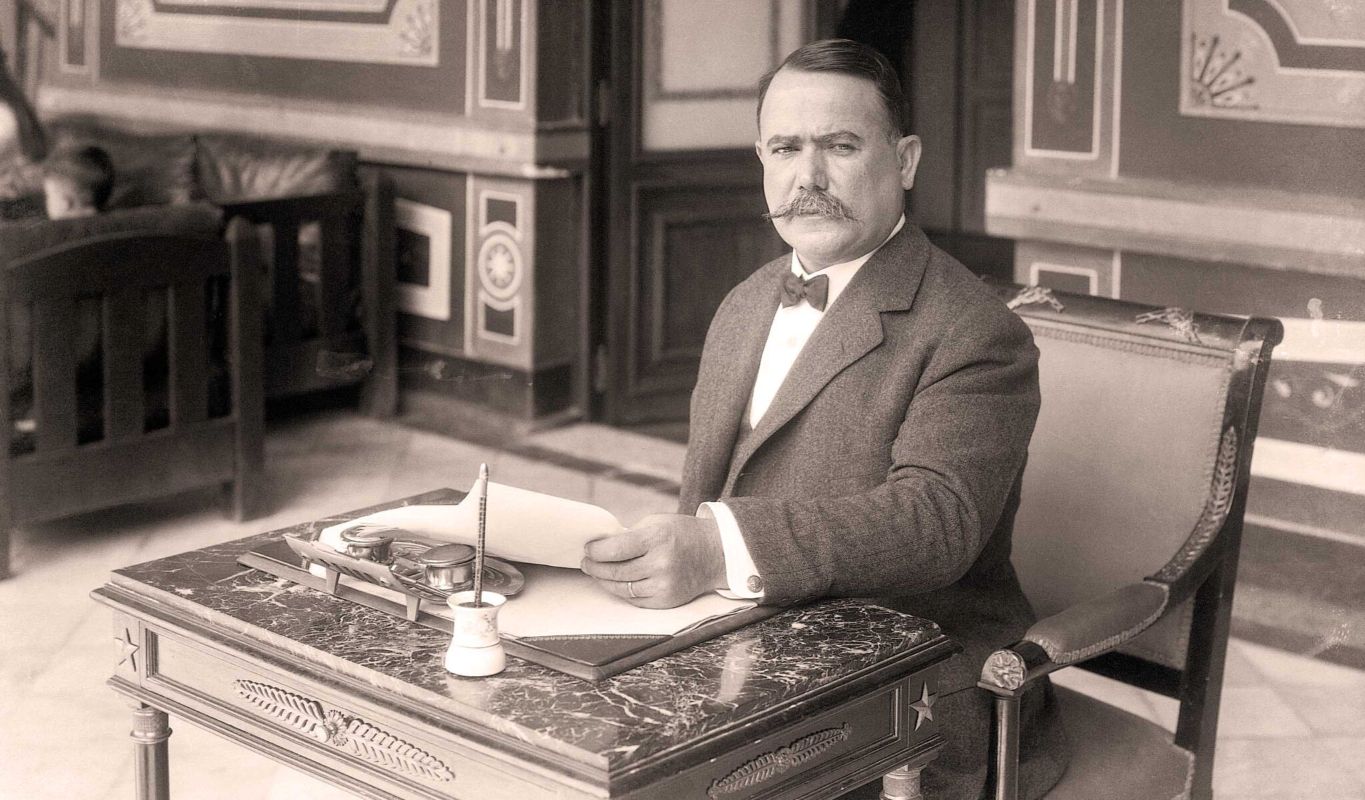
Here was a new rallying ground for the struggle against U. S. imperialism. The shattered forces of the petty bourgeoisie pulled themselves together and reorientated themselves toward the workers and peasants. They were not the same elements who had been with Carranza in 1914, for Carranza had in truth been a petty bourgeois leader without a petty bourgeoisie. It was to a considerable extent a new grouping, which is really only now finding its feet. These newly-made business men, government bureaucrats and politicians, are now making a definite bid for leadership in the broad national movement against imperialist domination.
Calles represents the movement for the creation of an independent national economy in Mexico under the leadership of the petty bourgeoisie, and as such, he is an enemy of U.S. imperialism. He is not always an uncompromising enemy, however—first, because he has the example of Carranza before him and is afraid of a head-on collision; second, because Mexico needs capital and until there is some substantial prospect of native Mexican accumulation it will have to come from abroad; third, because he dare not cut off all ties with the United States for fear that the “radical” Mexican workers and peasants will relegate the insecurely weak petty bourgeoisie to the background.
The Calles Program.
In a country like Mexico the middle class forms far too narrow a base for the construction of a national economy. Calles recognizes this fully. His governmental program—the first really well-worked out constructive program that has appeared in Mexico—assigns an important role to the workers and peasants, although always with an eye to middle class hegemony. That is what I referred to earlier in the present article when I spoke of “the beginning of development of an independent national economy with a base broader than that of the strictly capitalistic classes.”
Calles’ nationalist program is clearly set forth in a long series of official acts which piece together in a surprisingly consistent whole. The more important of them are the following:
1. FOREIGN RELATIONS.
(a) Controversy with United States over attempt to regulate Article 27 of the Mexican Constitution (oil and land laws).
(b) Orientation toward Latin America. (Move for Latin American congress; official explanations of U.S.-Mexican conflict to Latin American countries; raising of Mexican legation in Guatemala to rank of embassy; similar move with regard to Argentina, etc.)
(c) Close relations with the American Federation of Labor. The A.F. of L. appears to Calles as the only existing substantial organized force in the United States itself which may be used against the imperialists.
(d) Continuation of diplomatic relations with the Union of Socialist Soviet Republics. (Calles sometimes takes an ambiguous and even provocative attitude with regard to Soviet Russia—first, in order to satisfy the demands of the A.F. of L., and second, to discourage proletarian revolution in Mexico, but the bare fact of uninterrupted diplomatic relations is a circumstance of importance).
2. INTERNAL-POLITICAL.
(a) Official support to the Labor Party and CROM (Mexican Federation of Labor). (Appointment of Morones as Secretary of Industry, Commerce and Labor; appointment of Morones’ supporters to minor posts of all sorts; subsidy of Labor Party papers; support of Morones against ex-Governor Zuno of Jalisco, etc.).
(c) Application of the laws striking at the roots of power of the Catholic Church.
(d) Persecution of radical labor and peasant leaders, disruption of independent unions, etc.
3. INTERNAL-ECONOMIC.
(a) Economy program—reduction of the army—balancing of the budget—resumption of interest payments on the foreign debt.
(b) Establishment of the sole bank of issue.
(c) Establishment of farm-loan banks.
(d) Establishment of co-operatives.
(e) Distribution of permanent titles to lands partitioned out in “ejidos” (peasant communities).
(f) “Ley del Patrimonio de Familia”—step toward individual peasant ownership as against the “ejido.”
(g) Oil and land laws (under Article 27)—“Ley de Extranjeria.”
(h) Irrigation works, on co-operative basis or under government control.
(i) Local road-building program.
(j) Law exempting from all taxes Mexican business concerns formed with a capital of 5,000 pesos or less.
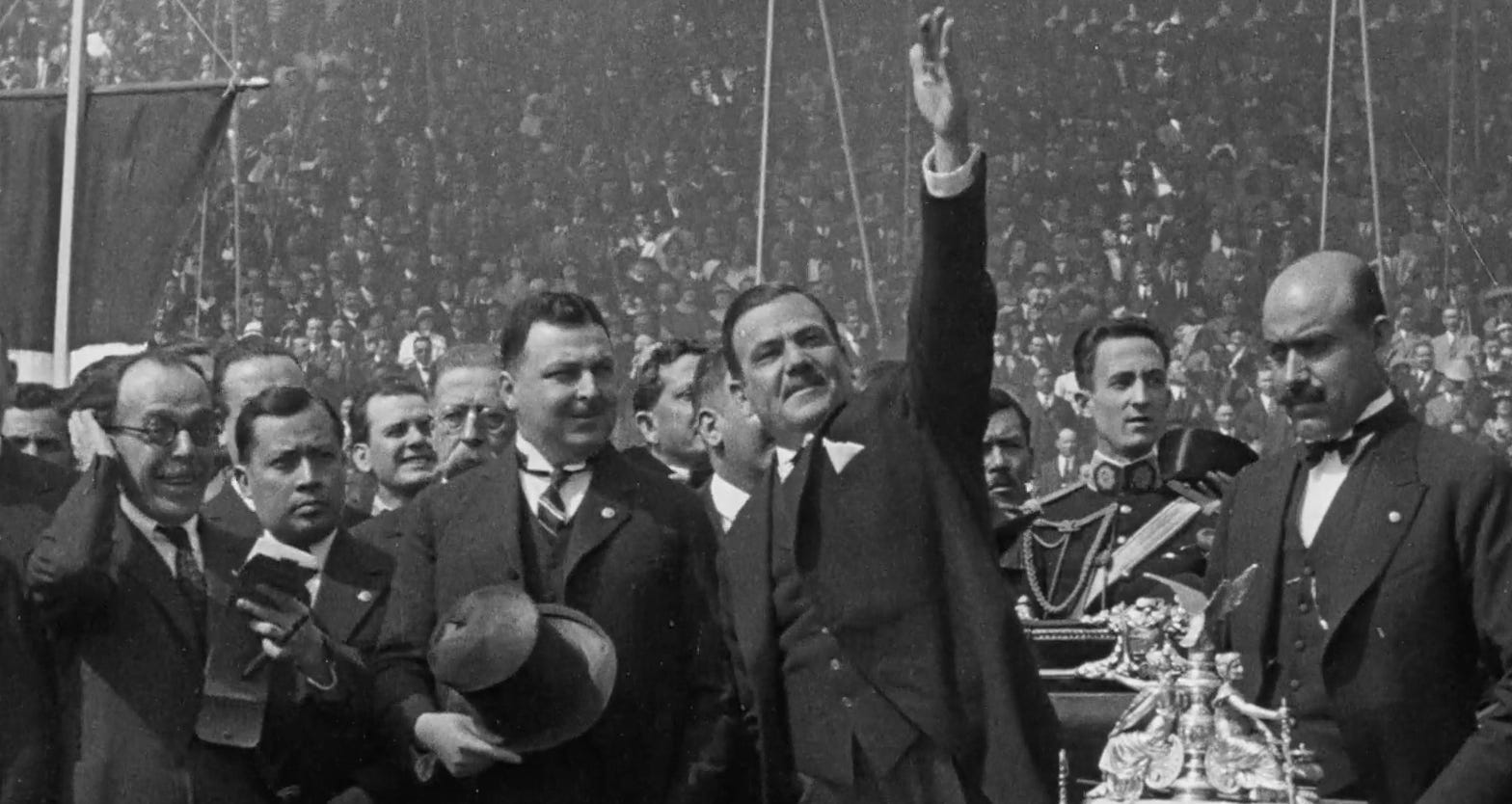
This is plainly a program for building up a national economy in Mexico which would be independent of foreign capital. It would be based upon co-operation among petty-bourgeois, peasant and working-class elements under state patronage.
Can Calles’ Program Succeed?
Can such a program succeed? Certainly not if it is followed out precisely as President Calles intends. The Mexican middle class could lead in the creation of a national capitalism only at the cost of great sacrifices by the workers and peasants. Already Morones has obliged workers belonging to the Crom to accept reductions in wages, on the ground that it is necessary to help Mexican capitalism in competition with the United States. This is called the method of the “reajuste” and it is one of Calles’ schemes for the accumulation of Mexican capital. Similar reasons are given for attacks on Communists and attacks on militant elements in the labor movement generally. Capitalist newspapers, business men, government and Crom labor leaders tell the workers day in and day out that “class collaboration” is a national necessity—“class collaboration,” that is, for the benefit of the middle class. Calles and his friends take up the slogan of the “united anti-imperialist front” and brandish it as a club to force the workers and peasants to accept the hegemony of the petty bourgeoisie in the nationalist struggle. But Mexico is overwhelmingly an agricultural country and the agrarian revolution is still in process. For this reason alone, if for no other, it will be impossible at the present time to put a damper on the radical atmosphere of Mexico, The Mexican masses have not sufficient confidence in the middle class to allow it to carry thru its own national program. Moreover, it has neither the requisite resources nor the courage, nor the ability.
The Hegemony of the Workers and Peasants.
The petty bourgeoisie has given body and form to the economic struggle against imperialism, and is necessary to any constructive pro- gram of Mexican nationalism. But the workers and peasants must dominate the alliance. On such a basis—with the center of gravity shifted to the workers and peasants—who can say that Mexico will not be able to work out her own economic solution while at the same time offering effective resistance to the imperialist pressure of the United States? Mexico has enormous natural resources. She has, considering the stage of development of the country, a well-disciplined working class. She has a peasantry which is already being organized on a national scale. Workers as well as peasants are skilled in the use of arms. With proper leadership and a proper constructive program—embracing many of the points brought forward by President Calles—Mexico may be able not only to maintain herself as an independent nation at the very door of the greatest imperialist power of the world but to become, far more actively than in the past, an organizing center for the whole Latin American resistance to imperialist domination.
Much would depend upon the complicated balance of forces in the United States and in the world at large. American imperialism only makes truce with Mexico. It obviously does not accept the present situation. Every step to curtail Wall Street privileges in Mexico and to build up an independent national economy places the persistent “Mexican Question” a little higher up on the American agenda.
Considerations that might have led Wall Street and Washington to temporize a few years ago do not have the same weight today. In the period since the World War, U.S. capitalists have fallen heir to a position which puts the United States in the forefront of consciously imperialist powers. American imperialism is everywhere on the offensive. Its aggressions reach into Europe, Asia and South America. It is impossible to appreciate the recent series of adventures of American imperialism in Latin America—from General Lassiter’s invasion of the City of Panama to the Pershing-Lassiter “arbitral” expedition in Tacna-Arica, and including the latest U.S. assault upon the sovereignty of Mexico herself—without expecting a determined drive for the complete subjugation of Mexico.
We must realize all that is at stake in this conflict. We must be prepared to lend solid support to Calles in his struggles against American imperialism, at the same time calling upon our comrades in Mexico—and throughout Latin America to point out to him that if he is sincere in his nationalist program he must rely frankly upon the important revolutionary and constructive elements of the Mexican population—the workers and peasants, who cannot be sacrificed to a small group of petty bourgeois and whose sacrifice would constitute the betrayal of Mexican nationalism.
Workers Monthly began publishing in 1924 as a merger of the ‘Liberator’, the Trade Union Educational League magazine ‘Labor Herald’, and Friends of Soviet Russia’s monthly ‘Soviet Russia Pictorial’ as an explicitly Party publication. In 1927 Workers Monthly ceased and the Communist Party began publishing The Communist as its theoretical magazine. Editors included Earl Browder and Max Bedacht as the magazine continued the Liberator’s use of graphics and art.
PDF of full issue: https://www.marxists.org/history/usa/culture/pubs/wm/1926/v5n07-may-1926-1B-WM.pdf
PDF of full issue: https://www.marxists.org/history/usa/culture/pubs/wm/1926/v5n09-jul-1926-1B-FT-80-WM.pdf
 Revolution's Newsstand