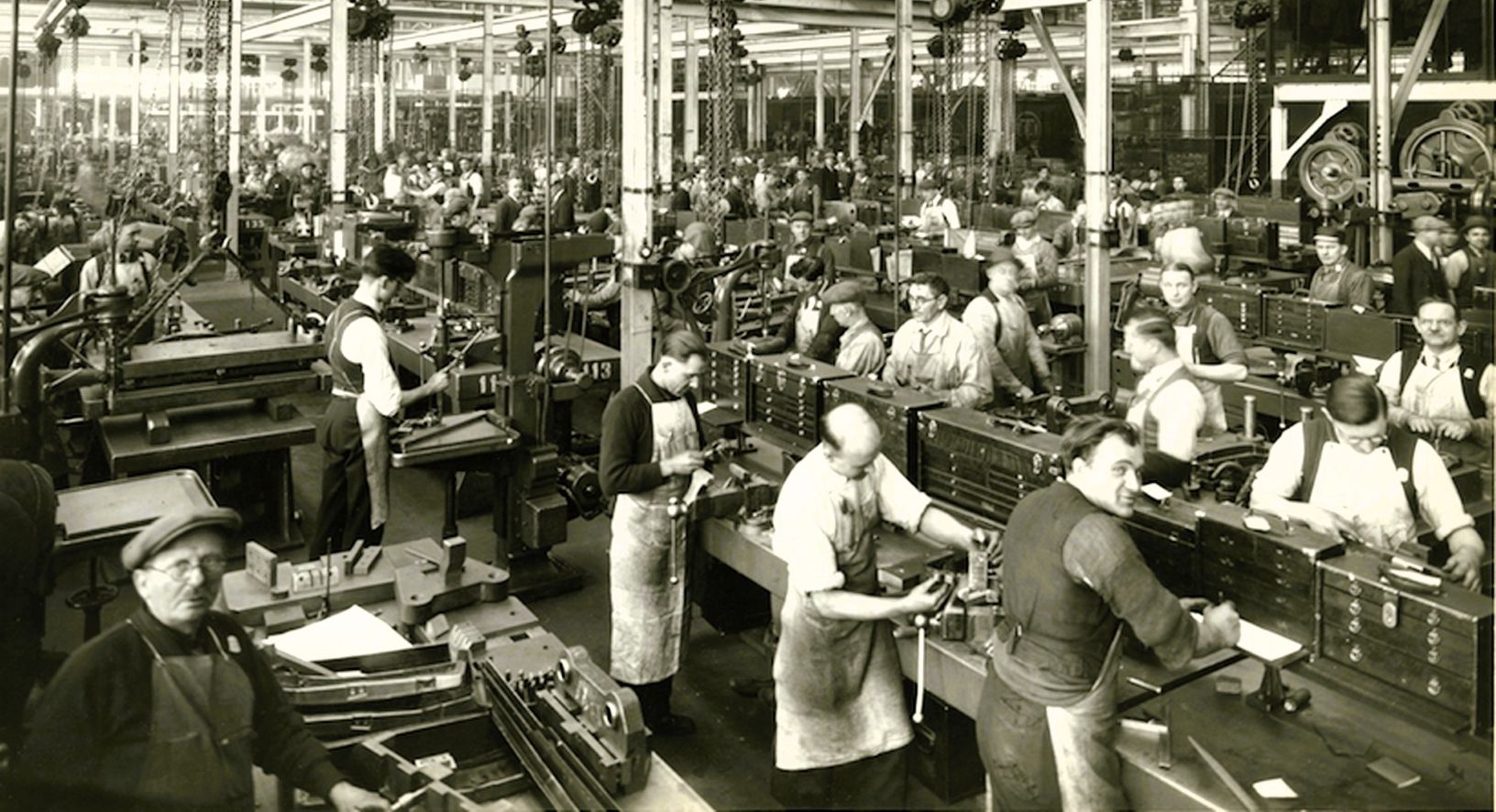
While the auto-industry, at least those directly employed in the ‘Big Three’ today, remains a relative bastion of unionism, with the United Auto Workers representing around 200,000 current auto workers and several 100 thousand more retirees (in addition, the UAW–not a craft union–has another 200 thousand members that come from outside manufacturing, mainly education and clerical). However, it took generations of blood, sweat, and tears to organize the notoriously anti-union, often violently so, industry. The breakthrough finally coming with the C.I.O. and sit down strikes of ’37. Oscar Preedin (an assumed name?) details many of the issues preventing an organizing drive in the early 1920s.
‘The Problem of the Auto Workers’ by Oscar Preedin from Labor Herald (T.U.E.L.). Vol. 2 No. 6. August, 1923.
THE automobile industry is at once among the most advanced and the most backward in America. In point of growth and development, in volume and technique of production, it leads the field, having in 20 years developed from almost nothing to one of the country’s major industries. But as regards the organization of the workers it is perhaps the most undeveloped of all the industries, for automobile factories are “open shop” to an extent hardly known in other fields. According to the dogmas of some doctrinaires, who maintain that prosperous industrial conditions are always favorable to labor organization, this is a contradiction–but if so, it is one based in the history and growth of the industry, and to be resolved only by a knowledge thereof.
Failure of Past Efforts
If the auto workers have not been organized let us say at once that it is not because they are material inferior to the workers in organized industries. It is true that “organizers” galore have come to them with wonderful plans, sometimes backed up with elaborate charts. These have all been very good on paper, and even showed some skill in drawing. That the auto workers have ignored them, however, and remained unorganized, is due to the combination of extremely powerful employers, fighting against organization of the workers, and very complex technical conditions in the industry which these plans ignored, ever-changing and cutting across all the traditional lines of labor organization. Efforts to unionize the auto workers have failed largely because they have neither been based upon actual conditions nor used modern methods.
A first step toward effective organization is to learn something about the industry, its relation to the present industrial life of the country, and the process of change going on. For this purpose we will leave aside the field of “automobile accessories,” and examine the automobile industry proper, the manufacture of bodies and parts, and the numerous and rapidly-growing repair shops.
Of prime importance is the fact that the automobile industry developed out of the machine industry and of the old carriage and wagon industry. When the “horseless carriages” began to appear in large numbers and their production was advanced through technical improvements, then both of the parent industries were profoundly affected-but in different ways. For the machine industry a new field was opened and it received an important enlargement; but the carriage and wagon industry found the ground being cut from under it; horse-drawn vehicles soon became old fashioned.
How the old vehicles trade is dying can be seen clearly from the U.S. census figures. The break in the line of development is in 1904, when auto production started on a large scale. From that year, the high peak of the carriage and wagon business, the number of establishments decreased from 5,588, to 2,286 in 1919; the number of workers engaged decreased in the same period from 77,882 to 18,173; the percentage of all workers engaged in manufacture dropped from 1.42 to 0.20; while the percentage of production values of all manufactures fell from 1.24 to 0.17. Thus in 15 years the position of the horsevehicle industry in relation to industry as a whole dropped to one-seventh of its former standing. This mother of the auto industry is dying.
Building a New Industry
The shops and workers that have gone from the horse vehicle industry have largely been transformed into auto body building or auto repair shops. The skilled mechanics–woodworkers, painters, blacksmiths–have been forced to adapt themselves to the new line. From this source the body building and repair branches have been recruited. The shops are mostly small with obsolete machinery. They are able to prolong their existence, first, because their strategic locations for horse vehicle transportation are now of equal strategic value for automobile transportation; and, second, because the decline in their own proper trade forces them to work so cheaply that erection of modern factories is prevented even where the new industry is sufficient to support the latter.
The problem of unionizing the workers in these two branches, body building and repairs, is very difficult. Already large numbers of workers are engaged in them, and both will increase for some time in even higher proportion than the automobile factories proper. The field is new and but temporarily filled with the junk carried over from the past. There is no doubt that eventually these branches will be “standardized” and unified, though the process will be slow in the repair branch.
The relative importance and growth of the three main branches of the auto industry are shown in the following table, built up from the U.S. Census figures:
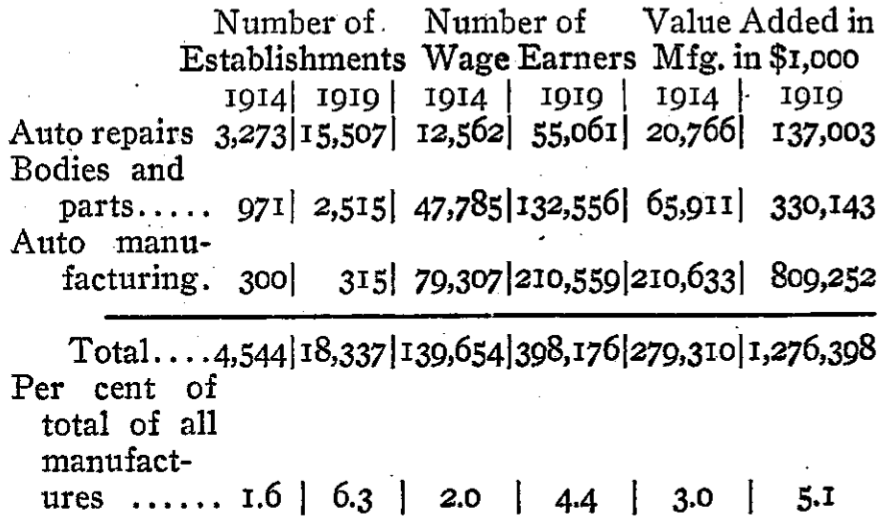
The problem of unionizing the workers in the repair shops is one of finding ways and means of bringing together widely scattered, skilled workers, of varied training and from widely differing backgrounds. Part of the workers come from the expiring carriage and wagon industry; others have grown up in the new industry, starting as helpers; while a distinct group is seen in the auto mechanics (iron workers). Only a small part of the latter come from the old skilled machinists. Most of them are young men, educated for just this particular kind of work. All over the country has grown up a network of “auto schools,” most of them controlled or subsidized by the manufacturers, for training such men.
The Lesson of Unionism
A part of the program of these “auto schools” is to teach the young mechanics that they are on the way to becoming Schwabs or Garys. They are taught to consider their dirty jobs in the repair shops as but the first rungs of the ladder towards high positions in the industry. The result is that they are meek, submissive, and yielding to the demands of their employers. Such illusions are so wide-spread that they constitute a serious obstacle to organization.
There are already many thousands, however, of these auto mechanics who have waited for the promised rewards for many years, but who still continue to work long hours at inadequate wages. They are being forced to look to organization as the only possible means to secure better conditions. They are bound to the shops by their specialized training, which has prepared them for no work outside; they cannot go away to other industries, they cannot rise where they are, and the grim logic of their position is making them ready for the union.
In the auto body branch the shops are larger than the average factory, and the concentration is increasing; where in 1914, the average number of workers to the shop was 49.2, in 1919 this had increased to 52.7. Some of them are the stronger of the former horse vehicle shops, which landed in the auto body industry during the landslide in their old trade. The workers here are more accessible to organization workers unions. The craft union lines are here wider Among them are many old members of the craft than in the repair branch or auto industry proper. The failure of labor organization among these workers is largely but the failure of craft unionism in general. But here also intense concentration is going on. For example, a big plant in Philadelphia has lately equipped itself to fill orders for 500,000 bodies during the next two years, and is now filling orders which in 1914 required 972 factories to handle. This means that very soon the auto body branch will be “fordized” in the same manner as the automobile manufacturing proper.
Industrial Unionism Necessary
Here we find the controlling condition of the automobile industry as a whole; namely, the final and complete elimination of all craft distinctions. Division of labor, simplification, and mechanization in the factories has wiped out the need of much skilled labor. In many places it is even found that cripples are as good as sound men; that some “hands” can even be without both hands; that others may lack a leg and still perform their functions; and sometimes blind men without special training are just as good as men with their sight. The old skill, the old craft lines, no longer have meaning. This new type of worker, unskilled and but a cog in a machine, already represents the majority of those engaged in the automobile industry.
Thus, while the industry is not yet entirely uniform, while many old forms and conditions are still inherited from the past, yet the main branches are already a very close unit and are almost completely dominated by the new methods of production. The old craft unionism is as little fitted to battle with these conditions as an old farm wagon for trans-ocean shipping. Only an industrial union, in the clearest sense of the word, can rescue the auto workers from their present slavery. The material conditions of the industry are ripe for true industrial organization. To find the dynamic forces and the proper methods to bring this about–that is the next question, which it was the purpose of this article but to introduce.
The Labor Herald was the monthly publication of the Trade Union Educational League (TUEL), in immensely important link between the IWW of the 1910s and the CIO of the 1930s. It was begun by veteran labor organizer and Communist leader William Z. Foster in 1920 as an attempt to unite militants within various unions while continuing the industrial unionism tradition of the IWW, though it was opposed to “dual unionism” and favored the formation of a Labor Party. Although it would become financially supported by the Communist International and Communist Party of America, it remained autonomous, was a network and not a membership organization, and included many radicals outside the Communist Party. In 1924 Labor Herald was folded into Workers Monthly, an explicitly Party organ and in 1927 ‘Labor Unity’ became the organ of a now CP dominated TUEL. In 1929 and the turn towards Red Unions in the Third Period, TUEL was wound up and replaced by the Trade Union Unity League, a section of the Red International of Labor Unions (Profitern) and continued to publish Labor Unity until 1935. Labor Herald remains an important labor-orientated journal by revolutionaries in US left history and would be referenced by activists, along with TUEL, along after it’s heyday.
PDF of full issue: https://www.marxists.org/history/usa/pubs/laborherald/v2n06-aug-1923.pdf
 Revolution's Newsstand