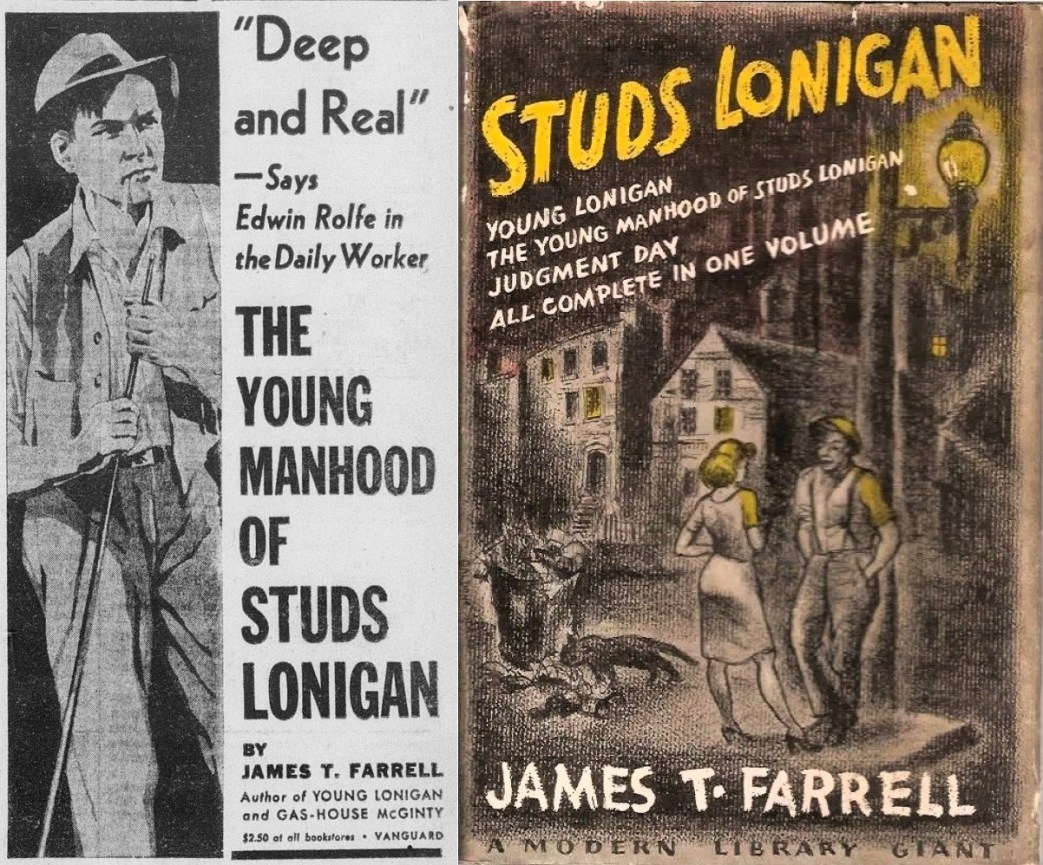
‘The Young Manhood of Studs Lonigan’ by Edward Newhouse and Edwin Rolfe from The New Masses and The Daily Worker. February, 1934.
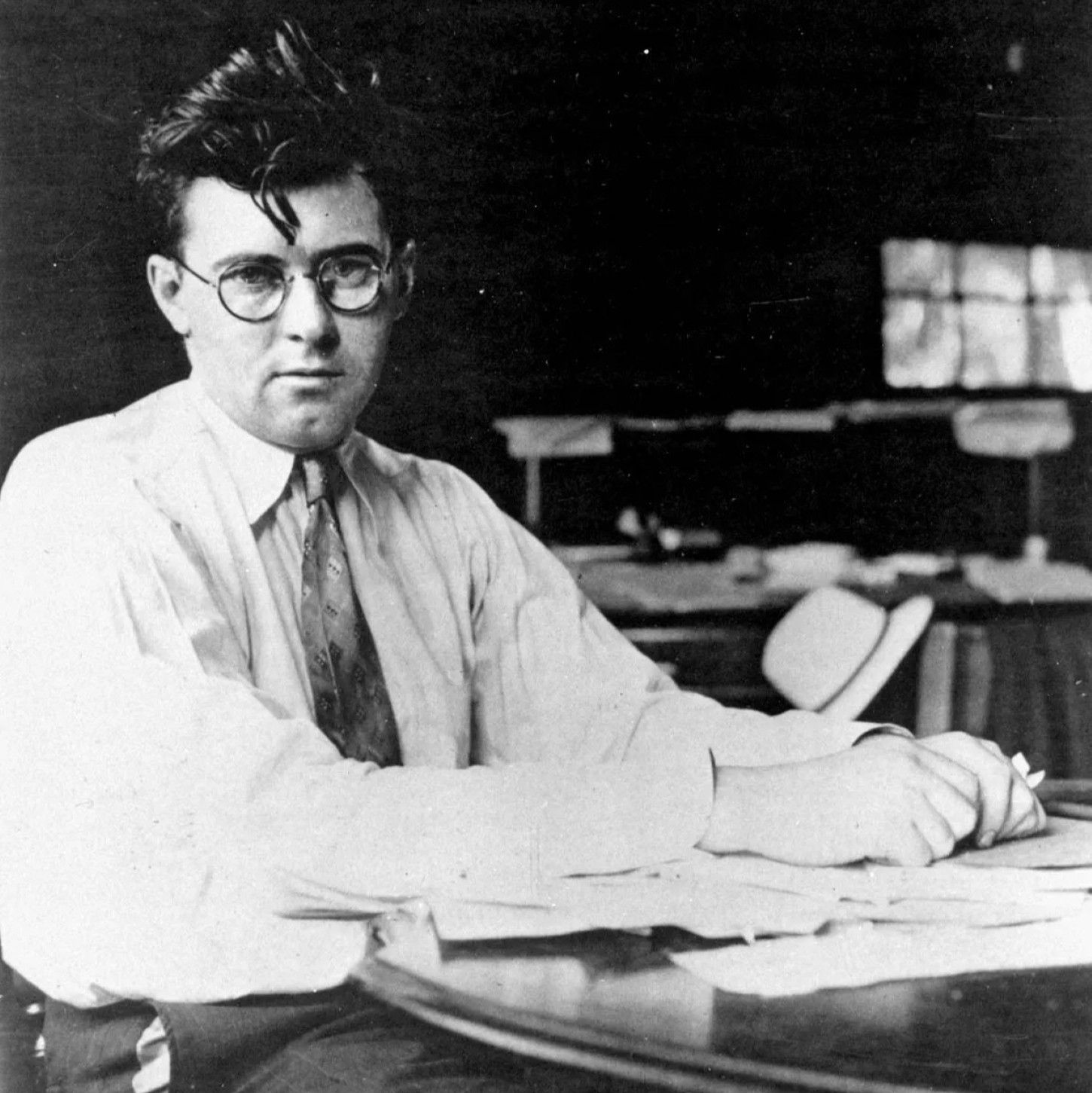
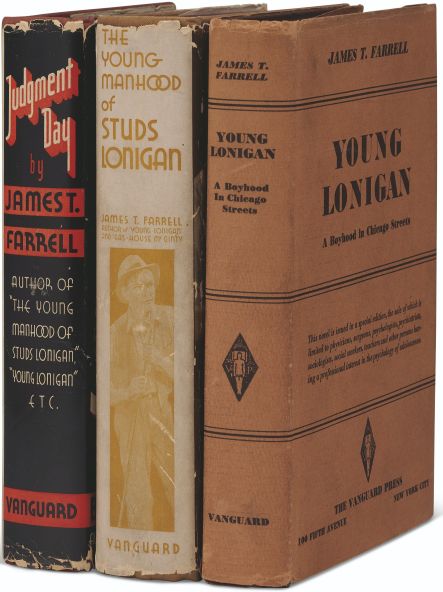
Reviews of what was among the most important novels and cultural creations of that standout generation of 1930s revolutionary activists. Novelist James T. Farrell’s ‘Studs Lonigan’ trilogy is a celebrated work (often listed on ‘Best of the Century’ lists), and among the finest examples of the ‘proletarian novel’ (though that term is by definition self-limiting) produced in the United States. The first in the series, 1932’s ‘Young Lonigan,’ was Farrell’s first book and slipped by, except for the Left, when first published. However, with its impressive and harsh prose, its realistic depiction working class Chicago lived by a young white man in that racially divided and impoverished Depression-era city, it created a sensatio. Its 1934 sequel, ‘The Young Manhood of Studs Lonigan,’ reviewed below by New Masses’ Edward Newhouse and The Daily Workers’ Edwin Rolfe, sold millions of copies, and was highly praised. It was followed a year later by 1935’s ‘Judgement Day’, completing Lonigan’s personal and political arc. Farrell (1904-1979) was born into an Irish working-class Chicago family, his father a teamster and his mother a domestic. Clearly talented, after high school he spent a few moments at the University of Chicago before dropping out to work, travel (including to Europe), and absorb himself in self-education and writing. For decades a person of the Left, long in the Communist Party-milieu and a fixture of its literary press, particularly The New Masses, Farrell found himself gravitating towards Trotskyism with the Popular Front/Purges period. Of the early Partisan Review trajectory, from around 1937 he was politically associated with the Trotskyism of the Socialist Workers Party. Agreeing with Albert Goldman and Felix Morrow, he would largely leave S.W.P. circles in 1948, slowly moving to the right through social democracy to Hubert Humphrey and Cold War liberalism by the end of his life. However, Farrell, who produced fifty novels and hundreds of essays, remains not just a very fine writer, capable of real greatness, but an indispensable voice in understanding the world of the working class and Left at the time when it was most organized and combative.
‘Portrait of the Gangster: The Young Manhood of Studs Lonigan’ by Edward Newhouse from New Masses. Vol. 10 No. 8. February 20, 1934.
THE cumulative effect of Young Lonigan (published 1932) and its sequel, The Young Manhood of Studs Lonigan, is exceedingly impressive. These two novels by James T. Farrell are the truest and most ruthless commentary upon street-Arab adolescence and manhood ever written in America. Young Lonigan is a study of a Chicago gang of boys from which our political life stems. Grown to maturity these drugstore cowboys, poolhall sharks, and killers on the make become ward heelers, racketeers and political leaders.
Since the characters belong somewhere in the upper brackets of the propertied classes, poverty is not the theme and the “mean streets” are not the milieu of either of these books. The special genre of brutal longings, the dehumanized, competitive desires, which characterize Studs Lonigan, the protagonist, belong to all America, and the sources from which they spring touch all shores and levels of society. The mind of the book, and not of the author, can be illustrated to some extent by the following: The reviewer, as a child, remembers looking into the window of a high-class cigar store and watching a thin, phthisical man, with a macabre, nicotine complexion, seated at a table, smoke one cigarette after another and drink milk and eat hershey bars to sustain himself. This was in 1907 or 1908, and it was one of those horrendous endurance-contests to which the exacerbated wealthy as well as the shipping clerk go for their catharses.
Since then the American psyche has reaped the pentecost of new technological discoveries. There is the cartoon, with sound effects, out of which jump abstract ghouls, mice, ghosts, the dismembered imaginings of bad dreams; Walt Disney’s confectionery fables for infantile minds. Then there were the Lloyd comedies of a few years back in which lovable, tortoise-shelled Harold invariably succeeded in whipping up the sadistic impulses of the “totalitarian” audience by precariously balancing himself on the ledge of a thirty story window. This is the background without which we cannot understand the neuroses of Studs Lonigan, Weary Reilley, Paulie Haggerty, Davey Cohen, Barney Keefe and others.
These Chicago Attilas, when not attending the Catholic parochial school, raid candy stores, steal milk, and attempt to set in motion race riots in order to give their lives the dramatic atmosphere of western pulp stories. Their sleazy pugilistic mores, their vandalistic and predatory habits of mind are harrowingly portrayed in a mimic war scene on a vacant lot. Standing in trenches which they have dug, these boys, protected by a Hooverville assortment of tin cans, boxes and barbed wire, hurl large rocks at one another. The raw, competitive motive of the American streets, which runs through our business, science, and art, is again made manifest in a football game in which the “home team” almost kills the fleet-footed Schwartz in order to win the game. And the same impulse of the street canaille is seen in a snapshot of Armistice Day on a Chicago El.
When the playmates of Studs Lonigan have flowered into manhood, “the Alky Squad of 58th Street,” they become dipsomaniacs, contract venereal diseases, and die of tuberculosis. They are driven by the same kind of jungle appetites as compel Archibald MacLeish’s Wall Street conquistadors to outstrip their competitors in power and prestige.
The one moment of relief and respite in the book comes when Studs, cowed by the death of Arnold Sheehan, decides to join a Y gymnasium so that he can trim down his alcoholic “aldermen” and live to be a centenarian. However, this feeling of penitence is fugitive, for at the close of the book Studs Lonigan is lying in the gutter, drunk and unconscious, after a New Year’s rape party.
The two novels make a definite and original contribution to American literature. Unlike Jack Conroy’s prose, which is the remnants of writing that has been done in the past five to seven years, Farrell’s Americanese is enormously skillful and deeply fused.
Farrell’s novels are the intransigent documents of a fellow-traveler, and doubtless will not please certain snipers in the ranks of the pseudo-Marxists–these sharpshooters, with one essay and one review in their belts, who have never made any deviations for the simple reason that they have never written one creative or critical line that will last. It is altogether regrettable that some of the more original and sensitive minds in the movement have not yet done a book on the Marxist approach to American literature and spared us some of the leftist hemorrhages.
It is true, there are no strikes or demonstrations in Farrell’s novels. Besides that, there is scarcely a figure or a character that can be salvaged, and yet these books are highly serviceable to both workers and intellectuals.
If Mr. Farrell has taught us nothing more than how hooliganism arises, grows, and festers in this horrific America, and if he has shown us nothing else but where to look for the vandals, the Pelleys and Art Smiths, the American Storm Troopers, he has instructed us well and profoundly. Some day, in our future, classless society, readers will examine The Young Manhood of Studs Lonigan, and say, “Look what we were, and see what we have come through!”
***
‘Farrell’s New Novel Portrays Chicago Life’ by Edwin Rolfe from The Daily Worker. Vol. 11 No. 30. February 3, 1934.
“Young Lonigan” Sequel Is the Best Achievement of Young Writer
JAMES T. FARRELL is a young Chicago novelist who during the past live years has risen rapidly into the ranks of the outstanding young writers of Action today. Almost completely unknown when his first book, “Young Lonigan,” was published, he continued to write short stories which appeared in such periodicals as the “American Mercury,” “Story,” “The New Review,” etc. His second novel, “Gas House McGinty,” published last year, revealed two Important factors in Farrell’s growth. It established, through a very experimental but nonetheless thorough treatment of a group of workers employed at the Continental Express Company offices, the author’s identification with his own rich and fertile proletarian background. Moreover, it marked the actual beginning of Farrell’s leftward growth. His new novel, it seems to me, is his outstanding achievement to date. In it we can observe the end of his youthful “experimental” period and the beginning of a genuinely mature approach to his material.
Begins Where First Novel Ended
“The Young Manhood of Studs Lonigan” begins where “Young Lonigan” ended. We get our first glimpse of William Lonigan on a sunny April day, walking cockily along the street, his shoulders slouched in the disdainful devil-may-care attitude of his seventeen years. The boy is approaching manhood; he has had a quarrel with the old man and he fears another when he gets home.
“He shrugged his shoulders, because Wilson was going to declare war any one of these days, and maybe the war would get him out of it.”
He watches the “punks” the younger kids in this tough Chicago neighborhood—playing at war in the trenches among the tin cans and refuse of a city lot, and he wants to join them. But the realization that he is seventeen years old, on the verge of manhood, keeps him from entering the mock-war. War is declared. Several of the older fellows in the gang enlist; Studs and two of his buddies try to make the minimum army weight by eating bananas (which they steal from an Italian pushcart vender) and drinking water. But all they achieve are painful bellyaches, which keep them in agony for a period of days.
This is Studs’ first disappointment, the first of a long series of frustrations which mount gigantically as Farrell applies the keen strokes of his unexcelled detail. Studs Lonigan plays football—it is dirty football.
He gloats over the deaths of several Negroes in a “race-war”; he wants a girl of his own, like Paulie Haggerty has, only he doesn’t want to get married. Studs gets drunk with the gang regularly, visits the bawdy houses, the dance halls where his goals pick up young and unsuspecting girls. And through it all, he feels the pointlessness of his life. He wants to better himself. He makes countless resolutions to keep fit, to stay hard and clean; he joins a Y.M.C.A. to keep trim by swimming. We read of one scene at the “Y” pool, where Studs and a companion wise-crack to each other about the officious-looking, sissified young clerks. We never see him at the “Y” pool again. He goes to church, listens to Father Shannon deliver a two-fisted, he-man, rip roaring attack on sin, joins “in a prayer to Mary, asking her protection and aid in the struggle of the Catholic youth of this land for the triumph of virtue.” But soon he is back again at the pool parlor, drinking, visiting the bawdy houses. The book ends in 1929, after a New Year’s Party.
Studs Lonigan in 1929
“The dirty gray dawn of the New Year came slowly. It was snowing. There was a drunken figure, huddled by the curb near the fireplug at Fifty-Eighth and Prairie. A passing Negro reveller studied it. He saw that the fellow wasn’t dead. He rolled it over, and saw it was a young man with a broad face, the eyes puffed black, the nose swollen and bent. He saw that the suit and coat were bloody, dirty, odorous with vomit.”
“It was Studs Lonigan, who had once, as a boy, stood before Charley Bathcellar’s poolroom thinking that come day, he would grow up to be strong, and tough, and the real stuff.”
It is a terrifying and brutal picture which Farrell gives us, the picture of a section of the post-war generation growing aimlessly through coarse and brutalizing experiences into frustrated and vicious men. In the sheer accumulation of his hard-boiled, superbly-detailed scenes, he intensifies the sense of frustration and defeat one feels, with Studs Lonigan. at the end of the story.
A More Significant Thread
But there is another thread which runs through the novel, slighter in its execution, but far more significant both for the understanding of the book and of its author. It is the recurrent and strengthening overtone of the italicized passages between the separate chapters–the passages which set the stage for the detailed actions of Studs and his Tang, and which, far more thoroughly than the major theme, set the trend and direction of the milieu.
Thus we find Mr. Le Gare “blacklisted! No hotel in the city would hire him.
He had been a waiter all his life. What work could he do now?…the blacklist meant the dust heap, the garbage can for a man his age. And his sons, daughter, wife, didn’t understand; it was tragedy, living with people who I couldn’t understand what a man was doing…He wasn’t a fool! He wasn’t! He had been right. And they needn’t have lost the strike, if only they had all shown unity, courage, heart…He could see it so clear. They could have won if only…Some day all the American working men would strike, and even the waiters would have to then, and then too…they would win…
Farrell Looks Forward
And young Danny O’Neill, looking out of the window of the Upton Service Station on a corner of Wabash Ave. in the black belt where he worked…realized that the Church “was not merely ignorance and superstition. It was perhaps not merely a vested interest. It was a downright hatred of truth and honesty…He realized that all his education in Catholic schools…had been lies…He tried again to study. He envisaged a better world, a cleaner world, a world of ideals such as that the Russians were trying to achieve. He had to study to prepare himself to create that world…”
Farrell has within his own experience the material of which great novels can be written. And he is enough of an artist, as this book clearly shows, to bring out the essence, the core of vitality, in this material. “The Young Manhood of Studs Lonigan” is not clever, nor slight, nor witty, as so many of the highly-praised novels of the past few years have been. It is deep and real. It tackles its problems hard and cleanly. Farrell possesses the type of perseverance and honesty and ability which, given a big enough theme, can produce a monumental work.
The New Masses was the continuation of Workers Monthly which began publishing in 1924 as a merger of the ‘Liberator’, the Trade Union Educational League magazine ‘Labor Herald’, and Friends of Soviet Russia’s monthly ‘Soviet Russia Pictorial’ as an explicitly Communist Party publication, but drawing in a wide range of contributors and sympathizers. In 1927 Workers Monthly ceased and The New Masses began. A major left cultural magazine of the late 1920s and early 1940s, the early editors of The New Masses included Hugo Gellert, John F. Sloan, Max Eastman, Mike Gold, and Joseph Freeman. Writers included William Carlos Williams, Theodore Dreiser, John Dos Passos, Upton Sinclair, Richard Wright, Ralph Ellison, Dorothy Parker, Dorothy Day, John Breecher, Langston Hughes, Eugene O’Neill, Rex Stout and Ernest Hemingway. Artists included Hugo Gellert, Stuart Davis, Boardman Robinson, Wanda Gag, William Gropper and Otto Soglow. Over time, the New Masses became narrower politically and the articles more commentary than comment. However, particularly in it first years, New Masses was the epitome of the era’s finest revolutionary cultural and artistic traditions.
PDF of full issue: https://www.marxists.org/history/usa/pubs/new-masses/1934/v10n08-feb-20-1934-NM.pdf
The Daily Worker began in 1924 and was published in New York City by the Communist Party US and its predecessor organizations. Among the most long-lasting and important left publications in US history, it had a circulation of 35,000 at its peak. The Daily Worker came from The Ohio Socialist, published by the Left Wing-dominated Socialist Party of Ohio in Cleveland from 1917 to November 1919, when it became became The Toiler, paper of the Communist Labor Party. In December 1921 the above-ground Workers Party of America merged the Toiler with the paper Workers Council to found The Worker, which became The Daily Worker beginning January 13, 1924.
PDF of full issue: https://www.marxists.org/history/usa/pubs/dailyworker/1934/v11-n030-feb-03-1934-DW-LOC.pdf
 Revolution's Newsstand