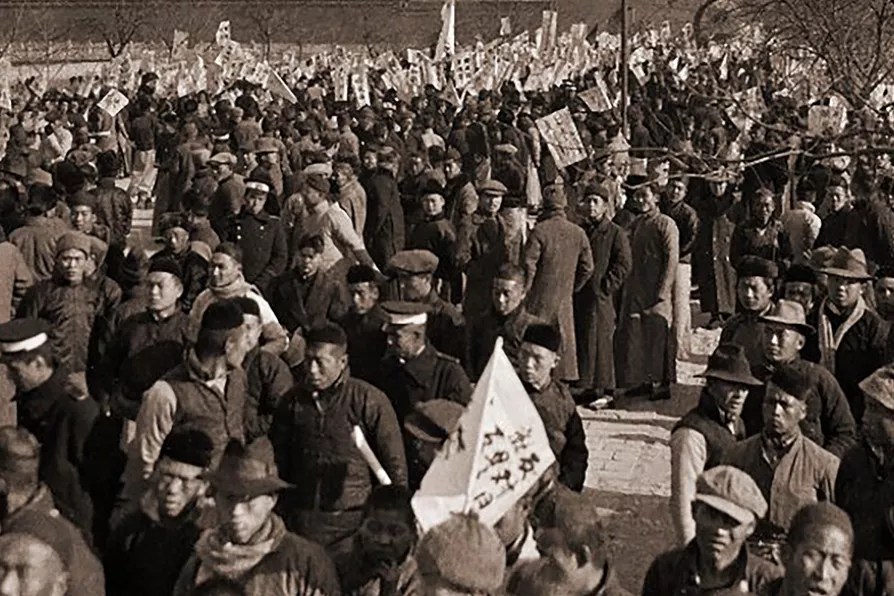
A useful early history of the origins and development of the Chinese Communist Party by ‘Yu-Ang-Li’ (any help identifying this comrade most appreciated) written after the fall, but before the expulsion of C.C.P. founder and leader Chen Duxiu and while the ‘ulttra-left’ leadership of Xiang Zhongfa and Li Li-san, advocating military campaigns and uprisings to seize Chinese cities, were still, at least for a moment, leading the Party.
‘The Communist International and the Foundation of the Communist Party of China’ by Yu-Ang-Li from Communist International. Vol. 6 No. 9-10. April, 1929.
THE Communist Party of China welcomes the tenth year of the existence of the Communist International as the anniversary of its own inception. The year 1919 is rightly considered by us to be the starting-point of the great wave of revolution in China, which ended in December, 1927, in the heroic rising of the Canton proletariat.
During the very days on which the First Congress of the Comintern was holding its sessions violent waves of anti-imperialist, anti-Japanese agitation were sweeping the country, arousing and summoning it to an active political life, to a struggle for the national emancipation of the millions of human beings in China. The famous Hong-Kong strike of April, 1919, and a number of strikes in Central China brought the working class to the forefront of the revolutionary struggle, and from this moment that class began to make its influence felt on all political events, and to win new positions every year in the struggle for the leadership of the exploited masses of the Chinese people.
The year 1919 was marked by a “Back to the people” movement among the finest, most revolutionary-minded elements of the students, which was met halfway by a movement of the leading ranks of the still disunited, but politically active working class, ready for struggle, but needing a Communist advance-guard.
Out of the groups of workers’ organisations created by this movement the Communist Party of China was born in the following year, and it grew vigorously and became the one militant mass Party of the Chinese proletariat.
I. THE HISTORIC CONDITIONS OF THE CREATION OF THE C.P. OF CHINA
From the first day of its birth the cradle of the young C.P. was tended by the Comintern and the revolutionary influence of the first proletarian dictatorship.
Across the ring of the capitalist blockade, through the falsehood and slander of the ideological agents of the exploiting classes, news of the great historical revolution that had been accomplished in Russia began to penetrate in a continually growing stream into China.
No Communist Party was yet in being, not a single Communist existed in China at that time, and yet the basic line of political demarcation even then became the slogan “for Soviet Russia, against “Wilsonism,” against the cunning pacifist deceptions of imperialism.
The birth of the Communist Party was welcomed by a chorus of hostile voices, hiding their fear of the workers’ movement behind phrases about the “unpreparedness of the social conditions of China for a Communist movement” and the “foreign influence” of the Communist International.
The C.P. of China acknowledged the enormous influence of the Soviet Union and the Comintern both on its creation and on all its further development.
The C.P. of China is one of the many divisions of the international working class, and it naturally sees its origin in the process of decline and disintegration of imperialism and the growth of a world socialist revolution. It affirms its internationalism in its international associations.
Yet the C.P. of China is in no less measure the product of national development, the development of the struggle of classes in China itself.
Possibly there is no other country in the world, with the exception of Russia, which in the course of fifty years has passed through so many revolutionary disturbances as stagnant, backward China. That was indispensable in order that China might take the road of capitalist development.
From the peasant war of the period of late and disintegrating feudalism (known as the Taiping War), which lasted several decades, and was suppressed with the aid of foreign intervention, through the first bourgeois-democratic revolution of 1911, down to the contemporary gigantic clash of classes—all this distance has been traversed in less than a lifetime.
A development which it took the far west hundreds of years of slow movement to accomplish, China, which set out late on the road of industrial development, had to complete in a few decades.
Into an exceptionally small historical space of time history condensed events of enormous importance: the disintegration of the feudal method of production; the industrial revolution, which began with the direct establishment of great factories and works, the mammoths of modern capitalist technique, on the backward economic ground of China, where artisan and handicraft production had previously reigned supreme; finally, the supremacy of imperialism with all its consequences for the semi-colonial countries; the formation of enormous reserve armies of labour, which can find no application either in agriculture or in industry, the subordinate position of the national industrial bourgeoisie, and so on.
The oppression of triple exploitation; that of a decaying, yet still powerful feudalism, of developing national capitalism and of imperialism, has transformed China into one of the weakest links in the modern system of capitalist States.
Consequently the Communist Party has deep roots and is untroubled by talk of its inadequate social basis. Almost a decade before its birth, in the stormy years of the counterrevolution of 1912, the spectre of Communism was already frightening all the factions of the Chinese bourgeoisie and landed proprietors.
And just as in the summer of 1927, when all the parties of the bourgeois regime concentrated against the “insufferable demands of the working class,” against its “illegal Communist strikes,” which destroyed the unity of the nation and shook bourgeois legality, so during the years of the first Chinese bourgeois-democratic revolution, Yuan-Shi-Kai and Li-Yuan-Lung, Tang-Shao-Yi and Wu-Wang Ming (the last two being the representatives of the “left-wing” of the Kuomintang of those days) all unitedly broke up the workers’ unions, bloodily suppressed the strikes of the Shanghai, Hankow and Chang-Sha workers, and proclaimed the unity of the Chinese nation, in contradistinction to the class struggle, which was proceeding and penetrating deeper into the nation’s existence.
During the years of the first revolution the Chinese proletariat did not create a party of its own. The left-wing of the Kuomintang sought to speak in its name, organising workers’ unions and exploiting the activity of the proletariat in the interests of the bourgeois parties.
All kinds of groups of anarchists and petty bourgeois politicians (like the leader of the “Chinese Social-Democratic Labour Party,” Chang-Kang-Wu), who had no contact with the masses of the proletariat, with its rank-and-file organisations, none the less spoke in its name. And at the moment when the workers entered on the struggle for essential economic demands (the general strike of the printers in Hong-Kong, strikes in the Shanghai, Hankow and Chang-Sha arsenals, and on the northern railroads), all these “friends of the working class” turned their backs on the working-class and cleared the field for the military and police commanders of conflicting political groups and parties.
Absolutely al! historians, both Chinese and foreign, of IgII pass over in silence working-class struggle which developed during those months.
The direct agents of the ruling classes and the simpletons of the petty-bourgeois groups found it convenient to maintain the illusion of the existence of class peace, the absence of any antagonism of classes.
But that struggle of the still young working class, the majority of whom had only just abandoned their last piece of land or sold their last tools, did not take place in vain.
When in 1919 a widespread movement began for the organisation of workers’ unions and socialist labour groups, the radical students went to the industrial areas, and there met the leading groups of workers, who had acted as leaders even during the strikes of 1912.
For instance, the workers of the Chang-Sha arsenal, whose strike had been bloodily suppressed by Yuan-Shi-Kai in 1912, proved in 1920 to be at the head of the trade union organisations of Northern China.
Through these revolutionary proletarians, through their experience of revolutionary struggle, the Communist Party affirms its descent from the past revolutionary movements of the Chinese working class.
The creation of the Communist Party is thus only the consummation of a long process of development of the Chinese proletariat, its emancipation from childish illusions, its emergence as a separate class in modern society.
But conscious Marxist Communism had to be brought into the workers’ movement of China from without.
Just as in Russia, the “theoretical teaching” of Communism “had arisen quite independently of the elemental growth of the workers’ movement, arisen as a national and inevitable result of the thought of the revolutionary intelligentsia.” (Lenin, “What is to be Done?” Collected works, Vol. V, p. 141.)
About the time of the rise of the national revolutionary and workers’ movement in 1919, many of the most radical elements of the Chinese intelligentsia had recognised the complete impotence of all the bourgeois and petty-bourgeois attempts to achieve the national emancipation of the country and its real revolutionary union by the old methods, whether parliamentary, or insurrectionary, or militant.
The national revolutionary movement had got into a hopeless cul-de-sac. All its past attempts had proved unsuccessful.
The very first attempt to reconstruct the political and economic system on the basis of constitutional-monarchical liberalism had been bankrupt in all eyes in 1898. And the left bourgeois wing of the Kuomintang, who by their continual compromise with the forces of feudal reaction and their obstruction of the revolutionary activity of the masses during the revolution of 1911-13 had ensured the restoration of the tottering forces of feudalism, had suffered no less a fiasco.
The later attempts were only worse forms of these antiquated methods of struggle. In the antics of the politicians around the lifeless corpses of the constitution and parliament (although the Kuomintang also participated in that game) no one believed. The military adventures in the south of Sun-Yat-Sen, who with his combinations of militarists sought to achieve the unity of China and ignored all the manifestations of a mass movement (Sun was, for instance, opposed to the anti-Japanese campaign of 1919) inspired as little hope of success. The most radical elements of the Chinese intelligentsia turned sharply round towards socialism, to the task of organising the masses, and the working class first and foremost. These first organisers of workers’ groups, unions, schools, socialist leagues of youth, and finally of the Communist Party itself, were the product of the disintegration of Chinese nationalism.
They were first and foremost the group that gathered around comrade Cheng-Du-Shu and his periodical, “New Youth,” which gradually traversed the road from democracy to Communism. In 1920, at about the time of the arrival of a representative from the Far Eastern Secretariat of the Comintern, in Shanghai, this group began to call itself a Communist group and thus formed the nucleus. of the Communist Party of China.
Very soon, towards the end of the same year, Communist groups began to be formed in a number of the largest centres of China. At the head of the organisation in Peking were comrades Li-Da-Chao (hanged by Chang-Tso-Lin in 1927) and Chang-Ho-Tao; in Canton were T’ang-Ping-Shan (a renegade from Communism and now the leader of a third party), and Cheng-Hung-Po (expelled from the Party and now a member of the Kuomintang). In Hunan was comrade Mao-Che-Dun, and in France were Chai-Ke-Shang and the young Cheng (shot by Chiang-Kai-Shek in the summer of 1927). One of the organisers of the socialist League of Youth, which afterwards developed into the Chinese Young Communist League, was comrade Chang-Ta-Lai, who died the death of the brave during the days of the Canton Commune.
In Pekin, Canton and Shanghai Communist journals and newspapers began to be published for the workers, and a number of Marxist and Leninist works were also issued. (The Communist Manifesto, “Wage Labour and Capital,” “State and Revolution,” “Communist Saturdayings” and so on.) At the same time more or less successful attempts were made everywhere to set up revolutionary trade unions and to lead the strike movement of the proletariat.
The first Congress, which took place in June, 1921, in Shanghai, laid the foundation of a central organisation, which afterwards at the second congress in 1922) became the Chinese section of the Communist International.
2. FROM PROPAGANDIST GROUPS TO A MASS PARTY
From the very moment of its birth the Communist Party had to repel a frantic pressure from petty-bourgeois and Liberal influences on the revolutionary, Marxist-Leninist understanding of the struggle of the proletariat and the tactics and organisational forms of the Party.
Anarchism and guild socialism, Bakuninism, Tolstoyism, and Gandhi-ism, “legal Marxism” and San-Ming-Shui (Sun-Yat-Sen’s doctrine of “nationalism, democracy and the people’s welfare”)–all these products of the ideological activity of the bourgeoisie, the petty bourgeoisie and the lumpen-proletariat saturated the political atmosphere of 1919 and 1920, rendering incredibly difficult the formation of a proletarian party under a Marxist-Leninist banner.
History had granted the Chinese Communist Party the briefest of periods in which to outlive the vacillations in its own ranks, and to effect the intellectual break-up of hostile theories. The obstacles which the parties of the West, with considerably more preparation, had overcome through a stubborn and systematic struggle spread over a number of years, had to be met and broken up by the C.P. of China in a period literally of months–the months that separated its inception from the revolution of 1925-27, when it was called upon to act as the sole political representative of the working class.
Only just organised, the Communist groups were already living through a serious internal crisis–they had to pass through the experience of a split with the anarchist-Communists. Of the original Communist group in Pekin only two persons were left; the first organisation in Canton proved to be entirely in the hands of the anarchists, and only after its dissolution was a Communist nucleus created. The split occurred on basic questions of principle, such as the dictatorship of the proletariat and the necessity for a centralised and disciplined party.
The young but already implacable Chinese Communists had no ground in common with those who vacillated on these questions, with those who sought to dissolve the Communist Party into unorganised and impotent circles. and clubs, with those who declared themselves “for Soviet Russia but against the dictatorship of the proletariat.”
But even at the first congress of the Party, after the anarchists in its ranks had been definitely dealt with, the struggle was concentrated on the resistance to bourgeois influence over the proletariat. Communism threw off the ideologists of the national bourgeoisie who had temporarily attached themselves to the Communist movement, such as Dai-Chi-Tao, Li-Hang-Ching and, soon after, Cheng-Hung-Po.
This group suffered from a fundamental fear of the workers’ movement, and were no less cautious of the idea of the dictatorship of the proletariat than were the anarchists. Instead of dictatorship they proposed democracy, instead of work to create trade unions and to extend the Party among the active workers, they spread the idea of work among the students: and the peaceable study of the theory of Marxism.
By their endeavours to occupy official positions in the provincial governments, they thrust the Party directly along the road of legal existence and reconciliation with the militarist groups.
Their task inside the Communist movement amounted objectively to the dissolution of the Party as a militant and revolutionary organisation of the proletariat.
A small handful, a dozen or so of Communists, firmly raised the standard of struggle for Communism, for the dictatorship of the proletariat, for a disciplined, Bolshevik Party, for a revolutionary trade union movement.
At that time the Party was not yet faced with the task of participating with other classes and parties in Chinese society in the national struggle for emancipation from imperialist oppression.
In exactly the same way the Party had not yet set itself the task of struggle for the leadership of the peasantry.
It was passing through the period of recognising itself as the political representative of the working class; it was working out its own basic programme.
The enormous number of the petty-bourgeoisie, vacillating between sporadic revolt and anarchism on the one hand, and support of the bourgeois system on the other; the lumpen-proletarian environment (and, to a large extent, origin) of the Chinese proletariat; the burden of backward craft prejudices–all these factors forced the Chinese Communists, no less than the Russian Bolsheviks, “to cut themselves off at first from all others, to single out solely and exclusively the proletariat, and afterwards to declare that the proletariat will emancipate the rest.” (Lenin, “Supplementary Notes on the Draft Programme”; selections from Lenin’s writings, Vol. II, p. 132.)
The Party had followed this road down to 1921. But in front of it was the task of transforming itself from small propagandist groups into a mass political Party of the proletariat.
Programmes alone were now inadequate. It was necessary to work out tactics. The proletarian advance-guard was bound to extend its horizon by the inclusion of an analysis of the relations of classes, and to determine its role and its tactical tasks within those relations.
The great importance of the second congress, which met in 1922, consisted in the realisation of the enormous importance of the anti-imperialist struggle, the struggle for national emancipation, for the bourgeois democratic revolution in a semi-colonial country.
This involved a reconsideration of the Party’s attitude to the national revolutionary organisations, already existing and struggling in China, and first and foremost to the Kuomintang. By its decisions on the formation of a single national front of all forces waging a revolutionary struggle with imperialism and militarism, the C.P. had predetermined its later entry into the Kuomintang.
The second congress had been preceded by a “First Congress of the Revolutionary Organisations of the Far East” in Soviet Russia, at which both the Communist Party of China and the revolutionary trade union organisations, and also the Kuomintang, had been represented.
This congress had enormous significance for the whole further development of the C.P. by laying down a permanent and systematic connection between the Communist International and the revolutionary movement of China. It made that essential change in policy, which was afterwards confirmed by the Second Congress of the Chinese C.P., consisting in the transference from propaganda work and the organisation of trade unions, to active participation in the political struggle, to the struggle of the proletariat for hegemony in the national bourgeois-democratic revolution.
The Party handled this highly important change in its tactical line with comparative ease. Under the leadership of the Comintern it overcame the tendencies towards complete subjection to the Kuomintang which appeared in certain places.
During this period the basic policy of the C.P. in regard to the Kuomintang was the instruction given by the Comintern in January, 1923:
“Whilst supporting the Kuomintang in all national revolutionary campaigns, in so far as that party carries on an objectively correct policy, the C.P. of China must none the less not become merged with that Party during these campaigns and must not lower its own standard.”
Foreseeing the danger of the tactics of a united national front before the Third Congress of the Communist Party, held in 1923, the Comintern returned to this question, setting forth the basic task of the bourgeois revolution in China in all its magnitude (the resolution on the agrarian problem) and emphasising the directing role of the working class.
Whilst absolutely confirming the position that “the central task for China is the national revolution against the imperialists and their feudal agents,” and thus confirming the necessity of winning the “union of the wide strata of Chinese democracy in this anti-imperialist movement,” the Comintern instruction to the Third Congress of the Chinese C.P. raised the problem of the peasants in the revolution to the front rank, long before the Seventh and Eighth Plenums of the E.C.C.I.
In that instruction we read:
“1. The national revolution in China and the creation of an anti-imperialist front will inevitably be accompanied by an agrarian revolution of the peasantry against the survivals of feudalism. That revolution can be victorious only if the basic mass of the Chinese population, the small peasantry, is drawn into the movement.
“2. Thus the central problem of the whole policy is the peasant problem. To blur that basic fact by any other conception whatever means a failure to understand the importance of the social-democratic section on which alone a victorious struggle against foreign imperialism, and for the complete annihilation of the feudal regime in China, can be achieved.
“3. Consequently, as the Party of the working class the C.P. must strive to ally the workers and peasants. That can be achieved only by an incessant propaganda for the realisation in practice of the slogans of the agrarian revolution, such as: the confiscation of rich land-owners’ estates, the confiscation of monastery and church lands, and its free transfer to the peasantry; the elimination of rack-renting and of the present taxation system; the annulment of leases and of taxation regulations between provinces; the abolition of tax-farmers, and of the mandarine system; the establishment of organs of peasant self-government to whom confiscated land is to be transferred; and so on.
“4. Starting from these basic demands, it is necessary to lead the whole mass of poor peasants to see the necessity of struggle with foreign imperialism, exploiting to this end the fact that taxes, the salt–Gabelle, etc., are in the hands of foreign capital. Only by introducing an agrarian programme under the slogan of the anti-imperialist front can we hope for its further success.
“5. It goes without saying that the leadership must belong to the Party of the working class. The latest events in the Labour movement (the large-scale strikes) have clearly revealed the importance of the workers’ movement in China. To consolidate the C.P. by transforming it into a mass Party of the proletariat, to gather the forces of the working class into the trade unions, are the first obligations of the Communists.
“6. The Communist Party must steadily thrust the Kuomintang in the direction of an agrarian revolution. In the places occupied by Sun’s armies it is necessary to introduce confiscation of the land in favour of the poorer peasantry, and a number of similar measures. Only thus can the success of Sun’s revolutionary army, support by the peasantry, and the extension of the basis of the anti- imperialist revolution be assured.”
Thus, under the guidance of the Comintern, was the Communist Party of China prepared to meet the great wave of the revolutionary movement. That Party had given birth to great organisations of the working class, had equipped itself with revolutionary theory and had assimilated the experience of the international workers’ movement while waging unceasing war on petty bourgeois deviations in its own ranks. And thus within a few years it had been transformed from small, unorganised propagandist groups into the mass Party of the Chinese proletariat, one of the foremost and boldest sections of the Communist International.
The ECCI published the magazine ‘Communist International’ edited by Zinoviev and Karl Radek from 1919 until 1926 irregularly in German, French, Russian, and English. Restarting in 1927 until 1934. Unlike, Inprecorr, CI contained long-form articles by the leading figures of the International as well as proceedings, statements, and notices of the Comintern. No complete run of Communist International is available in English. Both were largely published outside of Soviet territory, with Communist International printed in London, to facilitate distribution and both were major contributors to the Communist press in the U.S. Communist International and Inprecorr are an invaluable English-language source on the history of the Communist International and its sections.
PDF of full issue: https://www.marxists.org/history/international/comintern/ci/vol-6/v06-n09-n10-apr-1929-CI-riaz-orig.pdf
 Revolution's Newsstand