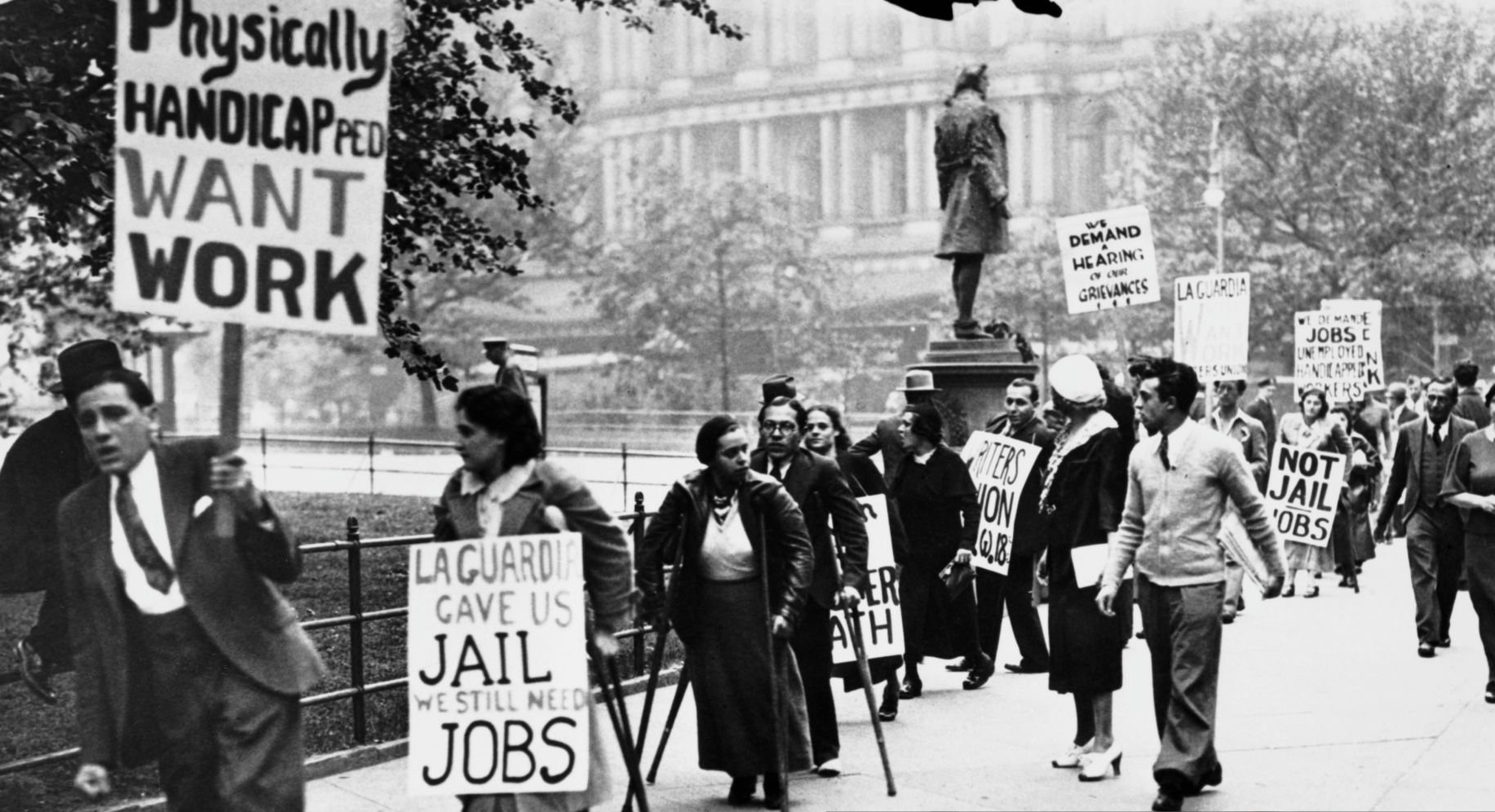
The newspapers, both Hearst’s gutter press and the ‘prestigious’ New York Times, find humor in the daily demonstrations of League of the Physically Handicapped. Formed in 1935 to protest discrimination in New Deal programs, the League engaged in direct action throughout that summer and fall; occupying offices, picketing and sitting in, winning a number of their demands and laying the basis for future disability rights’ movements.
‘A New Angle in Humor’ by Bruce Minton from New Masses. Vol. 16 No. 1. July 2, 1935.
The New York press has been enjoying a field day of kidding. Something in the spectacle of the physically handicapped picketing the Work Relief Bureau, something about the crippled who hobble up and down before the entrance demanding work in place of charity, has prompted the newspapers to trot out their best in the way of sophisticated humor. Even The New York Times is facetious at the expense of those whose legs have been permanently twisted by infantile paralysis or tuberculosis, whose backs have been stiffened or whose limbs have been shortened and withered. The Times could not resist referring to the cases of the handicapped who have been arrested and brought into court as “the saga of the crippled pickets” and jokingly described the “tortured soul” of Magistrate Harris “impaled on the horns of a dilemma.”
A visit to Relief Headquarters presents, so the press tells us, an amusing picture:
Police line the streets. The pickets file back and forth—many of them use crutches; some have braces or specially-built shoes and drag one foot painfully after the other; several lean on canes. They are mostly young—not many appear over thirty. They carry placards stating their demands for jobs plainly enough: they are all able to work, have all held jobs which they performed with ability and efficiency. Teachers, pharmacists, clerks, watchmakers, bookkeepers, a sprinkling of college graduates. They have been living on Home Relief—the married couples on $4.50 a week, the single on half this amount. They hobble past the office under the eyes of hostile police demanding not charity but work which they are competent to perform—as competent physically as. President Roosevelt, similarly afflicted, is to fulfill the demands on him.
But if the sight of the lame is not funny enough, there are always the smiles that come while talking to individual pickets. A nineteen-year old girl receives $2.75 a week and rent. Her shoes—made to order so that she can walk—cost $45. She throws her leg far out as she walks, twisting her whole body: she had infantile paralysis as a child. She trained as a stenographer, held down steady jobs. Now there is no place for her. She is a burden on her family. She wants to work. She looks one seriously in the face, unaware of the humor of her case.
Or the expert watchmaker. He sold his tools long ago because he wanted to keep off relief. He is married to a physically handicapped girl. She, too, needs specially-built shoes. She applied for them at Relief Headquarters; the doctor issued a prescription and the shoes were ordered. That was eight weeks ago. Since the picketing started, the shoe-order has been cancelled. Her husband was offered work—he limped to Twenty-third Street and was sent six blocks to Broadway; there he was told to go nine blocks to Twenty-eighth Street. He was interviewed, despatched to the job. He was accepted, on condition that he owned his own tools—valued at $150. Before he could be considered for the job, he must be a pauper; before he could take the job, he must buy tools to the tune of a small fortune. He was unable to take the position.
A middle-aged man with a stiff back and bad shoulder is also on the picket line. He had managed to land the position of janitor a few months before—employed by the Work Relief Bureau. But no sooner did he get accustomed to the work than he was discharged, handed a pick and shovel and told to apply for day-laborer’s work. Physically unable to comply, he was dismissed from relief because of his failure to cooperate.
In May, 200 afflicted men and women formed the League of Physically Handicapped and. stated their demand for jobs. Mayor La Guardia was unable to see a delegation—he was entertaining a baseball team from Hawaii. The League picketed Work Relief Headquarters. A delegation of six telegraphed Administrator Knauth for an appointment. When they arrived at the office, they were told that Mr. Knauth had suddenly left town. They were greeted by the assistant, Dr. Gambs, who refused to act on their demands. The members of the delegation announced that they would stay in the office until Administrator Knauth saw them and acceded to their request for jobs. Dr. Gambs exploded—all right, he threatened, you can stay but you can’t have food brought up here and we won’t feed you. For fifty-six hours, the six were forbidden food. They remained in the office, sleeping on tables and benches. On the sidewalk below, the picket line was reinforced by 5,000 youths from the United Youth Day demonstration. They were forcibly dispersed by the police. But each day, the handicapped reformed their lines, joined by other organizations and particularly by the members of the Writers’ Union. It was not a pretty sight—despite the jokes in the press—to see the handicapped limping in front of the door twenty-four hours a day. It got on the nerves of the administrators. On the eighth day—the delegation still camped on the twelfth floor at headquarters—the Work Relief Bureau called the police. Mayor La Guardia circled the building in his car to see that all was in readiness. And then the police swept into the street.
The melee that followed was particularly hilarious, according to press reports. For example, the police had been instructed not to use clubs, so they knocked the crutches out from under the pickets’ arms and when a victim fell helpless to the sidewalk, they kicked at him with their heavy shoes. They twisted one crippled boy’s arm. The boy cried, “Don’t do that. I’ll come along.” The police replied, “Easy now,” and continued to twist the arm. A girl was beaten until she was sick—she lay on the sidewalk for over half an hour before she was taken away by officers of the law. And while this went on, Administrator Knauth watched from the building and at the end observed with philosophical emotion, “Oh well, that’s life, what can you do?” “To reporters, he stated, “I didn’t see any brutality.”
The excuse for calling the police, according to the Relief administrators, was that employes at headquarters objected to the sight of crippled pickets. The newspapers headlined this, adding a jocular touch here and there. But the employes, when questioned, indignantly denied that they had anything but sympathy for the handicapped. And contempt for the police who after arresting and terrorizing the pickets, forcibly carried the members of the delegation out of the building and dumped them on the sidewalk.
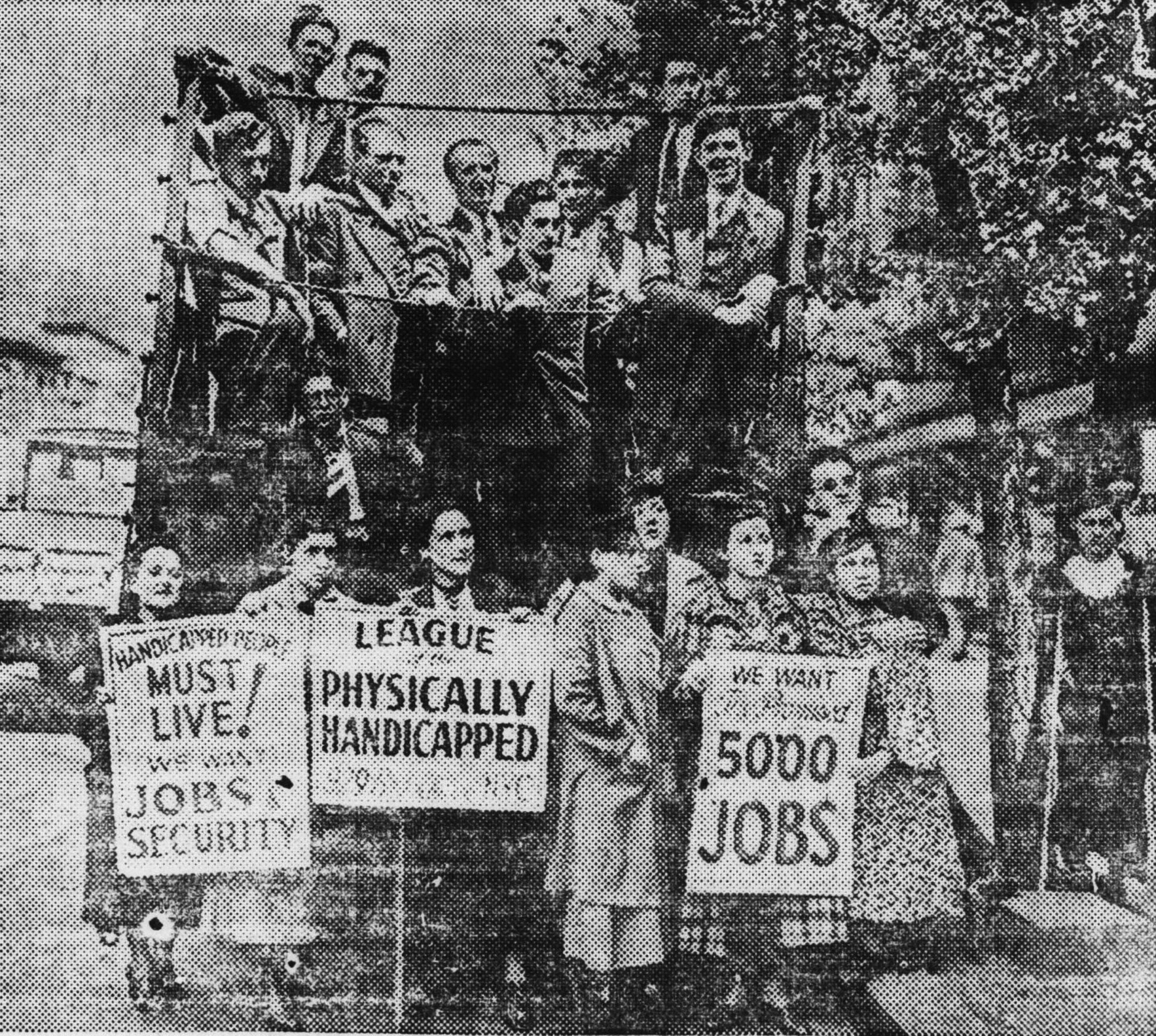
The beating of the lame—somehow it just doesn’t seem to fit into the picture of Americanism that Mr. Hearst has been trying to force down the public’s throat. The newspapers find it funny. Psychologists can perhaps explain this phenomenon—children and imbeciles laugh when they see men on crutches.
There is one little point still to be mentioned. The Hearst press has naturally led the scoffing sneers against the pickets. But Mr. Hearst is not always immune to the tragedy and pathos around him. The growing boycott against his newspapers has lowered sales at a rate alarming to his patriotic heart. And in consequence, Mr. Hearst has begun to employ crippled and consumptives and starving children; the circulation department rounds up the deformed and unfortunate and sends them from door to door with heart-rending stories. In nine cases out of ten, the plea works like a charm and Mr. Hearst chalks up another sale. Children are decked up in rags, taught harrowing stories about hungry brothers and sisters. Mr. Hearst is helping the underdog—by exploiting children and the physically handicapped, keeping tab on their sales and seeing that they don’t flag in their efforts. They walk miles a day…
It all goes to show that the radicals miss a lot of fun out of life: they can’t go down Broadway and laugh until they get pains in their sides at people carrying banners, “We Don’t Want Charity. We want Work!”
The New Masses was the continuation of Workers Monthly which began publishing in 1924 as a merger of the ‘Liberator’, the Trade Union Educational League magazine ‘Labor Herald’, and Friends of Soviet Russia’s monthly ‘Soviet Russia Pictorial’ as an explicitly Communist Party publication, but drawing in a wide range of contributors and sympathizers. In 1927 Workers Monthly ceased and The New Masses began. A major left cultural magazine of the late 1920s and early 1940s, the early editors of The New Masses included Hugo Gellert, John F. Sloan, Max Eastman, Mike Gold, and Joseph Freeman. Writers included William Carlos Williams, Theodore Dreiser, John Dos Passos, Upton Sinclair, Richard Wright, Ralph Ellison, Dorothy Parker, Dorothy Day, John Breecher, Langston Hughes, Eugene O’Neill, Rex Stout and Ernest Hemingway. Artists included Hugo Gellert, Stuart Davis, Boardman Robinson, Wanda Gag, William Gropper and Otto Soglow. Over time, the New Masses became narrower politically and the articles more commentary than comment. However, particularly in it first years, New Masses was the epitome of the era’s finest revolutionary cultural and artistic traditions.
PDF of full issue: https://www.marxists.org/history/usa/pubs/new-masses/1935/v16n01-jul-02-1935-NM.pdf
 Revolution's Newsstand