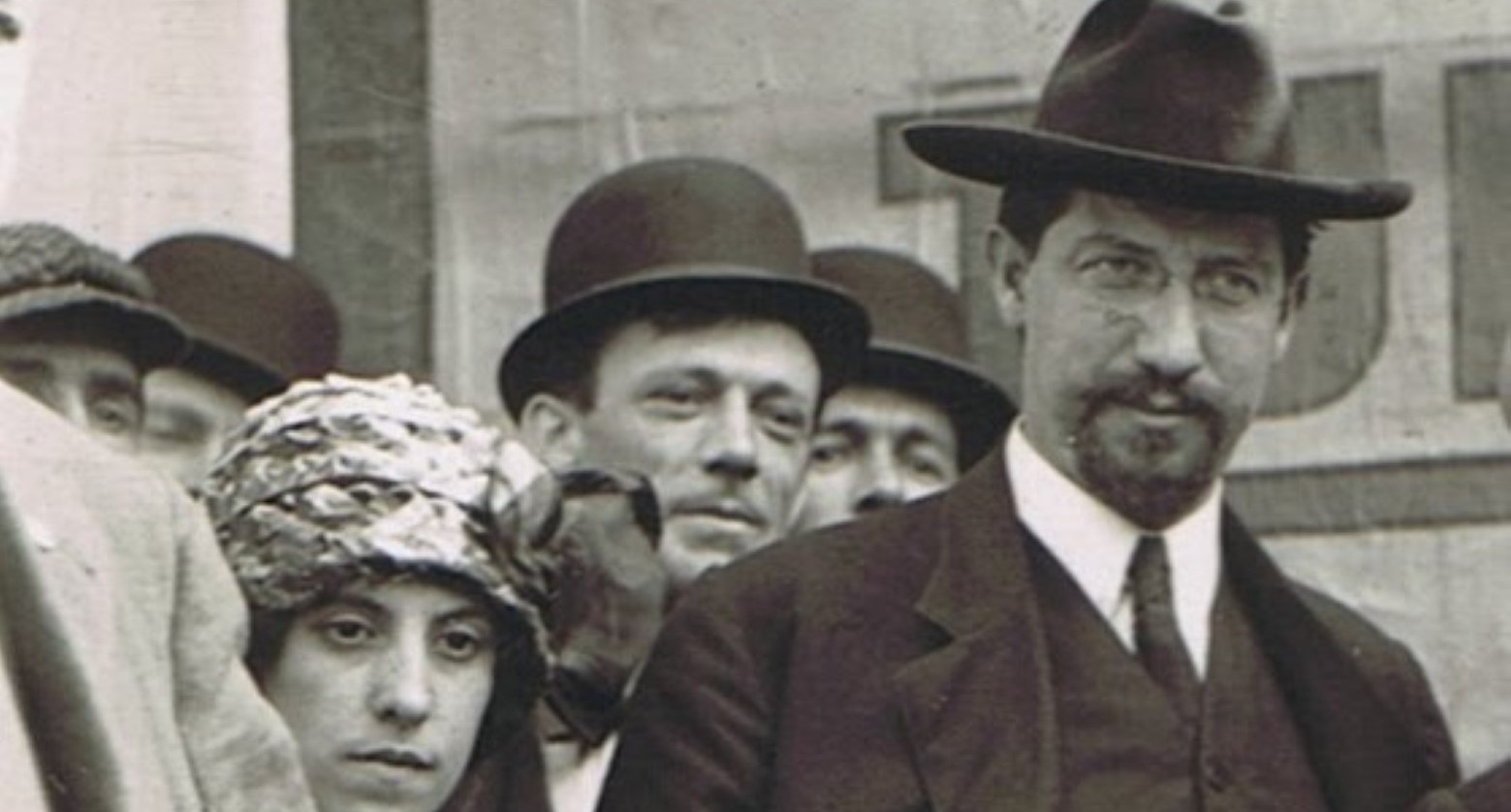
Some rare good news from the class struggle front as the frame-up murder charges brought against Sam Scarlett, Carlo Tresca, and Joseph Schmidt were dropped during the Minnesota Iron Range strike of 1916.
‘Celebration on Mesaba’ by Harrison George from Solidarity. Vol. 7 No. 364. December 30, 1916.
While the Black Flag of the Steel Trust Floats at Half Mast, at the Death of its Murderous Hopes, The Miners Greet Tresca, Schmidt and Scarlett With Cheers of Welcome.
The streets of Virginia, Minn., were black with people Sunday afternoon–the 17th–miners coming to the opera house where–so the news went round–Scarlett, Schmidt and Tresca, released and at liberty, would speak to them
Unexpected and suddenly had come the news of the collapse of the murder charges and the miners could not believe it was really true. So into the opera house, capped, wrapped and coated against the bitter cold, they came; incredulous of the glad tidings “Scarlett, Schmidt and Tresca FREE?”
And no sooner did they catch sight of either of them emerging from the small office of the Defense Committee into the corridors than there was a regular saturnalia of joyous greetings; rough red hands of the shafts and pits clasped those pale with the prison’s shadow, kisses and embraces marking the affectionate Italians, while eyes that shone with happiness eclipsed the tongue in messages of welcome.
When Tresca and Scarlett stepped upon the stage accompanied by Hilton, there was tumultuous and prolonged applause. Ettor, as chairman, introduced the “Little Judge,” O.N. Hilton–who met with hearty welcome. as he began a wonderful oration, saying in part: “I come before you today as one of the most intensely interested parties of and one of the principal actors in this great drama of Mesaba, the Minnesota Murder Trials, which has held the attention of the entire world of Labor.”
“In order that there may be a thorough understanding, I ask you to ask me any question in regard to the settlement of these cases now, and forego any carping criticism of your committee, which has worked faithfully and well and to whom all profound thanks are extended by myself and colleagues.
“Nor can I say too much in praise of those organizers and the Montenegrin strikers who have presented such examples of devotion to one another and have made such a vicarious sacrifice. Balancing it all, I can truly may that ‘the game is worth the candle’ and your strike was not lost, as no strike is ever lost, when it brings to Labor’s standard such men as I was summoned here to defend.
“The true significance of these cases was the settling once and for all, of the Chicago Anarchist Decision, which made a man responsible for any act of violence in a strike, if by utterance advised or approved of for its effect, although not physically present. If it sprang out of a doctrine propagated by him–he became a principal with the principal in the eyes of the law.
“It was upon a basis of the contention that this doctrine was infamous, that we had prepared to fight–prepared long ago, before your strike began–and whether in Minnesota or in Texas we had determined to find a remedy.
“Scarlett, Schmidt and Tresca represented this living principle. They were separate from the other group, who only represented the question of fact, That our contention was upheld and that the Haymarket Decision can now be regarded as unjust in fact and obsolete in law, is proven by the fact that Scarlett, Schmidt, and Tresca stand before you.”
Hilton spoke in detail upon the events that brought about a settlement; and in speaking of the Montenegrins his voice became vibrant with motion as he told how he saw the “wonderful devotion beaming from the face of Nickich,” when he had said “I want you, mister lawyer, to feel that I am happy to go,” “and I thought,” said Hilton, “that this was an unparalleled example of the only thing in life worth living for–the principle of service to others.” His voice tense with feeling, Hilton shouted his admiration of the Montenegrins; “It was not who should GO, but who should STAY, they ALL wanted to GO–to go to prison–to go for the other fellow! Never have I witnessed such self-abnegation; after twenty-five years of practice, never have been so profoundly moved as those noble Montenegrins that day the jury room at the courthouse in Duluth. As I looked upon them, I thought that if I had a hundred thousand Montenegrins such as these I could lick the world!”
Drawing a wonderful word picture his perforation, Hilton told of the horrors of Andersonville, the prison of the Federal soldiers in the Civil War. He told of how the prisoners there, famished and miserable, had waited longingly for rescue from the north, for the bugle call and flag that meant freedom to them. “Today,” he said, “You, the industrial slaves of capital, the miserable prisoners of the system, stand watching and waiting: while over the hill of your distress and your misfortune–the crimson banner of Industrial Unionism–and behind it pressing onward, the cohorts of the REB ELS OF TODAY, heralding the future, swinging forward–ever forward to the stirring strains of the tunes and the music of Joe Hill.”
Following Hilton, Tresca spoke in Italian; while Scarlett set the audience wild with an address, rich with his fighting spirit, untamed by iron bars. “It made no difference, I discovered,” he said, “whether you were in jail where the walls were iron bars or whether you were in the Belgrade Mine, where the walls are of iron ore, it is just the same. You are prisoners of the system in either place.” He recited a motto he had inscribed on the walls of the jail:
“The work-shop and the prison cell are much the same–both are Hell!” “Aggressively attacking the Steel Trust and the subservience of officialdom to it, Scarlett denounced the district attorney who had failed to prosecute Nick Dillon, Steel Trust gunman, the alleged slayer of Thos. Ladvalla. The crowd showed its appreciation by applause at every point. Schmidt being called away, Ettor closed the meeting with the statement that the report of the Defense Committee would be published soon after the first of the year.
Chas. Jacobson, secretary of 490, Box 372, Virginia, Minn., wants all live wires and those who have the interest of the I.W.W. at heart to come to the Range and hold the union strong. Now is the time for quiet, thorough and effective organization work, all free to come should by all means do so as the W.F. of M. is planning to take from our hands the fruit of the six months’ struggle. Work is plentiful in this section and all who understand the situation are charged to come as quickly as possible.
The most widely read of I.W.W. newspapers, Solidarity was published by the Industrial Workers of the World from 1909 until 1917. First produced in New Castle, Pennsylvania, and born during the McKees Rocks strike, Solidarity later moved to Cleveland, Ohio until 1917 then spent its last months in Chicago. With a circulation of around 12,000 and a readership many times that, Solidarity was instrumental in defining the Wobbly world-view at the height of their influence in the working class. It was edited over its life by A.M. Stirton, H.A. Goff, Ben H. Williams, Ralph Chaplin who also provided much of the paper’s color, and others. Like nearly all the left press it fell victim to federal repression in 1917.
PDF of full issue: https://www.marxists.org/history/usa/pubs/solidarity-iww/1916/v7-w364-dec-30-1916-solidarity.pdf
 Revolution's Newsstand