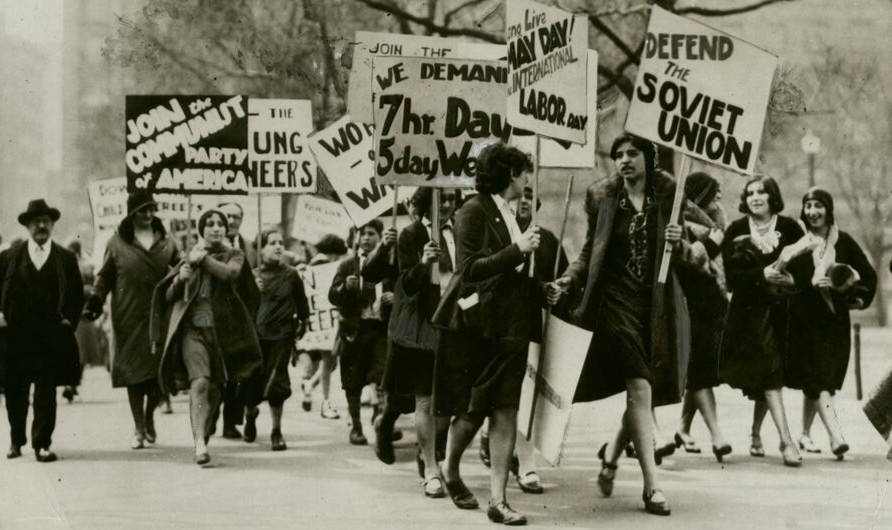
An essential document from Communist Party history as the then Organization Director gives a report on the state of the Party and its bodies to the Sixth National Conference held in March, 1929. Gathering after the expulsion of Cannon and Trotsky’s supporters, but before the leadership majority around Jay Lovestone would be expelled later that year, Stachel was a chief supporter of Lovestone’s faction but broke with him at the end and retained his leading positions in the Party. Stachel details the composition of the 9,300 membership figure, the functioning of the Party’s apparatus, fractions and language federations, work among women, Black workers, publications, and the new Party constitution.
‘Organization Report to the Sixth Convention of the Communist Party of the U.S.A.’ by Jack Stachel from The Communist. Vol. 8 Nos. 4 & 5. April & May, 1929.
COMRADES: It is unfortunate that we cannot devote as much time to the discussion of the Party’s organizational problems as it deserves; and it is also unfortunate that the Organizational Commission appointed at one of the sessions of the convention, did not get an opportunity to hold a regular meeting. As our Party Convention must come to a close tonight or by morning, I will therefore make my report in conformity with this existing situation. In my report, I will also therefore deal with the proposed draft constitution which is to be adopted by this convention as well as with the organization work.
I do not intend, comrades, to make a complete report of our work, but rather to indicate and take up the most basic problems that we have, and that we must pay adequate attention to if we are to be able to carry out the line of our Party, to carry out the Open Letter of the Comintern and the decisions of the Convention.
During the discussion of mass work at one of the Plenums of the Comintern Comrade Kuusinen made the following statement in his report:
“One of the relics of social democracy is the underestimation of the extent of the organizatory task involved in reaching the masses. This approaches very nearly to an underestimation of the consciously communist role of leadership. Miracles are expected from the elementary course of the spontaneous mass movement and inadequate steps are taken to organize and lead this mass movement. Our comrades talk a great deal about analysis of the situation, about slogans, political lines, etc., but unfortunately they concern themselves all too little with the organization of mass work.”
Comrades, this is the best quotation that I could find in searching through quite a bit of material and I think it is sufficiently adequate and fits our Party very well. In other words, comrades, rightwing mistakes are not to be found only in the Party’s main line, right-wing mistakes are to be found in the execution of this line, and I am speaking now particularly about our organization work.
Our Party as it is today, organizationally, is not yet fit to carry out the very important and increasingly important tasks that we face. We talk about the war danger. We talk about the organization of the unorganized. These principal tasks of our Party cannot be carried out unless we do a great deal to overcome many of the present organizational shortcomings. Our campaigns, many of them, do not reach deep enough among the masses. Many of them remain merely on paper and principally because of this organizational shortcoming.
COMPOSITION OF MEMBERSHIP
In attempting to discuss at the present time our Party’s organization problems, it is necessary first of all to give an analysis of the Party composition, and this is not merely from the point of view of social composition which is the principal one in matter of composition but also from the point of view of the distribution of the Party in the various industries, the age composition of the Party, the question of the language and native born workers, Negro masses, working women; all these are questions which we must take up; because we will find in such a study of the composition of our Party, that we will be able to trace many shortcomings in the Party’s political work.
First of all about the size of our membership. Our membership today is not what Mr. Cannon said in the February, 1928, Plenum; it is not between four and five or six thousand. Our membership today is somewhere between 12,000 to 14,000. Our dues-paying membership is at the present time and has been for the last year averaging 9,300. Of course, we can say that there have been strikes, unemployment; that is correct, but much of the discrepancy between the actual membership and the dues-paying figure is due also to a lack of understanding in the Party of the importance of paying dues, not merely from the viewpoint of a financial problem but from the viewpoint of a political and organizational problem.
How does this figure compare relatively? Well, before the Party reorganization in September, 1925, the dues-paying figures were 14,000. At that time we had a block of seven to eight thousand, consisting of Finnish workers. There were also groups among the Czechoslovaks, Letts, which, like the Finnish Federation, were social-democratic organizations in the main. You will recall, comrades, that the Finnish Federation maintained its name to the end—the Socialist Finnish Federation, affiliated with the Communist Party. And you will recall the Lettish organization in New York, having about 150 workers, 500 throughout the country, maintained its name—the Lettish Club of New York, affiliated with the Communist Party. And you will recall in New Jersey and other sections of the country the Women’s Czechoslovakian branch of the Workers Party.
With the reorganization of the Party naturally these elements were sloughed off. They were not expelled formally. They did not come into the reorganization of the Party, for instance, those among the Finnish comrades, Czechoslovakian comrades, Letts, Germans, who went out together with Lore. Those who remained are today good comrades, carrying on Party activity. It is characteristic, important, but not surprising, not at all, that those who remained have today more influence among the masses, in their respective languages, than the old Federations had with their big membership. Take, for example, activity—even such a thing as attending Party meetings or fulfilling the basic Party task of participating in elections in the units. I remember the time when we had in 1925 out of 1,100 Finnish members in New York only 66 participating. At the present time, comrades, our membership— absolutely, in terms of dues-paying members—is smaller than in 1925, before reorganization. But actually, from the point of view of active members attending meetings, participating in Party work, mass activity—the Party membership has increased quite a bit.
Let us for a moment mention the last elections in the units. Over 7,000 participated in the elections—perhaps around 7,400 throughout the country. Surely Mr. Cannon must have been wrong when he said we have around 5,000 members, when 7,400 voted in the Party elections. And I say, comrades, that when we can record 9,300 dues-paying members and 7,400 participating in the elections, we see where the membership is and see that our membership is participating in Party work and in the solution of Party problems. Let us take the period since reorganization. For the first year since reorganization, 1926, the average number of dues-paying members was 7,599; for the year 1927—8,200 odd. We see, comrades, therefore, not a big increase, not a satisfactory one, but nevertheless we can record a slight increase—about 1,000 every year—which is, of course, not a very good showing, but at least gives the lie to those who say our Party is in a period of retrogression as far as membership is concerned.
SOCIAL COMPOSITION
Now as to social composition: Comrades, it is a fact that the composition of our membership is not good, and it would be foolish merely to state the number of workers in the Party and try to prove that we have a good social composition. We have to go a little more into detail, taking up the industries, the important industries, the basic industries; for example, the war industries,—in order actually to be able to know to what extent our Party has roots among the basic sections of the masses. Nevertheless, I want to say that those comrades are wrong who have the notion that our Party consists of a majority of petty-bourgeois elements. I have heard that said, and I believe I will have to prove to the comrades that that is wrong. We have not at the present time, covering the last few months, a complete analysis of the Party composition. Our complete analysis we have only for the period of about May, June, July of 1928, when we prepared a report which was sent to the C.I. Organization Department at the time of the Sixth World Congress. In addition to that we already have a partial report on a registration being taken now throughout the Party.
What do we find in the more or less complete report? We find that out of about 10,000 members registered, 8,136 are classified under what we call Group A Workers; 450 classified under Group B—also workers-social service group; barbers, window-cleaners, janitors, etc., and 1,696 in Group C, which includes housewives, office workers, students, salesmen, professional workers and business men. It is not enough for me to state that here we have 80 per cent workers. How about the basic industries? That is the first question. It is my opinion here that we cannot say that the situation is very good. Why? Let us look for a moment; let us begin with the building trades: There are a very large number listed in the building trades. Not a very large number when compared with the number of workers actually in these trades, but large in proportion to the rest of the working class in our Party. There are 986 in the building trades; 1,527 in the needle trades; then we have the food workers—about 400; shoe-workers 300; metal workers, 851; textile workers, 146; now, I believe, about 350, after the New Bedford strike, the strikes in Paterson and Fall River. We had 1,200 miners at that time; now the number is much smaller, because, as I shall point out later, many of these enrolled during the mining campaign—in fact, the greater bulk of them—dropped out of the Party. Continuing the list we have: lumber workers, 163; railroad workers (very important to us), only 56; marine workers, only 33; automobile workers, 407; rubber workers, 82; furniture workers, 50; laborers, 1,170, printers, 195.
Comrades, I think this shows our problem. The basic industries—not one among the packing house workers (there maybe some classified among the food workers or laborers). The figures are not absolutely accurate, but even so it is clear that the great bulk of the membership does not consist of those in the basic industries. Not at all. And in some industries we have practically nothing. For example, among the chemical workers,—I don’t think we have twenty-five in the entire Party, and we all realize the importance of this industry in the present situation.
BASIC INDUSTRIES
While it is true that the majority in the Party are workers nevertheless the composition from the point of view of the basic industries and industrial workers is not good. Even those in the basic industries that we have are in one or two industries—not a good cross-section of the industries of the country. Nevertheless, we must say, comrades, that we have too many petty-bourgeois elements throughout the country, particularly in some districts. For example, the district of Minnesota, which is considered a good district. They brought in a big delegation,—eight delegates. This district shows what? 850 members registered; 250 industrial workers, 150 farmers, 150 clerks and office employees, and 250 housewives, ten petty-bourgeois elements and 40 intellectuals. Comrades, certainly this district needs a lot of improvement. Here is a district where out of 850 members, only 250 are industrial workers, 150 clerks. Of course these clerks are in the cooperatives, but they are clerks nevertheless, and they do not participate in mass struggles, they are not in the factories, not in the unions. The same with the housewives. However, one more thing should be added. In some districts, some comrades are of the opinion, just because they have a bad composition of membership that there are no industries in their district. Take, for example, California. California, I think, can compare with any district in bad social composition. This is not the fault of any one comrade. It is the fault of all of us, the entire Party, and of the Organization Department. But we note, for example, that the comrades in California had the idea that there were no industries in California. For example, in the Los Angeles sub-district, where the greatest majority of our membership is constituted, according to the report of a comrade who had made a study, the majority of our membership constitute non-proletarians, and also from the point of view of nationality, practically 90% of the membership is Jewish. And most of them are detached from any struggle—except the big struggle which has been going on in the last few months, that is, the internal Party struggle. They were very active in that struggle.
A few months after the last Party Convention, we made an attempt through the Organization Department to direct the entire Party to a study of its field of activity. We worked out a questionnaire which we sent out to all locals asking them to make a survey of the industries, the unions, the mass organizations, and begin to work consciously and systematically within them. We received a very bad response. I was told by some comrades the questionnaire was too involved. I think that was correct, and therefore when the Women’s Department tried to work out a similar questionnaire, we were able to give them good advice. We told them, the more questions you ask the less answers you get. There are industries in California, and I hope the comrades will be able to find them and that the Organization Department will be more active in helping them to find them after this Convention.
Also in Buffalo and Connecticut we have too many petty-bourgeois elements.
NEGRO MEMBERSHIP SMALL
Now, comrades, a few words on the question of Negroes. I don’t know the exact number, but I believe we have somewhere between 150 and 200 Negroes in the Party. A hundred and fifty-nine, Comrade Huiswoud says, besides those that have been taken in recently. Comrade Hall reported, after his recent tour, that 300 Negro workers signed applications to join the Party. I hope we have succeeded already in getting them into the Party, but judging from past experience in recruiting members at mass meetings, if we succeed in getting the District Organizers to follow them up and bring half into active Party membership it will be a great victory for our Party. The recruits we secure directly through the factory nuclei usually have a greater average remaining in the Party. However, even if it is 300, the number is quite small in comparison with the size of the Negro working class in the industries, because we know that in the past few years there has been a steady increase of the Negroes in the basic industries, and when we examine the progress of our Party in these industrial districts we find we have advanced very little. Take, for instance, the district of Detroit. In my opinion it is a very good district. It is true they have a very good industrial composition, but how many Negroes do you have in the Party? Why don’t you have one Negro comrade here today? You fell down on the job, which shows that even our best section doesn’t yet pay sufficient attention to drawing in Negro workers into our Party. This is true about every district in the country, practically, and this is one of the basic problems in Party composition, and I say, comrades, that we must set ourselves a goal that by the next Convention we should have at least 2,000 Negro workers in our Party. (Applause).
TOO FEW WORKING WOMEN
Comrades, a word or two about working women. Women in our Party constitute about 22% of our membership. But if I stopped here, it would not be correct. At least half of these are housewives, which shows that while there are 814 million working women in the country, the percentage of working women in our Party is only 10%. That is bad. We are therefore behind from this point of view in the social composition of our Party.
A word or two about age composition. This Convention—even this Convention—is not a very young Convention. That is my opinion from looking over the delegates.
AGE COMPOSITION
The average age of our Party, comrades, is somewhere between 30 and 40. I think, comrades, that the Party composition from age point of view should be much younger and in this connection, with the help of the Organization Department of the Comintern, we have made certain proposals which are embodied in the draft thesis which we hope we will carry through in cooperation with the Young Communist League after this Convention, which should lead to the improvement of the age composition of our Party.
MUST RECRUIT MORE NATIVE WORKERS
How about the composition of our membership from the point of view of native workers? Here I think the situation is not good. I can just name for example some of the reports from the districts. Take District 5, Pittsburgh—95 Americans. Not so bad, but out of a membership of 550! Minnesota—out of 850 members, 50 Americans. District 10—out of a membership of 278—86 Americans. (Interruption: Do you mean Americans who came over on the Mayflower?) We are not talking about the Mayflower, but of native workers in the basic industries. District Philadelphia—270 Jews, 10 Finns, 62 Italians, 38 Ukrainians, 22 Russians, 50 Americans. (Scharfenberg: How about the Germans?) We can find only 9 Germans here. District 6, Cleveland—103 South Slavs, for example, 56 Hungarians, 13 Russians, 170 others, but only 70 Americans.
Of course, comrades, let us not be discouraged. If you study these figures in comparison with the figures at the time when we had a so-called “English Federation” in the Party, you will find that in spite of the fact that the so-called English branches included many elements that could hardly speak English, yet they constituted an insignificant percentage of the Party membership. Therefore there has been some improvement. But the situation is quite bad. At the same time, I want to say a few words at this point on the question of foreign-born and native born, and this brings me to the second question before us, and that is we, all of us, must at the present time direct the entire Party, orientate the entire Party towards work in the factories, concentrating particularly in the basic industries. And when we approach the problem of work in the factories and the basic industries principally, what do we face? We face the fact that the working class of this country, in its national composition, consists of a majority of foreign-born. For example, we find 67% of the oil workers are foreign-born, 62% of the packing house workers, 61% of the miners. We find textile workers over 60%, clothing workers also over 60%, steel workers over 60%; in fact, talking about the basic industries, as I said, not the great majority, but a majority, over 60% are foreign born. If we add the number of Negroes and young workers to the foreign born, you will find that they constitute the overwhelming majority of the workers in the basic industries. That means something for us. It seems that so long as we will concentrate in the basic industries—and we must concentrate in the basic industries—we will have the overwhelming majority in our Party consisting of foreign-born, young workers and Negroes. The young workers in the basic industries are mostly native born, the children of foreign-born workers. Of course we must mention that the changes in agriculture and the rationalization in industry bring and will bring larger numbers in the near future of native American elements into the basic industries. The trouble at present is, we haven’t enough Negroes, not enough young workers and not enough even foreign-born from the basic industries and certainly an insufficient number of native born. The youth are American, native born, you say. I will come to that. That is why we have a special point in the draft thesis dealing with the age composition. Because we must deal with these millions of young workers who in certain industries and enterprises constitute a majority; and if we do that, we will be able to improve the native composition of our Party.
At the same time it would be incorrect to interpret this demand as meaning that we must not do everything in our power to draw in genuine native American elements into our Party from the basic industries, also from industries not so basic.
THE QUESTION OF FACTORY WORK
Factory Nuclei—Our Party today is not yet organized as a Bolshevik Party. About 90% of the Party is organized in street nuclei. Only 10% are in factory nuclei. However, one thing is encouraging, and that is that our factory nuclei, all of them, practically, are in plants of over 1,000 workers. And all of our 120 so-called nuclei (of some of them I say so-called because they are not functioning) are in factories of nearly one-half million workers.
That is a very important fact, comrades, which we can and must register. In other words, if our Party comrades organized in the factory nuclei carry out their Communist duty in their everyday work, through these factory nuclei, they can gather contacts among a half million workers in the basic industries, because all our nuclei are in mining, steel, metal, rubber, automobile, textile, etc., with only one in the needle trades. Certainly it is impossible for the Party to continue in the present stage with only 10% in the factory nuclei. And for that reason following this Convention, comrades, we will have to see to it that the work of our districts, of our sections is completely orientated toward work in the factories, and to the building up of factory nuclei. In doing this we will have to pay attention to the special problem of the factory towns. We all know that there are a great number of industrial towns where there are basic industries, very large plants, where the workers are most bitterly exploited, where they are company ruled, where the workers are in actual slavery, and where our Party has no foothold at all. Our membership is to be found mostly in the larger cities.
FACTORY TOWNS AND COLONIZATION
In approaching the question of factory work, of building up factory nuclei, we will have to pay a great deal of attention to these factory towns. And in connection with this, we will have to take up, not as an adventure, not as a piece of romanticism, but as an actual problem, the question of colonization. Colonization does not mean, Comrades District Organizers, that you write a letter to the national office to please send you five comrades experienced in a certain industry. I assure you we have no file of steel workers, metal workers, that we can send to your district. What does it mean? Does it mean that from New York and the other big cities we send out comrades? No, it means that every District Organizer must in his district, and every Section Organizer, or Sub-District Organizer must in his territory, make a study of the most basic industrial plants, and begin systematic activity in transferring comrades from less important industries to these basic industries and concentrate activity there. It means that Cleveland, for example, can take from the city of Cleveland many comrades who are engaged in the not so important industries and transfer them to Akron, etc., to build up the Party and carry on the Communist work. Comrades, we have had some experience in colonization, some good, some bad. I want to mention the bad side only.
How do some of our comrades conceive of colonization? Some comrades conceive it as going into some industry and becoming a Weisbord in a couple of weeks. Everyone wants to go into an industry and conduct a big strike in two weeks. That would not be so bad if you could do it successfully, but strikes are not built that way. Comrades, do not conceive of colonization as a need for going in right among the masses of workers and staying there for a long time and building systematically. Some comrades conceive it as visiting. They want to go for two weeks into one plant, then some- where else they do not stay in one place a sufficient time to get a foothold among the workers. And of course some comrades make many mistakes. For example, some New York comrades, when they come to another district, consider their first task to impress upon that district how backward it is and that they come from the leading district of the Party. New York is the leading district, but some of the other districts can teach New York many things, for example how to organize factory nuclei. Colonization, comrades, must become systematized and the comrades sent into plants to work and to build the Party nuclei. If we do that, we will accomplish a great deal, because there is no question that the field is ripe, quite ripe for this work. The masses are willing to listen to the straight message of communism. Of course some comrades make the mis- take of coming into a plant at 8 A.M. and advertising that they come direct from New York, that they are Bolsheviks, and they lose their jobs at 12 o’clock. That is not good. It is not entirely the fault of these comrades. The Organization Department in the center and the district will have to work out directives for these comrades; how to carry on the work, and explain it to them. We have attempted to do this through the press and Party Organizer. Not sufficiently, it is true; we have to strengthen that line.
ACTIVITIES OF OUR FACTORY NUCLEI
Now about those factory nuclei we have: Do they function? Well, some of them do. Some of them do pretty good work, but quite a number, comrades, are nuclei merely in the sense that the comrades who belong to that so-called unit all work in the same factory. They do not perform the functions of a factory nucleus in carrying on mass activity among workers there. In fact there are some that call themselves nuclei, who meet far away from the factory, never talk to the workers there, never publish any bulletins there, and in fact are not nuclei, and the members there are not very good Communists. We have had cases, for example, where members of our Party have worked in a plant for 10 or 15 years, and all the fore- men knew they were Communists, but they were never fired, because they never did their communist duty. But we played a trick on them. Some of these comrades we asked to come together and do some real work and to publish a bulletin. They refused to come. Those that came were not known to the foremen as communists, but were known to workers, and they did some good communist work. But who were fired? Those who did not do anything.
Some comrades ask shall we work openly or shall we work secretly. That is a foolish question. We must work in such a way that the workers know that there is a communist nucleus, that it gives direction, that it takes up every struggle, brings Party slogans into the factories, mobilizes the workers not only on the basis of immediate issues but ties up with the Party’s main slogans and demands; that these workers know that there is a Party in the factory leading struggles. That means we must lead struggles so that they will know it. At the same time that the workers will know your activity the sympathizers know the members of the nucleus, the bosses should not know who they are. Certainly not. Secret to the enemy but the workers must know. If a nucleus is secret altogether so that nobody can find them, particularly the workers, when a nucleus is such that the workers can’t find it and the bosses do, that is not a nucleus. When we have a nucleus which the workers know through its activity, and the bosses can’t find out who the leaders are, that is a very good communist nucleus.
SHOP COMMITTEES
I want to talk about the organization of the unorganized and the shop committees. Comrades, we have at the present time very few shop committees organized by our factory nuclei. Up to a year ago Detroit did not have a single shop committee. At the present time we have shop committees in a number of industries,—auto, steel, packinghouse, shoes, etc. How can we organize the unorganized workers, how can we mobilize these masses, organize them into unions, without shop committees? The shop committee is an instrument for the organization of a union and then becomes the basic unit of the union. Take the automobile industry for example. We have the Auto Workers Union there. You can talk to the workers for years to join the Auto Workers Union; they are afraid to join the union. Because, if it is organized as it was up to recently, every worker that comes to the open meeting of the union knows that his job is endangered, and because they know that, they do not come. The factory committees organizing the workers in each department through a delegate system; the captains of all departments into a central bureau or committee in that factory; this is the basic unit of the Auto Workers Union. On such a basis we can build up the Auto Workers Union. On such a basis we can build up unions in many other industries. It is impossible to do what some comrades want to do in building shop committees. Some comrades call the workers together in the shop. Once when I explained to one comrade how we build shop committees in the United States, he said: “That is not correct; what you should do is to call the workers in that factory together and elect a shop committee; then it will be representative.” That would be very good, but it can’t be done now in the United States. It is not very practical. It could be done, but it would be good for the bosses. The shop committee must be built up on a department basis.
I will take a concrete example. We have a factory, let us say of 5,000 workers. Let us say there are twenty departments. It is wrong to just sign up everybody for a shop committee and then call all together in one meeting, about fifty, seventy-five or one hundred. If you do this you defeat your own purpose of getting any foothold among them. All the workers would be known immediately to the boss and of course blacklisted and fired. If we organize on a department basis, that would mean we have, let us say, five or six or seven, later on more, in each department. What do we do about that? Do we do away completely with the possibility of victimization? That is nonsense. The only time we can do away with victimization is by remaining inactive. When Mr. Lore criticized the reorganization on the basis of shop nuclei, he wrote in his famous article against reorganization, that this means loss of jobs. For that matter, if you were not organized on the shop nucleus basis, but if you are a communist working in a factory, you may be victimized. The only time to be safe from victimization is not to be a communist, not to be a militant worker, not to carry on the class struggle. But what we can do and must do is to minimize, to reduce that victimization to the possible minimum. That is accomplished by the proper organization of shop committees on a departmental basis.
Naturally when we are ready for open struggle, then, of course, it is different. Then we enroll all the masses, all the workers who are in struggle into the organization; then we have open organization. But until we are ready for open organization, every care must be taken to prevent victimization, to reduce it to a minimum; at the same time to put to the forefront the struggle in the factories. Caution must be practiced to carry on work, but at no time is caution to be substituted for activity in the factory.
We will not be able to carry on our campaign to organize the unorganized without our Party increasing many times the number of factory nuclei in the basic industries and seeing to it that they become living units in the life, in the struggle of the masses in those factories. With the organization of our factory nuclei, with our taking the initiative in the organization of the shop committees, our Party will organize the great bulk of the unorganized masses of the workers in the United States.
FACTORY PAPERS
A few words about factory papers. We have at the present time about forty factory papers. Some of them are assuming almost the character of a newspaper, as for example the Ford Worker (Detroit). Quite a number of our papers are printed, others are mimeographed, others are multigraphed. Altogether our papers have a circulation of between 60,000 to 70,000. And all of our papers are in the basic industries, again with the exception of one in the needle trades, where we have a needle-trades nucleus. Our papers are in the automobile, steel, mining, railroad, lumber and packing houses. These papers, comrades, are a very great instrument for our Party. They reach the masses, taking up the struggles and the grievances of the workers in the factories.
I want to say a few words about the political content of our papers. When we began publication of factory papers, there were some peculiar notions among some of the comrades, including leading comrades. Some had the idea that these papers were to appear not openly as organs of the communist nuclei but as organs of shop committees, and the character of the papers corresponded to that confused idea. These papers are organs of our Party in these factories. When you make that clear, then you make clear what the political content of the paper should be. We went through certain stages in the evolution of the content of factory papers. In the first stage, the papers were merely trade-union organs, nothing else. For example, some papers in the auto industry did not differ much from the Auto Workers’ News, organ of the union. That was the stage where we can say that our comrades did their best to hide the face of the Party. That was the period in which we made many mistakes, and in which the work was so carried on that it did not bring organizational results for the Party, because we could not get results when the workers did not know that the Party was carrying on the work; and the contents of the papers had a trade-union character, and not a communist character.
Then we had a reaction—after much criticism by the Organization Department of the Comintern and by the C.E.C. Our comrades began to improve and brought in much political content into the papers; and we had a period where we had much material in these papers of a political character. But what was the matter with it? The political material had nothing to do with the struggle in the factory—absolutely nothing at all. If it had, the average worker in the factory could not see it. Now we are engaged somewhat successfully in solving that problem, so that we now come across articles which combine in correct communist form the struggle of the workers in the factories with the political slogans of our Party. Of course, we are far from completely accomplishing this, but we are on the right road. Our papers generally can be criticized as being too little international; in fact, they do not even sufficiently deal with the problems of the Soviet Union; do not sufficiently bring the example of the Soviet Union to the exploited workers in the United States; do not sufficiently deal with war, war preparations. Al] these shortcomings must be corrected.
PARTY COMMITTEES
I want to come now to the question of Party apparatus and Party committees. It is a fact that many of our nuclei do not even have executive committees or bureaus. It is a fact that very little attention is being given by our Party to the training of functionaries in the nuclei and sections. This is responsible to a large extent for the chaotic condition of the work in many units and local party organizations. This we attempted to solve recently. We have met with some success. We have built up section committees in some districts. We have begun the process of building up the nuclei executive bureaus, and have begun to give them some direction as to how to conduct their work. We cannot, comrades, underestimate this problem. It must receive a great deal of attention. Otherwise we appear to be sitting on top giving directions, which fall on deaf ears and are not carried out into life. Even where the nuclei read communications, the organizer brings the communication from the center to the meeting, the comrades are tired and do not listen much, no concrete tasks are worked out, and the directions—if anything good is in them—are lost. Many times the communications are too long, the directions too abstract.
PROLETARIANIZATION OF COMMITTEES
I want to talk about the proletarianization of the Party committees. One of the organizational proposals made by the Comintern delegation, which we accepted, was that a minimum of 50 per cent of the C.E.C. shall consist of workers in the factories, principally from the basic industries. If any comrade were to look upon this proposal as a concession to the Comintern, such an opinion would be absolutely not the opinion of our Party and would be an anti-Party position. This proposal is welcomed by our Party because this proposal means drawing in factory workers who can and will contribute to the leadership of our Party, and not, as some comrades believe, merely be fixtures. Such a position is an anti-communist position.
We have already had sufficient experience to know that factory workers on leading committees are the best guarantee that the Party will maintain the proper contacts with the awakening masses and will know the mood of the masses; that the Party will be able to avoid to the maximum all the deviations to the right and to the left; that our Party—particularly in the present situation, in the present period of imperialist war preparations—will be able, through the help of bringing in these new elements fresh from the factories into the highest bodies in the Party, to fight against the right danger which is a reality in our Party.
This danger we have spoken about in this Convention, spoken of in our discussions, and this danger has its objective roots, and it means that we must take every measure to overcome those tendencies in our Party that make for such mistakes, that make for deviations from the correct line of the Comintern. It is in this sense that we approach the entire question of proletarianization of committees from top to bottom, and if this is true about the C.E.C., so much more must it be true about the district committees and section committees and in the nuclei. In the New York district, for example, the biggest district in the country, we had last year no more than three factory workers on the entire district committee of 38. The present district committee in New York, of course, has been selected in line with the draft organization adopted by the Polbureau, and is a tremendous improvement over what we had a year ago.
The present make-up is that probably 95 per cent are of proletarian origin and about 50 per cent are factory workers.
Comrades, we must stabilize our Party committees—the districts and the sections. You will note in the draft thesis that we have done away with what we called sub-sections and sub-districts. Of course that means that a section consists of either a part of a city or a city itself or a number of cities, with a central city as the headquarters of the section. The section committees have in the past merely existed. They were not vital parts in the life of the Party. The districts would conduct all the work directly through the units, the section would merely be a sort of committee in between, always trying to find out why it had to exist.
Take New York, for example. The sections had no political direction over the units, no organizational direction. Once in a while we gave them permission to call a mass meeting. We have done away with that now. The sections will become real political bodies, exercising as well organizational responsibility in their territory so that they can become actual living forces leading the workers in their territory under the direction of the district committees.
BUILDING PARTY APPARATUS
A few words about Party apparatus. We have begun the process of building up departments. That we did even after the 1925 convention, where we for the first time had an Organization Department and Agitprop Department. We always had an Industrial Department. Some of these departments, comrades, are doing good work. Some do not yet understand their tasks, and I can also say that in some districts we have entirely too many departments— too many on paper, and you can tell as a rule that in proportion to the number of departments there is an inverse quality in the functioning of departments. The Kansas district, with about 200 members, at one time had nine or ten departments.
Our plan at present is to concentrate on the building up of the Trade Union, Organization, Agitprop, Negro and Women’s Departments. In some districts, where it is necessary, we also build an Agrarian Department, as, for example, in Minnesota. (Crouch: How about Anti-Imperialist Department?) My opinion is that we should not have an Anti-Imperialist Department in the districts. This work should be conducted by the entire Party through its sub-divisions. At the present time it looks too much like a private little sub-division when in reality it deals with the most important work of the whole Party, the war danger.
PARTY FRACTIONS
I want to speak next on the fractions in mass organizations. First of all in the trade unions. In our Party the trade-union department is made responsible for the fractions. My opinion is that this is not entirely correct. In my opinion, the work of the fractions should be placed under the direction of the Organization Department. But let us speak about the condition of the fractions. I think, comrades, between 1925 and 1927 we had made great progress for the first time in building up fractions in the trade unions. Between 1927 and 1929 we have taken quite a few steps backwards. Why? In my opinion, it is not enough to explain this by lack of sufficient attention.
I want to recall that immediately following the last Party convention, at the national fraction meeting of the delegates to the Third Congress of the TUEL, this question came up and some comrades, in my opinion, by taking a wrong position, contributed to the disintegration of the trade-union fractions. It is true these comrades made some correct criticisms, as, for example, when they pointed out that one of the reasons that the TUEL did not grow was due to the fact that those non-Party workers whom we had drawn into the TUEL found that everything was cooked up for them, and it was useless to go to a meeting because everything was decided in advance. And it is a fact that some of our fractions decided even how to open and close the door. That is not the job of our fraction. The job of our fraction is to lay down general policy and tactics, but it is not necessary to define every step from A to Z.
That was a correct criticism, but the conclusion was wrong. Some comrades concluded, therefore, that we did not need fractions where we had the TUEL, and because of that, in my opinion, not only the fractions but the TUEL disintegrated.
There was no central direction for the fractions in the last year. The comrade appointed by the C.E.C. was given some other work most of the time being across, and certainly he could not lead the fractions from there. I do not blame that comrade because it is not his fault, but the Trade Union Department and the Central Committee as a whole are responsible for this. I feel certain that the comrade who up to a week ago bore the name of fraction secretary cannot tell us how many fractions we have, where they are, or what they do. I have some figures I have tried to compile. I am not the fraction secretary, but I can give you some figures.
We have in Boston approximately 125 comrades organized in trade-union fractions; in New York about 1,800; in Philadelphia about 130, Buffalo 40, Cleveland about 100. These I believe exclude the miners. Detroit has 175, Chicago 450, Minnesota 40, Seattle 30, California 75, Connecticut 50. Our fractions are in the following industries:
Building trades, carpenters, plumbers, painters, etc.; needle trades, shoe and leather, machinists, jewelers, textile, mining, auto, rubber, engineers and draftsmen, barbers, musicians, teachers, dental mechanics, printers, upholsterers and a number of fractions in the Central Labor Unions.
I say, comrades, that the incoming Central Committee, whether it decides to continue to have the fractions under the direction of the Trade Union Department or Organization Department, will have to see to it that the comrade placed in charge of fraction work devotes his time to this work, which requires the time of a fulltime functionary. We must again revive these fraction organizations and see to it that all our Party members who are in the unions are organized in fractions and carry out the Party line, and those of our members not yet in the unions are drawn into the unions as rapidly as possible. How many Party members are in unions today? Forty-six per cent of our membership today is in trade unions. In 1925, 32 per cent were in the trade unions.
I want to speak a few words about fraction work in the language organizations. Comrades, it is an indisputable fact that although the federations no longer exist, the federation spirit does exist. For example, the Organization Department of the Comintern on the 9th of July, 1928, in drawing up a basis for a report from the American Party, says, under the heading “Liquidate Ideological…”
“a. Survivals of federationism, failure to reorientate the work of the new units after changing their names, survival of language federationism after the liquidation of the federations.”
This is very mild, comrades, very mild. The fact of the matter is our membership, which consists of a majority of foreign-born, has still a great tendency towards federationism. Not only that, the bureaus that are sub-committees of the C.E.C. for Party work n their languages, who are instruments really of the Party, sort of sub-committees of the Agitprop, sometimes even take upon themselves the right to discipline Party members, which shows to what extent they do not understand their true role.
In the draft thesis we have had much to say about this and we will not only have to say what we said in the thesis, but sharpen the criticism here, and what is more important, carry it out in the quickest possible time. Does this mean that we will stop working among the language workers? Of course not. We have already explained that in considering the workers’ composition in the basic industries; but even mass organizations—we have at the present time fractions organized in mass organizations comprising, I believe, something like one and one-quarter million workers. In other words, we have Party members working in mass organizations comprising about one and one-quarter million workers where we come in contact with them.
For example, you take the work among the Jugoslavs, the South Slavs. We have, all told, 793 Party members working in the various fractions. They have 8,000 sympathizers and are working on three different organizations, which consist of 70,000 members, a national organization which consists of 68,000 members and one of 10,000 members. And we have respectively Party members in these organizations: 400, 100 and 30. Shall our comrades not work in these organizations? I think that would be wrong. Of course, if our comrades were to spend the major portion of their time working in these language organizations, rather than where they must work first in the factories, secondly in the trade unions, then that would be absolutely wrong. But, at the same time, we will not abandon these mass organizations that consist of the great bulk of workers in the basic industries to the bourgeois and petty-bourgeois leadership of these organizations.
If you study our membership on the basis of language composition, you will find that on the basis of about 14,000 members or 13,000 members, about 8,000 or 9,000 are registered in the various languages. Out of these only one-fourth are active in the language mass organizations. That is, only about 2,000 to 3,000 probably at most, are active at all in these organizations. Because many of them merely attend a meeting of this organization once a year, many of them pay their dues by mail once a year or once in three months and do not function at all. It would not be correct, therefore, to say that our membership, most of them, are active in these so-called language mass organizations. That is not correct. However, even here I agree with Comrade Schmies that in every district certain comrades can devote their time, a very small number of comrades, to certain of these organizations, but the great bulk of our membership must spend their time not in these organizations, which are secondary and tertiary organizations, but must devote their major time in the factories in the first place and in the trade unions secondly.
Our language press, of course, suffers from the same evils that our language bureaus do. Of course, comrades, it would be wrong if I failed to state that we are gradually improving that condition through frequent conferences of our Party press. I believe on the average, at least of once a month, the Agitprop and the Org Department call the press together and take up with them the Party campaigns, and we can say there is going on an Americanization of our language press.
There was a time when many of our language papers might as well have been printed in the country of their origin. Today I think that is changed. You will find today that most of our language papers are very active in the revolutionary struggle of the Party, in the most basic campaigns, as for example the mining campaign. We could never have conducted that campaign so successfully without the South Slav Radnik, the Vilnis, Uj Elore, and the others that operate among the miners. We feel the need of these papers and we are glad to record that while here and there may be some fluctuation, in the main there has been an increase in circulation of these papers since the Party reorganization, which shows that the Party gained and did not lose in mass influence as a result of the reorganization.
I want to say in conclusion that we find the way the bureaus are constituted today, that although they have no organizational rights, in my opinion we must still make further changes to make them correspond more to the actual task which they must perform for the Central Committee. Maybe we will not call them bureaus any more. We may abolish them. But we will have to have some sort of sub-committees as now. No more conferences of language fractions, but bureaus to carry on certain tasks among the masses in their language; and then define their work and bring it more and more into harmony with the Party’s main tasks.
PARTY CAMPAIGNS
I want to speak for a few minutes on Party campaigns and systematic organizational work. Our Party campaigns, comrades, many times do not hit bottom. That is, we proceed with a manifesto, communications to the units, publicity in the press, but we do not mobilize the masses. Why? Principally because our comrades have not learned that we cannot conduct campaigns of the Party without bringing these campaigns, these slogans, to the masses in the factories. We call conferences of a united-front character, and what do we do?…Lately we are changing this. The last few conferences we have shown some improvement. But until recently we would call the trade unions and the language organizations. What would that mean? The bureaucracy of the American Federation of Labor would see to it that the unions did not come. Only those we have control of, and these are very few in the American Federation of Labor, would come and send delegates. And even when they did, the local union meetings, we must say, even among the miners, were not real meetings of the membership—in unions of 1,000 miners, how many attended these meetings? 50 or 60, sometimes only 20 or 15. So even if we have the best of conditions where we have a left wing working, a communist coming to the conference and reporting back to the union, only a small fraction of the workers can know about our campaigns and struggles.
Then with the language organizations, the same thing is true. A comrade comes representing a certain fraternal organization which meets once in three months, and then merely to pay dues. The trouble is that we do not see that particularly in the United States, where the great bulk of the workers are unorganized and where practically all of the workers in the basic industries are semiskilled and unskilled and are unorganized, we cannot conduct campaigns without going right to the factories, that we cannot mobilize the masses without going to the factories. When we want a united front conference today, we have to call shop committees and shop delegates and then see to it that our Party nuclei in all these shop committees and among these delegates bring back the message to the workers in the factories, and with our nuclei in the factories, factory papers, etc., carrying the principles and policies of our Party to the masses.
Another point. Our campaigns are not well prepared. I told you at the outset that I would speak only about our shortcomings and not about our achievements, because I don’t want to burden you at this time and because we haven’t the time to pat ourselves on the back. We never prepared our campaigns well enough. During the election campaign we made some improvement. In a certain sense we did begin to plan the campaign very early, and we made some mistakes very early, and you will all remember them. But we began to overcome the so-called…approach toward Party campaigns, and I think we can report progress. Those who have followed our press and bulletins will remember that long before certain action was to take place we had everything explained to the membership; we had even divided up the campaign into stages—first mobilize the Party, then mobilize the organizations close to the Party; and then we had a long period where we concentrated on mobilizing the masses under the Party slogans. But much more must be done. In the future they must be planned over a long period and better prepared and more basic in character, so far as reaching the masses. We do not secure the necessary organizational, or, I should say, adequate organizational results from our mass campaigns. Take the mining campaign. In the mining campaign which lasted over a long period I think we recruited something like 1500 Party members throughout the country. And out of these I believe no more than 300 or 400 actually remained in the Party. Perhaps it was a little more, but not much more. Take the Pittsburgh district, where we recruited something like 700 or 800 members. These were the reports. We find today that practically no more than 200 actually remained in the Party. In the Ohio district, on the other hand, where we recruited a much smaller number, the great bulk remained in the Party. We haven’t time to go into a study of the approach. But I know in Ohio the new miners that joined the Party were taken care of, while in the Pittsburgh district the D.O. himself did not have sufficient help and time and did not pay attention, so these miners dropped out. Some comrades give the argument that we recruited some miners under false pretenses—that they thought they were joining the Miners’ Relief. I do not take that seriously. There may be one or two, but the great bulk joined because they believed in our Party, saw our Party in struggle. Some dropped out because they were not mature enough and particularly because we did not do sufficient to train them and to keep them and draw them into our Party work.
Many times, comrades, we conduct campaigns and get no results at all. For example, during the election campaign we did not recruit any new members into the Party, although from an agitational viewpoint the campaign was a success. This situation is very bad. The influence of our Party, which we can measure in terms of our press, is around 225,000 readers of our press of various papers—our influence in the trade unions, our influence among the unorganized. All this is not reflected in the growth of the Party organization. And this problem we will have to tackle. The recruiting of Party members must not be looked upon as a special task for a certain period but must be organically linked up with every campaign of our Party. And at the present time, when we will be engaged immediately after the convention in the campaign against the war danger, which is a campaign not for a moment, but one which will go into every other activity of the Party, will touch upon and embrace the campaign to organize the unorganized, must be linked up with the building up of the factory nuclei in the first place, with the recruiting of members, with the building of the Party, with the building of factory papers. The recruiting of members hitherto has not been systematic. We must not merely be happy to go on the street corners, or hold mass meetings and recruit members. Most of these never really get into the Party. The only time when we really recruit members is when we recruit them direct from the factories as a result of activity and struggle on the part of our comrades. Does this mean that we should not recruit members from the unions, in the clubs, in every mass organization? We must recruit members everywhere. But the main place to recruit members is right in the factories. And we must concentrate on the basic industries and pay particular attention to those industries connected with the war preparations.
DISTRIBUTION OF PARTY LITERATURE
Just a few words about literature. I will not speak much except to say that what is true about our organization work in general is true about literature. We can record some progress both in publication and distribution of literature, but not yet sufficient, not even a good fraction. Every Party member must consider it his duty every day to sell the Party organ, to distribute it, to sell Party pamphlets (how to sell we have spoken of many times in The Party Organizer and the Daily Worker, and we will speak some more). We must find methods of selling our papers, bulletins, leaflets and pamphlets in the factories as well as outside. These methods must be found and this work must become the everyday work of our Party. A very small fraction of our Party sells the Party pamphlets. What does it mean when we publish a pamphlet or so of 10,000 copies? What does that mean with our workers? It is a joke. It is a good joke. And take our press. It is true that we have 225,000 readers of various papers, both daily and weekly, but our central organ, the Daily Worker, is in circulation I believe, I do not want to give the figure, I do not know the exact figure, but I am afraid it is not more than 20,000, most likely much less. I do not want to argue on the Daily Worker whether it is 13,000 or 18,000, but even 20,000 with our working class, with 10,000 dues-paying party members, with 13,000 party members, we will find a circulation of almost as much as our membership, a little more. That is absolutely impossible. And if we are serious to build our Party, to conduct the war campaign, to organize the unorganized, how are we going to do it if we do not build our Press? I think, comrades, that this problem, which is still looked upon as a sort of special problem to raise finances now and then, must become a central problem. We have worked very hard to maintain the Daily Worker. We must work even harder to increase the circulation so that it can really become a mass organ of the American working class.
WORK AMONG THE NEGROES
A few words about work among women and young workers and Negro work. I have spoken much longer than I expected to and for that reason I will of necessity be short now. Take the Negro work. First of all the Negro departments must be built up. I know that for a time we did not have the proper comrade at the head of the Negro department and that hampered the work, but this has been overcome and with the cooperation of the districts we can really begin to build our work among the Negro masses. It is necessary that this work shall not be confined merely to the Negro comrades. That is nonsensical. Such a conception is a wrong conception. Likewise we must not merely limit the Negro comrades to Negro work, but they must be-drawn into the actual leadership and leading committees of our Party in all fields of Party work. I would like to see some districts with Negro Agitprop directors and industrial organizers and we must see to it to have Negro district organizers, to demonstrate that Negro work does not mean carrying on work among the Negroes, that the Party must carry on work among the Negroes and the Negro comrades work in the Party. The Negro Departments must be built and the Negro press, the Negro Champion, must be built. I know that many districts receive a bundle of the Champion and if we would take a tour throughout the country we would find many copies lying around the office; also of the United Farmer. There is not a district in the country that cannot produce a couple of hundred copies of the United Farmer and the Negro Champion. This is bad. We must change our course in this respect. I don’t want to speak any longer on this except to emphasize, as the organization thesis does emphasize, the importance of the entire Party concentrating on Negro work.
Likewise work among women. We had made some mistakes in some districts because of the social composition of the women; most of them being housewives, the work was limited or primarily was work among housewives. This must be changed and I am glad to say has already been changed not in all districts but in the policy of the Central Committee.
The policy is to concentrate our work among the factory women. To build the work we must dwell on questions of concrete issues, on basic issues, on issues such as the war danger, such as unemployment, on issues such as the various struggles in relation to the various neighborhoods that come up from time to time, local issues. And, of course, we must also carry on our activities in the trade unions, building up women’s sections, women’s auxiliaries; and, finally, we don’t want to neglect—although we don’t give it primary importance—work among housewives. This latter work must not be kept distinct but must be linked up, as it is in most districts, with the work among the working women, so that the work of the working-class housewives becomes an auxiliary force to strength-n our work in general and also our work among the working women in the factories, and also help in every work in which we engage.
The Women’s Department must be built up. The organization of the March 8th meetings, Women’s Day, in most districts is the work of a women’s committee. This is wrong. It must become the work of the entire Party, just like the Paris Commune or May Day.
We will have to establish a press to reach the women, a special press. We are working on this question now, and the incoming C.E.C. and the Polbureau will pay attention to this.
THE YOUNG WORKERS
On the Young Workers League: We have to register the fact that the Y.W.L., though making progress, even in proportion to the size of the Party, is very backward—talking about size now. It has a very small membership, and the composition, also, in some districts is not good. The Party has had for a long time the slogan: “Wherever there is a factory nucleus of the Party, there should be a factory nucleus of the League.” But the actual policy seems to be: Wherever there is a factory nucleus of the Party, there should not be a factory nucleus of the League, and there is none. This must be changed, comrades. Perhaps we should have less slogans and more work. The slogan is correct, however; and, while we all know that the social democrats underestimate the youth, we also do it, from the C.E.C. down. The Party representative doesn’t attend the League meetings. We don’t know what the League is doing, don’t guide them, help them neither organizationally, nor politically, nor—certainly Comrade Zam will bear me out here—financially. Perhaps something is wrong with the League. We must give greater attention to the Young Communist League.
As the Sixth Congress pointed out, the basic problem in work among the youth is that the youth organizations are not growing very rapidly, and this is true about our section. We may have to change many things, draw in more of the younger elements, change the form of our activity, as indicated by the Y.C.I. in the letter received from the Y.C.I. which we sent to all districts but which the districts have not yet given attention to. This must be done. The letter we sent and the letter of the Y.C.I. for work among the youth to help the League must be put into practise, not merely accepted as a formal letter.
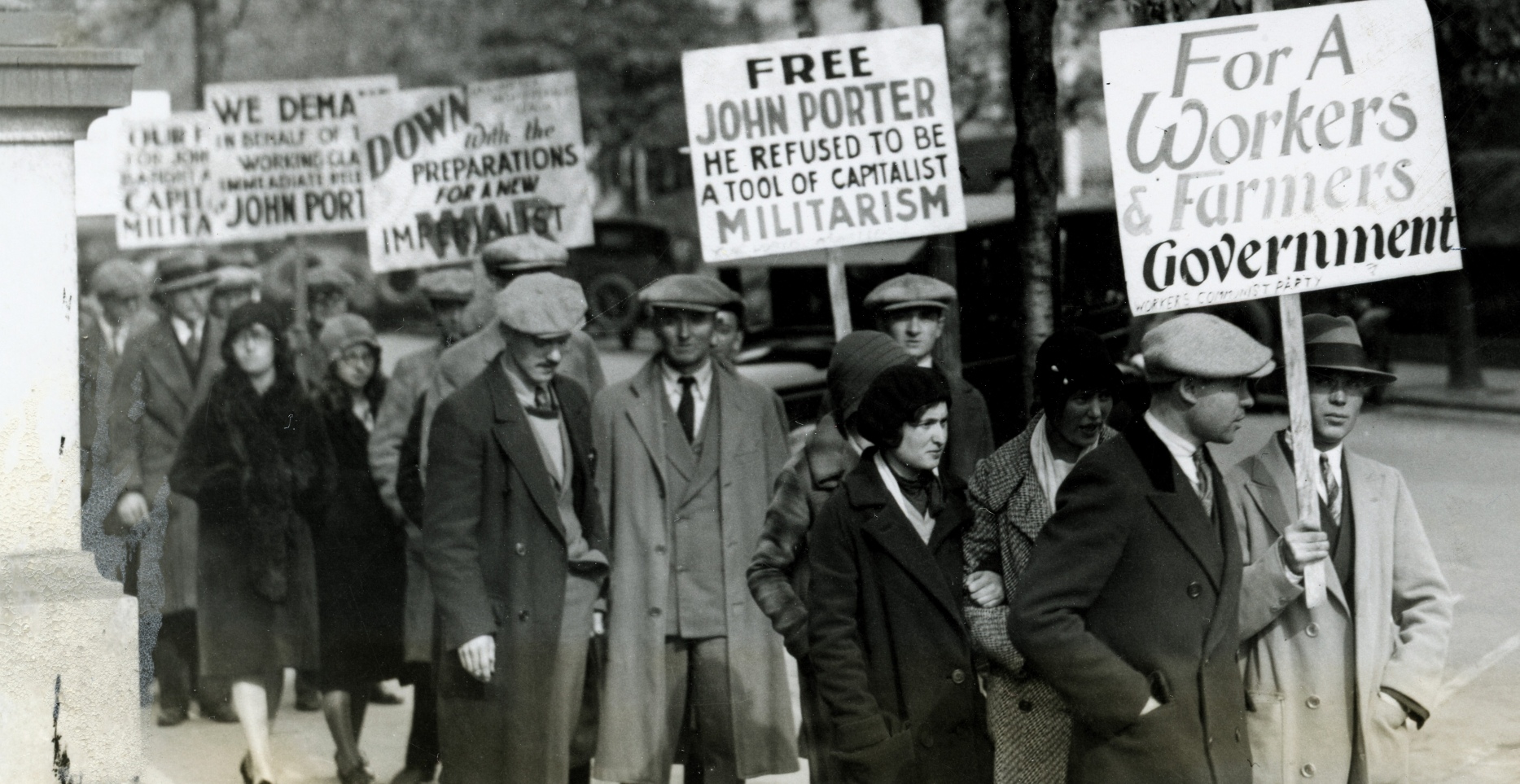
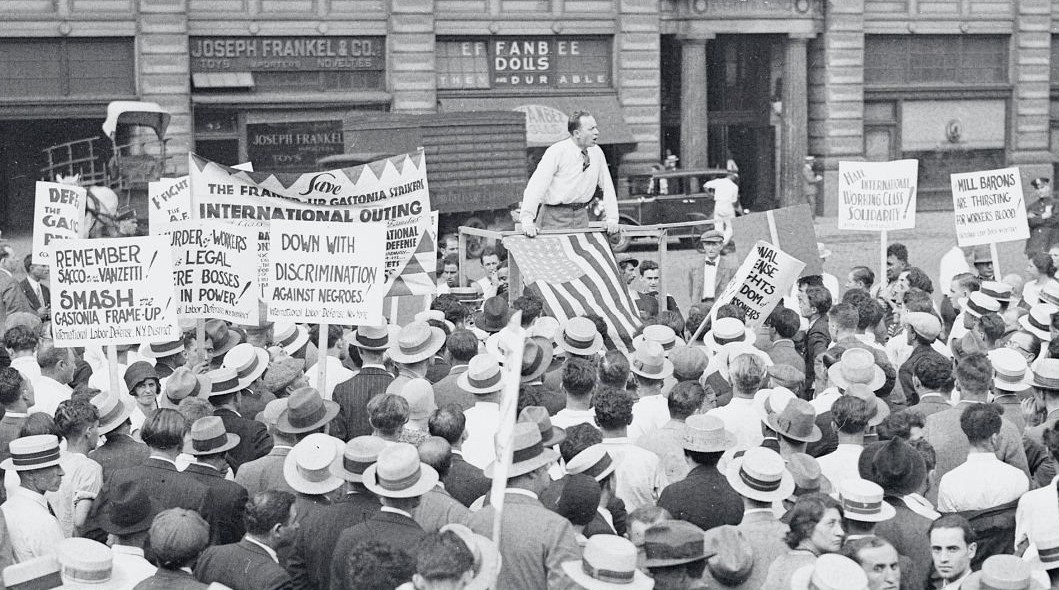
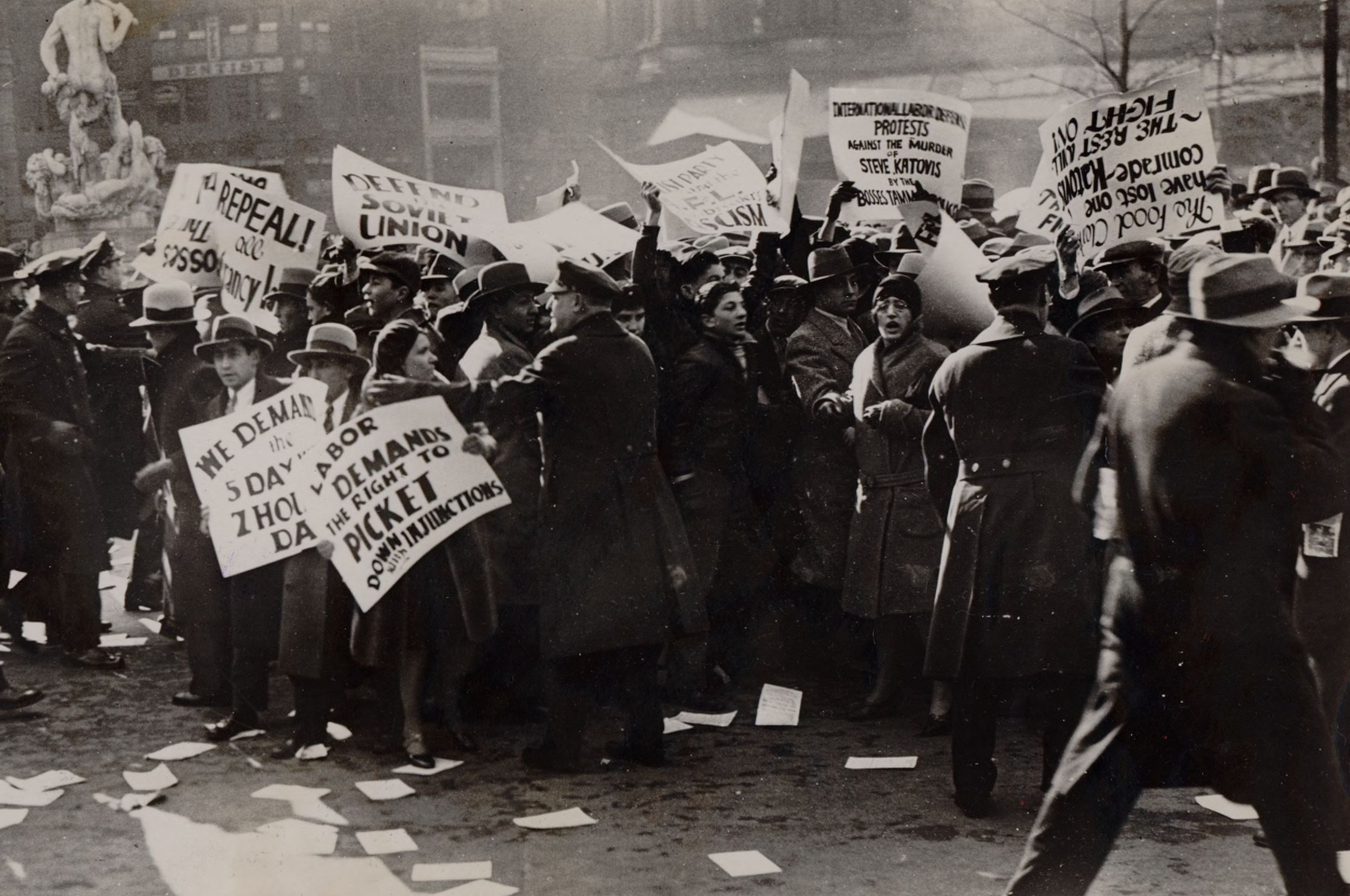
I forgot to speak about one point in one of the other matters | referred to and that is about mass demonstrations. Comrades, our Party has had a number of good demonstrations in the past period. Yet there is some confusion on this question. Many times we confuse a picket demonstration with a mass demonstration. Do you know what I mean by picket demonstrations? For example, when we send a few dozen or a hundred or so in front of, let’s say, Morgan’s or the Navy Yard, or some place in Washington to demonstrate and dramatize certain events—that is a picket demonstration. And many times our comrades don’t understand the difference between this and a mass demonstration. So what arises? Some comrades say when we call a demonstration a picket demonstration we must publish it in the press. Well, if we publish it in the press, that means we expect to face the difficulties that arise from that. That means we must make it a mass demonstration. We don’t want to publish in the press that there will be 100 pickets. If the authorities know in advance, we will never get to that place with that small group. The police, who know of our aims, will be so situated that we will never accomplish our aims. When we have a picket demonstration we must accomplish our aim, and to do that we cannot publish it in the press. When we have a mass demonstration we must organize the workers for it as well as publish it in the press. We must use different methods according to whether it is a mass demonstration or a picket demonstration.
I have merely indicated our problem. Our demonstrations will increase in number and size. Also the authorities when they see our strength and know of our aims will want to say something, and we will have to answer them, and only with the masses can we give the proper answer.
THE DRAFT CONSTITUTION
I want to say now, comrades, a word about the draft constitution.
The first thing we must note, comrades, is the proposal that we will make, which reads as follows: “The name of the organization shall be The Communist Party of the United States of America, Section of the Communist International.” (Applause). This means, comrades, that we are changing, as we have done in 1925. You remember in 1925 we changed from Workers Party of America to Workers (Communist) Party of America. Now we are changing from Workers (Communist) Party to the Communist Party of the United States of America, and you will realize why we say the United States of America. Because the Latin-American Parties have objected to our calling ourselves the Communist Party of America, and rightly so.
Why do we make this proposal? First of all, because we believe our name should be Communist Party. Secondly, comrades who were in the campaign will remember that many workers were confused. There was a labor party in some states on the ticket, and we could not go on as Workers (Communist) Party, we could go on as Workers Party, with the result that our main slogan was “Vote Communist” on posters, leaflets and stickers. By the way, the last time Comrade Gitlow and I were in Pittsburgh, a few weeks ago, we walked over a number of bridges and we found that the bridges were still covered with red signs, “Vote Communist.” Comrades will remember that during the campaign we instructed all districts to cover the streets with “Vote Communist.” In New York, Pittsburgh, and other districts, they did very well, so that practically all the workers read our slogans. Our main slogan was “Vote Communist,” but when the workers came to the ballot box they saw Workers Party. Many workers were confused. Comrades, this is another reason why we must change the name as we have done.
The other changes in the draft thesis that we have made are of a minor character, except, for example, we have brought the constitution in line with the proposed changes, abolition of sub-sections and sub-districts and then we have laid down guides for action…
Comrades, I conclude. I have merely indicated some of the propositions; some I have not had sufficient time to touch, as for example, the need for building up the I.L.D., but it is clear at the present time that our main task is to orientate to the factories, change the Party composition, proletarianize the Party; more women, Negroes, native-born; building up factory nuclei, giving real life to them; building factory papers, strengthening the Party apparatus, building the leading committees, building fractions; guiding the work in the trade unions and mass organizations; more systematic work in the Party campaigns, more systematic recruiting of workers into the Party.
These are the chief tasks that flow from our political tasks. These we must carry out if we carry out the decisions of the Sixth World Congress and the Open Letter of the Comintern. We hope that this convention (where we had hoped to have at least two days on organization, but unfortunately could not)—we hope the Party members, the Party functionaries, will see to it that these tasks will be carried out into life so that we can report the doubling of our membership, 500 new factory nuclei, and at least 200 new factory papers, at the 7th National Convention of our Party. (Applause).
There are a number of journals with this name in the history of the movement. This Communist was the main theoretical journal of the Communist Party from 1927 until 1944. Its origins lie with the folding of The Liberator, Soviet Russia Pictorial, and Labor Herald together into Workers Monthly as the new unified Communist Party’s official cultural and discussion magazine in November, 1924. Workers Monthly became The Communist in March,1927 and was also published monthly. The Communist contains the most thorough archive of the Communist Party’s positions and thinking during its run. The New Masses became the main cultural vehicle for the CP and the Communist, though it began with with more vibrancy and discussion, became increasingly an organ of Comintern and CP program. Over its run the tagline went from “A Theoretical Magazine for the Discussion of Revolutionary Problems” to “A Magazine of the Theory and Practice of Marxism-Leninism” to “A Marxist Magazine Devoted to Advancement of Democratic Thought and Action.” The aesthetic of the journal also changed dramatically over its years. Editors included Earl Browder, Alex Bittelman, Max Bedacht, and Bertram D. Wolfe.
PDF of full issue: https://www.marxists.org/history/usa/pubs/communist/v08n04-apr-1929-communist.pdf
PDF of issue 2: https://www.marxists.org/history/usa/pubs/communist/v08n05-may-1929-communist.pdf
 Revolution's Newsstand