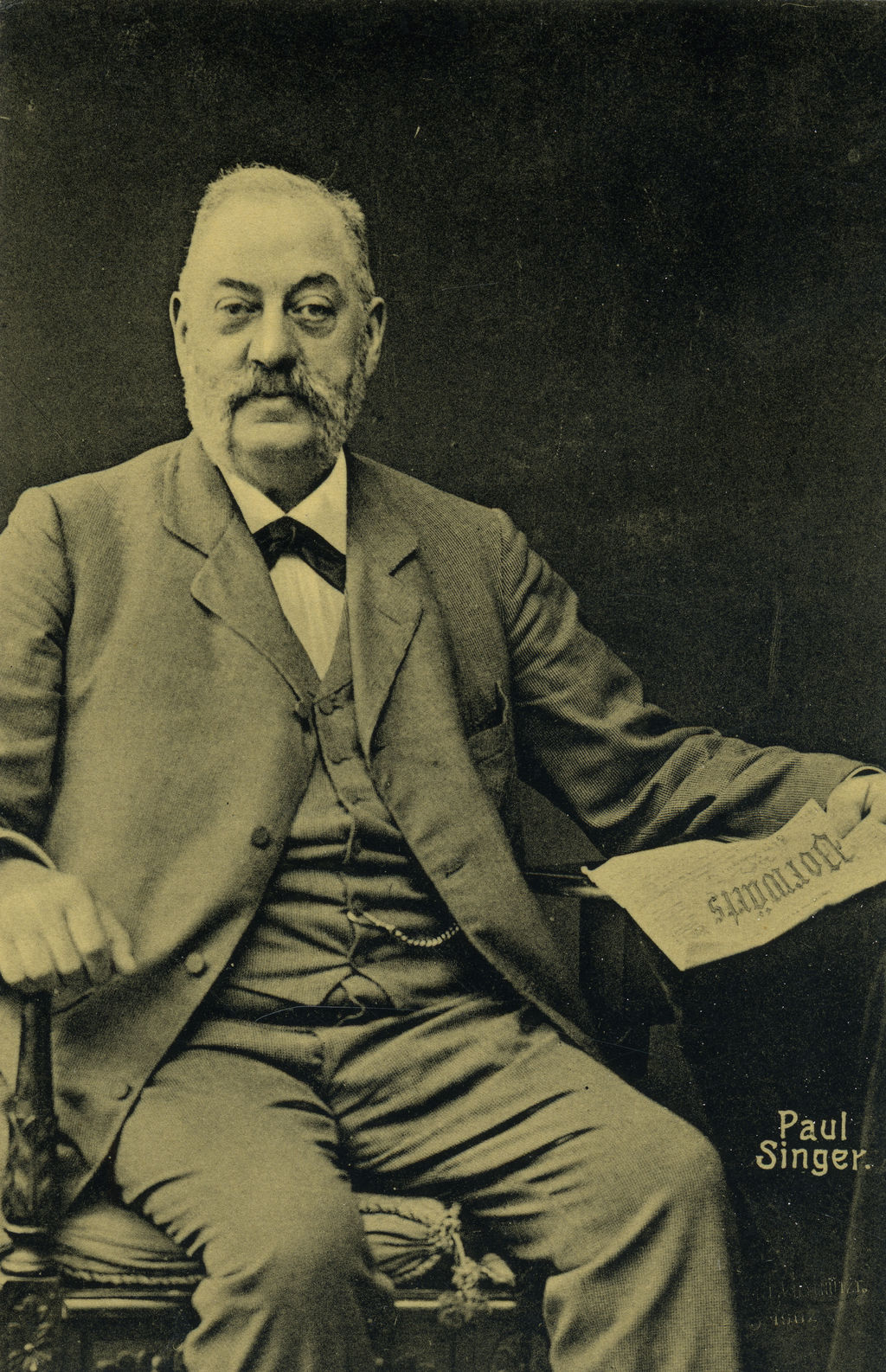
The Call on the passing of one of the giants German Social Democracy, both as a parliamentarian and in the heroic period of the Party when it waged an underground struggle against Bismark and the Anti-Socialist Laws.
‘Paul Singer is Dead in Germany’ from The New York Call. Vol. 4 No. 32. February 1, 1911.
Great Socialist Leader and Fighter Yields Only to Disease.
HELPED BUILD PARTY
His Life a Story of Long Struggle Against Brutal Oppression of State.
BERLIN, Jan. 31. Paul Singer, the Socialist leader, and one of the greatest forces in the reichstag, died today of pneumonia.
He was stricken last week, his illness being due to the overtaxing of his strength by his labors. Singer was a notable figure in all parliamentary debates, and was a great leader of the Socialist wing.
In the death of Paul Singer the Socialist movement of Germany loses one of its ablest generals and a most effective fighter.
Singer was not a scholar of the type of Kautsky. He was not the passionate orator Bebel is. He was a practical idealist–cold, calculating, severe In his requirements of exactness and punctuality to a point which amounted almost to military discipline. But he was present with practical helpful word or suggestion in time of a crisis. His practical turn of mind helped, in a great measure to build up the splendid Socialist organisation in Germany. His business sense helped keep the Socialist party on a sound financial basis.
Singer was born in Berlin, January 16, 1844, of Jewish parentage. He received his education in the real gymnasium of his native city, and in 1869 he and his brother established cloak factory. He remained in the cloak business until 1886. During this time he traveled much through France and England. While apparently absorbed in business Paul Singer took a keen interest in the political movements of his time. He joined the Progressive party (Fortschritts Partei) in his early twenties, helped found the Demokratische Zeitung, an organ which opposed Bismarck’s rule of blood and iron, and still later helped establish an even more radical paper called Die Waage.
Joined the Party.
In 1870 Singer, together, with a number of other Democrats who saw that there could be no compromising the Bismarck rule, joined the Socialist party.
At first his activity in the Socialist party was more of a philanthropic nature. He helped financially many of the Socialists whom the anti-Socialist law had driven into exile and whose families were left in sore straits.
But while doing this apparently harmless philanthropic work Singer was drawn more and more into the Socialist movement. The persecutions to which the Socialists were subjected forced thousands of them into exile, left a gap in the Socialist movement in Germany which could not easily be filled.
The anti-Socialist law likewise showed that the Socialist party of Germany had to adopt different agitation and organizational methods. The work of the Socialist party, if it was to be carried on at all, had to be carried on secretly. Money was needed to keep the movement alive and some sort of a permanent financial organization put on practical basis became a crying need.
These circumstances forced Singer, the cloak manufacturer, more and more to the front as a leader in the Socialist movement.
And once Singer began this work of putting the Socialist party on a solid footing there was no getting out of it. He could not vacate his post.
In January, 1884 he was elected a member of the city council of Berlin, and in October of the same year the working people of Berlin, with a vote of 25,368, sent him to the reichstag as their representative.
His Expulsion.
In the parliament Singer at once became a marked man. His speeches cut the government to the bone. After hesitating for more than a year, however, Bismarck finally expelled Singer from Berlin in 1886. Singer moved to Dresden, and two years later, in 1888, he gave up his business activity, and devoted himself exclusively to work within the Socialist party.
When the anti-Socialist law was repealed, Singer returned to Berlin, where he was elected to the municipal board. in addition to his being reelected a member to the Reichstag. From that time until his death Singer was also a member of the Vorstand or the executive committee of the party.
The repeal of the anti-Socialist law was in a large measure brought about by the activity of Singer, who in 1888 astounded all of Germany by an expose of the methods of persecuting Socialists and of the spy system that Germany developed. This expose, which contained no flowery language but cold facts, made the existence of the anti-Socialist law preposterous.
Law Then Repealed.
In 1890 the Socialists in Germany polled a million and a half votes and the anti-Socialist law was abolished.
At practically every Socialist congress Singer presided. This honor was accorded him without the slightest opposition. Singer was a master in parliamentary law, and the order and executive skill with which he conducted meetings and conventions could not be surpassed.
A Socialist, who was a delegate to the Socialist congress in Stuttgart in 1907, gave this impression of Singer as he saw him presiding;
“He seemed as if cut out for the job of chairman of such a notable gathering. There was something military in his bearing. When Singer rapped his gavel all factions came to order immediately. The most heated debate was instantly cut off.
“This almost military discipline of the veteran Socialist was never tactless. If Singer came down with his gavel there was good reason for his doing so. There was no despotism about his orders, but good common sense, and in every se his action was in the interest of the cause.
“His bearing was dignified in the extreme. His language was not flowery. It did not abound in fine words and phrases or noble sentiments. What he said was direct, forceful and to the point.”
Singer retained his close connection with the Socialist press in Germany to the last. He was the nominal publisher of the Vorwaerts. the Berlin Socialist daily, and it was his guiding spirit that was in a large measure responsible for the splendid progress which the Vorwaerts has made from a small, tottering sheet to one of the leading daily papers in the world.
***
Editorial.
In Paul Singer the German Social Democracy loses one of its most faithful servants and trusted leaders.
Originally a wealthy capitalist, he threw himself unreservedly into the struggle of the working class for emancipation, severing completely the ties that bound him to the class from which he sprung. His abilities, both parliamentary and executive, were far above the average, and these he placed entirely at the command of the Socia! Democracy. Since 1884 he was repeatedly elected to the Reichstag, as well as to the municipal council of Berlin, by the votes of the workers. He was also for many years a member of the central executive committee of the Social Democracy, and he was regularly chosen to preside over the annual congresses of the party. And when it was learned that he was unable to attend the Magdeburg congress of last summer, those who knew Paul Singer began to fear that his life was approaching its end.
Of his wealth he gave lavishly to the party as well as to charity. For Paul Singer was not of those who refuse aid to the submerged victims of capitalism because of their recognition that such aid cannot change the vicious system. His heart beat warmly for the helpless and downtrodden, and his hand was ever ready to support them. He was the moving spirit of the Berlin asylum that has given free shelter to thousands upon thousands of unfortunates. In the management of this asylum, the man’s practical abilities as well as his bold and aggressive spirit had occasion to assert themselves. For when the police began to infest the institution with its agents for the detection of criminals, it was Paul Singer who caused the board of directors to issue an ultimatum to the government that either the police be withdrawn or the doors of the asylum would be closed. The police were withdrawn.
Kindly to the victims of social injustice, a faithful servant of the working class, ever loyal to his comrades in arms, but an uncompromising foe of the existing social order and an aggressive leader in every attack upon the ruling classes–such was Paul Singer, the capitalist who turned Socialist because he arrived at the conviction that the capitalistic social order deserved to be overthrown and was doomed to be overthrown.
The New York Call was the first English-language Socialist daily paper in New York City and the second in the US after the Chicago Daily Socialist. The paper was the center of the Socialist Party and under the influence of Morris Hillquit, Charles Ervin, Julius Gerber, and William Butscher. The paper was opposed to World War One, and, unsurprising given the era’s fluidity, ambivalent on the Russian Revolution even after the expulsion of the SP’s Left Wing. The paper is an invaluable resource for information on the city’s workers movement and history and one of the most important papers in the history of US socialism. The paper ran from 1908 until 1923.
PDF of full issue: https://www.marxists.org/history/usa/pubs/the-new-york-call/1911/110201-newyorkcall-v04n032.pdf
 Revolution's Newsstand