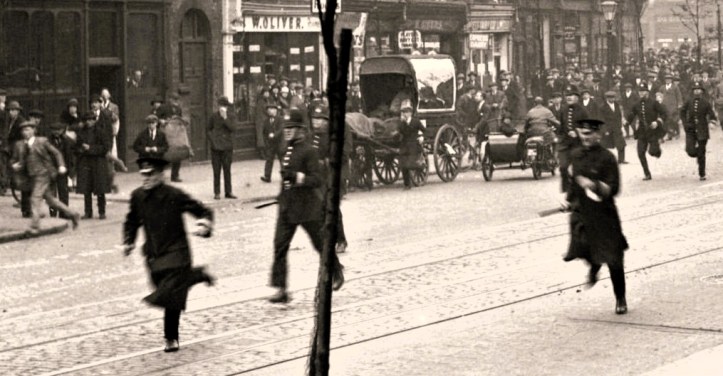
A valuable addition by a leading Communist to the histories of the Britain’s 1926 General Strike, Murphy’s speech to the Comintern during that year’s Seventh E.C.C.I. Plenum in November giving the broad historical, economic, and political contexts of the momentous struggle.
‘The Lessons of the English Strike’ by J.T. Murphy from International Press Correspondence. Vol. 6 No. 91. December 30, 1926.
Comrade MURPHY (England):
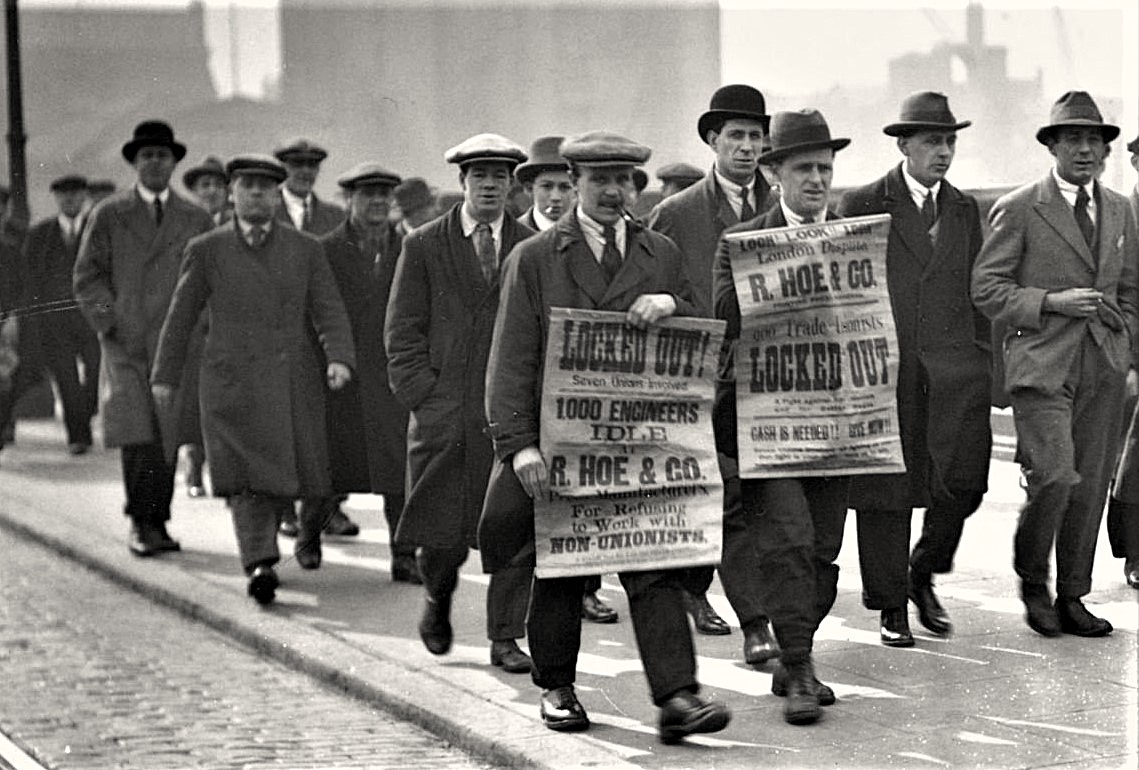
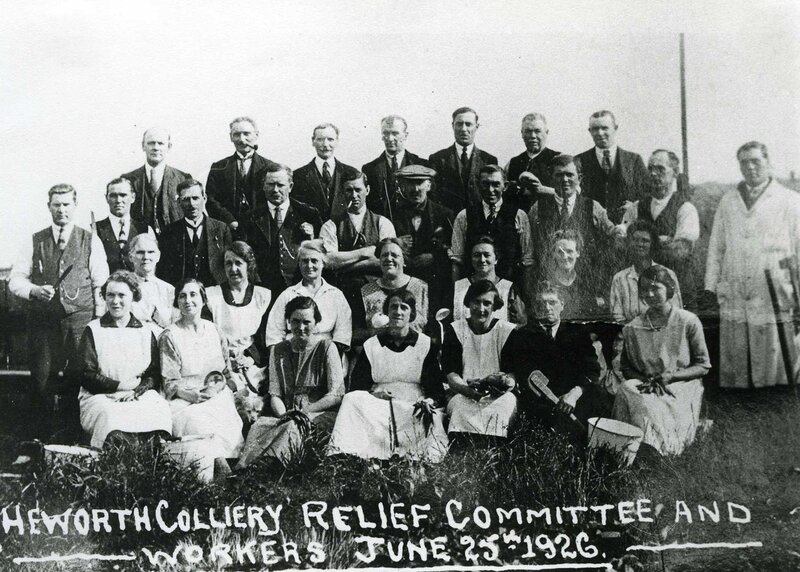
Comrades, the first words that I must say this evening before going to my report proper, must be with reference to the termination of the miners’ lockout. Everyone here who has become acquainted with the terms upon which this dispute has ended, after so magnificent a struggle on the part of the miners, will join in declaring quite openly and frankly that the agreements which have been made in the districts can only be regarded as agreements made under duress, and can only remain intact just so long as the miners have not developed power enough to smash them. No one of us, under the circumstances existing in Britain can regard these agreements as worthy of anything other than to be completely shattered at the earliest possible date. I am quite confident that the admiration we have for the miners and for their women-folk who have joined them so magnificently in the struggle, will inspire us to render still further aid to them to the best of our ability. We helped them to fight against the imposition of slave conditions. We will help them to shatter these new fetters of slavery.
I have to report now upon the English situation with special reference to the General Strike and the miners’ lockout, for these two together constitute the most profound and far reaching event in the history of Great Britain for a hundred years. On May 3, of this year, 4 million workers, with one accord, struck a mighty blow at the very foundations of the oldest imperialist country in the world. For nine hectic days their ranks were solid. Enthusiasm was growing the will to extend and develop that struggle was spreading far and wide amongst the workers of other industries that had not been called into action. Suddenly, through treachery on the part of the leadership of the unions and the labour movement, the strike was called off and a million miners were left in the lurch to continue an isolated struggle lasting now for seven months despite the mighty array of State power and all the forces of class oppression mobilised against them.
Accompanying this mighty conflict of class forces, we have witnessed the farthest reaching advance of international solidarity action, led by the workers of the Soviet Union. We have been witness to a wholesale disturbance in world economy, and in the framework of British imperialism. We have been witness to far-reaching changes in class relations on an international scale. The importance and significance of this great event can hardly be over-estimated. So profound has been the effect upon every phase of the situation in Britain itself that we can now unhesitatingly say that the working class of Britain has definitely stepped out upon the path which leads to Social Revolution. Such an event constitutes a political event of world importance, it warrants our deepest study.
In presenting this report on behalf of the Executive Committee I do not intend to repeat in full the report on the thesis of the June Executive meeting when it summed up the British situation on the lessons of the British General Strike from May 3rd to 12th. In the Thesis which has been presented to the Enlarged Plenum we have confined ourselves as much as possible to supplementing the June thesis rather than going into a repetition of our work on that occasion.
At that time we established, first, that the general position of British economy in relation to world economy, may be characterised as that of a steady process of decline. We also stated that a most important component part of the general decline of British imperialism has been the acute crisis in the British mining industry. These conclusions have been completely verified by the events which have followed. Indeed, one of the most important features of the miners’ struggle is the fact that it proceeds on the battle ground of the decline of the British Empire, a decline which has gone so far that the capitalist class of Britain are no longer able to make concessions to the workers and every conflict, even for the most elementary economic demands, is converted rapidly into a political struggle of first class importance.
Let us examine the effect of the strike and the lockout on British economy in general. In Comrade Bukharin’s report a number of statistics were brought forward which show that Britain has lost her monopolistic position in world trade, that in the development process of the colonies and dominions Britain is rapidly losing ground to the United States.
The figures show that this feature is not confined to the British Empire, but extends to the whole of her world trade. But within the British Empire itself the process has strengthened what we call the centrifugal factors operating against the British Empire. I mean by that, the tendency for the elements of the British Empire to draw apart from the centre (Great Britain). I want to supplement the information which is conveyed in Comrade Bukharin’s report in order that we may get a more complete measure of the extent and seriousness of the decline of Great Britain.
First of all let us examine the State expenditure as revealed in the national budget. In 1914 the national budget amounted to 72 million pounds. At the end of the War it rose to 1,000 millions. In 1926, after very many strenuous efforts to reduce the budget, it amounted still to 824 million pounds. The municipal budget in 1913 amounted to 71 millions, in 1925 it had risen to 160 millions. I want you to grasp the significance of these figures. They mean a rise of from 18 to 40% of the national income passing into the national exchequer and the exchequers of municipal authorities. How does this compare with the position of her greatest rival America? It is estimated that of the American national income only 10.5% goes into national expenditure in the form of taxation. Now while America can foresee a balanced budget in the immediate future, Great Britain has to face the fact that this year as a direct sequel to the 7 months lockout, there is already a deficit of 62 million pounds in the first 6 months of the year, and although it is usual for income to come in more rapidly during the latter part of the year, there is every prospect of a very substantial deficit in the national budget at the end of the year.
The position of the municipalities is equally bad from the standpoint of the bourgeoisie. No less than 60 unions of the local authorities have been forced from economic necessity to apply for loans for relief.
Turning from the national local finances to the effects on British industry in general, and especially, on the heavy industries already heavily hit by the crisis, Sir Robert Horn, a leader of the Federation of British Industries, in a speech agitating for the cutting of relief, declared that 11 shipyards on the Clyde in 1913 paid £17,000 in taxes for poor relief, but in 1925 the amount has risen to £61,000. In 1926 this amount will have considerably increased. What these 11 yards will have to pay as the present economic conditions continue can well be imagined. But he went still further to show the effect of the stoppage upon the economic life of the country. He went on to say that in Sheffield the poor rate was 2d. on the pound in 1913 but today in 1926 it has risen to 5/1d, this meant an advance in the cost of steel production. When this is taken in relation to the intensified competition with foreign steel manufacturers, when we realise how narrow is the margin for competition, the serious effect of the stoppage upon steel production is obvious to all of us.
But the situation does not end here. Turning from taxation in general and its effect upon trade, let us examine the imports and exports. Here we shall find that imports are growing, exports declining. So much so, that even when all allowances have been made for what are called re-exports and invisible exports (earnings of shipping and returns of foreign investments), we find the situation described by the “Bankers’ Magazine” as follows: Taking into account these invisible exports it comes to the conclusion that 5 months of the stoppage meant a total adverse balance of 44 1/2 million pounds for the year and consequently, “We as a nation have been temporarily living beyond our means and have been drawing upon the rest of the world for a proportion of our daily needs. At the same time in order to meet the bill we have, nationally and individually, had to draw upon our savings”.
Let us go still further. From an exporter of coal during these months, Britain has turned into an importer and in the process has dislocated her shipping traffic. Formerly she exported coal and used the vessels which went out with coal to bring back grain and foodstuffs. Now the ships are sailing out with ballast to bring back coal, thus necessitating extra charges, giving away all the advantages she had previously in the way of regulating freights; and she is unable to bring the foodstuffs as freely as hitherto while at the same time creating such a shortage in shipping that the freight rates soar to unprecedented heights.
When we take all these facts in relation to the story told by unemployment and the time lost in industrial disputes, it can be no exaggeration to say that the General Strike and coal struggle has accentuated the general decline on a very large scale and that it will continue to do so. Do not think for a moment that simply because the lockout has ended that this means an immediate readjustment of the market and immediate recovery. It must not be forgotten, as Joynson Hicks points out this week, that the orders for coal have been of such a character that they extend over a long period and even though the mines were working in full swing tomorrow morning, the import of coal into Britain will continue until at least February next. One can understand from this fact alone what a disrupting effect this situation will continue to have on British industry. Already we can hear outcries from industrial centres with regard to having too much coal on hand. When the mines get working fully and the imports continue to come in, we can see that there will be another crisis in the coal market during the next few months.
Now let us take the effect upon unemployment and see what these figures show. In 1921 when the last great lockout of the miners took place there were 1,500,000 unemployed. Since that time the figures of unemployment have not gone below a million, and today, apart from the miners, there are on the register 1,500,000 unemployed. When these figures are kept in mind and related to the tremendous dislocation caused by stoppages in industry we can take the measure of the great forces which are operating to undermine the position of the British industry. For example, in 1921 there were 86 million days lost in disputes. In 1926, up to the termination of the lockout, there were 165 to 170 million days lost as a result of the lockout and General Strike.
Nor can we take all these figures out of relation to the position of British agriculture, which continues to decline year by year. This is a feature of the general economic crisis of Britain. So when we visualise the adverse balance with regard to import and export trade simultaneously with a decline in agriculture, simultaneously with the eating into the financial reserves of the country, we can understand how serious is the position for British economy.
At the centre of this crisis stands the coal crisis. Ever since 1921 when the coal crisis flared up and produced a stoppage of three months duration, an open conflict between the miners and mine-owners has only been avoided by a series of “accidents”. Coal exports, which formed a great proportion of British trade exports, have been continually declining in these years of the development of home production in other countries, increasing rivalry of Britain’s competitors and the coming in of new fuels–especially oil. Britain has now lost almost completely the South American market as a result of the stoppage, and a large part of her European market has been taken over by Germany. America has increased her output of coal on a tremendous scale and has been wise enough to look well ahead and to involve Britain in purchasing her coal exports right into next year. She has displaced Britain in South America and has become a great exporter of coal to England.
Nevertheless none of these efforts could make up for the cessation of British coal production and at the present moment there is a definite world shortage of coal which has had the effect of increasing prices and raising freight rates everywhere. All of these things naturally have their repercussions on the economic life of other countries besides England. French prices have been rising rapidly. Ruhr prices of anthracite coal went up 100%, Belgian domestic coal has risen 120%. In Poland there has been such a shortages of trucks that it is declared to be disastrous. In Italy there is such a shortage of trucks that many big works are finding it difficult to carry on. In America prices are rising steadily. So much for the economic background and the economic effects of these seven months of struggle.
In thus summing up the economic situation created by the coal strike which the bourgeoisie themselves estimate to have cost £500,000,000 we can record that British capitalism is now compelled to draw on its reserves–that it no longer has surplus capital for export. It is faced with a heavy burden of taxation in one form or another. It has an increasing indebtedness, it faces more severe competition from her rivals.
When we review these serious factors we must also ask, has there been no counter-balancing factors arising out of this situation? In answering, we have to record certain developments which show that British capitalists are not prepared to give up the ghost, even economically, without great efforts to recover. This is observed in the growth of trustification, one of the immediate effects of this great crisis. This is going on rapidly in the mining industry itself. Not reckoning the financial control which these companies exercise over other concerns. These are indications of the immediate effects in regard to trustification in the mining industry. That they have been thought of prior to the stoppage is seen in the Coal Commission report. It was hoped to see the small mining companies starved out and swallowed by the big ones as a result of the increasing difficulties in the mining industries.
In addition to this development, we have to record the formation of big combines in the chemical industry where a trust has been formed with a capital of £30,000,000. Then we have the Lever Combination with a capital of about £86,000,000, a trustification process in the motor industry, etc. so we witness an immediate strenuous effort on the part of the bourgeoisie in Britain to pull their forces together, to intensify the process of trustification. This is the immediate economic reaction in the capitalist ranks with regard to the coal stoppage.
Nevertheless, when these efforts are taken into account we still are driven to the conclusion that the crisis has not only carried Britain further down the decline, but it has accentuated its difficulties in its relations with other countries and has accentuated the rivalry between the powers. We can say quite definitely that the immediate effect of the lockout of seven months duration has been to further accentuate the inequalities of the capitalist forces throughout Europe especially.
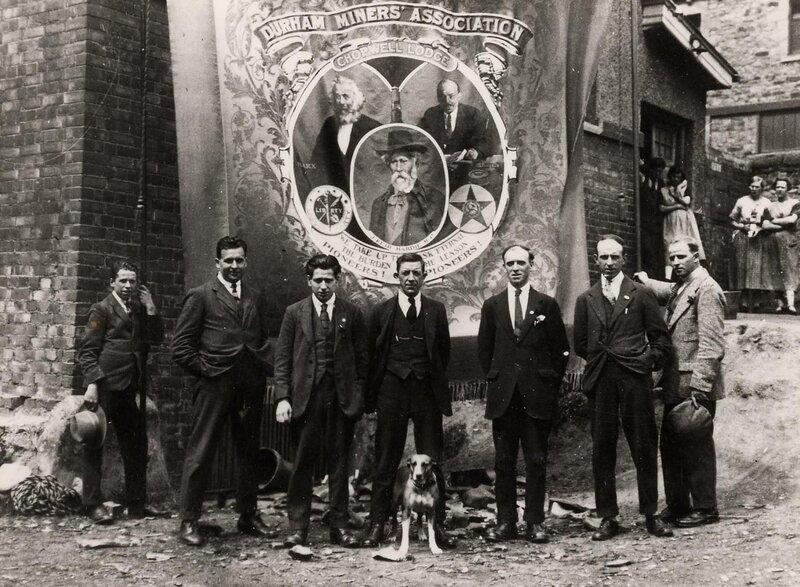
Let us consider how the stoppage has effected the political situation. In considering the changes which have taken place during the period under review the fact is clear that however the course of events of Great Britain’s diplomacy may have gone, the internal situation of Great Britain has prohibited her from following up her diplomatic plans with any great force. Hence we have been witness to a considerable setback in her plans in a variety of directions. First of all her plan for a European bloc against America and her plans for the encirclement of the Soviet Union have, to say the least, not been very successful. That these objectives were in the minds of the British Government, in her great Locarno scheme there is no doubt. These were frustrated at Geneva on the one hand when Brazil made her move under the pressure of America and on the other hand by France and Germany, who have grown more fraternal in their relations, witness the Thoiry conversations and the steel combine project. But if Britain was compelled to change her line in Europe and seek new positions with the aid of Italy, no less severe are the blows she had received in the Far East.
It is only a short time ago that Britain was striving with all her might to secure a military intervention policy in China. But Britain dare not enter into a war under such circumstances as existed at home in this period. With her steel industries at a standstill, with the output of coal at a standstill and transport dislocated, for Britain to pursue her policy of armed intervention to its logical end was practically an impossibility. Consequently, we can say that this great struggle of the miners has. helped the Chinese revolution enormously. Historically speaking the General Strike and Miners’ lockout have been the allies of the Chinese Revolution.
This is not the only setback which British imperialism has received during these months. Then the troubles with Australia and South Africa need only be mentioned to complete the picture.
That Britain’s weakness is apparent on all fronts is obvious from the proceedings of the British Empire Conference which opened in London in the midst of the coal dispute. There were two guests at this Conference who were not wanted, but who were ever present first the miners and second America. The Ministers assembled there knew quite well that the longer the stoppage continued the worse would be the financial condition of Great Britain and the more they must look to the U.S.A. for assistance. How can Britain export capital when her balance shows a deficit? Lest it be thought that we are exaggerating the situation, permit me to quote Mr. Keynes who estimated that the bills for overseas investments during recent years are as follows: in 1924 123 million pounds were available; in 1925 85 million pounds, while from January to September 1926 the figure has fallen to 38 million pounds. He adds that at present we have no surplus for foreign investment and that we must reckon on a deficit of £21 million by the end of the year.
This state of affairs does not hold great promise to the colonies, and, as Mr. Bruce, the Premier of Australia, explained with regard to markets, that if Britain cannot fill the bill then they would have to look further afield. In regard to finance we know where their eyes turn, we are all familiar with the gold bug of America. We know also that Britain last year was compelled to place an embargo on the export of capital even to the colonies, so that Australia had to look to the United States for money. We are also aware that Great Britain has been unable this year to invest any money in Canada. Indeed it is stated that at the present time Britain has less money invested in Canada than before the war. In order to meet the present situation there has been an export of gold from British holdings in Australia to the United States. So long as this process continues it is difficult to see how the bonds of the Empire are going to be held tightly together. It appears as if America is untying these bonds very nicely.
In spite of all the facts I have brought before you with regard to British economic difficulties, we are witness to a very interesting contradiction this is a contradiction between the prosperity of the banks, finance and certain finishing, mainly luxury, industries and on the other hand the intense depression of the basic industries, such as coal, steel and textiles. This phase is referred to in the London “Times” of the 21st of June. It says: “Taken as a whole this year’s report of companies engaged in heavy industries are the worst since the collapse of post-armistice boom, and in many cases the worst in all the ups and downs of a long history. Yet the remaining industries, for us, are enjoying a very fair measure of prosperity and not a very few of them an exceptional amount of it.”
There is an interesting explanation given for this phenomena, by Dr. Snow, lecturing before a statistical society. He analysed the situation as follows: That whereas in 1913 75% of our imports were balanced by our exports, only 66% of these imports were met by exports in 1925, the balance being affected by invisible exports, that is to say, the income from foreign investments, shipping and all kinds of commissions, etc. These have increased in relation to visible imports and in fact have increased absolutely. For 1913, they amounted to £339,000,000, in 1923 £373,000,000 and in 1924-25 £429,000,000.
Dr. Snow says that
“while the tendency before the war was for exports to increase in importance as a means of paying off imports, today the tendency has been reversed. The change is of menacing significance, a significance that cannot be ignored”.
It means that all this flourishing of the banks and of certain luxury industries, is due to the income d derived from investments overseas, in the Dominions, the Colonies, etc. This rise, which is indicated as an absolute rise in the income, which is to a considerable extent hiding the fundamental seriousness of the economic situation in Britain, is due to the fact that for a number of years these investments have not been paying fully and now they have come to fruition. Hence the absolute rise of income from investments in the colonies, in the Dominions, etc. But even when these are taken into account we find that this year, as a result of the stoppage, there is a big deficit in the national balance sheet, and an inability on the part of Great Britain even from a financial point of view, to maintain her hold upon the colonies and of the Dominions especially, because of her inability to supply capital to these parts of the Empire.
To think that there is a possibility of Britain recovering by shifting her unemployed to the Dominions, as is indicated in the Imperial Conference is equally fatuous. This idea of exporting the great masses of the unemployed to the Dominions as a solution of the situation only needs a moment’s consideration. What do the Dominions require to make migration there at all a workable proposition? The Dominions do not want the mass of unemployed that are in England, what they do want is immigrants with £ 400 of capital each. Well, I do not know any one of the unemployed who can get anywhere near that figure. So let us examine the situation in the Dominions and see how they feel about it. New Zealand for example:
“In all the cities, except perhaps in Wellington, which is undergoing a rapid extension of building in the labour situation there has been a worse state of unemployment than in 1921-1922. Meanwhile every steamer from Britain is bringing in masses of emigrants. It is true that the farming areas will absorb a certain proportion but the British coming into New Zealand do not want to go on the farms.”
They are replacing the native population in the industries and this of course has caused dissatisfaction among the natives. So there is developing a feeling against Great Britain as a consequence of this proposal to unload the unemployed in New Zealand. That it is the same in Australia goes without saying. The possibility therefore of handing on the great mass of unemployed, these two million paupers, to the Dominions proves to be not so simple a solution of the economic difficulties in which Great Britain is today.
But not only are they failing with regard to their emigration schemes, but the dominions are developing their own self-assertive bourgeoisie. Australia is developing her own bourgeoisie, and very much so. Where before the war only 13% of Australia’s debts were owed to Australians, this year Australian capital has so far developed on national lines, that 55% of the debts of Australia are internal debts to Australians, meaning a corresponding decrease in regard to Great Britain. Consequently it is not surprising that Mr. Bruce gets on his hind legs and speaks very frankly in regard to the financial and political aspects of Australia. When speaking of Australian relations to the British Empire and America he said on Nov. 11th in London:
“To us in Australia this friendship (with America) is of vital concern. We are particularly closely drawn towards our great sister democracy. Our constitution is based on hers. Our development has travelled along similar lines. Our problems are the same. America’s traditional policy of non-interference in European affairs is one which finds echo in our country. And we feel that when America struck a blow for her own freedom at the end of the 18th century she struck a blow for all the British Dominions of today…”
Very tight bands are these that are binding the Empire together! After the defeat of Lord Byng in Canada the new government declared that he was not going to interfere with the domestic politics of Canada and the next week Canada appointed her own ambassador to Washington! We have only to add to these series of incidents the declarations and resolutions of the Imperial Conference published a few days ago. They openly proclaim the disintegration process which I have indicated here.
Summing up therefore the effects of the general strike and the miners’ lockout upon the British Empire we can say: They have accentuated the centrifugal tendencies, destroyed financial unity, increased the contradictions in the economic fabric of the Empire and strengthened considerably the political tendency in the Dominions to look elsewhere for assistance. This struggle has strengthened also the foundation for unity between the working class of Britain and that of the Dominions, the oppressed peoples of the colonies and those other countries to which British Imperialism aspires.
Now let us turn to an examination of the effect of the struggle upon the classes. Reaction of the General Strike and the miners’ lockout on the bourgeoisie internationally can be summed up as follows: first of all there was reaction and open solidarity against the General Strike, but once they were of the opinion that the British bourgeoisie were not immediately to be thrown on the scrap-heap they began to take advantage of the situation. Britain’s struggle became at once their opportunity and they seized it.
As for the British bourgeoisie we saw that immediately the trade unions were on the point of declaring the General Strike, all forms of democracy were scrapped, the Emergency Law was promulgated over the signature of the monarch. Parliament and all its subordinate bodies passed under the dictatorship. The call to King and Country became openly and unashamedly a call for the protection of property. The army, the navy, air forces, police, church and press were mobilised behind the Emergency Law. To these forces a large proportion of the petty-bourgeoisie rallied solidly against the workers. These were the outstanding features of the class relations at the outbreak of the General Strike.
All this we have studied very fully in our June thesis of the Executive Committee and so we need not dwell upon it too fully. The members of the Liberal Party declared their solidarity maintained with the Tory Government. This solidarity was until some weeks after the general strike was betrayed. The Labour Party leadership, the General Council, the Parliamentary Labour Party went with the General Strike, in order to betray it and denounce it. They even surrendered their parliamentary activities to the bourgeoisie. This resulted in the maintenance of a wide front of class solidarity against the workers when, had the labour forces taken up the lead of the Communist Party to force the government to resign and to compel it to face a general election, the solidarity of these forces would have been broken. But scared by the staging of a civil war setting by the government, the middle classes thought they were directly facing the issue of civil war, and in their fear they rallied to the government. Had the labour movement directed the strike towards forcing a general election they would have had the means not only to develop the strike situation but to bring many of the middle class elements to the side of the workers and away from the government.
The end of the General Strike did not mean the end of the Emergency Law nor the end of the dictatorship. The capitulation on the part of Thomas, Purcell and Company did not mean the capitulation of the government. The Emergency Powers continued right through the miners’ struggle, making futile the paltry opposition of the labour forces in parliament and putting to scorn all talk of “good will between the classes”. But the government began to lose its support. A factor in this change was the attitude of the government to the church leaders. Whatever may be said about the middle classes in England, they have a reverence for the church. When a section of the Liberals supported the churchmen, this process went a little further. We see this in the results in the byelections which followed immediately after the General Strike. But this process of turning against the government culminated with the passing of the 8-hour law. This event is the turning point in the fate of the government and the class solidarity which supported it. From disputing about the General Strike, the Labour forces led by MacDonald, who had been the allies of the government in the denunciation of the General Strike, had now to change their line of action. With the introduction of the 8-hour law they again became allies of the miners and were compelled to oppose the law. So also the Liberal forces led by Lloyd George. So instead of the Tory Government rallying the whole of the middle class forces, labour bureaucracy included, now the middle class forces, the labour bureaucracy and the Liberals turned against the government.
But although this process was proceeding rapidly into the ranks of the petty bourgeois forces, the Tory Party rapidly passed entirely under the domination of what are known as the “Die-Hards”, whose programme includes, strengthening the powers of the House of Lords, emergency legislation against trade unions, penalising of pickets, subjection of trade union ballots and accounts to government inspection, etc.; to disenfranchise the unemployed and the curtailment of the powers of municipalities. Remember, we have here two million paupers and they are proposing as a political manoeuvre against the working class to disenfranchise this large body of workers in order to prevent the normal operation of the Parliamentary system. The recent municipal elections of course, give them reason for alarm and show how great has been this change in the political outlook of the masses of the population. The gains of the Labour Party during the Municipal elections have been so great that they constitute almost a landslide.
But if this attack is important not less is that conveyed in the following from the “Daily Mail”, directed at the municipal authorities where there is a Labour majority. This organ says: “The second point of the greatest importance is to give to the Home Secretary fuller authority over the various local police forces.” This declaration along with the recent actions of the Home Secretary for maintaining order, makes it practically clear that the bourgeoisie in Britain has no intention whatever of being deprived of the control of the police force.
When the recruiting for the Organisation for maintenance of Supplies was begun by the Government in preparation for the strike, and during the strike, we were witness to a distinct class selection process, partly due to the reaction of the strike upon the middle classes and partly due to deliberate agitation of the Home Secretary. The Fascists, who up to now had played no very important independent role in the open, were absorbed by the O.M.S., and Police Magistrates openly advised the Fascists to join the police force, which, since the police strike of 1919 has been thoroughly cleansed of discontented elements, and subjected to a process of militarisation by the introduction of army elements guaranteed against internal propaganda. So grateful were the bourgeoisie for the service of the police in the general strike, that they raised a voluntary subscription in the “Times” newspaper amounting to £250,000. Throughout the General Strike and the miners’ lockout, they have constituted the most militant forces of oppression. They constitute a definite class army the advance guard of the standing army of the bourgeoisie. Imbued with Fascist ideology, and under military control and discipline, this police force constitutes as important a problem to the working class movement in Britain as the army and navy.
Summing up our observation on the effect of the long struggle on the bourgeoisie in Britain we can say that it shows a predominance of the “Die-hard” elements in the ranks of the Tories, a complete disintegration of the Liberal Party, an absorption of Fascist ideas simultaneous with the militarisation of the state forces and police; a drift of the middle class (especially the lower middle class) towards the Labour Party which steadily absorbs the Liberal Party membership.
Now let us turn to the effect of this dispute upon the labour movement. How did the labour forces react to the events of these seven months? You all know how the leaders sabotaged and betrayed the General Strike. Now let us see how they acted during the lockout. The German reformist press says:
“We are supporting the British coal miners’ fight best by cutting off the markets for British capital. Only in this way will the British coal miners’ strike be won. If we did not deprive British capital of its markets then the coal barons would have no fear of the strike and would let the strike run on without end.”
Cheering, isn’t it? This explains why eleven million tons of blackleg coal entered Britain between May and September. Then please listen to the friendly words of the “Vorwaerts” on Cook, the miners’ leaders:
“Cook, by his policy of everything or nothing has gotten himself into a blind alley. He uses Moscow money. and thereby makes himself dependent upon Moscow which pays and dictates…For the Russian roubles which Cook brings them the British coalminers pay altogether too high interest. Therefore anyone who understands and sees things must have the courage to do everything possible to bring the movement to a speedy conclusion.”
Therefore, anyone who understands and sees things must do everything possible to bring the movement to a speedy conclusion.
Talking of money investments, the Amsterdam International no doubt will get all the honours, for they say: “If we lend money to help the miners, they must pay interest”.
The Miners International leadership was no better, indeed it was worse. With the reactionary Hodges at its head, it advocated wage reductions and longer hours for the British miners and has conducted an unparalleled campaign of vilification of the British Miners’ leaders. The Miners International has been an instrument for the defeat of the British miners.
These actions are on a par with the General Council of the Trade Union Congress upon whose shoulders lies the full responsibility for an absolutely treacherous betrayal of the miners in the General Strike. It has conducted a campaign of sabotage of the miners throughout the seven months. We all know of their conduct at the Paris and Berlin Conferences of the Anglo-Russian Committee. We all know their conduct when they shamefully conducted the policies of Baldwin and refused to lift a finger in the aid of the miners. We can all remember how they sneered at the proposals of our Russian comrades. Now they have withdrawn the Secretary and Chairman from the Anglo- Russian Committee. What does that mean? It means that they are shattering the Anglo-Russian Committee and endeavouring to avoid responsibility for it. They are doing it on behalf of the mine-owners and against the interests of the British working class, who as events will prove are against such an action. That is the meaning of their action at the present time.
Then I would draw your attention to the actions of the International Co-operative Alliance. We may as well put them all together while we are at it. The International Co-operative Alliance received correspondence from our Russian comrades asking that the International Co-operative Alliance render aid to the miners. It postponed consideration of this correspondence for months and then we witnessed the action of the British co-operative leaders who are of the same kidney as the General Council. They made a storm inside of the Co-operative Alliance meeting, opposing aid for the British miners, on the plea that if the British co-operatives think the miners need aid, they, the British co-operatives will propose it. The Russians must stop interfering with British affairs and leave this business entirely alone, which is considered to be completely a British affair. Such is the action of the International Co-operative Alliance.
But if this be the case with the leaders of the organisation, the same cannot be said of large numbers of the rank and file, both of the co-operatives and the reformist unions. Many local organisations have helped the miners in spite of their leaders. They have done it through many organisations, some directly, some through the Workers’ International Relief. In some cases they succeeded in bringing pressure on the central organs of their unions to secure aid. Even the reactionary American Federation of Labour has had to take part in sending funds to help the British miners as a result of the pressure of the revolutionary workers in that organisation. But when all allowance is made for these efforts, the amount of financial assistance, of help of one form or another, little has been accomplished on an international scale.
Whatever may be the weaknesses of the Communist International one thing stands out clearly to the workers of the world: the absolute unanimity of the call of the Communist Parties for class solidarity “Help the miners!” has been the first slogan of all the Communist Parties. The revolutionary workers of China, of India, have out of their poverty sent their contributions to the miners’ fund. Class war prisoners of Poland have deprived themselves of the help given by relief organisations and passed it on to the miners. The Passaic strikers of America have also taken money out of their own funds in order to prove their solidarity with the British miners. But greater than all these is the colossal aid of the workers of the first Workers’ Republic. There has been nothing like this in history. Such a sustained solidarity and aid as that of the Russian workers to the miners is a guarantee of the final victory of the workers on all fronts.
Comrades, we know and the great masses of all lands know full well whatever the filthy lying bourgeoisie may say either through the voice of Joynson Hicks or the snarling beast, Birkenhead, that the magnificent aid of the workers of the Soviet Union to the miners and working class of Great Britain, was and is a voluntary aid given in the name of revolutionary working class solidarity. The trade unions of the Soviet Union not only drew the Soviet Union closer to the workers all over the world, they have advanced the cause of the Red International of Labour Unions of which they are a part and which has also conducted a campaign for aid and strengthened immensely the solidarity movement within the Amsterdam International.
When all this is recorded, however, and compared with what has been accomplished by the reformist unions, we still have to acknowledge our weaknesses. Although the Parties of the International have done much propaganda concerning the strike and the lockout, yet we have to face the fact that we have been unable to move the unions into action on any large scale. There have been a few instances the actions of the transport workers of France and the Hamburg dockers stand out in isolation. The question must be faced frankly. Our International Parties have not yet dug deep roots into the trade unions. We have several large Parties numbering over 70,000 over 100,000 in membership. I find it very difficult to think that these Parties have conducted their work effectively inside the trade unions when he see how passive they have been in reacting to the experience which we have passed through, when we see that they have left the unions completely under the control of the Social Democrats.
Two tasks lie definitely before our Parties. We must understand that every large national dispute is now an international event of primary importance. We must strive to internationalise the struggles of our national life. We must extend, broaden and develop our trade union work and establish our influence in the transport unions and in the unions of the heavy industries. When we recollect that 11 million tons of blackleg coal have been shipped into Britain during the lockout, these lessons should be manifest and clear to everyone of us.
We must internationalise our work and take further steps in the direction of transforming the Communist International into an international Party.
Now let us turn to the British situation, in particular, and to the effect on the British Labour movement. There have been three important stages in the differentiation process following the General Strike. When the General Strike capitulated and the Lefts became Rights, the first differentiation took place. The Miners’ Federation, the Minority Movement and the Communist Party remained on the Left. The rest went over to the bourgeoisie. The next important change took place in the passing of the 8-hour law. Then the Labour Party and the Liberal Party lined up objectively with the Left forces against the Government. The third stage arrived when the differentiation process deepened in the Miners’ Federation, first by the rejection of the Bishop’s proposals which had the support of the leaders, even Cook; second, when the Miners’ Conference accepted the Government terms, third, when the miners proved themselves in advance of Cook and the Bishops; fourth, when the rank and file proved itself in advance of the Government and the National Conference by rejecting the proposals and mobilised around the policies of the Communist Party and the Minority Movement.
Of course, this rapid development in the advance of the Communist Party and the Minority Movement is not an isolated phenomenon. The greater the need of assistance to the miners, the more the Labour bureaucracy hardened itself against the masses and agitated against the strike. This gave an impetus to the profound developments which have been proceeding throughout the years of chronic crisis, since 1920. These years of crisis have shattered the main sections of the labour aristocracy. The coal strike has carried this process still further into what were known as the sheltered trades. The depression in the heavy industries is having its inexorable effect upon the railways. The four great railway companies of England show a reduction of over £4,000,000 of receipts in 1925 as compared with 1924. This year there is a reduction, due to the strike, of £25,000,000. There are 50,000 railwaymen unemployed today and during the last few years the railway workers had reductions totalling not less than £55,000,000. A similar story could be told of the transport workers and it is obvious that in all transport the economic basis of reformism is being rapidly destroyed, but the more the masses have to struggle, the more the leaders of the bureaucracy become solidified and play the role of open allies of the bourgeoisie to prevent struggles or to betray them.
Nevertheless, whilst we have witnessed this we have also to observe the process which is operating in the opposite direction. It is on the basis of the movement among the masses that we witness a rapid growth of the Minority Movement, and the rise of an organised Left Wing in the Labour Party which for the first time appeared as an organised bloc at the recent Labour Party Conference. At the same time we are witness to a rapid growth of the membership of the Communist Party itself and also of its ally the Young Communist League.
The development of the Left Wing of the Labour Party is something which demands most earnest attention, for we are now witness not only to exclusion of Communists from the Labour Party, but to the expulsion of local mass organisations, local Labour Parties from the Labour Party. These local Labour forces which sympathise with Communists, which will pass Communist resolutions or resolutions of a Left Wing character, are now being expelled from the Labour Party. At least 13 Labour Parties have been expelled from the national body and the national body is attempting to create in these districts new Labour Parties rivalling those which have been expelled. This is a splitting movement amongst the masses, increasing the difficulties of the working class forces.
Here is a very interesting problem for the extended application of the united front policy. We have to urge not simply the affiliation of the Communist Party to the Labour Party but for the organisation of “Left” forces into a united bloc, including both those who remain in the Labour Party and those who are expelled, fighting under the hegemony and leadership of the Communist Party for the reaffiliation of the expelled local Labour Parties simultaneous with the fight for the affiliation of the Communist Party to the Labour Party. This is a wide mass action which the Communist Party itself can lead and extend.
Simultaneous with this attempt to split the forces of the workers, there proceeds the incorporation of the Liberals. As the Liberal Party disintegrates, the Labour Party strives to become not simply a Labour Party, with a labour programme, but a national “people’s” party which will represent everything except a definite class policy on behalf of the workers.
But this process does not move forward without difficulties for the labour bureaucracy. These difficulties arise from the trade unions, which as yet are the source of the Labour Party revenue, and from the bulk of the membership who are faced with severe struggle to maintain their most elementary requirements: Nevertheless, at the present stage of development the consolidation of the trade union bureaucracy against all struggles enables the Labour Party to expand its influence and to combat the efforts to organise the masses for struggle and divert the masses’ resentment into parliamentary reformism. In this the Independent Labour Party is playing an important role, ostensibly playing a radical part by talking of struggle for “a living wage”, “Socialism in our time”, etc. in order to keep the workers loyal to the Labour Party leadership, which is of I.L.P. composition. Actually it is playing a counter-revolutionary role and is the agent of the bourgeoisie. It works out an extensive industrial peace programme, including work in the co-operatives, as a means of peaceable transition towards Socialism.
But this is a very dangerous game, this using of revolutionary phrases by reformist hands, for many of the workers in the I.L.P. take the revolutionary phrases seriously and think that all of them are real slogans of struggle. Consequently, the Leftward movement is also a growing movement inside the Independent Labour Party itself and is a part of the wide Left movement within the Labour Party.
Several important facts can therefore be established concerning this process of differentiation within the Labour movement.
First, a movement of the masses towards the Labour Party and an awakening of their political consciousness, witness the recent Municipal election results.
Second, the domination of this movement by the reformists. Third, a broad-based movement of the masses towards the Left both in the trade unions and the Labour Party.
Fourth, a great growth in revolutionary consciousness especially by the masses of the Miners’ Federation.
Fifth, the increasing hegemony of the Communist Party over the Leftward moving masses.
The whole of this process of the shifting of class forces, and of differentiation in the Labour movement, has gone on in the teeth of the aggressive policy of the Tory Government. The more fiercely the Government pursues this course the more certainly will it accentuate this process both quantitatively and qualitatively.
We are not only witnessing the development in the Left Wing of the Labour Party, which incorporates a Left Wing in the Independent Labour Party, but we witness also the growing strength of the Minority Movement in the trade unions. Nothing was more startling to the bourgeoisie and the labour bureaucracy than the part played by the Minority Movement in the General Strike and the miners’ lockout. It startled them first of all with its preparations for the General Strike. They thought, after the General Strike, with the great defeat of the masses, that it would be very difficult for the Minority Movement to get a successful conference. Contrary to expectations we saw the annual conference of the Minority Movement get as large a number of delegates as it obtained in the special conferences before the General Strike. Here was a clear indication that the Minority Movement was not simply of an ephemeral character, but a development which had got its roots deep in the masses and was now playing an increasingly dominant part in the development of the trade unions.
What then are the perspectives which immediately open before us? There is not the least doubt that the Tory Government today is hated as much as the coalition government of 1922, and that a general election would bring a Labour Government, possibly with the aid of the Liberals. That such a prospect opens up big possibilities is obvious to every one of us. But there is another perspective which is really more immediate, for in one of his speeches, Joynson Hicks, as spokesman for the government, said:
“there will be the elections, three years hence. I do not see why there should be one now. We do not resign and proceed with a general election merely for the utterings of some discontented elements”.
The threat is obvious. The defeat of the miners will undoubtedly carry with it the defeat of every section of the working class. The Government may rush through with all urgency the policy to which the Scarborough Conference of the Tory Party committed it, with regard to the Trade Unions, the Political Levy, disfranchisement of the unemployed, strengthening of the House of Lords, etc., and force the most bitter conflicts and degradation upon the masses.
We know that the railway companies have been holding off for some months pending the finish of the miners’ struggle for the introduction of the reduction of wages upon which the railway unions have already agreed. We are confident that, just as we were witness to an immediate flood of employers’ demands for further reduction of wages and changes of conditions immediately after the General Strike, so we shall be witness to an attack upon the rest of the workers. The struggle is beset with the greatest difficulties. The unions are fettered by all kinds of agreements. The Miners’ Federation itself is almost broken in pieces by the recent “terms of district settlement”
Largely upon the manner in which, our Party in Britain and the Communist International faces this immediate perspective depends the future course of events. Let us not be under any illusion the Communist Party and the Communist International are now a definite political factor in Britain operating at a time when the objective conditions are increasingly favourable for the growth of our power and influence. For this reason it is necessary for us to take stock of the work of our Party in Britain during this period.
Our Party in Britain came through the General Strike with honours. The Communist International agreed on this, and so did large sections of the British workers. Since the General Strike, there are a number of outstanding achievements to our Party’s credit. It has more than doubled its membership in a period of persecution wherein not less than 1,200 of its members were sent to prison for varying terms. It can record that in this membership it has had very few passengers indeed. The Party has pulled its full strength and its recruits are drawn from the best elements of the proletariat.
This is a fact worth recording. Most of the workers who have joined are not fresh workers in the movement, but those who are active workers in the trade unions and in the British Labour movement and the co-operative movement. Further it has drawn into its ranks about 2,000 women workers who have played no small part in great mass actions of women workers in the miners’ struggle. It has led the way in the organising of a Left Wing in the Labour Party. On all fronts, whether on the question of aid rendered either personally or in various organisations or in the conducting of a united front campaign wherein it exposed completely all the hypocrisy of the I.L.P., we can say that the British Party has succeeded. But its greatest achievement lies in its success within the Miners’ Federation. No one denies that the recent determined rejection of the miners of the terms of capitulation was due to the intense campaign of the Communist Party and of the Minority Movement. Even the capitalist press declares that had it not been for our work in the Miners’ Federation they could have achieved their victory much more easily. These are triumphs for the British Party and triumphs which we gladly record. Nevertheless, it was only to be expected that a Party operating amidst rapid growth and changes would make errors. Indeed, it was easier to make errors in these seven months than before the General Strike. Before the General Strike there was a general forward movement of the whole of the trade unions. But the rapidly changing situation after the General Strike has presented us with a far more difficult period. In this period our Party made mistakes, mistakes however which we can say are rapidly being corrected.
Many of them have already been corrected. Others are in the process of being corrected. For example, our Party (and I myself also, as I have already acknowledged at a meeting of the Presidium) made a mistake concerning the declarations of the Russian Trade Unions on the General Strike. We suggested that the fight should not be carried on in this way, that in order to save the Anglo-Russian Committee there should not be vigorous criticism of the English reformist trade unions by the Soviet unions. This was wrong.
I am glad to say our Party unanimously agrees that this was wrong. We also made an error which has also been acknowledged, that we failed in the early stages after the General Strike to clearly expose the role of the Left Wing capitulators. But on this point I will not dwell further. The mistakes you will find in the theses, but I want to direct attention to certain characteristic weaknesses which have not yet been fully overcome.
There is, I think, a slowness to appreciate political changes and second, a slowness to turn the struggle into political channels. For example, I have explained how on the passing of the 8-hour law, there was a complete shifting of social forces. And yet, a number of weeks passed more than a month before we put forward the slogans and began the campaigns which were necessary to meet this new situation. This movement of the political forces on the passing of the 8-hour law called for a prompt demand for the resignation of the Government and dissolution of parliament, for the repeal of the 8-hour law. They were hesitatingly put forward, dropped and later reissued. But they ought not only have been put forward as demands, they ought to have characterised the whole campaign. There is no question of these demands being considered in contrast to the campaign for the embargo and levy. The latter are slogans for the development of the weapons of the labour movement. The former. the political objects of the struggle arising immediately from the government’s new line of action. Lately the Party has developed this campaign Nevertheless I draw attention to this slowness to adjust itself to the political requirements of the situation so that we watch this weakness with increased attention and urge upon our Party the importance of bringing out the full political significance of the struggle, and to guard against the danger of conducting the struggle simply as a trade union struggle. Nevertheless, whilst noting these errors, we can say with confidence that our Party in Great Britain has in the main conducted a sound line of action which is attracting the masses in Great Britain.
As to the Minority Movement, I have already indicated the importance of this movement and the part which it has been playing. But I want to add an observation here in view of the importance of this movement in relation to the development of our Party. What is the principal weakness of the Minority Movement? I think we can say quite definitely that the weakness of the Minority Movement today lies in the fact that its influence has not been transformed into concrete organisation. It remains still a great influence rather than activity against reformist leaders, rather than an organised effort to change those leaders, replacing them with revolutionary leaders. The necessity to overcome this weakness is one of the principal tasks which we must emphasise in the immediate days ahead of us. When we concentrate our forces not only on exposing the Trade Union leaders by propaganda, agitation, analysis, etc., and follow up the development of campaigns by organised effort to definitely remove those responsible for betraying the workers, we shall continue to witness experiences such as we have witnessed in the Miners’ struggle. Here we have seen over and over again the masses ahead of the leaders, nationally and locally and yet no change of leadership. And why? Simply because our influence and the influence of the Minority Movement has not been transformed into machinery of the Minority Movement through which could be conducted a systematic battle to remove this leadership.
Now what are the conclusions, our principal tasks? We have concluded as follows: That the unequal development of capitalist countries has been made more unequal; Britain’s decline as world power has been accentuated, while the power and prestige of her rivals has been developed thus making for sharp developments in the struggle between the powers. We have witnessed the Labour and trade union bureaucracy, in Great Britain and internationally, becoming more and more consolidated as the active agents of the bourgeoisie for the Americanisation of Britain and Europe, for the internal resistance to the struggle of the workers who have moved toward the Left. Further we are witness to the great efforts on the part of the bourgeoisie to force through a greater concentration of industry. Therefore we have to say first of all, that our international tasks under these circumstances are clearly to intensify the struggle for international unity of the trade unions, to concentrate the energy of the Parties on work inside the unions, in order to give them correct political direction.
In Britain we can see that the reaction of this pressure upon the labour movement is bound: first, to drive the masses and large sections of the petty bourgeoisie to the Labour Party; second, to extend the process of differentiation of the Labour movement and drive large masses of the workers to the Left and to the Communist Party. The task of the Communist Party under these circumstances is to place itself at the head of the struggle of the masses, to prepare the workers for further war against the trade union bureaucracy; to develop a relentless policy of exposure of the reactionary labour leaders, revealing them to the masses as agents of the bourgeoisie in the working class movement; to concentrate this process upon the political tasks before the working class.
These are our conclusions, our prospects and our tasks. We declare to the bourgeoisie, carry on in your madness, you are torn asunder by your own contradictions.
We declare to the lackeys of the bourgeoisie MacDonald, Thomas, Purcell and the Amsterdam leaders also carry on seven months of ceaseless efforts of the masses in spite of your infamy and your treachery have proven that your days also are numbered, as are those of your masters.
To the miners of Britain we declare:–your defeat is not a defeat but as retreat before more powerful foes; you, with the working class, will regather your forces, secure a revolutionary leadership and rise again to conquer.
To the workers of the world we declare:– that the seven months struggle of the workers against the oldest imperialist country has produced unheard of manifestations of working class solidarity; they have demonstrated the unstable character of capitalist stabilisation, the utter futility of reformism and the inescapability of the revolutionary tasks before the working class. They affirm in unmistakable language that the October Revolution of Russia was the first October and not the last. (Prolonged applause.)
International Press Correspondence, widely known as”Inprecorr” was published by the Executive Committee of the Communist International (ECCI) regularly in German and English, occasionally in many other languages, beginning in 1921 and lasting in English until 1938. Inprecorr’s role was to supply translated articles to the English-speaking press of the International from the Comintern’s different sections, as well as news and statements from the ECCI. Many ‘Daily Worker’ and ‘Communist’ articles originated in Inprecorr, and it also published articles by American comrades for use in other countries. It was published at least weekly, and often thrice weekly.
PDF of full issue: https://www.marxists.org/history/international/comintern/7th-plenum/v06n91-dec-30-1926.pdf
 Revolution's Newsstand