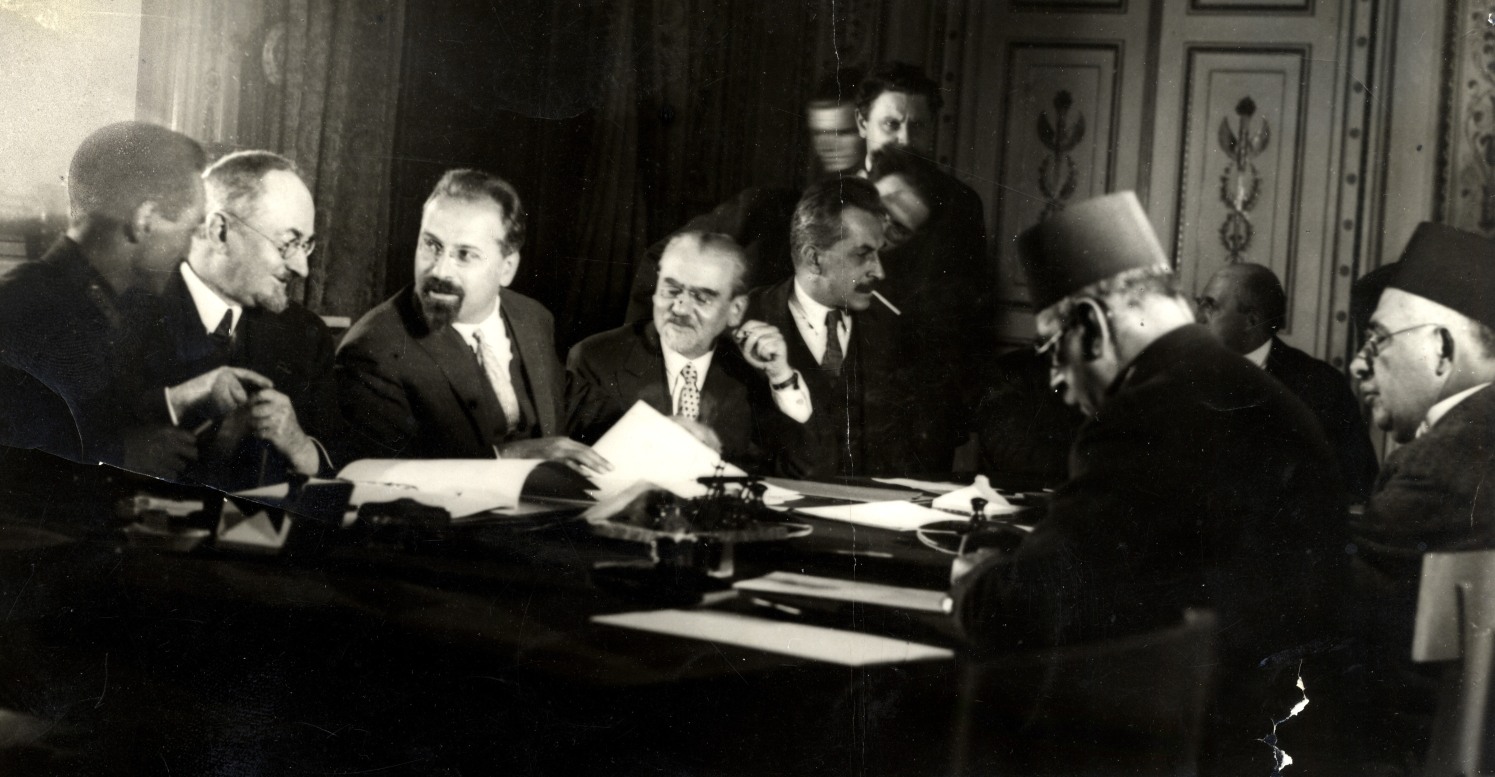
Before the Russian Revolution, the Czarist Empire exerted much influence in today’s Iran, with Britain becoming its main rival for dominance. After the Revolution, Britain still sought dominance while it also sought to build a cordon sanitaire around the Soviets, while the U.S.S.R., after the defeat of the Gilan Soviet Republic in northern Iran, mainly sought to keep Iran neutral. In 1927 the Soviet and the Persian governments signed a series of treaties, including a non-aggression pact, their significance is explained below.
‘The Treaty between Persia and the Soviet Union’ by Irandust from International Press Correspondence. Vol. 7 No. 57. October 13, 1927.
On October 1st, 1927, six documents of the greatest political importance were signed at Moscow by representatives of the Governments of the Soviet Union and of Paris. To give an idea of the significance of this event, let it suffice to point out that it marked the conclusion between the two Governments in question of a guarantee of neutrality, a commercial agreement (in the form of an exchange of notes), a customs convention, an agreement as to the fishing rights on the Persian shore of the Caspian Sea, an agreement regarding the port of Pehlvi and a lease contract referring to this port, concluded in the name of the Caspian Steam Navigation Company.
It is not possible to enter here into any detailed account of these agreements, wherefore we shall simply deal with their political significance, which extends far beyond the limits of relations between Persia and the Soviet Union.
While in the West we can observe a feverish activity on the part of the so-called Great Powers and their retainers with a view to masking the deep-rooted antagonisms by which the capitalist world is rent, to preparing for a renewed armed conflict for raw materials and markets, and to removing the menace of a socialist revolution, the Government of the Soviet Union gives proof, by each successive step it takes, of a foreign policy of a fundamentally different character. It is tenaciously and systematically endeavouring to pursue a policy of peace and of creative work, not only within its own borders but also in its international relations. The agreement of neutrality just concluded with Persia is a logical factor in this peaceful work of construction, which has already found expression in a series of other agreements, concluded by the Soviet Union with Turkey, Afghanistan, Germany, and Lithuania.
If for the Soviet Union the agreement with Persia represents a further step forward along the traditional path of a peaceful policy, it is of yet greater political significance to Persia. The present international situation is characterised by extreme tension and the accentuation of all differences underlying the international capitalist system.
British imperialism, which being in its decline has had recourse to a policy of imperialist adventurism, aspires to create a uniform bloc of the forces hostile to the Soviet Union and to organise a kind of crusade against the Soviet republics. One of the tasks of British diplomacy on the Eastern front was the inclusion of Persia in the chain of British dependencies, which was to have extended from the Mediterranean to the Indian Ocean. This chain, which Great Britain started to forge shortly after the end of the war, began in Egypt and was to have reached, by way of the Arabian mandatory States and Persia, as far as Beluchistan. Already from 1918 till 1920, the Persian link in the chain was firmly grasped in the hands Great Britain. The success of the Soviet Republics in their struggle against intervention and the blockade, and the establishment of friendly relations between the Soviet Union and Persia in 1921, thwarted the customary colonisation tactics of Great Britain, which aimed at the dismemberment of Persia and its conversion into a buffer-state or a rampart for Great Britain’s Indian stronghold.
It must be admitted that Persia is not yet sufficiently strong to withstand once and for all the disintegrating policy of British imperialism. Every step taken towards an emancipation from British influence costs Persia dear. Suffice it to recall the fact that the Persian policy of an approach to Turkey and the conclusion of a treaty with that State contrary to the interests of Great Britain, caused a series of Kurd revolts and provocatory actions on the Turco-Persian border, all of which were organised by the British military authorities at Baghdad.
A number of circumstances, however, have of late tended to show that Persia is accumulating internal forces enabling the country to pursue an increasingly independent and self-determined policy. One of the circumstances in question was the abolition of the capitulations, which was not very well received by British diplomatic circles. In this connection the British diplomats attempted to bring about the formation of a bloc against Persia by Great Britain, France, and Spain. Another fact in point was the steadfast refusal by the Persian government to submit to Parliament the question of war-indebtedness to Great Britain, as also Persia’s refusal to accede to the International Air Convention, under which the British “Empire Line” from London to Karatchi via Cairo and Baghdad would have been completed across Persian territory. All this led to violent attacks and complaints on the part of the British press, which expressed great dissatisfaction at the too independent spirit displayed by Persia in this connection.
Under this head we may also include the declaration of the Persian delegate at the League of Nations Council at Geneva regarding the participation of Persia in the interpretation of Article 16 of the League of Nations statutes in the sense of Locarno, and also the participation in sanctions ordained by the League. It will be remembered that at one of the latest sessions of the League of Nations Council the Persian delegate seconded the protest of Finland against the interpretation in the sense of Locarno of the obligations of Germany based on Article 16. The present attitude of Persia in this matter proves that its Government has recognised the danger threatening the weak States through their unwilling participation in international conflicts prepared by the great imperialist Powers, even though based on the pretext of Article 16 of the League of Nations statutes. True, the same delegate declared at Geneva that Persia did not consider the conclusion of treaty agreements between individual States as contrary to the principles of the League of Nations.
In discussing the recent events pointing to a desire on the part of Persia to pursue an independent policy, there should be mentioned the measures adopted by the Persian Government against the activity of the White-Guard emigrant organisations on Persian territory.
The possibility of a systematic independent policy on the part of Persia ultimately depends on the consolidation of its economic position and the attainment of a certain economic independence. The latter fact in particular would form a serious obstacle to all attempts of the imperialist Powers to convert Persia into a suitable area for marshalling their array.
For these reasons the conclusion of the economic and commercial treaties between the Soviet Union and Persia is likewise of the utmost political importance. These agreements are just as much factors of peace as is the treaty of neutrality. By establishing conditions of economic co-operation between Persia and the Soviet Union, they strengthen the economic hinterland of both these States and create the presumptions for a speedier growth of the independent and national elements of Persia, thereby securing for that country the possibility of an independent course in home and foreign politics by depriving Great Britain and the other leading capitalist Powers of the chance of using Persia as a tool in their imperialist intrigues, so dangerous to international peace. Therein consists the international significance of the treaties signed on October 1st by Persia and the Soviet Union.
International Press Correspondence, widely known as”Inprecorr” was published by the Executive Committee of the Communist International (ECCI) regularly in German and English, occasionally in many other languages, beginning in 1921 and lasting in English until 1938. Inprecorr’s role was to supply translated articles to the English-speaking press of the International from the Comintern’s different sections, as well as news and statements from the ECCI. Many ‘Daily Worker’ and ‘Communist’ articles originated in Inprecorr, and it also published articles by American comrades for use in other countries. It was published at least weekly, and often thrice weekly.
PDF of full issue: https://www.marxists.org/history/international/comintern/inprecor/1927/v07n57-oct-13-1927-inprecor-op.pdf
 Revolution's Newsstand