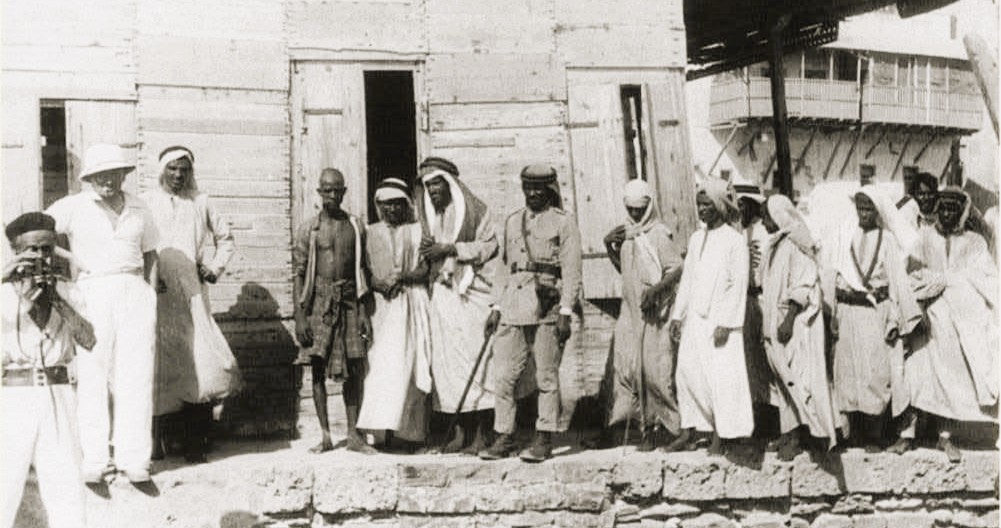
The war between Saudi Arabia and Yemen has been fought before, and as before it was imperial interests which were decisive in the conflict. Important background for today’s events which are clearly an echo of the past, involving similar forces and global consequences. A look at the 1934 between British-backed Ibn-Saud’s Wahabi kingdom of Saudi Arabia and Imam Yahya’s Italian-back Zaydi kingdom in Yemen.
‘The War for Imperialist Domination in Arabia’ by Lam-Aliff from International Press Correspondence. Vol. 14 No. 33. June 8, 1934.
Serious events are taking place on the Arabian Peninsula, between the Persian Gulf and the Red Sea, which separates Asia from Africa. Two peoples, both of whom are of Arab nationality, have been at war with each other for a year. One inhabits Nejd and Hejas, with the sacred Mohamedan towns of Mecca and Medina, and the other inhabits Yemen, the richest district of Arabia, the “earthly paradise” of the Koran. Nejd and Hejas are ruled by King Abd El Aziz Ibn Saud, the spiritual leader of the Mussulman sect known by the name of “Ahuwan” (brothers) or “Wahabits,” after the name of their founder, Wahib. Yemen is under the rule of the Imam Jahia Ben Hamid, who belongs to the first of the two sects into which the world of Islam is divided: Sunnits and Schiits.
Those who wish to absolve themselves of responsibility for the events taking place in Arabia maintain that they are due to religious rivalry. Others attempt to explain them as being due to the personal ambitions of the two oriental despots. Without denying the existence of these factors, we assert that they are not the causes of the war. Another factor must be mentioned: the economic, and therefore decisive, factor, namely the interest which the population of Nejd, a poor and almost desert area, might have in conquering the rich and fertile territory of Yemen.
There is no doubt that the imperialists are exploiting this factor. It would, however, be a mistake to look for the causes of the war in Arabia in the interests of its population. For in Arabia, as in all colonial countries, the interests of the imperialists are the dominating interests.
India is the richest and most important colony of the British Empire. The policy of Great Britain in the Near East, and before all in Arabia, aims in the first place at securing the routes to India. Arabia, owing to its geographical situation, commands the sea and air routes to India.
If one also takes into account the oil deposits and other natural wealth of the peninsula one will easily understand that British imperialism has every reason to endeavour to bring Arabia under its domination.
In 1916 Great Britain induced the Arabian tribes to engage in a “holy war” against Turkey for the independence of Arabia. This revolt was headed by the sheriff of Mecca, Hussein El Haschimi, to whom Great Britain promised the throne of united Arabia and the Califate of Islam. This, however, did not prevent Great Britain. from handing over Palestine to the Zionists and dividing the Arabian Peninsula into several emirates.
In view of the dissatisfaction of King Hussein, which was to be attributed chiefly to the pressure exerted by the masses who were disappointed in regard to the promises made to them, the British imperialists incited Ibn Saud (at the time Emir of Hejas) against King Hussein, whom he dethroned and in 1924 banished to Cyprus, where in the meantime he died.
Later on differences arose between Great Britain and Ibn Saud, who refused to sign the treaty submitted to him by the British Ambassador, Sir Gilbert Clayton. And then, as if by the touch of a magic wand, a revolt broke out in Hejas, led by the Sheik Ibn Reffad against Ibn Saud. Serious rivalries arose between Iraq, which at that time was a mandated territory administered by Great Britain and Hejas. Guerilla warfare broke out on the frontier between Hejas and Transjordania, which is likewise a mandatory State of Great Britain. At the same time Egypt, which is controlled by Great Britain, boycotted the pilgrimages to Mecca, which did serious harm to Hejas, which lives to a great extent on the pilgrims. This state of affairs lasted until 1929, at which time Ibn Saud again entered into negotiations with Great Britain, and was later induced to sign the treaty which he had rejected.
Step by step Great Britain occupied Aqaba, Oman, Aden and Basra and brought them under its direct rule. It converted them into important fortresses. In this way, at the moment when the conflict between Yemen and Hejas broke out, there were on the Arabian Peninsula only two kingdoms–that of Ibn Saud and that of Imam Jahia–which had preserved a semblance of independence. The war between these two countries has its origin in the intentions of British imperialism to conquer Arabia completely.
Opposite Yemen, on the coast of Africa, on the other side of the Red Sea, is situated the Italian colony of Eritrea. The fascist State, which is seeking a way out of its insoluble crisis in imperialistic expansion in Asia and Africa, has chosen Yemen as a point of support for penetrating into Arabia. For this purpose fascist Italy, making use of Great Britain’s difficulties with Ibn Saud (in the year 1926), induced the Imam of Jahia to sign a treaty of “friendship.” Under this treaty numerous Italians settled in Hodeida, which became an important port for Italian trade in Arabia.
British imperialism, as a means of meeting this threat of its Italian rival, attempted at first to disturb the friendship between Yemen and Italy. It succeeded in this to a certain extent, for in the years 1930 and 1931 conflicts arose between the two “friends.” On one occasion the Imam even expelled an Italian medical commission from his capital. Italy, on its part, did not remain inactive. In 1932 it signed a treaty with Ibn Saud, and at the same time his son, who is now leading the action against Yemen, was given a pompous reception in Italy. Shortly afterwards a conflict broke out between Yemen and Hejas over Asir, an emirate lying between the two countries. This conflict developed into the war which we are now witnessing. The hostilities between the two Arab countries are being followed from the immediate neighbourhood by the warships and aeroplanes of the imperialist rivals, who are supplying the belligerents with weapons and ammunition.
France, on its part, is no longer remaining indifferent to these events. It must not be forgotten that the route to India is at the same time the route to Indo-China, the “pearl” of the French colonial empire. At the same time, Aden lies opposite Jibuti and French Somali. Finally, the construction of the Haifa-Baghdad railway evokes a regular fight between France, which possesses Syria, and Great Britain for the traffic to Iraq and Persia.
That France is not remaining passive in the war in Arabia is proved by the fact that, for the first time since the world war, it has paid Ibn Saud the contribution due from Tunisia for the sacred places. France is now discussing the disarmament question with Italy and Great Britain. These negotiations are not without influence on its attitude to events in Arabia. The wars in Morocco and Arabia, like the wars in China and in Latin-America, are only preludes to the world war which is germinating on these remote battlefields.
An analysis of the facts clearly reveals that the essential factor in the war in Arabia is the struggle of British imperialism for its domination. This fight is not going on without collisions: collisions with its imperialist rivals, collisions with the national emancipation movement of the Arab masses.
All this creates a complicated and, at times, confused situation. British imperialism does not shrink from employing any means in order to achieve its aims. We have seen how, during the world war, it carried on propaganda for the independence of Arabia. To-day we see how it is attempting to make use of the strong Pan-Arab movement, the champion of which is Ibn Saud. Great Britain is not fighting for the hegemony of Ibn Saud or of the Imam Jahia, but is endeavouring to weaken them both in order to render them more subservient to its will.
The national revolutionary movement has already repeatedly frustrated the imperialist plans in Egypt, in Arabia, in Palestine, and only recently also in Syria, where the French government was compelled to abandon its plan to conclude an enslaving treaty with the native feudal landowners and reactionaries. The fact that British imperialism is compelled to resort to the Pan-Arab movement in order to achieve its purposes proves the strength of this movement. The Pan-Arab movement which is playing a big role in the events in Arabia, will become stronger precisely as a result of the policy of the imperialists, by the uniting of Yemen and Hejas under one single rule. But the creation of an independent federation of the Arab countries will not be undertaken either by Ibn Saud or any other Arab king. It will be the result of the revolutionary fight of the Arab masses against the imperialists and their native lackeys.
International Press Correspondence, widely known as”Inprecorr” was published by the Executive Committee of the Communist International (ECCI) regularly in German and English, occasionally in many other languages, beginning in 1921 and lasting in English until 1938. Inprecorr’s role was to supply translated articles to the English-speaking press of the International from the Comintern’s different sections, as well as news and statements from the ECCI. Many ‘Daily Worker’ and ‘Communist’ articles originated in Inprecorr, and it also published articles by American comrades for use in other countries. It was published at least weekly, and often thrice weekly.
PDF of full issue: https://www.marxists.org/history/international/comintern/inprecor/1934/v14n33-jun-08-1934-Inprecor-op.pdf
 Revolution's Newsstand