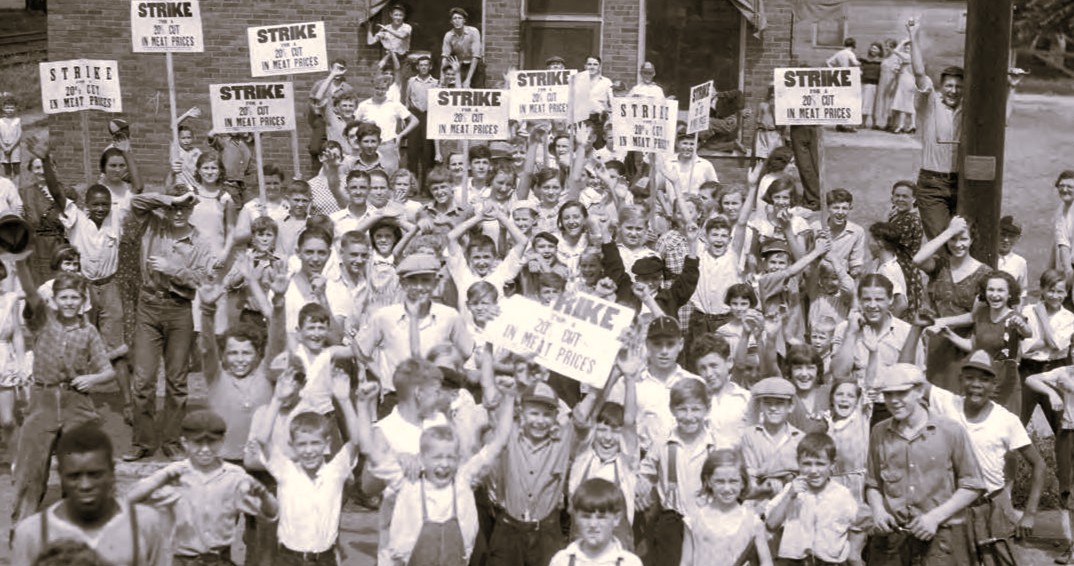
A struggle exemplary of Communist community organizing during the 1930s. The inside story of how the Party organized the Hamtramck, Michigan ‘meat strike’ in 1935. Led by Mary Zuk, who would later win a seat on city council, and largely involving Polish women, the Detroit-area working class neighborhood fought high food prices during the Great Depression.
‘How the Meat Strike Started in Hamtramck’ from Party Organizer (C.P. Internal Bulletin). Vol. 8 No. 9. September, 1935.
By Section Organizer, Section 8, District 7
THE Party Section Committee was aware of the high cost of necessary commodities of life, and the sentiment of the people against it. Early in June when our Section Committee discussed the three month plan of work we made it a point to fight against the high price of meat. It was decided to call a conference of all women’s organizations to take up the question of meat, but the conference was delayed from one week to another. Finally the Section Committee assigned one comrade of the Section to attend the meeting of the working women of Hamtramck, to convince the women that action must be taken. There was some pessimism expressed that our group was too small and that it would be too big a job to undertake because of the insufficient forces in our organization. Some of our people believed that the people of Hamtramck would not support the strike movement.
Party and non-Party women were called to the Section Committee meeting, and we planned with them the calling of a mass meeting. A committee of women comrades and non-Party members issued five thousand leaflets calling for a mass meeting on Friday, July 19, 1935, at the Polish Falcons Hall. The leaflets were issued in the name of the Provisional Women’s Committee Against the High Cost of Living, and were distributed by five women and six men who went from house to house knocking at the door explaining the purpose of the meeting, and asking the people how they felt about the high cost of meat. The general opinion of the workers was that something must be done against the high cost of meat.
The housewives’ response to this meeting was very good, about 400 women attending; an announcement was also made through the Polish hour radio W.M.B.C.
At this meeting twenty-five women volunteered to serve on the Committee of Action. Resolutions adopted to protest the high cost of meat were sent to President Roosevelt and Secretary of Agriculture, Mr. Wallace, demanding action in order to reduce the cost of living. A resolution was also presented to Mayor Lewandowski and the Common Council of Hamtramck, in order to state their position in regard to the strike action against the high cost of meat. A Committee of Action comprising 25, and supported by other women visited the council meeting where Mary Zuk, chairman of the Committee of Action, spoke on the resolution. The City Council spoke favorably on the issue and decided to send resolutions to President Roosevelt and to the Michigan Congressmen, requesting that something be done in regards to the high cost of meat.
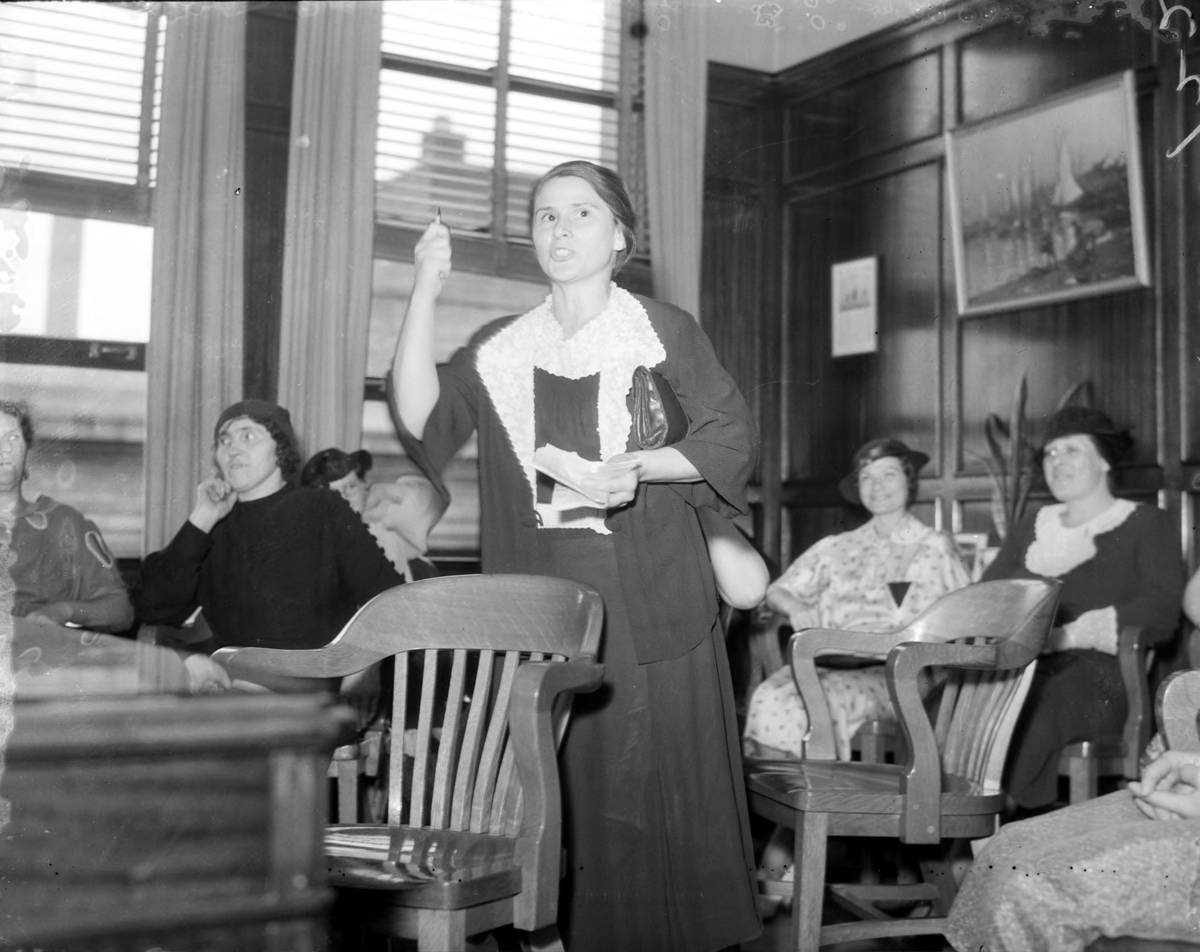
In the discussion with our comrades to take strike action immediately, the Action Committee decided to call a larger mass meeting on July 26, and requested the Board of Education to grant them the school for this meeting. The committee was granted the Copernicus Sehool. It was the first time in the history of Hamtramck that workers ever had an opportunity to use a public school to discuss their problems.
During the discussion of the second mass meeting at the Copernicus school (Friday, July 26) a proposal for immediate strike action to begin on Saturday, July 27, was met with some opposition. This opposition believed that the time was not yet ripe and more time was necessary in order better to prepare ourselves. With the help of the District our comrades agreed at this meeting to take a strike action vote for Saturday, July 27. The meeting at the school was very successful; twelve hundred women attended. It was an historical meeting. Never before on any issue were we able to mobilize so many women into one meeting. A fighting spirit prevailed among all the women present at the meeting.
Women members of the Action Committee gave reports and proposed to strike the next day, Saturday, July 27. After discussion from the floor it was unanimously resolved to take strike action. The membership of the Action Committee was increased to sixty. Women, who never spoke in public and did not think they were capable, became not only fine speakers but leaders of the strike. This strike involved about 75 per cent of the city’s population of 48,000.
Meat Strike Aimed at Big Packers
Four days before the strike, women delegations visited small butchers asking them if they were willing to support them in the strike. Ninety-three butchers signed up and agreed to close their shops, thinking that the women would not be able to stage a successful strike. On Saturday, the day of the strike, all the butcher shops were open in the morning. Only when the militant women pickets stopped people from buying were the butchers forced to close. Over 8 per cent of the butchers shops were closed by evening, due to the militant picketing which kept all purchasers from the stores.
The first day of the strike was a tremendous success (even the bourgeois papers admitted this in their issues). After the first meat strike day in Hamtramck the movement spread all over Detroit. The Action Committee called upon the Detroit women to strike the following Friday and Saturday. First, action was taken in North Detroit, a district adjoining Hamtramck, where the militant picketing of Hamtramck housewives was duplicated and resulted in the closing of butcher shops. Additional communities in the suburbs–Dearborn, Lincoln Park, Delray, and other districts of Detroit—took action at the same time.
This strike shows the correctness of the Party line. With very little effort on our part, and with correct and prompt application of the Party line, we can mobilize the people against the high cost of living and Roosevelt’s starvation program.
It is high time that our comrades dropped the idea that the masses are dumb and will not act in their own interests. Such an attitude must be fought tooth and nail wherever its exists. Another weakness among Party members in the mass organizations was to regard the strike as only a woman’s affair and leave the picketing to the women. In such a struggle every comrade must raise himself to the highest levels of endeavor, and help the women in every way that he possibly can to mobilize and organize bigger and better groups of people.
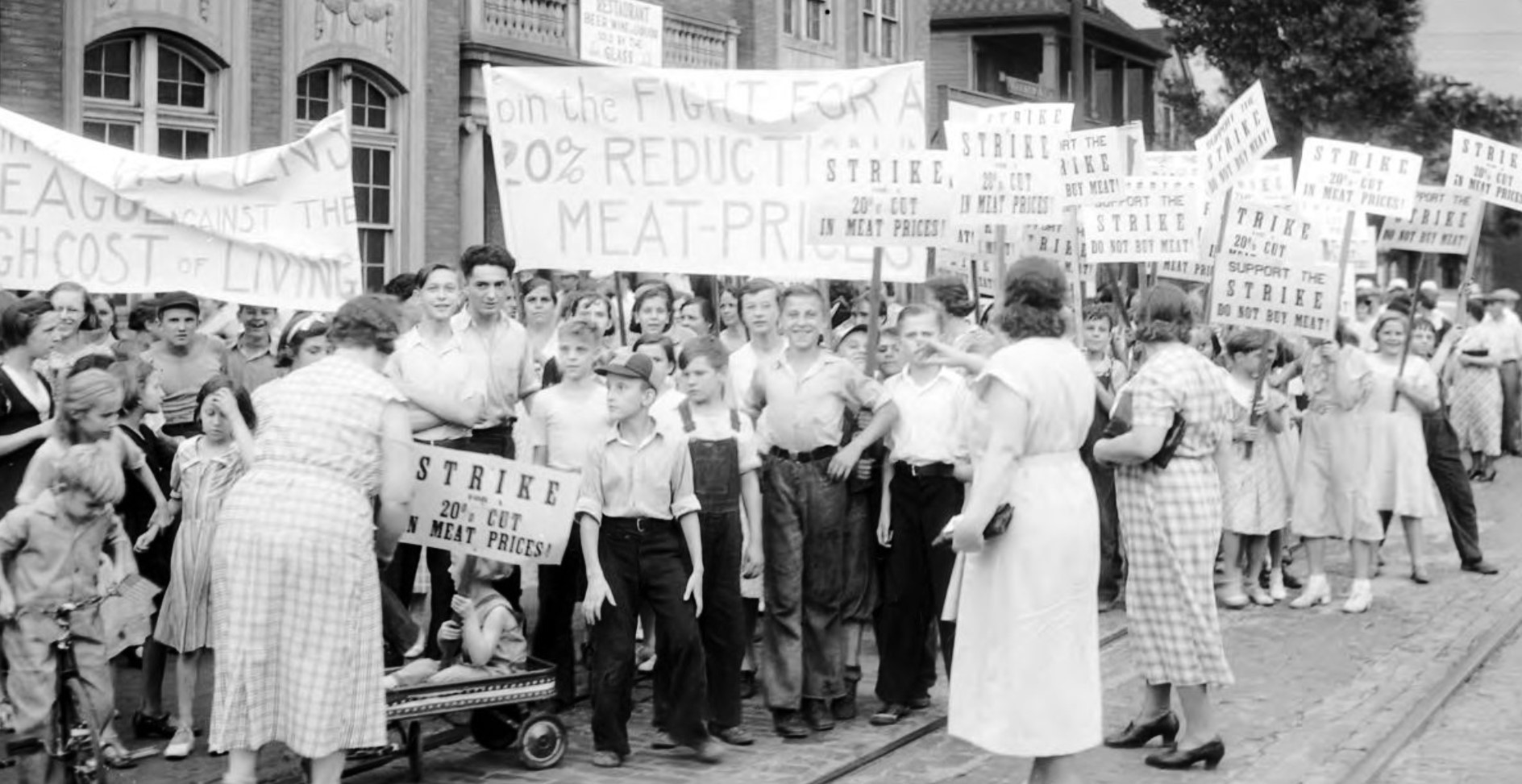
It is interesting to note how the women conducted their activity every day of the week. Each evening the Action Committee met at 6 p.m. during which time they discussed practical steps. After about an hour and a half they broke up into groups, each group going to a designated place for an open air meeting. They marched through certain streets with signs and called upon people to attend the open air meeting, and within 15 or 20 minutes they would have a crowd of between 200 and 400 people. New women got up and spoke at these meetings. That is the way new speakers and leaders are developed.
After the first day of the strike all the bourgeois papers attacked the strike as “communist led.” Their purpose was to scare away new elements and break the strike. In this effort they were not successful. Our reply was that the strike was not only for Communists but for everybody who eats meat. Nobody is asked to state his political belief, whether Democrat, Socialist, Communist or Republican, or whether he goes to church or not, but we ask everybody who wants to support the meat strike to join our organization. We also said we have Communists in our ranks who are good fighters and we are glad to have them. These points were brought up at every meeting, in a special Strike Bulletin, a two-page paper selling for a cent that went like wild fire, and in special editions of the Trybuna Robotnicza (Polish workers paper).
When the reactionary forces attacked the strikers as Reds, we called an open-air mass meeting and parade. Close to 2,000 people, mostly women, participated. Though the parade was to end at the City Hall, it continued right on through all the main streets of the city due to its great enthusiasm. A loud speaker led the parade issuing slogans and calling on the small retail butchers for unity with Hamtramck women.
When the meat strike spread to Detroit, the task was to unify all the local Action Committees into one (Wayne County Committee). Now this committee is leading and spreading the strike throughout the county. With the strike in full swing the Women’s Action Committee decided to build the Women’s League Against High Cost of Living, with membership books and dues of 5 cents a month. In order that the strike be successful the main point stressed was the necessity of building block action committees in Hamtramck. Ten places were selected for concentration and women were assigned to organize and be responsible for the women in that section. The success of the strike now depends on the organization which must be built in the neighborhoods and through them of winning a greater number of people.
Our Party members must pay due tribute to the splendid work of the women in this strike and particularly to the women Party members. They showed us how the job can be accomplished, that they know how to fight and are willing to fight. Husbands in the Party must not abuse their wives any longer by allotting them a minor role in the movement. It is only Hitler who wants them to stay in the kitchen and take care of children. The women have given us a lesson, showing us that they can do more than men. They are not only able to take care of the home and the children, but are willing and capable of fighting for better living conditions, filling their position better than men.
This tremendous mass movement against the high cost of meat must also be accredited to the work carried forth by the Party fractions and close sympathizers. These met regularly during the strike and, with the assistance of active Party members, discussed and helped solve the problems confronting them to the best advantage of the revolutionary movement.
The Party Organizer was the internal bulletin of the Communist Party published by its Central Committee beginning in 1927. First published irregularly, than bi-monthly, and then monthly, the Organizer was primarily meant for the Party’s unit, district, and shop organizers. The Organizer offers a much different view of the CP than the Daily Worker, including a much higher proportion of women writers than almost any other CP publication. Its pages are often full of the mundane problems of Party organizing, complaints about resources, debates over policy and personalities, as well as official numbers and information on Party campaigns, locals, organizations, and periodicals making the Party Organizer an important resource for the study and understanding of the Party in its most important years.
PDF of full issue: https://www.marxists.org/history/usa/pubs/party-organizer/v08n09-sep-1935-Party%20Organizer.pdf
 Revolution's Newsstand