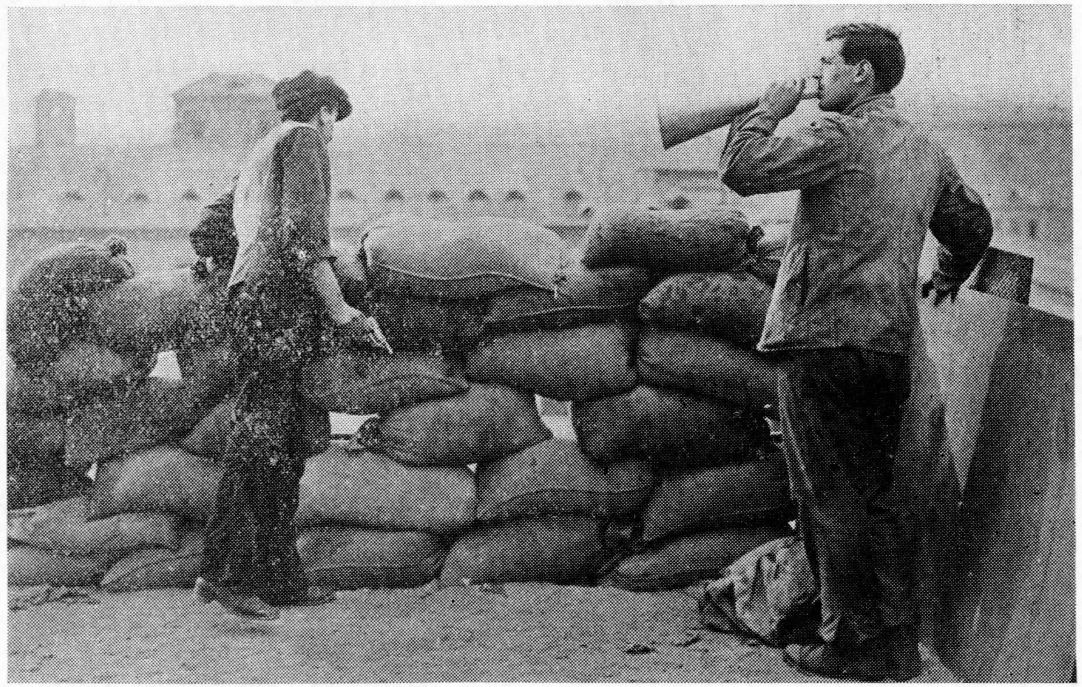
Pankhurst reports from Gramsci’s ‘Red Turin’ during Italy’s post-war Biennio Rosso revolutionary wave.
‘Italy and the Revolution’ by Sylvia Pankhurst from The Communist (C.P.A.). Vol. 1 No. 7. November 15, 1919.
“ITALY is already in a state of Revolution,” said a Hungarian comrade who took an active part in the revolutionary agitation which preceded the creating of the Hungarian Soviets.
“Italy is to-day what Hungary was last year. The same revolutionary types are emerging. There is the same high cost of living the same scarcity of necessaries, the same unemployment, both civil and military.”
The struggle for Fiume, he declared, will hasten the military disorganization; soldiers who wish to desert will go to Fiume or, more often, allow it to be thought that they have gone there. The excuse will be acceptable to the officers, who approve the annexation. D’Annunzio has set with impunity an example of insubordination which others will follow. The Army and the Government have taken opposite sides upon the Fiume question; therefore a wedge has been driven between the Government and its military forces, which may lead to a wide gulf. The nationalist spirit of Italy has been aroused, and that spirit will eventually break loose from restraints and dash onward to the formation of a, nationalist Republic. Thus will come the bourgeois revolution. After that Italy, suffering unde: the blockade which the other Allied nations will apply by way of punishment, will pass on to the rising of the masses, the dictatorship of the proletariat, the Soviets, and Communism.
Fiume is coveted by Italian capitalists, because the possession of this port would facilitate Italian trade with Central Europe and the provision for Italy of coal, oil and other needed raw material. Italian Imperialism probably thinks also that an Italian Fiume may be the jumping-off place for future conquests. Italians believe that British Imperialists are opposed to the Italian possession of Fiume, because Britain could secure more control over the port and the territory behind it if it were held by a weak newly created Slav nation than by Italy.
Therefore Italian nationalism, stimulated by the press, flares up on the Fiume question. Even some of the Italian private soldiers are asking: “Of what use is the League of Nations when it allows Britain and France to make great gains by the war and refuses this to Italy?”
On the other hand, Socialist comrades speak also of other tendencies. Italy was but recently a nation; there is a movement in her component parts to break away under the debts and scarcity which are the harvest of the war. Should any part of the old kingdom break away, it would repudiate its share of the war debts of United Italy; this is an inducement to disunity. Should one of the old kingdoms break away, it would call itself a republic and make a pretence of setting up a democracy; that is a necessary pretence of the present day. But there is no half-way house to democracy in times of scarcity; it is either share and share alike, or the rich seize the major portion whilst the poor die of want. In face of famine and danger there are only two alternatives–the Soviets or the dictatorship of the rich.
Whilst in Italy the capitalist State is struggling with the overpowering difficulties created by the war, the movement of the proletariat is growing apace in numbers, in strength, in coherence, and in strength and definition of purpose.
་The Workers’ Movement in Turin.
In the city of Turin the Socialist Party has 1,000 members, of whom about 50 only are women. The members’ subscription varies according to the occupation of the member; students and manual workers pay 70 centesimi per month, professional men pay 5 lire a month. Every member must belong also to the national Socialist Party, for which the subscription is 2 lire a year. Those who desire to join the party must sign its programme, and no one is received as a member who has belonged to any capitalist political party within a year at least. Members of the Socialist Party must belong to a Trade Union if there is one which they are eligible to join.
In addition to the Socialist Party of Turin, there are 25 Socialist Clubs which together have a membership of 5,000. Every member of the Party must belong to a Socialist Club, but members of the Clubs need not join the Party. The Clubs are in fact recruiting and training centres for the Party. Each Club has its own premises and comprises 3 divisions:
1. Adult men.
2. Youths between 14 and 25.
3. Women and girls over 14 years.
***
Upwards of 300,000 discharged soldiers have been organized into a Socialist organization for disabled soldiers. This work has been largely done by Young Socialists. It was found that there was a natural tendency for the discharged soldiers in the villages to meet together to discuss their war experiences, and since they belonged to all sorts of varied occupations–cobblers, blacksmiths, and so on–and as many were unable to work at all, it was found easier to link them together in a discharged soldiers’ organization for Socialism. There is also a bourgeois organization for discharged soldiers.
***
In Turin the Majority Socialist movement stands for the Soviets, and believes in the necessity of insurrection. In the Camera del Lavoro, a meeting was being held the night we were there, to discuss the military organization of the workers.
There are three main currents in the Italian Socialist movement:
1. Those who believe that Socialism can be won through Parliament, and desire to obtain a Parliamentary majority for the Socialist Party.
2. Those who wish to establish the Soviets, and desire to use Parliamentary action for propaganda purposes only, who believe that the Socialist aim is not curing a majority; they consider that eventually an insurrection will be necessary.
3. Those who believe in abstaining from Parliamentary action altogether and in bending all energies now towards preparing for the Soviets and the insurrection.
In Turin the last two factions predominate, but it is important to notice that all three sections belong to the one Socialist Party.
Pietro Rabuzzana, the Secretary of the Turin Socialist Party, and Gramsci, the Editor of “L’Ordine Nuovo,” a new pro-Soviet weekly, both advocate Parliamentary action for propaganda purposes. Rabuzzana and others are agitating that it shall be a rule of the Party that all Socialist Members of Parliament, as a condition of their candidature, shall place in the hands of the Party Executive a signed letter of resignation from Parliament, which the Executive may at any moment send to the Government, and thus, secure the withdrawal of the M.P. if the Party thinks that he has deviated unduly from the policy of the party. This plan, it is contended, would preserve party discipline amongst Socialist Members of Parliament and would insure their adhesion to the principles of the Socialist Party.
Gramsci, on the other hand, though not a single Italian Socialist Member of Parliament is satisfactory from his standpoint, thinks little of this proposal. He rightly says that should a Member of Parliament betray the Socialist Party and the Party then cause resignation, the forces of reaction would combine to support him, and he would probably be returned. Gramsci bases his advocacy of Parliamentary action rather on the argument that if the Socialist abstain from such action, the workers who are not yet advanced enough to look beyond Parliament will drift away from the Socialist Party and come under capitalist influences. He urges also the propaganda value of election work, saying that the censorship has checked1 propaganda, but that election propagandists need not fear the censorship.
The time of the election contest is the time, he declares, in which the workers are most revolutionary. The instances of coercive manipulation of the elections cited to us made this easy to understand.
At Iglezia, in Sardinia, we were told, the miners supported a Socialist candidate. The police went to one of the miners’ meetings, and slipped knives into the pockets of Socialist enthusiasts, marking the coats of these same men with chalk. The men whose coats were marked with chalk were presently arrested, and as they were of course found to be in possession of illegal weapons, they were imprisoned until after the election day. At Gioia del Colle between 500 and 600 Socialist electors were imprisoned over the day of the election. In another district a table was placed across the entrance to the ballot box. Supporters of the Government were allowed to enter by crawling under the table, opponents of the Government were beaten back with sticks and prevented from voting.
The Italian General Election has been called by the Prime Minister, Nitti, because he cannot solve the Fiume question to the satisfaction both of the Italian bourgeois opinion and of the Big Four.
Gramsci and others believe that the result of the present election will be the return of a larger band of Socialists, the elimination of the Liberals, an increase in strength for the parties of reaction, including the Christian Socialists, whom they allege to be more reactionary than the Liberals, and who they believe will secure a larger number of seats by promises which they will be unable to fulfil. A strongly militarist Government is anticipated and it is believed that this may goad the Italian workers to insurrection.
Emulating the Bolsheviks who changed the name of their party in 1918 to the Communist Party, there were up to a dozen papers in the US named ‘The Communist’ in the splintered landscape of the US Left as it responded to World War One and the Russian Revolution. This ‘The Communist’ began in September 1919 combining Louis Fraina’s New York-based ‘Revolutionary Age’ with the Detroit-Chicago based ‘The Communist’ edited by future Proletarian Party leader Dennis Batt. The new ‘The Communist’ became the official organ of the first Communist Party of America with Louis Fraina placed as editor. The publication was forced underground in the post-War reaction and its editorial offices moved from Chicago to New York City. In May, 1920 CE Ruthenberg became editor before splitting briefly to edit his own ‘The Communist’. This ‘The Communist’ ended in the spring of 1921 at the time of the formation of a new unified CPA and a new ‘The Communist’, again with Ruthenberg as editor.
PDF of full issue: https://www.marxists.org/history/usa/pubs/thecommunist/thecommunist3/v1n07-nov-15-1919.pdf
 Revolution's Newsstand