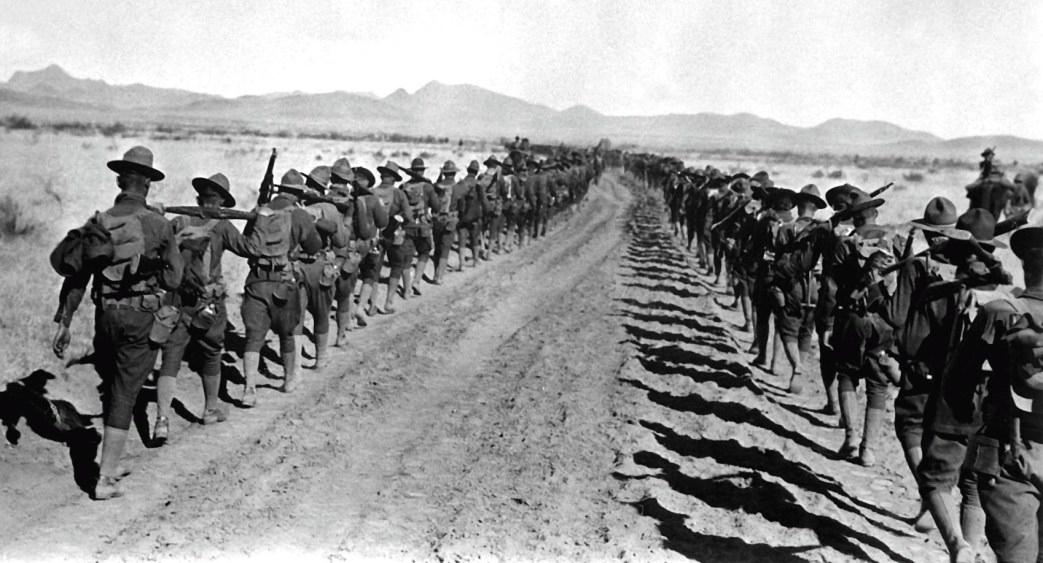
It was the Mexican Revolution, not the Russian, that first transformed understandings of imperialism, agents of change, and means of struggle for many U.S. activists. Comrades like Louis Fraina met the Russian Revolution of 1917 having already sought to understand the Mexican Revolution and the role of the United States, while also actively participating in its events. Fraina would remain deeply invested in Mexican politics; writing a dozen articles, organizing solidarity meetings, and later debating the nature of the Mexican Revolution with John Reed at the Comintern. In 1921 Fraina was assigned to Mexico City by the C.I. in aid of the fledgling Communist Party, where he lived until 1923.
‘Mexico and American Imperialism’ by Louis C. Fraina from Class Struggle. Vol. 3 No. 1. February, 1919.
While President Wilson in Europe indulges his favorite sport of promoting democracy in words—while preparing to accept fundamental Imperialism in fact—the sinister interests that skulked behind the ideology of the war are actively preparing to make the world safe for American Imperialism.
The war has ended America’s “splendid isolation”—ended it, not because of democracy and for purposes of democracy, but because of Imperialism and for purposes of Imperialism. The Capitalism of no belligerent nation—with the incidental exception of Japan—has profited the way American Capitalism has. Capitalism in Russia has been annihilated; Capitalism in Germany is on the verge of being annihilated; the Capitalism of Great Britain, France and Italy is staggering under a disastrous national debt, apprehensive of the approach of proletarian revolution, overwhelmed by the problems of resuming industrial and trade relations. American Capitalism alone is bloated, aggrandized, supreme. From a debtor nation, the United States has become a creditor nation, France and Italy being virtually its financial vassals; its Capitalism has monopolized the foreign markets of its beloved allies, while industry has been given a tremendous impetus, finance acquired a new vision, and Imperialism developed more savage appetites.
There was much criticism of President Wilson’s “democratic” program; but it is now being made apparent to the critics that this “democracy” is the characteristic expression and necessity of American Imperialism. This, of course, alters the case; and while the peoples of Europe, who have been captivated by the words of democracy, are being prepared for a great deception, American Imperialism is preparing to satiate its appetites and acquire supremacy…
Mexico, which is considered by the imperialist as “our Balkans,” is again appearing as the immediate objective of American Imperialism. The New York Evening Sun says editorially, in its issue of December 26:
“With his usual acumen and his familiar directness of speech, Colonel Roosevelt goes right to the point when he says that ‘Mexico is our Balkan Peninsula. Some day we shall have to deal with it.’
“The letter of our correspondent, Mr. Gardner, gives one concrete reason why Colonel Roosevelt is right. The American owned company which he represents has over 2000 stockholders. Their money was invested in good faith in a legitimate industry. But, says Mr. Gardner, the property ‘has been non-productive for the past five years,’ owing to the lawlessness, banditry and Governmental incompetence, to use no harsher word, in Mexico. The rubber company’s experience is but a small item among many, but it means an injury to thousands of our own people, as well as dangerous economic anarchy to the Mexican himself. Some day, as Colonel Roosevelt says, ‘we shall have to deal with it.’”
The correspondent is D.H. Gardner, Vice-President of the Obispo Plantation Company, and the gist of his appeal is this:
“Lives have been sacrificed, property has been destroyed, industries abandoned and foreign capital appropriated or rendered unproductive, all to no purpose whatever, for Mexico appears to be utterly incompetent to establish for herself a stable Government or afford protection to life and property worthwhile. Is it not time for the peoples of other nations to take a hand for the good of Mexico herself, and is it not the plain duty of other Governments to see to it that money invested there by their subjects be properly protected and safeguarded in accordance with international law?”
Strange—international law has during the war been invoked against Germany for its invasion of Belgium; now it is invoked to justify an invasion of Mexico and its conquest—for that is precisely what the gentleman proposes…
Memory informs one that intervention in Mexico was proposed some years ago because that “unhappy country” was being “ravaged by revolution,” and that revolution was a menace to all. But now the revolution is no more—revolutionary ideals have decayed and become maggots. The regime of Carranza, according to all reports, is a brutal one, using the utmost in violence against the workers and the peons, the methods of suppression used by American Capital at Ludlow, at McKees Rocks, at Passaic. The Mexican Government is a typical government of Capitalism, of bourgeois law and order. Accordingly, the American press, church and capital should praise, bless and encourage this government after their own heart. Why do they not? Because the Carranza Government insists that the larger share of the profits sweated out of the Mexican workers and peons should go into the pockets of the Mexican exploiters. The Carranza Government is trying to make Mexican Capitalism national and independent, instead of being a satrapy of international Imperialism. But this, clearly, means that foreign investors, particularly the innocent, religious and meek American investor, does not squeeze profits out of his investments as easily and plentifully as one squeezes juice out of an orange. “We shall have to deal with” Mexico!
The American Government, in April 1918, through Ambassador Fletcher, threatened the Mexican Government with action should it continue to impose control upon foreign capital. This apparently was unsuccessful—and armed intervention is being proposed in place of diplomatic intervention.
Why—to protect capital, to insure profits, to make Mexico safe for American Imperialism, and then the world! All this, of course, is in the approved style of German Imperialism; but instead of stigmatizing “our” imperialists as being “pro-German,” they stigmatize Mexico. As a fact, all Imperialism, in one way or another, pursues the policy of the former predatory Germany.
The organizations of American Imperialism are making elaborate plans for imperialistic conquests, and using the government as an instrument of Imperialism;—which means, ultimately, the blood of the American proletariat in new wars to make the world safe for—? In a recent issue of The Nation, William S. Kies, vice-president of the American International Corporation, a characteristic instrument of American Imperialism, says that “our” bankers should be free to make both political and non-political loans, and describes political loans as “loans carrying with them port or harbor concessions with powers of administration and the collection of charges; the granting of large areas of land for purposes of exploitation with complete power of control and government; the giving of franchises for the construction of important and strategic railways, conferring upon the lender complete control in the management and administration; and the granting of monopolistic privileges of various kinds.”
This is Imperialism; this is precisely the policy pursued by the European nations that provoked the recent war; this is the policy characteristic of American Capitalism, and not the words of democracy perfervidly uttered by President Wilson.
Thus is the policy each imperialistic nation will pursue, provoking new antagonisms and new wars. But this is not all. While “our” peace delegates—Woodrow Wilson and his secretarial staff—speak beautifully about self-determination of peoples in Europe, there is not even a murmur concerning self-determination for the peoples of Central America and the Caribbeans, prostrate under the iron heel of American Imperialism; instead, there is an aggressive campaign to impose “American determination” upon Mexico. Colombia, Nicaragua, Haiti, Santa Domingo—to say nothing of the Philippines—are all vassals of American Capital, their policy and destiny determined at Washington, D.C., U.S.A. These are the deeds of Imperialism that mock the words of democracy.
They speak much of the League of Nations of “free peoples”—but why not free the peoples of Central America, the Caribbeans and the Philippines? They speak much of a League of Nations, merging the national interest into the international—but has it been proposed that the United States shall abandon the Monroe Doctrine?
The Monroe Doctrine is the assertion of the supremacy of the national interests of the United States on the American continents; it is an implied and often actual threat to the independence of the American republics; it is the characteristic continental expression of “our” Imperialism. Its abandonment is a necessary requirement of any real League of Nations; but its abandonment would mean the abandonment of Imperialism—and that would mean the end of Capitalism and the coming of Socialism. But then, the League of Nations is not what it pretends to be: words do not always mean what they appear to mean; and the function of a League of Nations would be to preserve Capitalism, and to “clean out” such “plague spots” as revolutionary Russia and Germany, or, in a different sense, Mexico.
No, the Golden Age is not here: it may be an age of golden words, but that is all. It is an age of Imperialism ascendant and Socialism conquering…Mexico, Central America and the Caribbeans will be the American skeleton at the “feast of peace.”…The intervention of the Socialist proletariat is necessary.
The Class Struggle and The Socialist Publication Society produced some of the earliest US versions of the revolutionary texts of First World War and the upheavals that followed. A project of Louis Fraina’s, the Society also published The Class Struggle. The Class Struggle is considered the first pro-Bolshevik journal in the United States and began in the aftermath of Russia’s February Revolution. A bi-monthly published between May 1917 and November 1919 in New York City by the Socialist Publication Society, its original editors were Ludwig Lore, Louis B. Boudin, and Louis C. Fraina. The Class Struggle became the primary English-language paper of the Socialist Party’s left wing and emerging Communist movement. Its last issue was published by the Communist Labor Party of America. ‘In the two years of its existence thus far, this magazine has presented the best interpretations of world events from the pens of American and Foreign Socialists. Among those who have contributed articles to its pages are: Nikolai Lenin, Leon Trotzky, Franz Mehring, Karl Liebknecht, Rosa Luxemburg, Lunacharsky, Bukharin, Hoglund, Karl Island, Friedrich Adler, and many others. The pages of this magazine will continue to print only the best and most class-conscious socialist material, and should be read by all who wish to be in contact with the living thought of the most uncompromising section of the Socialist Party.’
PDF of full issue: https://www.marxists.org/history/usa/pubs/class-struggle/v3n1feb1919.pdf
 Revolution's Newsstand