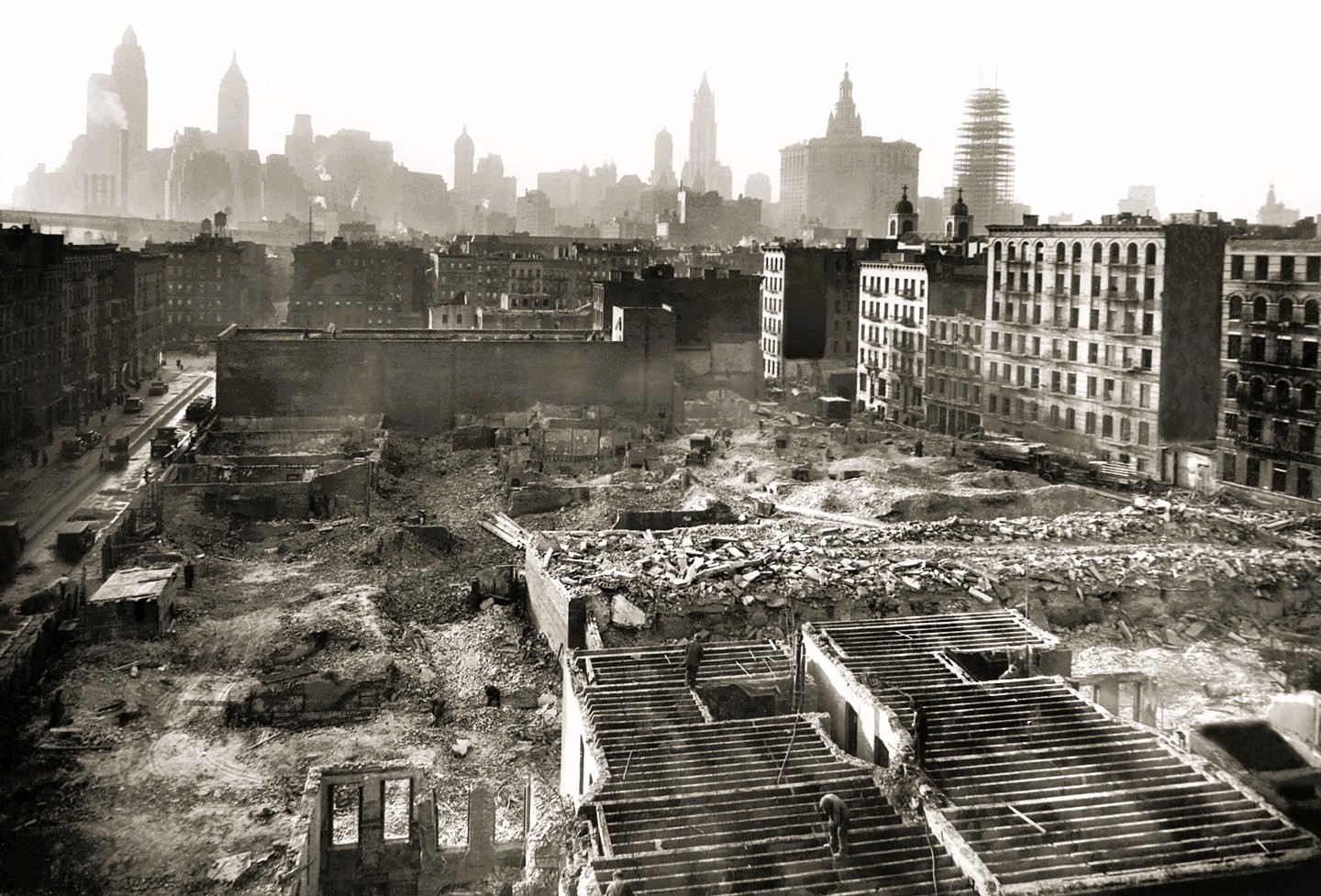
Gentrification comes to New York via the New Deal in a story so often repeated since that this could be a template. An impoverished, largely Italian, proletarian neighborhood in Manhattan, a slum, is cleared to make way for Knickerbocker Village, and the interests that most parasitical and vulgar of creatures, the New York property speculator, in this case Fred F. French.
‘The Slum Clearance Farce’ by Philip Sterling from New Masses. Vol. 12 No. 10. September 4, 1934.
“Throw “Em Out, They’re Breaking My Heart!”
“Knickerbocker Village apartments are the realization of an ideal. The State Board of Housing, the Reconstruction Finance Corporation and the Board of Estimate and Apportionment of New York City have collaborated with the Fred F. French Companies in producing the most superb apartments possible through modern architectural construction and financial channels and at the most moderate rentals”—From the prospectus
AND why, does anyone suppose, did Fred F. French thus readily win the gracious cooperation of municipal, State and Federal bodies? The answer is “slum clearance.”
Go from the Chatham Square station of the Third Avenue L down Oliver Street, made famous as Al Smith’s early home, and turn into hunched-up, evil-smelling Oak Street. Wade, unshuddering, in the ankle-deep offal of its serried rows of push-carts, keeping your eyes off the ground and you’ll see the brick battlements of the New Deal’s newest New York stronghold—$9,310,770 worth of “slum clearance” which has only one shortcoming: it provides no places for the hundreds of poor families driven out of the razed slum dwellings.
Here is slum clearance with a vengeance. The project has made a five-acre dent in the vast areas of New York which still harbor 69,000 “old law” tenement houses built prior to the laws of 1901.
From the prospectus and the matron in charge you learn the following:
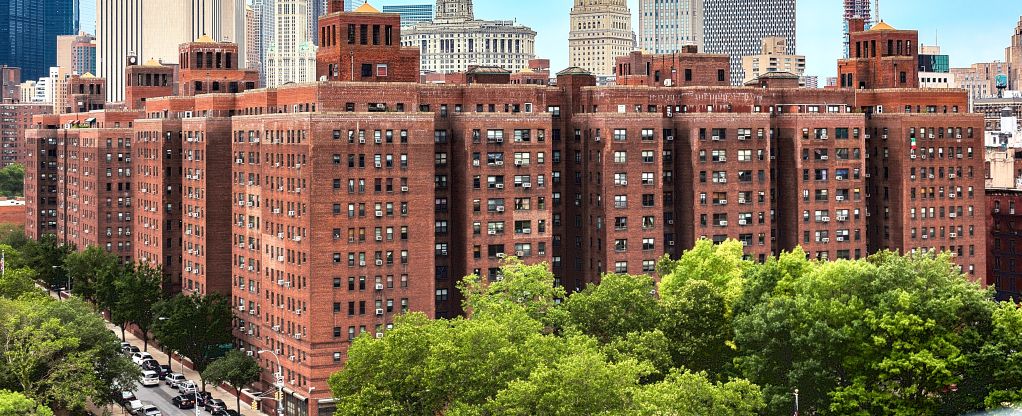
“Located only two short blocks from the East River, between picturesque Brooklyn and Manhattan bridges, Knickerbocker Village, with its twelve-story, fireproof buildings, set in gardens and playgrounds, dominates the entire section.
“The apartments encircle central gardens of nearly an acre each and more than half of the five acres is devoted to flowers, trees and playgrounds. No such thing exists here as the well-known inside room. The rooms are of good size, well-lighted and ventilated. There are roomy closets to delight the tenant. Every kitchen has been planned for the greatest convenience and is equipped with electric refrigeration. Incinerators are conveniently placed, Penthouses open on tiled terraces with views up and down the East and Hudson Rivers.”
To this may be added information about the latest thing in steam radiation, mail chutes, playgrounds equipped with sandboxes, swings, trapezes, and playrooms provided for use in inclement weather, as well as rooms for club and social purposes. All this, mind you, for $12.50 a room. You can get three and a half rooms, the smallest of the apartments, from $37.25 a month up, four and a half rooms from $54.35, five and a half rooms from $66.25. Penthouses, nine of them, go to $85 a month and up.
“Are you encouraging people from the neighborhood to move in?” you ask the renting agent. She evades the question but finds an opportunity to reassure you later by telling you that “most of the people in this neighborhood can’t afford to pay even these rents, reasonable as they are.” This information is gratuitous. A survey of the neighborhood last year showed that the average family there cannot afford to pay more than $7 per room. And even this estimate is a high one. According to Oscar Fisher, author of a recent real estate evaluation system published in the Real Estate Record and Guide, residents of this neighborhood are actually able to pay only about $5 per room.
This is the physical picture, in sketchy outline, of the New Deal’s first great assault on America’s millions of acres of slums (by special arrangement with Fred F. French). How did it come into being? And why?
To the uninitiated it would appear at first—glance that slum clearance means more than the razing of old buildings. One might think it meant the substitution of new and better buildings expressly for those who have until now been compelled to live in slums because they could not afford anything better. But that’s not important either to Fred F. French or to the governmental agencies that fell all over themselves in their hurry to lend him $8,075,000, which will not be amortized for about forty years, to build Knickerbocker Village.
French, himself said to a class in economics at Princeton last December:
“What matter whether an organization pay $15 or $5 per square foot for land; offer one-room or six-room apartments to the public; cater to the white-collar or some other class, and get along without tax exemptions and subsidies or accept them. What matter all these things as long as the crime and disease-breeding habitations of our big cities are forever destroyed and as long as the new structures offer decent accommodations for whoever may occupy them and bid fair to support themselves out of the rents collected.”
In accordance with this noble dictum, Mr. French and his ubiquitous realty companies embarked on the following procedure in promoting Knickerbocker Village:
In 1930, 1931 and 1932 they bought up most of the five acres needed, using dummy corporations to prevent prices going up. During these years the assessed valuation for the aggregate land parcels was $1,037,500 or about $4.73 per square foot. Seldom, if ever, in these times is real estate bought for its full assessed value. It is common to pay about two-thirds of the assessed value.
The R.F.C., which made the loan on the supposed basis of actual cost, allowed $3,171,260 of its total loan as the cost of the land, or about $14.50 per square foot. In other words, French realized $2,133,760 in the very process of borrowing money from the government. Out of this profit he was readily able to chip in the $1,235,770 representing his 15 percent total of the $9,310,770 total cost of the project.
Still prepared to make unsung sacrifices in the cause of slum clearance, Mr. French was then able to pocket $897,990 or the difference between the profit he made on the government’s price of the land and the amount he was required to contribute to the project. All this money is merely a loan, it may be argued, but a Joan which may be liquidated over a forty-year period is good enough for anyone’s purpose, even Mr. French’s.
But the most significant aspect of the fearless French organization’s single-handed battle with the dread slum dragon is this: No matter how ethical and above-board the rest of the transaction may be, the fact remains that money for payment or amortization and interest on the loan is derived from the income of the building itself. And in theory at least, when the loan is amortized, buildings and lands become the sole property of Mr. French. I say in theory, because even Mr. French must be aware of the possibility that forty years hence the name of his pet project may have been changed to the Harry Alan Potamkin apartments, or to the Angelo Herndon House.
To unify the five-acre plot on which Knickerbocker Village stands, it was necessary to buy from the city. Hamilton Street, which made an irregular bisection of the area. For this the French interests paid $55,000. The total assessed valuation of the land bordering on Hamilton Street, according to the City Record for 1930, 1931 and 1932 was approximately $270,000, or an average of about $4.20 a square foot. Logically, the value of the street itself can be calculated from the value of property fronting on it. On this basis the 25,000 square feet of Hamilton Street should have cost Mr. French about $105,000. But if he were to buy the street at the same rates he fixed as “actual cost” of the land as allowed by the R.F.C., he would have had to pay about $362,500 or about $14 a square foot.
Clearly, the only possible objection in this situation is not the use of Hamilton Street for the project, but the bargain rates at which Mr. French obtained the street.
Once the site of the project was well in hand, the next step was to get the loan. In just what mysterious manner the R.F.C. determines which applications shall be favored, this writer doesn’t know, but certainly a man of Mr. French’s wealth and importance is not without friends in any Federal administration any more than he is without them in past and present city administrations. And there were several touching instances of such friendship displayed.
The R.F.C. agreed with the New York State authorities that no loans would be made for New York. City housing projects without the approval of a special committee headed by Alfred E. Smith. Mr. Smith’s committee approved the $8,075,000 loan.
Another proof of friendship. Long before the loan was granted, the French interests knew they would need Hamilton Street. Immediately after it was granted, long accounts were published in New York newspapers quoting Mr. French on the history of the slum area which was to be rehabilitated by his efforts:
“The buildings now occupying the area are five- and six-story walk-ups from 50 to 100 years old. Many rooms have no outside opening of any kind. It is necessary for the tenants to obtain drinking and sanitary water from faucets in the court at the rear of the buildings. The outhouses in the courts spread disease. Children, in many cases undernourished, are forced to play in streets in an environment which encourages waywardness and crime.”
Mr. French neglected to mention that the parents of these children would be unable to pay $12.50 a room for quarters in his new project and that they would have to move to other slums.
Be that as it may, Mr. French was a fighter for slum clearance and his friend Borough President Samuel Levy flew to his assistance, declaring that:
“If practicable, it might be wise to eliminate Hamilton Street to permit the blocks north and south of it [the Knickerbocker Village site] to be made into one super-block to enable better private property development.” There was at this time no direct talk of efforts by the French interests to acquire the street. Yet Mr. Levy, with true statesmanlike vision, foresaw their need.
It was also Borough President Levy who in May, 1933, presented to the Board of Estimate the resolution to make Knickerbocker Village tax exempt. That beautiful mechanism of American democracy which permits so often the combination of public spirit with friendship, sped this resolution through over the opposition of the New York Real Estate Board, which was frankly alarmed at the competition the project would furnish against the tens of thousands of empty high-class apartments owned by the rest of its members.
With an estimated income of $900,000 a year expected from the project, tax exemption becomes an important matter, for it is permissible only for enterprises which show a 6 percent profit or less. But modern business enterprise is equal to such contingencies. The practice of interlocking and subsidiary companies is common and if one of these charges the other exorbitant fees for goods or service, the interests which own both are not losers. Income and profit records may be juggled thus to prove anything that may be desired. The Fred F. French-controlled Knickerbocker Village, Inc., entered into an agreement for the management of the property with Fred F. French Operators, Inc. In these days of inflation and rising living costs it is wholly conceivable that the cost of managing the enterprise will absorb all income above the 6 percent profit required to keep it eligible for tax-exemption. One more little touch. The dummy corporations which bought the parcels forming the site bought more than enough. Following the consummation of the R.F.C. loan, the dummy corporations sold the surplus parcels. Figures are not readily available, but is it unfair to assume that they were sold at a profit in view of the fact that all property values in the neighborhood are enhanced by such an improvement as Knickerbocker Village?
And just to top it off, it should be stated that Fred F. French, as general contractor and architect for the project, received fees totaling 9 percent of the cost, or $574,473.51. It is almost fruitless to inquire what wages were paid on the job. There is irony enough in the fact that the architectural draftsmen and other technicians of the kind for whom Knickerbocker Village is supposedly intended were paid wages which would have made it impossible for them to live in such a place.
The buildings I had just left covered an area which was formerly known as the “lung block” because it was a hot-bed of tuberculosis. This comparatively small area produced 291 cases of T.B. in ten years.
I recalled reading the statement of Robert W. DeForest who, as Tenement House Commissioner in 1903, said:
“Every consideration of public health, morals and decency requires that the buildings in this block be destroyed at an early date. I understand that several of these houses are permanently infected with the germs of the tubercular disease and that the only remedy and method of preventing the further spread of this disease from these houses is the destruction of the buildings.”
One more phase, but a crucial one, remains to be examined. What did the 443 families who lived in the area before it was cleared and improved, gain by the construction of Knickerbocker Village? Are any of them living in the new buildings? Have they better quarters for the same rent or less, as a result of their enforced removal? What has become of them?
The answers are provided by a survey of 386 of these families made by the Fred Lavanburg Foundation and Hamilton House. The survey was undertaken originally at the instance of Mr. French, who apparently believed that scientifically collected data would help to create the “slum clearance” smoke screen he needed for his enterprise.
But the survey was a boomerang, for the two agencies undertaking it proved not only the need for slum clearance, but also proved that the dwellers of the slum area gained no benefits from the construction of Knickerbocker Village. The survey is entitled “What happened to 386 families who were compelled to vacate their slum dwellings.”
Some of the facts of major interest uncovered by the study follow:
Only three families planned to move into Knickerbocker Village. The same three, incidentally, were the only ones paying $35 or more a month for a flat. Of the others, 379 expressed a wish to move into the development, disposing of the oft-repeated argument that slum dwellers don’t want improved housing.
“Though almost all the families desire to move into Knickerbocker Village,” the report declared, “only a small number will be able to pay the higher rental.”
Most significant of all, the survey shows that 319 of the 386 families surveyed, or 83 percent, continue to live in old law tenements declared to be unfit for human habitation by the Tenement House Commission as early as 1900.
Only 14 percent of the families left the neighborhood. The others settled in the slum buildings of adjoining blocks. The largest number of the families, regardless of size, felt that they could pay only $15 a month for any kind of living quarters.
The large majority of the families expressed a willingness to pay the same amount for quarters in Knickerbocker Village as they paid for their present living quarters.
A few of the other items of interest brought by the survey follow:
Before leaving the “lung block,” 260 families lived in apartments with the toilets in the halls. After moving to new quarters, 206 still had their toilets in the halls. Before moving, all the families had to use coal stoves for heating; after moving, 320 out of the 386 still used coal heating. Three hundred and sixty-one had no bathtubs at all before moving, and after moving 148 families were still without any kind of bathing facilities in their own apartments. But whereas only 25 had bathtubs in their kitchens before moving, 144 families had them in their kitchens after moving. An improvement it is true, but out of the entire 386, only 54 families had, after moving, any kind of bathing facilities which might be termed modern.
The primary test of course, is the matter of rentals. Before leaving the lung block, 340 of the families paid up to $25 a month for flats, but only 312 were able to find places for $25 a month or less after moving. At the same time only 8 families paid $30 a month or more before moving, but 28 paid $30 and up after moving. A more detailed examination of the comparative rentals demonstrates even more thoroughly that most of the families are paying the same amount or more for the same kind of quarters they had before moving.
When Mr. French read some of these facts as reported by the newspapers after the results of the survey were made public, he was angry. He wrote a letter to the New York Times declaring that the survey was wrong, that 85 percent of the families had moved away from the neighborhood and that the Lavanburg Foundation and Hamilton House were suppressing the real facts. Furthermore, he believed this to be ungrateful conduct in view of the fact that most of the information for the survey had come from his office. Subsequently he was forced to retract his protest, because it was his protest and not the facts of the survey that was untruthful.
One is sorely tempted to end the presentation of such facts as these by a strong agitational appeal for working class action to force real slum clearance. But that’s hardly necessary. The facts are there. They are not an isolated collection. They symbolize the housing program of the New Deal. And as more workers continue to wake up to the true meaning of the New Deal, the facts themselves will become a spur to action. It’s only a question of time before the workers begin some slum clearance of their own. It’ll probably start on Park Avenue and Wall Street.
The New Masses was the continuation of Workers Monthly which began publishing in 1924 as a merger of the ‘Liberator’, the Trade Union Educational League magazine ‘Labor Herald’, and Friends of Soviet Russia’s monthly ‘Soviet Russia Pictorial’ as an explicitly Communist Party publication, but drawing in a wide range of contributors and sympathizers. In 1927 Workers Monthly ceased and The New Masses began. A major left cultural magazine of the late 1920s and early 1940s, the early editors of The New Masses included Hugo Gellert, John F. Sloan, Max Eastman, Mike Gold, and Joseph Freeman. Writers included William Carlos Williams, Theodore Dreiser, John Dos Passos, Upton Sinclair, Richard Wright, Ralph Ellison, Dorothy Parker, Dorothy Day, John Breecher, Langston Hughes, Eugene O’Neill, Rex Stout and Ernest Hemingway. Artists included Hugo Gellert, Stuart Davis, Boardman Robinson, Wanda Gag, William Gropper and Otto Soglow. Over time, the New Masses became narrower politically and the articles more commentary than comment. However, particularly in it first years, New Masses was the epitome of the era’s finest revolutionary cultural and artistic traditions.
PDF of full issue: https://www.marxists.org/history/usa/pubs/new-masses/1934/v12n10-sep-04-1934-NM.pdf
 Revolution's Newsstand