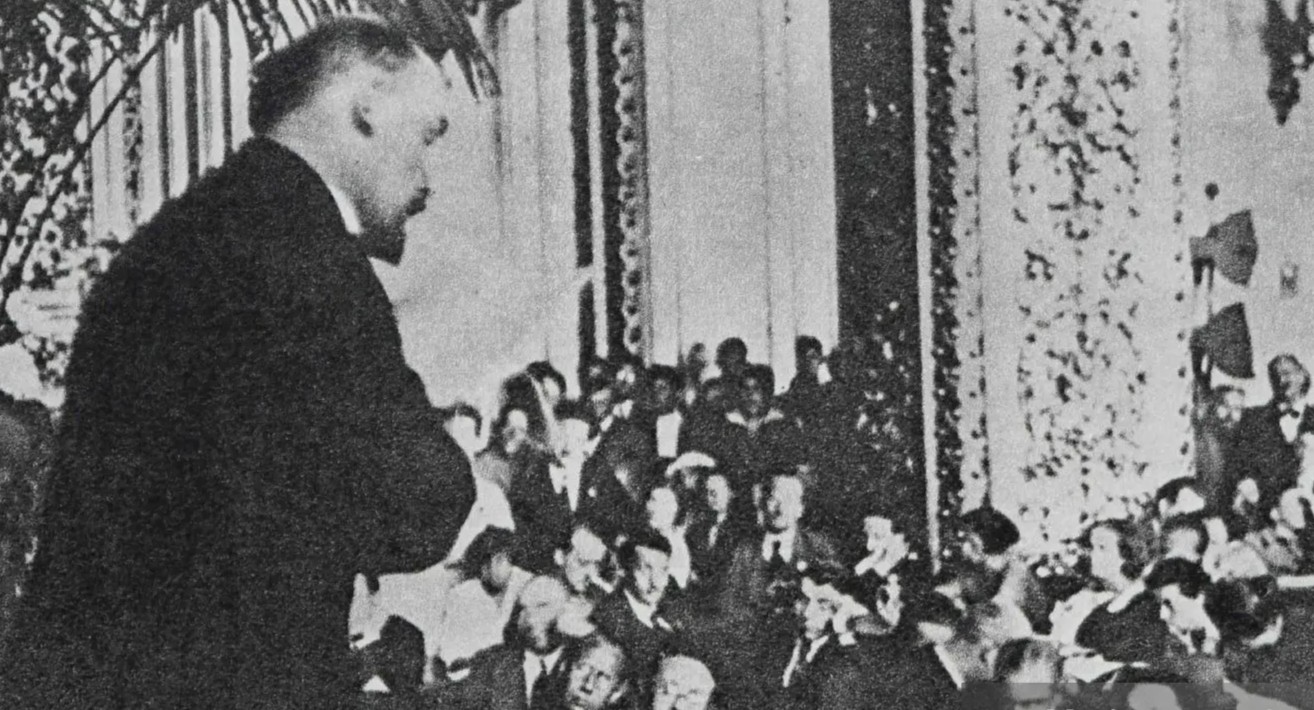
After his first stroke in March, 1922 Lenin’s health had progressively deteriorated with public engagements becoming fewer and shorter by the end of the year. This speech given on October 31, 1922 to the Soviets’ Central Executive Meeting–something like an extended cabinet meeting in capitalist governments–being one of his last. Most of his work while battling illness was to highlight the most serious problems he felt the Revolution faced. Here his focus is on issues of governance with the persistence of bureaucracy being the most urgent. A few weeks after this speech, in December, 1922, Lenin had his second massive stroke and went to Gorky to convalesce. There, fully realizing his precarious health and morality, he began with a transcriber what would be his final works. By March, 1923 he was almost completely incapacitated and unable to verbally communicate. This is the first English translation, published shortly after the speech.
‘Speech to the All-Russia Central Executive Committee’ by V.I. Lenin from International Press Correspondence. Vol. 2 No. 99. November 16, 1922.
October 31, 1922
Comrades! Permit me to utter a few words of greeting. Above all, our first greetings must naturally be for the Red Army, which has again just shown its heroism, and has cleared, by the occupation of Vladivostok, the whole region of the Far Eastern Republic allied to the Soviet Republic. I am confident of speaking in the names of all when I say that we greet this fresh deed of heroism on the part of the Red Army most joyfully, the more so because it has brought us a decided step nearer to the end of the war. It has thrown the last forces of the White Guards into the sea (Applause). I believe that the Red Army has freed us for a long time from any possible repetition of the White Guard attacks on Soviet Russia, or on the republics which are, directly or indirectly, allied to us.
At the same time I must not forget to mention, if I do not wish to be guilty of unseemly boasting, that here not only the heroism and power of our army have played a part, but also the whole international situation, and our diplomacy.
There was a time when Japan and the United States signed an agreement supporting Koltchak. This lies so far back that many of us perhaps do not even recollect it. And yet such a situation did once exist. And if we have attained a point where such agreements have become an impossibility, and where Japan’s military power has not prevented her from engaging to evacuate the occupied districts, and from actually fulfilling this engagement, it is thanks to our diplomacy.
In the near future our diplomacy will again be confronted by a task of enormous importance, a task involving important interests for us. I am thinking of the conference on the Near East convened by England in Lausanne on the 13. November of this year. I am fully convinced that our diplomacy will be able to maintain its authority equally well on this occasion, and will efficiently defend the interests of all allied republics and of the R.S.F.S.R. In any case we shall make it our endeavour to reveal to the masses what are the real obstacles, and in what degree these run counter not only to the justifiable desires and endeavours of our state, but of all states interested in the question of the Straits.
With regard to foreign politics I limit myself to these brief remarks, and pass on to the discussion of your activity.
I believe that the have attained most important successes, although at a first glance the success may not appear so great to everyone. Let us take for instance the first code of laws, which you have already accepted; the Labor Code. It is a tremendous victory for the Soviet power that precisely now, when all governments are arming against the working class, that we can present ourselves with such a code of laws, establishing the fundamentals of labor legislation, as for instance, the eight hour day. It is true that with regard to this code of laws mere consideration might have been accorded to this or that wish. I do not however believe that such wishes would have been right. We must reckon with the fact of the states in which a mad capitalist competition is raging, where there are millions and tens of millions of unemployed, where the capitalists are organizing mighty capitalist federations and preparing to attack the working class, our land is the most backward of all, our productive powers are the least developed, and we have the least idea how to work. This is perhaps an unpleasant truth, but it has to be admitted. But I believe that precisely because we do not seek to veil such facts with fine phrases and official explanations, but admit them candidly, we need not fear to mount the tribune and declare that we have expended more energy than any other state on the removal of these deficiencies, and that we are doing our utmost to overtake the other states with a speed which they do not in the least imagine.
But naturally the speed is not fantastic, we require some years of stubborn work to attain this aim. Nothing can be done in a day. We have had five years of experience, and we know what time means. We must remember what it means in the future also. Nobody amongst us believes in a fantastic speed of change, but we can believe in a possible speed, in a speed surpassing the tempo of any other historical period of evolution; and when the movement is led by a really revolutionary party, such a speed is an unequaled possibility.
I now come to the problem of the ground law. As you are aware, our first laws immediately after the revolution contained regulations respecting land which, though not quite technically perfect, nor perhaps juridically so, none the less contained all essentials, all that was of unqualified necessity for the peasant, and ensured his alliance with the working class. And even if the law which you have now accepted proves to require improvement in this or that regard, we shall be able to carry out these corrections without any special difficulty, just as you have accepted improvements in the code of criminal law at this session.
The land, the living question for the majority, of the population, the peasantry, is for us a fundamental question. In this respect we are so far advanced that the Russian peasant knows that not only do we set no brake on proposals towards the alteration of old laws, but we accept these most favourably.
You have also dealt with such questions as the civil code of laws and the general regulations for litigation. In the policy which you pursue so faithfully these questions touching the interests of the broad masses of the population, are the most important. Here it has also been our endeavour to draw a line of limitation between the justifiable satisfaction of the needs of every citizen living under the new economic policy, and the abuses of the new economic policy, which are law in all other countries, but whose legalization we decline. It remains for the future to show in how far the corrections which you have just made with this intention, and which you approve, will succeed in their object. In any case, we do not bind our hands in any way. Should daily experience show that there are abuses upon which we had not calculated, we shall take immediate steps for their removal. In this respect, as you are aware, such rapidity of legislation is unfortunately unknown in other states. We shall see if the near future will not force these powers to try and keep up with Russia in this respect.
We must also accord some attention to the equally important question of the provincial Soviet congresses and government executive committees. All former systems, legislatures, and constitutions left this question unanswered. It was thought that in the provinces everything would take its old course. We, on the other hand, are convinced that if our revolution has been able to attain many successes, this is solely because we had the power in the provinces in our hands, and because we invariably paid the greatest attention to local experiences. When the revolution in October 1917 was crowned at once with such success that in the spring of 1918 we believed the war to be over, though in reality it was just beginning in its worst form, that of civil war (in reality the peace concluded at that time with Germany who did not collapse until the autumn, in every way gratified ‘those elements among the Allies who resented our peace was able with Germany)–when as I say, the revolution to carry out its work with such rapidity, this was due to the fact that we have always counted upon the peasant population, and have opened new vistas of activity to them; we always expected from the provinces that enthusiasm, which imparted perseverance and speed to our revolution.
I am aware that at that time the provinces went through troublous times. We were much occupied by the relations of the provinces to the centre, and I will not assert that we were always able to carry out our task in the most ideal manner. The general level of our culture could not permit us to even dream of an ideal solution. But we have the right to assert that we have carried out our task with greater uprightness, truth, and perseverance, than any other state.
I must soon conclude. I shall only touch upon one more question, one of the greatest interest to me, and which should be of interest to you also, though it is not contained either in the agenda or in the inquiries. This is the question of our state apparatus, an old and yet eternally new question.
In 1918 we had a census taken of our state apparatus in Moscow. The result showed that there were 231,000 state and Soviet employees in Moscow, (including the central state employees and the Moscow municipal employees). Recently, in October 1922, we undertook a recount, convinced that our distended apparatus had shrunk. The resultant figure was 243,000. This is the result of all our reductions.
This example shows the need of further studies and comparisons. At that time, in the year 1918, as we undertook the census in the first heat of reform, we were not yet in a position to reduce the figures to anything sensible. The civil war left us no leisure whatever for this. We hope that it will now be done. We are fully convinced that our state apparatus, which suffers from many defects, which is considerably more than twice as large as it need be, which often works against and not for us–we need not be afraid to utter this truth from the tribune of the highest legislative body of our republic–will be improved. Its improvement will require much work and capability. A start has already been made in the serious consideration of the nature of these improvements, but at present it is only a start, a few articles, some local investigations. If we all go away from here with fixed resolve to devote much more attention to these questions than we have done, if we are firmly resolved to spend less time on vanity and bustle, if we really get to know our apparatus and work for years on its improvement, it will be an enormous step forward, and afford real security for our success. We must have the courage to admit that our apparatus is primitive. The best workers undertook the most difficult tasks alike in military and bourgeois administrative spheres, and as a rule they took up their work wrongly. But all the same, they have understood how to correct themselves, and how to work. The present relations between these–perhaps only a few brave individuals–and the hundreds who only sit and sabotage or half sabotage, and lose themselves in their red tape, these relations are suffocating our living cause in a labyrinth of red tape.
We must get thoroughly to the bottom of this matter, as we have not yet succeeded in doing. Years and years will have to pass over, for years and years we shall have to learn, for the cultural level of our workers is very low, and it is exceedingly difficult for the workers to undertake the work of production, new to them. But our sole reliance is upon the uprightness and enthusiasm of the workers. Years and years must pass before the improvement of our state apparatus can be realized.
I am convinced that if you will further devote your powers to the same activity as has actuated you in the present session, we must inevitably arrive at the very best results.
International Press Correspondence, widely known as”Inprecorr” was published by the Executive Committee of the Communist International (ECCI) regularly in German and English, occasionally in many other languages, beginning in 1921 and lasting in English until 1938. Inprecorr’s role was to supply translated articles to the English-speaking press of the International from the Comintern’s different sections, as well as news and statements from the ECCI. Many ‘Daily Worker’ and ‘Communist’ articles originated in Inprecorr, and it also published articles by American comrades for use in other countries. It was published at least weekly, and often thrice weekly.
PDF of full issue: https://www.marxists.org/history/international/comintern/inprecor/1922/v02n099-nov-16-1922-Inprecor.pdf
 Revolution's Newsstand