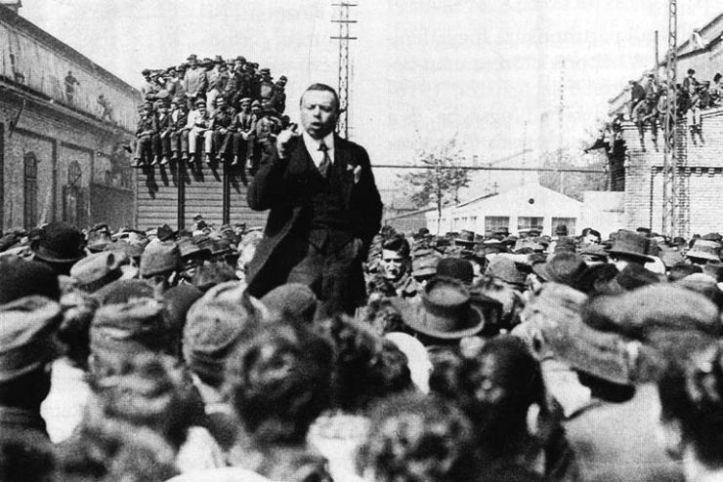
One year after the fall of the Hungarian Soviet Republic, Bela Kun reflects on the loss and takes stock of Hungary’s workers’ movement under the new reactionary Horthy regime, who would rule for the next 25 years.
‘The Hungarian Workmen Under the Rule of the White Terror’ by Bela Kun from Communist International. Vol. 1 No. 11-12. June-July, 1920.
THE Hungarian labour movement, crushed at present by the White Terror, is passing through a period of self-criticism, and is taking the first steps towards a new assembling of revolutionary forces. A permanent counter-revolution is still set against the permanent revolution. Whereas, on the one hand, the White Terror still shows a tendency to gain strength and, on the other, the proletariat still remains unorganised, the revolutionary frame of mind of the hopelessly beaten working class is expressing itself for the time being in a singular faith in the advent of a better future. However, this yearning-for-revolution inactivity, like the evangelical doctrine of hope, resembles the tactics of the counter-revolutionary Social Democracy awaiting the coming of the Messiah. The wide, profound masses are thirsting for revolution, and only the obstacles standing in the way of revolutionary organisation prevent the realisation of revolutionary action.
The immediate future will confirm that the four and a half months’ dictatorship of the Hungarian proletariat deserves the grateful acknowledgement of the world proletariat—not only in International respects, but as a useful and self-sacrificing ally of the Russian Socialist Federative Soviet Republic, and not only for what it has done in the matter of organisation of public economy and of socialist organisation of rural economy, but also for the revolutionising of the masses, the results of which will be to the advantage not only of the Hungarian, but also of the International proletariat.
The number of victims of the White Terror may be great, the sufferings and tortures of the proletariat during the months of White Terror may have grown to an incredible degree; but one thing is certain, that the proletariat of other countries, by means of “reasonably progressive” revolutionary tactics, will not be able to attract to the side of dictatorship and Socialism the large popular masses at a lower price than that paid by the Hungarian working class, cured, at present of all sentimentalism. And there where lie the shadows of the forest of gallows which has grown up in Hungary, where the bloody hand of the White Terror still strikes, we who have learned by the experience of the lost battle, and stand now on the threshold of a new struggle, must firmly establish that we were right in presuming that we must seize the power at whatever cost, because only in this way was it possible to remove rapidly and radically from the path of the revolution its greatest obstacle—the unpreparedness of the working class for a social revolutionary ideological and organisational expression of such a State—the Social Democrat Party.
At present this work has been accomplished by the bourgeois dictatorship and the White Terror. The Hungarian working class, inspired by the memory of its great martyrs, rich in revolutionary experience, is entering now upon a new struggle. It will not be satisfied with the fact that “history has already nailed its executioners to the pillory”—it will wish to pass on to decisive action.
The Social Basis of White Terror.
The Hungarian White Terror has assumed proportions which surpass even all the horrors of the Finnish White Guards. The Hungarian Communist Party will present a special report on the actions of the White Terror based upon facts: in this article we will only point out its social basis.
At first the Hungarian counter-revolution was the united action and, later on, the separate action of the Social Democrat Party on the one hand, and of the officers, soldiers and the bureaucracy on the other. The government which was formed after the overthrow of the proletarian dictatorship, from the representatives of the labour unions with the leader of the Social Democratic Party, Julius Peidl(who during the Soviet rule had renounced all political activity), at the head did not even attempt to enter into relations with the labour unions during the three and a half days of its rule; it was only engaged in disarming the workmen and annihilating the decrees which had been published by the Soviet Power. In this work it found support in the officers, soldiers and the bureaucracy. The imprisonment of all Communists who would not hide or seek to escape by flight was begun during the Social Democrat government of Peidl and his Minister of the Interior, the Social Democrat Karl Payer. Otto Korvin, one of the noblest figures of the proletarian revolution, was put into prison, as well as the metalworker Franz Janchik, who awaits the fate of Otto Korvin.
However, the officers, soldiers and bureaucracy desired to carry on the White Terror by their own forces, especially as the hopelessly powerless Government of the labour unions was only a ballast in this way.
Since then the White Terror has changed its aspect several times, in accordance with the various coalition governments which were formed with or without the participation of Social Democracy, taking the form of parliaments; later on the restoration of royal authority, the representatives of the White Terror still preserving their independence up to this day, with respect to all social classes, even the bourgeoisie.
The social basis of this lasting independent dictatorship of the officers, soldiers and bureaucracy consists in the necessity felt by all the groups of the richer classes to permanently support the counter-revolution for the defence of private property.
Thess White Terror is directed not only against the working class, but also against the capitalists; it is in general anti-industrial in its policy. Nevertheless the banking and large industrial enterprises, interested in the capitalist form of private property, are the reliable support of the militarist dictatorship, because the latter is defending the right of private property against the proletarian revolution, as a social institution, although the White Guards are expropriating private property by means of robbery in the full sense of the word, for their own needs.
At first the White Terror found a social support in the petty bourgeoisie of the towns and among the middle and large landowners. But a union of interests of these two classes cannot be lasting since the former is chiefly the consumer, and the latter mostly the producer. As a matter of fact, the class of petty bourgeois is retreating more and more into the background, and at the same time the very weak political control over the actions of the representatives of White Terror, of which this economically and politically insignificant class was capable, is ceasing.
By degrees, as the petty bourgeoisie is being pushed back, the peasant basis of the White Terror is also disappearing. The class of rich landowners who have only partly mastered the capitalistic method of production, and owing to the economical decline of the country are returning to feudalism, is succeeding more and more in harnessing the peasantry to its carts.
However by this circumstance the groups of the population which have been actively supporting the rule of White Terror have diminished more and more, the peasant-group, which had been united, is splitting, because the smaller peasant owners and the landless peasants have lost hope of land reform. Against the industrial and rural proletariat are arrayed the richer classes, who have closed ranks behind the back of the military dictatorship. Even the Jewish bourgeoisie, although it does not easily give up power, is willingly supporting the White Terror, ”the latter being the only means of defending private property in Hungary. However, the social basis on which the military-bureaucratic dictatorship rests is still narrowing. The completeness of the economic crisis is revealing itself in the question of food supplies. In Hungary the bread ration is not guaranteed to the population of the towns. The troubled state of the country, over which rules the counter-revolution, needs “committees of public order” and the same demands are being made of the counter-revolution as were made of the revolution. The bureaucrat and military parties are endeavouring in consequence to keep up their parasitic existence, not only by means of a merciless terror but also by the help of political measures. These political means are the following: a “Hungarian Socialism” guarding the co-called territorial integrity of Hungary and shaking its fist in the face of the neighbouring nations, anti-semitism, frequent indulgence in the pogroms, and lastly, the awakening of illusions regarding international importance of Hungary, in the sense that being an anti-Bolshevik State (in alliance with Poland) she will be able to obtain more favourable peace conditions from the Entente, or at least the revision of the conditions of the Peace Treaty.
The narrower the social basis becomes, the more necessary it is to have recourse to political measures. By degrees as the political weapons become blunted the need arises for the application of the deadly arms of the White Terror; first of all, toward the class of industrial and rural proletarians; the complete oppression of the latter being the compensation to the larger industries and banking concerns for the anti-capitalist policy of the military dictatorship in other regards.
Ideological transformation of the working class.
Although the four and a half months’ dictatorship of the proletariat had greatly helped to strengthen the revolutionary ideology of the working classes, it still, as its fall proved, did not succeed in revolutionising them to a sufficient degree. The obstacles to this were—the sabotage of the Social Democrat Party, which occupied a place in the Soviet Republic, looking upon it as a temporary dwelling place, the bureaucracy of the labour unions, and the lack of forces in the Communist Party.
As regards the inactivity of the Social Democrats, the characteristic feature of the latter is the fact that at each meeting of the Workers’ Soviet the Communists had to continue to prove that, in spite of the radical expropriation of all means of production, the bourgeoisie had not ceased to exist. In regard to the campaign in favour of mercy to be shown to the bourgeoisie, which was repulsed by the masses, our objections tended to show that such a campaign would lead not only to a strengthening of the forces of the counter-revolution, but also to a weakening of the self-consciousness of the proletariat and its readiness for the class struggle. The conscious communist van guard was only a thin layer of the working class and it had very few organisatory and agitation forces. The artful Social Democratic party and the bureaucracy of the industrial unions frequently and in the presence of large masses even successfully entered into contests with the enthusiastic but inexperienced communist campaigners. On the one hand in consequence of our tactical mistake, which—in my opinion—does not lie in the fact of our union with the Social Democrats, and on the other hand, in view of the fact that the Social Democrats possessed administrative experience whereas the leaders of the communists did not, and further in consequence of the confidence of the masses, the members of the Social Democrat party and representatives of the bureaucracy of the industrial unions acquired such posts in the Soviets which enabled them not only to prevent the execution of the measures of the dictatorship, but also to hamper all revolutionary work among the proletarian masses. It was the same trend of affairs that made Marx say of the Paris Commune: “As far as was in their power they prevented the real activity of the working classes, just as before they had hampered the development of each of the preceding revolutions. They are an inevitable evil. With time it would have been possible to get rid of them, but it was just time that the Commune lacked.”
The Commune was an isolated revolution; but the Hungarian revolution is one of the links in the International Proletarian Revolution. What we did not succeed in doing during the dictatorship of the proletariat the White Terror has accomplished, as well in the matter of revolutionising the ideology, as in the question of how to “get rid” of “the inevitable evil”–the obstructing leaders.
The fall of the dictatorship called forth among the working class a disillusionment and disgust which prove the superficiality of the revolution. (it is just through this cause, according to Marx, that all bourgeois revolutions come to an end).
However the revolution had attained sufficient depth to make the disillusionment of the Hungarian workmen but short lived; and only the non-class educated bourgeoisie hanging on to the revolution still suffered from it. This condition of affairs was skillfully, kept up by the Social Democratic Party which is continuing its calumnies against the dictatorship. Nevertheless even after this the popular masses have not gone over to the Social Democratic party. It is true that the workmen became averse to communism for a short time, but at the same time they refused to take part in the restoration of the social democratic ideology. A very thin layer of the working class, together with the very dregs of the bourgeoisie, constitutes the army of pogrom-makers, under the banner of Christian-socialism. All the remaining politically unorganised mass of workmen which is day by day becoming more and more consciously revolutionary is resisting the influence of the party and industrial bureaucracy.
In Hungary the number of workmen Social Democrats is insignificant. The complete collapse of industry, colossal unemployment (out of 100,000 metallists only 21,000 are employed) have considerably diminished the specific gravity of the working class. The results are making themselves felt in the self-consciousness of the workmen, chiefly in their lack of self-assurance. But the workman taking part in political life has become completely free of all illusions concerning Social Democracy, and even those politically indifferent proletarians still under the influence of the dictatorship and the events which followed it, are not at all inclined to the social democratic doctrine.
The economical measures of the dictatorship were annihilated by the social democrats and the economical policy of the White Terror suppressed all the short-tailed social measures of the November revolution of 1918.
The miners are completely chained to the mining enterprises, owing to the annihilation of their right to break their labour engagements: strikes were proclaimed to be state treason; in spite of all this the workmen are not thinking of a restoration of the “democracy” and only the idea of a dictatorship finds favour in their eyes.
A characteristic feature of the ideology of the workmen is their attitude towards the question of the application of force and arms. If the pacifist frame of mind of the workmen during the whole period of the dictatorship after the ending of the war is easily comprehensible, as well as its aversion to the use of arms, then at present the contrary may be observed. The prevailing opinion, completely free from all sentimentality, is that the realisation of all hope and effort can only be expected from the application of arms and force. The influence of the trade unions is falling in consequence in spite of the absence of a revolutionary Communist organisation. Side by side with the organisation of the oppressive White Terror this transformation in the ideology of the workmen leads to a disinclination on their part to enter into a partial struggle, the object of which would be the attainment of social-political or any other partial advantages. Armed action, the remembrance of the former dictatorship and the hope of a future one—in spite of any kind of terror—have not disappeared from the minds of the workmen. The insufficient productivity of their labour and discipline which were manifested during the revolution and which were the result of fatigue after the war, are now the results of a consciously accepted decision, by means of which they hope to prevent the restoration of capitalism. In the enterprises of the larger industry there are now only an insignificant number of workmen.
The rest are driven out into the streets, the productivity of the employed men is kept up by means of armed force.
However, this dis-classing of the masses of the working class is very sad. Unemployment, persecutions, emigration, have lowered not only the material level, but also the moral level of the workmen which is the basis of all revolutionary discipline. A characteristic feature of such a loss of caste among the workmen and their joining the ranks of the pauper-proletariat (Lumpen-proletariat) is that it is mostly to be noticed among the labour aristocracy, the workers of the larger industrial enterprises. Owing to the economic crisis which has stopped almost all the large enterprises, the revolutionary ideology is mostly to be met with among the workmen employed in the enterprises of middling proportions. In general it may be said that the loss of caste of the labour aristocracy has almost completely smoothed away all differences which had formerly existed between the various layers of the working class.
The result of this transformation in the ideology called forth by the White Terror is the ever recurring instances of self-sacrifice and the readiness therefor which was lacking in the Hungarian working class when it had obtained the dictatorship without any sacrifices.
Such is the ideology of the working class in its principal features after the defeat of the revolution, under the horrible rule of the White Terror.
The stratification of the working class.
Owing to the White Terror there is no organised revolutionary movement in Hungary at the present time. The Social Democratic party, supported by Horti, which very much desires to appear as the party of the working masses and which is striving to organise them is far less of an organised political party than the Hungarian Communist party which is bringing down upon itself the most cruel persecutions as soon as it gives the slightest sign of life, be it but the smallest personal notification. All the leaders of the Hungarian labour movement have been obliged to emigrate with the exception of the most reactionary Social Democratic party which has openly entered the service of the monarchist counter-revolution, and the bureaucracy of the industrial unions. However, such “labour leaders” like Peidl, Garami Buchinger have also had to flee the country, although they had not been “compromised” during the dictatorship and had even personally helped in the establishment of the White Terror after the fall of the dictatorship, by passing a resolution at the congress, in which, in the name of the Social Democratic party, it was stated “that the offenders were to be punished.”
Directly after the fall of the dictatorship the party became divided again, after its union on March 2lst. After short periods of adherence to the Soviet Republic and the Third International, the leaders of the Social Democracy under the leadership of Bem Weltner and Kunfi hastened to renounce their short lived but honest revolutionary past and in the paper “Hungarian Weekly of Vienna” in which they collaborated and the “Labour Gazette” of the Austrian Social Democracy, not only repentantly returned to the lap of the Second International, but duly added their voices to the concert of calumnies against the dictatorship, abusing the Communists who were at the time languishing in prisons and in the concentration camps. The left wing of the Social Democrat party (Landler, Varga and others) remained true to the Communist party.
Meanwhile the right wing of the Social Democrat party after negotiations carried on by Ernst Garami, took the liberty of sending two representatives into the government of the White Terror. Soon after this the right wing became divided into two parts, namely: the group of Banchak, which continued to serve the White Terror even under the rule of Horti, and the group of Garami-Buchinger, which is inclined to agree to a monarchy, but demands the disbandment of the military detachments who are supporting the White Terror. This last group is also negotiating with Horti. The industrial unions also belong to the party officially but their members are keeping aloof.
After the change in the revolutionary conditions the group Bem Kunfi forgot all revolutionary and Independent-socialist mottoes and it is now carrying on negotiations with Massarik, the Tchek Socialist-Chauvinists and the Hungarian bourgeois radicals, regarding the organisation of a bourgeois democratic revolution with the corresponding posts of ministers. The group is not numerous, consisting of officers, without soldiers.
The Hungarian Communist party, the Hungarian section of the Third International, is compelled to limit its activity not only in Hungary, but in the adjacent countries as well, to the secret preparation of a revolution. The ranks of the party are becoming thinner owing to the many sentences of death by the verdicts of the lawful courts and the so-called “Folks Court,” which are even now insistently demanding new victims. Many brave warriors und leaders are in prison. In spite of all, the emigrants are organising rapidly and striving to re-establish the contact with the popular masses, which had become lost after the fall of the dictatorship.
In Hungary the Communist Party has no other way but illegal organisation. Its immediate duties are as follows:
1) The completion of the illegal organisation and the centralisation of the existing nucleuses.
2) Together with this organisatory work—to awaken the revolutionary spirit in the workmen for the purpose of developing the class consciousness and inciting the activity of the working class.
3) A definite rupture with the Social Democracy, which, thanks to the last unions, has escaped “the last judgement.”
The struggle against the White Terror at the present moment is possible only under the form of a joint operation with the other detachments of the International proletariat.
The completion of the work of organisation, the awakening of revolutionary activity, will make it possible to pass over to actions in masses and to their completion by means of an armed uprising.
Notwithstanding all the signs of a forthcoming collapse the White Terror organisation is still sufficiently strong to obstruct completely the way to organisation and propaganda by means of insurmountable obstacles, which lie first of all in the lack of experience of illegal movements, and on the other hand in revolutionary impatience, which, although worthy of respect, frequently changes into despair and is called forth by the fact that people accustomed to the immediate visible successes of lawful movements, become impatient and pusillanimous while awaiting the fruits of a hidden movement which take a longer time to ripen.
In its revolutionary work the Hungarian Communist party has to reckon first of all with the international police organisations and also the social democrat parties which figure sometimes as the masters, and sometimes as the slaves of these police organisations. Nevertheless at present there are some signs of success in the struggle.
The Central party organ “Red Gazette” (Vérdés Ujsag) is published in Vienna as a supplement to its brother-paper “Red Banner” (Rote Fahne). Soon the party paper will appear weekly and in a larger edition. The propaganda literature has been published in sufficient quantities up to the present time and its numbers will be increased with the removal of the obstacles to its circulation.
There is as little to be said of the Hungarian industrial movement as there is of the economic situation of the working class. The conditions of life of the workmen, as in all capitalist countries, and especially in vanquished Hungary, have fallen extremely low, and the industrial movement represents the same picture as all the European industrial unions, but even a more pitiful one. In the eyes of the workmen these unions have still a certain importance, because they are the only lawful places for the meetings of the workers. They are however in the hands of the industrial bureaucracy and will keep this position so long as the White Terror defends the union bureaucracy from the indignation of the workmen.
Agrarian question.
During the dictatorship of the proletariat in Hungary the land had not been divided. The Soviet Republic socialised the larger landed property and proceeded to the introduction of agriculture on cooperative principles by means of the organisation of the rural proletariat. Owing to the inactivity of the rural proletariat, and to the caution used in the interests of guaranteeing the uninterrupted production of the agricultural products the expropriation of the larger agricultural enterprises was carried out, except in certain localities, at first only nominally, and without the necessary revolutionary character. Nevertheless the rural proletariat united into associations on the larger estates, served as an armed support to the dictatorship, in the same degree as the industrial proletariat.
The dictatorship of the proletariat brought the most direct and visible advantages to the labourers employed on the farms, therefore after its overthrow their position was the worst. The proletariat and semi-proletariat for a long time after the fall of the dictatorship was at the service of the richer peasantry. However as a result of the agreement between the rich peasants and the landed proprietors of the larger estates, of the obligatory conscription into the White Army, and of the propaganda of the soldiers of the Red Army, dispersed throughout the country, a strong revolutionary movement is awakening among the peasants with small farms and the landless peasants. This movement is further increasing in consequence of the fact that the agreements signed by the labourers directly before the dictatorship and also the contracted labour tariffs to be paid in species and in products existing during the dictatorship were not only destroyed by the landed proprietors when the estates had been returned to them, but the landowners are exacting socage duty from the labourers “as expiation for their sins in the past.”
The rural proletariat has as yet not proffered any independent demands. In correspondence with the economical and ideological interests of the small peasant owners the idea of a division of the land is in great favour.
The immediate duty of the Communist party in the agricultural question is this: without going against the peasant movement, which is directed towards the distribution of the land, to continue independently thereof to spread among the poorer elements the old motto of an organised seizure of the land by revolutionary means, profiting by all the natural ill successes of any lawful land reform. In this way it will be possible to save a considerable part of the lands for future public management.
The possibility of the peasant revolution opening’ a new chapter in the Hungarian revolution is very limited, but undoubtedly its echo among the working masses will be louder than its voice itself.
It is hardly possible to give a more precise prognostic of the future of the Hungarian revolution. One thing is certain, that in Hungary a struggle for life or death is going on for the right of private ownership, and this struggle, touching directly upon the very basis of capitalist production, does not allow the ruling classes to desist from the application of terror. This would not be possible even if the military, against all probability, would be willing to lay down its arms.
If the government of Horti should become engaged in any military adventure, the proletarian revolution would again take place in Hungary and the dictatorship of the proletariat would again be established. The slightest revolutionary flare up in Central Europe would immediately carry with it the industrial and rural proletariat of Hungary.
The White Terror can only be put an end to by means of a proletarian revolution, even in the case of the Terror assuming a parliamentary or constitutional form.
Meanwhile the Hungarian proletariat, after its four and a half months’ struggle in the advanced trenches of the international proletariat revolution, has to hope for the most active support on the part of the international proletariat.
This support, a beautiful example of which is being given by our Russian and Italian comrades, we are equally awaiting from all the other sections and groups of the Third International.
The ECCI published the magazine ‘Communist International’ edited by Zinoviev and Karl Radek from 1919 until 1926 irregularly in German, French, Russian, and English. Restarting in 1927 until 1934. Unlike, Inprecorr, CI contained long-form articles by the leading figures of the International as well as proceedings, statements, and notices of the Comintern. No complete run of Communist International is available in English. Both were largely published outside of Soviet territory, with Communist International printed in London, to facilitate distribution and both were major contributors to the Communist press in the U.S. Communist International and Inprecorr are an invaluable English-language source on the history of the Communist International and its sections.
PDF of full issue: https://www.marxists.org/history/international/comintern/ci/old_series/v01-n11-n12-1920-CI-grn-goog-r3.pdf
 Revolution's Newsstand