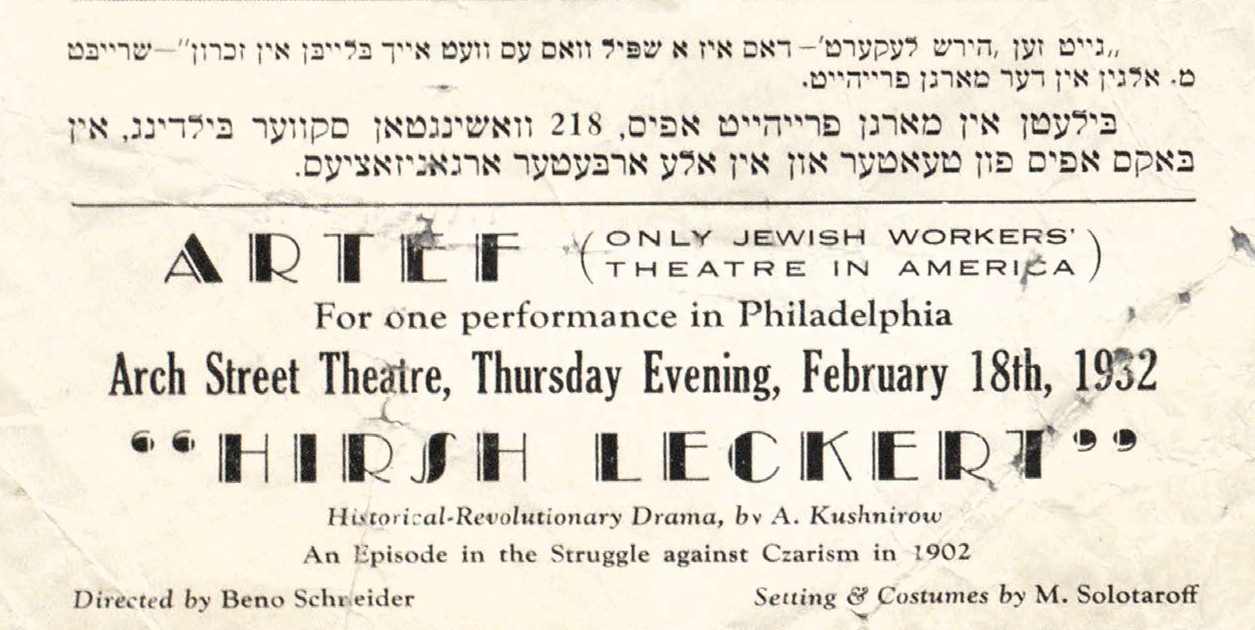
Begun in 1925 as a project of Young Workers League members, ARTEF grew into a central institution of radical culture during its 15-year existence. Combining political commitment with the highest artistic aspirations, the theater’s influence reached far beyond the Jewish left and was the training for a generation of actors, directors, and writers.
‘An Island of Creative Achievement’ by Joseph Freeman from Ten Years of the ARTEF (Arbeiter Theater Verband), New York. 1937.
IT IS a wonderful thing to watch the transformation of the small and obscure artistic experiment into a recognized force. I remember the Artef confined to the “movement”, and not even the whole of the movement. It belonged to the Jewish comrades, to that rich cultural world around the Freiheit which the rest of America ought to know but doesn’t because of language barriers. It belonged to the advanced needle trade workers, to some of the Yiddish-speaking intelligentsia.
And now Artef is on Broadway, part of America’s theatre. Leading American writers, artists, actors, directors, journalists-men and women who do not understand Yiddish when they hear it but know great theatre when they see it come to enjoy, to pay tribute, to learn. In the sea of commercial production they greet an island of creative achievement, profound imagination, rich emotion–everything that the theatre at its best should have.
This is due in part to the fact that the “movement” itself has come out of its old restricted world and has entered the national life as a respected force. Proletarian art in various forms has become a mighty stream in American art; the voice of the worker striving for a better world has been heard across the land through the medium of the writer, painter and actor who, for this reason or that, also wants a better world. America was prepared by the economic crisis to hear the message of social struggle and social transformation.
Under these circumstances, Artef had special advantages: it was not the product of mere concept. This working-class theatre was created by workers whose life was made up of the factory by day and the stage at night. There was emotional continuity; the life reflected on the stage was the life actually lived at the machine, on the picket line, in the tenement, at the May Day parade.
Men and women who made Artef had both the integrity and the courage of the proletariat, and theirs was the greatest gift an artist could have: their art was an inseparable aspect of their living world.
What brainstorms, what heartaches the middle-class artist has before he bridges the gulf between his education and his dawning understanding of the contemporary social struggle! What debates over art and propaganda, content and form, individual and class! With the Artef things were more clear. Life was the life of the workers; theatre was the dramatic method of presenting.
Thanks to the talent, the self-sacrifice and the courageous imagination of the men and women of Artef, we have this remarkable theatre; but thanks too to the class from which they sprang, of which they are a part, from which they draw their artistic sustenance.
Perhaps the impact which Artef has had upon the recognized American theatre will open the way to further contact between English-speaking Americans and those vast minority groups (most of them workers) whose own American life has produced a rich art in other languages–Yiddish, Italian, Hungarian, Slovak, Greek. Perhaps, too, the English-language theatre of the left will learn (it is always anxious to learn) the meaning of pure-hearted devotion to a theatre of the people whose democratic nature is itself a source of artistic strength.
Access to full pamphlet: https://digital.library.pitt.edu/islandora/object/pitt%3A31735047448570#page/1/mode/2up
 Revolution's Newsstand