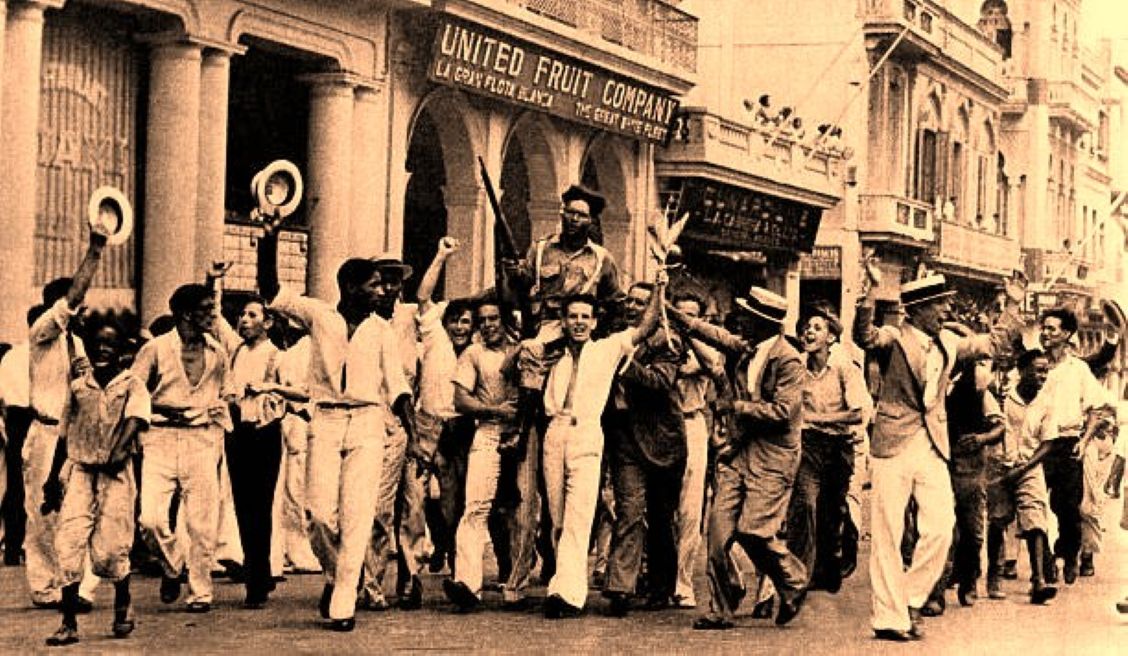
Less than two years after the unfinished Revolution of 1933 brought down the Machado regime while the U.S. and its Cuban military puppets remained, and the masses refuse to recognize the legitimacy of Batista’s military junta with another national general strike. It was put down with great violence.
‘Cuban Workers in Island-Wide General Strike’ from The New Militant. Vol. 1 No. 13. March 16, 1935.
Mendieta Sustained by Wall Street Army Alone
Intolerable Conditions Result of American Sugar Imperialism, Cause of Permanent Unrest–All Support to the Cuban Workers!
Wall Street’s most important semi-colony, Cuba, is now in the throes of a nation-wide general strike. Martial law has been declared. The death penalty has been decreed for all those offering open opposition to the government.
The trade unions have been declared dissolved. A great struggle is under way between the workers, professionals and students on the one hand and the agents of American imperialism on the other. Hundreds of thousands of the most oppressed people under Wall Street’s domination are desperately attempting to overthrow the Sugar Trust’s Cuban lackeys.
For weeks, strikes and bombings have harassed the Mendieta government which in turn has replied with a reign of terror against all of its adversaries. A strike of teachers and students, spread from one province to the other, extended to various industries and professions. As this issue of the New Militant goes to press, practically all labor and professional groups in Cuba, including most of the government employees as well are on strike. The nation is paralyzed. The capitalist press reports the strike is being broken by military terror. Its accounts are obviously exaggerated.
The present outburst in Cuba came as a surprise to no one acquainted with recent developments on the island. The very narrow social base that Mendieta once had, as with Machado in 1934, has been washed away from under him until his sole supports today are the army under Batista and American imperialism, represented by Jefferson Caffery.
Cuban Labor
In spite of division and persecution, the Cuban labor movement has recently conducted a number of exceedingly militant struggles. The increasing poverty of the masses following the loss of the gains made during the “Autentico” (Grau San Martin) regime (Sept. 1933-Jan. 1934), drove them again to militant action and revolutionary struggle. New revolutionary conspiracies and terrorist activities of the petty-bourgeois parties and groups alternated with strikes of the workers on plantations and in the mills. In some places the peasants and agricultural workers seized landed estates.
The impotence of the government increased as the waves of the new upsurge washed away its social base. The general political strike is but the culmination of a whole series of violent, bloody struggles which open the way for new revolutionary advances of the Cuban masses.
A Crisis Regime
The Mendieta regime was born in crisis and has lived in a state of permanent crisis. Time and again when its life appeared threatened, the imperialist masters were obliged to take steps to prolong it. Among these measures were the renouncement of privileges under the “Platt Amendment” by which the United States had, since 1901, reserved the legal right to intervene in Cuba at any time it saw fit; and the Reciprocal Trade Treaty, signed between the U.S. and Cuba in August of last year for the purpose of saving Cuba and Mendieta for Wall Street.
The first of these measures gave Mendieta a short breathing space from the attacks of the middle class nationalist elements, while the second promised a small degree of economic improvement.
These two “concessions” were such in appearance only, as the trade treaty also reacted in favor of American exporters whose Cuban trade had fallen off five-sixths in four years, and the Platt Amendment had outgrown its usefulness and no longer fitted in with the “pacifist” policies of the U.S. State Department. Thus the Sugar Trust and its political allies tried to stem the once more rising tide of the Cuban revolution.
A Single Product Country
But the general contradictions of capitalist economy are inevitably sharper in such “single product” countries as Cuba (over eighty percent of Cuba’s economic life is sugar; eighty-five percent of the capital invested in Cuba is American controlled). Cuba is equipped with a highly efficient and modern sugar producing system, capable of producing between 5 and 6 million tons per year. The U.S. government allots it a quota of approximately 2 million tons. These are the fundamental reasons for the state of affairs in the island republic.
The chain of American imperialist economy is today strained to the utmost and is threatening to break at its Cuban link. Therefore it is the foremost task of the American workers in their struggle against the class enemy, to extend their solidarity to their Cuban fellow workers so that by the joint efforts of both, a really serious blow may be dealt imperialism.
The Cuban masses stand alone in America, as masters of the technique of the political general strike. In this respect, as well as for their heroism and great sacrifices in the struggle against the common enemy–Wall Street–they stand out as an inspiration and example to the workers of the United States as well as those of the other Latin American countries.
In August 1933 the general strike was directly responsible for the overthrow of the government. This time, however, it will have greater difficulty in accomplishing this aim. Machado had lost the support of Wall Street; the forces of American imperialism are on the side of the present government.
We must be alert and prepared to support the struggles of the Cuban workers. Our slogan must be: Hands off Cuba; All support to the Cuban masses in their struggle against our common enemy–Wall Street and its lackeys, Mendieta, Batista and Co.!
The Militant was a weekly newspaper begun by supporters of the International Left Opposition recently expelled from the Communist Party in 1928 and published in New York City. Led by James P Cannon, Max Schacthman, Martin Abern, and others, the new organization called itself the Communist League of America (Opposition) and saw itself as an outside faction of both the Communist Party and the Comintern. After 1933, the group dropped ‘Opposition’ and advocated a new party and International. When the CLA fused with AJ Muste’s American Workers Party in late 1934, the paper became the New Militant as the organ of the newly formed Workers Party of the United States.
PDF of full issue: https://www.marxists.org/history/etol/newspape/themilitant/1935/mar-16-1935.pdf
 Revolution's Newsstand