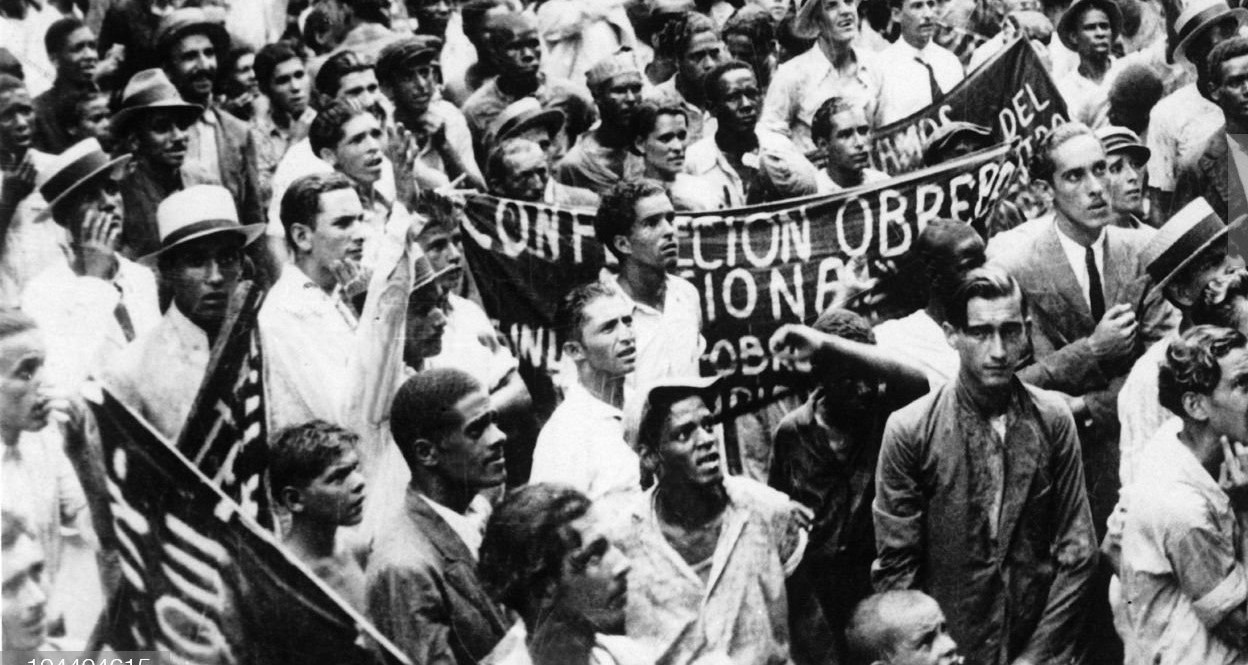
A synopsis of the revolution that, a generation before 1959, shook the U.S.’s former colony and the hemisphere. Something like its Israeli colony today, Cuba was central to both regional interests and overall U.S. imperial strategy. Like Israel, U.S. ties to Cuba were deeply intertwined–military, political, economic, and on many levels, personal connections made Cuba of the ancien regime a cornerstone of the Monrow Doctrine of U.S. western omnipotence. The momentous events of 1933 saw a mass student rebellion and workers’ general strike overthrow formerly U.S.-backed dictator Gerardo Machado, and the coming to power of Batista, then as U.S.-allied kingmaker in Cuba’s military, as U.S. imperialism attempted to retain control of the island.
‘Cuba’s Second Revolution’ by A.G. Bosse from International Press Correspondence. Vol. 13 No. 42. September 22, 1933.
After holding power for three weeks the Cespedes government, put into power by U.S. Ambassador Welles, has been overthrown by a mass movement of the workers, peasants, and rank and file of the armed forces. Welles’ job was too crude and the revolutionary pressure of the masses too great to continue Cespedes in office long. The revolutionary Junta now precariously in power is democratic and bourgeois both in its leadership and programme, though pretending to be radical because otherwise it could not exist.
The United States, angered and disturbed by the quick overthrow of its agent, has sent or has ready (by September 7) to send to Cuban waters 30 warships, plus a dozen planes with marines and thousands of the latter. With every repetition of his opposition to armed intervention Roosevelt rushed more warships. He could hardly prepare more fully and quickly if it were against Japan.
The causes of the second revolution were the great discontent of the masses with the refusal of Cespedes to do any more than continue the policies of Machado in disguised form. The peasants demand the division of the great estates and plantations; the workers bread, increased wages, and the right to unionise; and the rank and file of the soldiers, sailors and police the elimination of Machadist officers, and the restoration of their pay cut. All groups, except the landlords and big bourgeoisie, demand the ending of the rule of American imperialism, especially of the sugar and public utility magnates and bankers.
Other reasons were the retention of Machado officials in office, failure to call for immediate revision of the constitution and holding of a general election, Cespedes’ aiding Machado to escape and his refusal to seize the latter’s property, and the fact that Cespedes followed Machado’s policies, legalising all the actions of his congress and preparing for another dictatorship.
The sugar workers have backed up their demands for improved conditions and lower taxes by threatening to take over the plantations and mills. In a number of provinces they have done this and driven out the foreign and native owners. The soldiers are fraternising with the people. In Santiago de Cuba the general strike continues, and at Cienfuegos the workers have sacked hardware stores and seized arms. The influence of the Communist Party, Y.C.L., and revolutionary unions is rapidly spreading and threatening the restoration of “law and order.”
The cabinet is reported to have been selected by the rank and file of the army and the students, also by the left wing of the A.B.C. (landlord-bourgeois secret opposition under Machado), and the revolutionary students of the Directorio Estudiantil. All political groupings but that of Menocal were at first reported to be supporting the Junta, but more recent reports include rumours of the breaking away of many of the bourgeois groups, as revolutionary mass pressure intensifies and American military intervention comes closer.
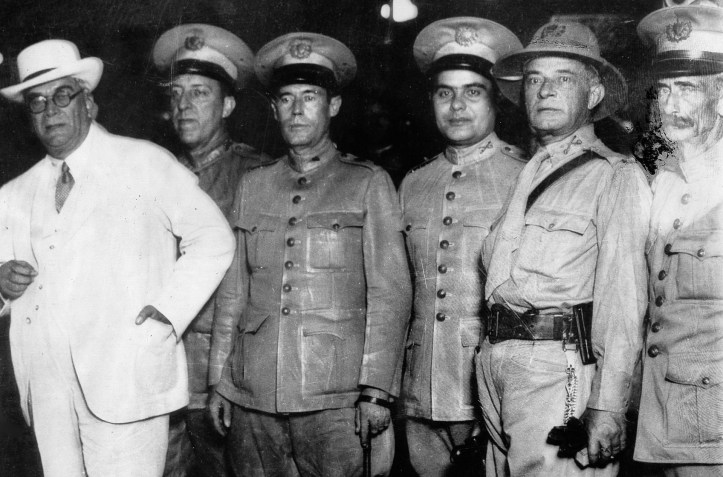
The “revolutionary” character of the Junta is shown by the fact that all its members disclaim radical intentions. Thus, San Martin states its programme is “non-political,” while Carbo characterises his colleagues as respectable and “solid.” With Cuba surrounded by American warships Carbo says that to think of armed intervention would be “an insult to Roosevelt,” that their presence “does not mean a threat to Cuban sovereignty.” One radical A.B.C. leader in the Junta even says the revolution was unintentional, so far as its leaders were concerned: “We did not aim to unseat the De Cespedes government, but merely wanted to spur it on to more decided revolutionary action.” (N.Y. “Daily News,” September 7.) Sergeant Batista, who led the military uprising and is now the head of the army, states the revolution is not Communistic, “nor will the armed forces tolerate such.” He characterises the new government as “without any political tendencies whatever.” Communist meetings and agitation in the army are being prohibited, and army and navy officers being restored. An ex-army officer has already been made head of the national police. The Junta has secretly decided to attempt to disarm all civilians.
The excuse for intervention is the alleged disorders at the far eastern end of the island, but the press, for example the N.Y. “Herald Tribune” of September 7, states explicitly that there has been no disorder anywhere: “On the contrary, the shooting down at sight by the A.B.C. of Machado’s adherents came to an end with the passing of the Cespedes government, and no murders have been reported in the last two days.” It is the threat of the peasants to seize the plantations and the workers the mills, that alarms American imperialism, and this despite the extreme caution of the Junta. The 5,000 Americans on the island and the investment of over a billion dollars in Cuba must be defended no matter how many Cubans are massacred.
One purpose of the tremendous American naval concentration at Cuba is to obtain the restoration of Cespedes, if possible, as is admitted by Roosevelt spokesmen. The government apologists of intervention say it will be only a small intervention, to protect foreign lives and prevent “anarchy,” not a comprehensive occupation, “taking over the agencies of the government…and carrying out electoral reforms or industrial programmes.” (N.Y. “Herald Tribune,” September 8.)
The Communist Party and Y.C.L. of Cuba issued a manifesto on the general strike on August 3, when the strike was just beginning. It contained the programme for which the masses of workers, peasants and revolutionary petty-bourgeois are fighting to-day.
That the struggle for the demands contained in the manifesto has been intensifying is evidenced now even in the capitalist press, which for weeks refused to take cognizance of the Communist movement. The N.Y. “Post” says Cespedes Kerensky has been thrown out; “will it now set up a Bolshevik republic?” (September 7.) The “Times” refers to Ruben Martinez Villena as “the youthful leader who organised the general strike which brought about the downfall of General Machado…the Communistic element is rapidly gaining strength, particularly down the island, where thousands of underpaid workers are out on strike.” (September 7.) Even Welles admits that Communist agitation has been increasing in the last two weeks. Revolutionary agitation has forced the government to turn over to the unemployed a $500,000 appropriation for the maintenance of the presidential palace, which is to be closed.
A wave of strikes preceded the overthrow of the Cespedes régime, 15 strikes being declared in one day by groups ranging from tobacco workers to doctors. Over 8,000 workers struck on four sugar plantations in Havana province, their struggle being supported by the croppers and tenants. At Coliseo workers on six plantations struck, at Central Hormiguero in Cruces province 1,000 struck, in Fuerta de Golpe all tobacco workers, in Cardenas and Rincon sugar workers, in Havana photo-engravers. The Cruces strikers won an eight-hour day and wage increases, but reopened the strike immediately for further demands, including cancellation of all debts to the company. In Moron 3,000 workers won their demands, but when the plantation owner telephoned for troops they threatened to blow up the bridges and occupy the plantation if the troops came. At a number of other sugar centres militant hunger marches are reported. At American copper and asphalt mines strikes or lock-outs have been declared. In Oriente and Santa Clara provinces workers under Communist influence seized a number of sugar mills and drove out the American and Cuban owners.
On September 7 thousands massed in the streets of Havana to celebrate International Youth Day, having forced the Junta to issue a permit after its initial refusal. The demonstrators carried red flags and slogans reading, “We pay no debts to Yankee bankers,” “Drive the Marines out of Guantanmo,” and “Let’s have no government that will deal with Yankee extortioners.” Batista had to withdraw the machine-guns posted around the park, and in the evening another Communist demonstration was held. Thousands of leaflets calling for the meetings and containing the demands of the revolutionary workers were distributed before the demonstration.
International Press Correspondence, widely known as”Inprecorr” was published by the Executive Committee of the Communist International (ECCI) regularly in German and English, occasionally in many other languages, beginning in 1921 and lasting in English until 1938. Inprecorr’s role was to supply translated articles to the English-speaking press of the International from the Comintern’s different sections, as well as news and statements from the ECCI. Many ‘Daily Worker’ and ‘Communist’ articles originated in Inprecorr, and it also published articles by American comrades for use in other countries. It was published at least weekly, and often thrice weekly.
PDF of full issue: https://www.marxists.org/history/international/comintern/inprecor/1933/v13n42-sep-22-1933-Inprecor-op.pdf
 Revolution's Newsstand