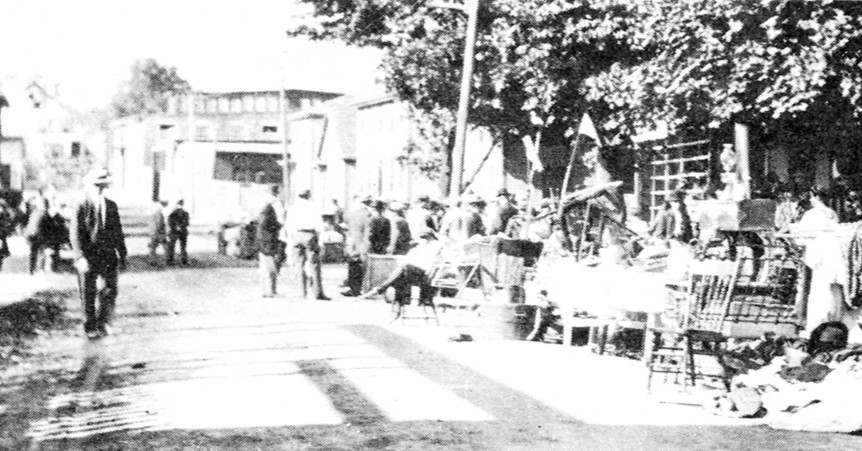
A tenacious fight by 1500 largely Polish and Greek mill workers in the small town of Ipswich, Massachusetts sees family thrown into the streets rather than submit.
‘Ipswich Strikers Evicted’ from Solidarity. Vol. 4 No. 29. July 26, 1913.
Camp On Street With Their Goods and Refuse to Move on Orders of Authorities.
Ipswich, Mass, July 15. The mill owners suddenly got busy yesterday morning and began to evict strikers from company houses. All day long the company tools sweated over the household goods which they had to carry cut into the street. In one house the strikers left a good fire in the cook stove. The mill agents had an awful time getting the hot stove out of the House. They burned their hands and cursed while the strikers looked on and laughed. By evening 35 grown people and a dozen little children were in the street with their poor belongings.
Before this moving was finished for the day, the town authorities served notices on the strikers to remove their goods from the street. The workers only laughed at the order and made it very plain that they would not touch a thing and would hold the town responsible.
That evening the evicted strikers laid out their blankets on the street and made ready to sleep on the ground. The town officials came round attempting to frighten the workers away, but the strikers refused to scare a bit. Then to prevent the town people from seeing the spectacle, the street lights were turned off. The strikers promptly lit their oil lamps and a whole block of household goods was illuminated drawing attention to the people sleeping on top. The mayor and other officials returned and pleaded with the strikers not to humiliate the town by sleeping out, but no one paid the least attention to these, good fellows. About eleven o’clock in the evening the street lights were turned on again and the strikers put out their lamps to save the fuel colder nights.
On Tuesday the authorities did everything possible to get the strikers to remove the goods in order that the town would not have to stand the damages. The strikers were too wise for this and refused to move anything. So a whole block is littered with goods.
Stoves have been set up on the street on which the strikers are cooking their meals, eating on the street as best they can. Fires are kept burning in the stoves all day. When scabs or any specials come along the usual fuel is suddenly changed to rubber and rags. When the authorities kick the strikers explain that it is the best fuel they can afford under the circumstances. The wind was favorable” and some scabs nearly chocked while passing.
Last night all the little children slept on top of the piles where every one could see them. Some of the citizens came along and wanted to take the little ones away and give them shelter. The mothers refused, stating that if eviction was their lot, their children would also learn by it and be able to profit in the future. All day long curious people from other towns came to view the evicted people sleeping and eating on the street.
The authorities are up in the air and do not know what to do. The plan was to evict the strikers and see them haul their goods away and make room for more goods which would be thrown into the street. The refusal to move has put a different phase on the matter. To put more goods in the narrow street means to shut off traffic. The mill-owners seem to be stupefied at the solidarity of the strikers who are only laughing over the affair. At the same time the bosses are getting ready to evict all the rest of the strikers. Notices have been served already and tomorrow is the day on which the job is to be finished. It is a puzzle where the goods will be piled, unless they are carried to another street.
The only thing lacking here is funds to carry on the struggle. The strikers have an abundance of determination and courage, but they need food to carry on the fight. They are willing to eat and sleep in the street or anywhere else, if funds can be sent in to feed them. All money should be sent to Ipswich Defense League, Box 282, Ipswich, Mass.
Ipswich Strike Committee.
The most widely read of I.W.W. newspapers, Solidarity was published by the Industrial Workers of the World from 1909 until 1917. First produced in New Castle, Pennsylvania, and born during the McKees Rocks strike, Solidarity later moved to Cleveland, Ohio until 1917 then spent its last months in Chicago. With a circulation of around 12,000 and a readership many times that, Solidarity was instrumental in defining the Wobbly world-view at the height of their influence in the working class. It was edited over its life by A.M. Stirton, H.A. Goff, Ben H. Williams, Ralph Chaplin who also provided much of the paper’s color, and others. Like nearly all the left press it fell victim to federal repression in 1917.
PDF of full issue: https://www.marxists.org/history//usa//pubs/solidarity-iww/1913/v04n29-w185-jul-26-1913-solidarity.pdf
 Revolution's Newsstand